Business Development Service in Midtown Manhattan

You've built something remarkable. Now you're facing the gap between founder credentials and founder reality—the pressure to perform in a market where neural stamina is everything.

In my practice across Midtown's founder and emerging-executive community, I consistently observe the same inflection point: the moment when a founder or business leader transitions from individual contributor to founder-entrepreneur or from corporate executive to independent operator. At that threshold, the neurobiological demands shift radically. You're no longer optimizing within an existing system—you're building one. You're no longer executing someone else's vision—you're persuading capital allocators that your vision is worth funding. You're no longer managing known stakeholders—you're navigating investors, board members, customers, and market forces simultaneously. The difference between founders who scale rapidly and those who plateau isn't always intelligence, strategy, or work ethic. It's whether their nervous system has been rewired to navigate founder-level pressure without defaulting to the defensive patterns that constrain decision-making, investor communication, and business growth. Business development is where that neurological rewiring happens.
Schedule a Strategy Call

Founder Coaching

Founding a business activates every pressure system in your brain simultaneously. You’re managing identity risk—your reputation, your network, your financial security are all on the line. You’re navigating chronic ambiguity—no manual exists for the specific challenges your company is facing. You’re sustaining focus across competing demands—fundraising, hiring, product development, customer acquisition. Egana-delSol et al. (2023) measured this neurologically: entrepreneurs receiving structured education showed measurably decreased resting-state arousal and a 0.47σ reduction in responsiveness to negative stimuli—essentially, their nervous systems became more resilient to setback and failure feedback. What they documented is that these neural shifts preceded behavioral changes. The brain rewired first; sustainable founder behavior followed.

My founder coaching methodology treats this explicitly. I’m not teaching you how to be a founder—you’re already living it. I’m identifying where your nervous system is generating reactive, suboptimal patterns and rewiring it. Specifically: Do you panic when your latest customer acquisition drops? That’s amygdala over-activation signaling threat. Are you ruminating on rejection from a VC meeting instead of moving to the next prospect? That’s anterior cingulate cortex stuck in error-checking mode. Are you unable to make clear hiring or product decisions because you’re catastrophizing around downside? That’s prefrontal cortex being hijacked by threat detection. Nicolau et al. (2023) conducted a meta-analysis of executive coaching randomized controlled trials and found that coaching’s strongest effects were on cognitive activities (g=1.28) and behavioral outcomes (g=0.73)—meaning that when you rewire how a founder thinks, their actual behavior shifts durably. Over 12-16 weeks, using Real-Time Neuroplasticity™, we identify your specific pressure patterns and rebuild your nervous system’s capacity to remain resourceful under founder-level stress. The outcome is a founder who fundraises without emotional dysregulation, scales without burnout, and navigates ambiguity with strategic clarity rather than defensive reactivity.


Learn more about Founder Coaching in Midtown Manhattan →

Business Growth Consulting

You’ve built a business that’s profitable, operationally sound, and stuck. Revenue has plateaued. Customer acquisition has become harder per dollar spent. Your team is executing well but growth has stalled. The traditional diagnosis is “you need better marketing” or “you need to raise capital to scale” or “you need new product strategy.” Sometimes those are true. Often, they mask the real constraint: your nervous system can’t sustain the executive capacity required for business growth, and that neurological ceiling is acting as a business ceiling.

When I’m brought in for business growth consulting, my first assessment is always neurobiological. How is your nervous system currently organized at your company? Are you and your leadership team operating from a state of resourcefulness and strategic clarity, or are you in chronic stress-response mode? Iodice et al. (2022) trained senior managers in neurobiofeedback—teaching them to self-regulate their stress response in real time—and found that trained managers demonstrated steeper probability discounting (better risk assessment), longer deliberation times on high-stakes choices, and lower impulsivity. In other words: better, less reactionary business decisions. McEwen & Davidson (2012) documented that chronic stress produces measurable brain changes—amygdala enlargement and hippocampus/prefrontal cortex volume reduction—that directly impair the executive functions required for strategy, pattern recognition, and adaptive decision-making. The interventions that reversed these stress-driven changes? Intentional neural interventions—exactly what my growth consulting methodology employs.

What distinguishes my approach is this: I don’t add another strategic framework or marketing playbook to your team’s workload. I assess and rebuild the neural foundation that makes strategic execution possible. Are your key decision-makers able to sustain focus on long-term growth initiatives while managing daily operational crises? Can your leadership team hold complexity without collapsing into oversimplification? Can you evaluate new opportunities against your core strategy without being derailed by every new threat or market signal? Valesi et al. (2023) provided the first neurophysiological evidence that the quality of coach-coachee relational dynamics is measurable in real time using EEG—meaning that growth consulting rooted in neuroscience isn’t just metaphorically “brain-based,” it’s literally changing brain states. Over 16-24 weeks, using Real-Time Neuroplasticity™, we rebuild your organization’s neural fitness: restoring prefrontal function for sustained strategic focus, rebuilding emotional regulation so decision-making stays clear under pressure, rewiring how your team manages ambiguity and failure feedback. The outcome is measurable acceleration in business growth—higher revenue per customer, faster market response, more confident capital decisions, and sustained execution velocity.

Learn more about Business Growth Consulting in Midtown Manhattan →

Investor Relations Coaching

You have 45 minutes to persuade experienced investors to risk millions on your company. That window isn’t decided by your deck or your unit economics. It’s decided in the neural moment when investors are evaluating your credibility, your resilience, and whether they believe you can execute your vision under pressure. Genevsky et al. (2017) scanned investors’ brains while they reviewed funding pitches and found that nucleus accumbens activity (the reward anticipation circuit) predicted funding decisions at 59.1% accuracy—substantially higher than investors’ own behavioral self-reports. What activated that circuit wasn’t always the strongest product or the best business model. It was the founder’s ability to communicate with cognitive clarity and earned confidence while under high-stakes pressure.

Investor relations coaching treats this explicitly. Most pitch coaching teaches you how to talk about your business. Neuroscience-based investor coaching teaches you how to activate the neural systems in investors’ brains that make them willing to fund you. Zheng et al. (2021) found that investor confidence mediates how much social influence affects investment decisions—high-confidence investors are more independent in their thinking; low-confidence investors are more swayed by herd dynamics. A founder who projects neurologically authentic confidence (not performative bravado, which investors detect instantly) changes how investors’ brains process the entire pitch. Davydova et al. (2024) used fMRI to compare persuaded and unpersuaded investors and found that theory-of-mind regions (the brain’s mentalizing circuits) are active in resistance to persuasion. In other words: when you pitch, the investor’s brain is running a parallel model of whether you actually understand your market, your customers, and the challenges ahead. If your nervous system is generating anxiety signals (elevated cortisol, shallow breathing, micro-expressions of doubt), the investor’s mentalizing circuit detects it and concludes you don’t fully believe in what you’re saying.

My investor relations coaching addresses this at the neurological level. We identify where your nervous system activates threat signals during investor meetings—is it the dollar amount being discussed? Is it the moment a sharp question arrives? Is it the silence when an investor takes time to consider your response? We then systematically rewire your response to those triggers so you remain in a state of resourcefulness and strategic clarity throughout the pitch. We work on how you communicate under pressure—not to be slick or performative, but to be neurologically coherent, which investors perceive as authentic conviction. Over 8-12 weeks, typically intensifying as your fundraise timeline compresses, using Real-Time Neuroplasticity™, we rebuild your nervous system’s capacity to present with clarity, answer tough questions without defensive reactivity, and communicate your vision with the kind of earned confidence that activates investor reward circuitry. The outcome is pitch meetings where investors experience you as a credible, capable, genuinely confident founder—which means substantially higher close rates on fundraising and better terms.

Learn more about Investor Relations Coaching in Midtown Manhattan →

Midtown Manhattan is where founders and business leaders live, work, and raise capital. The concentration is specific to the city’s particular economic structure: media and publishing conglomerates producing spin-off founders; advertising holding companies (WPP, Interpublic, Omnicom) generating agency entrepreneurs; medical practices and medtech ventures emerging from the Upper East Side corridor; fintech and healthcare startups headquartered around Madison and Park Avenue.

This ecosystem has fundamentally changed in the last three years. The return-to-office mandate arrived in 2025. JPMorgan mandated five days in-office. Morgan Stanley followed. NBCUniversal shifted to four days beginning January 2026, followed by Paramount Global’s five-day requirement. The result? Midtown Manhattan office leasing surged to 23.2 million square feet in the first nine months of 2025—37.6% year-over-year increase, the strongest leasing environment in 20 years. Availability fell to 13.4% in Q4 2025, its lowest point since Q2 2020. Asking rents averaged $84.24/SF, with premium Class A buildings at $119/SF—a 14% increase since 2021. What this signals is that organizations are betting heavily on Midtown as a command center, a collaboration hub, a place where decisions happen in person.

New York City hosts 41 Fortune 500 headquarters (2024), concentrated in Midtown. These are the command centers for JPMorgan Chase, Morgan Stanley, MetLife, Verizon, Paramount Global, and dozens of other capital allocators and strategic decision-makers. In this ecosystem, business development—raising capital, scaling revenue, building investor relationships, navigating business growth—happens constantly.

The city’s creative industries employ 274,000 people, earning an average of $146,000 annually—28% above the citywide average. Advertising holds 19% of all U.S. advertising employment (location quotient 6.6, meaning six times the national concentration). Creative media employment surged 20% from 2017-2022. Publishing alone represents 95,000 jobs, $11 billion in wages, and $34 billion in economic output. What these numbers represent is not just employment—they represent a continuous stream of entrepreneurs launching ventures. Senior editors and publishers spin off boutique imprints. Advertising account directors launch independent creative studios. Media executives found digital media companies and newsletter platforms. Midtown’s founder ecosystem is densely populated and highly capitalized.

The startup ecosystem strengthens this further. New York City hosts over 10,000 tech companies and startups, with $10+ billion in annual early-stage funding and 119 unicorns as of 2024. Q4 2024 saw major funding rounds: Cyera ($300M Series D), Melio ($150M Series E), Maven Clinic ($110M). Unlike Silicon Valley, NYC’s startup funding is weighted heavily toward media, fintech, healthcare, and fashion—sectors where Midtown founders are embedded. The Upper East Side operates as a distinct healthcare and medical services corridor, with physicians founding and scaling practices, medtech ventures, and concierge medicine models. This is a founder population with capital, credentials, and pressure.

What distinguishes Midtown’s business development need is this: corporate spinoffs and founder-exiting-to-entrepreneur transitions are constant. Executives at Fortune 500 companies, media conglomerates, and advertising holding companies regularly launch independent ventures. Unlike Silicon Valley founders, where entrepreneurship is the cultural baseline, corporate-to-founder transitions in Midtown create a specific pressure pattern: you’re accustomed to operating within established systems, with institutional support, defined roles, risk mitigation. Suddenly, you’re the sole decision-maker. Suddenly, every decision carries financial and reputational consequence. Suddenly, you’re navigating investors, board dynamics, and market uncertainty without the buffer of a corporate organization behind you. This neurobiological transition—from corporate executive to independent founder—is where most Midtown entrepreneurs hit their first performance ceiling. Founder coaching, business growth consulting, and investor relations coaching directly address that transition. The market need is dense, continuous, and high-value.

Dr. Sydney Ceruto, PhD — Founder, MindLAB Neuroscience

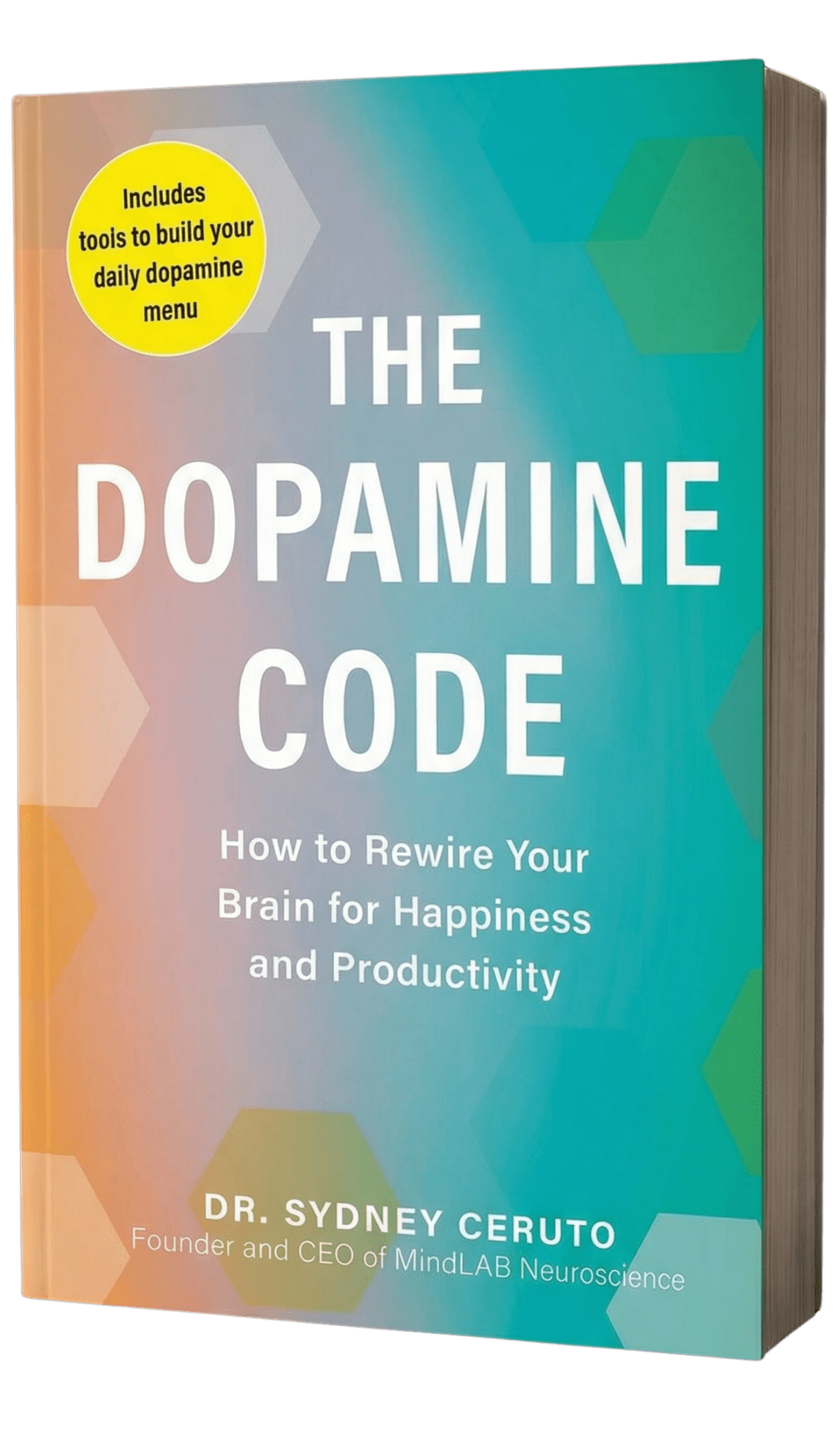
Dr. Sydney Ceruto holds a PhD in Behavioral & Cognitive Neuroscience from NYU and Master’s degrees in Clinical Psychology and Business Psychology from Yale University. She is a Lecturer in the Wharton Executive Development Program at the University of Pennsylvania, an Executive Contributor to Forbes Coaching Council, and an inductee in Marquis Who’s Who in America. Dr. Ceruto founded MindLAB Neuroscience in 2000 and has spent more than 26 years developing and refining her proprietary methodology, Real-Time Neuroplasticity™. She is the author of The Dopamine Code (Simon & Schuster, June 2026).

Frequently Asked Questions

I'm a senior executive at a Midtown media company thinking about launching my own studio. What's the difference between a founder coach and a business consultant—and which do I actually need?
Founder coaching and business consulting address different layers of the transition you're about to make. A business consultant helps you develop strategy, model financials, plan go-to-market. A founder coach addresses what changes neurobiologically when you move from being an executive within a system to being the solo decision-maker building a system. The pressure of founder-level accountability activates threat systems in your brain that corporate roles typically buffer. Founder coaching teaches your nervous system how to remain resourceful—how to make clear decisions, manage investor relationships, navigate uncertainty—under that new pressure. Most media executives launching studios need both: strategy consulting for the business model and founder coaching for the neurobiological transition. The reality is that your business strategy is only as good as your nervous system's capacity to execute it under pressure.
My advertising agency spin-off has been running for 18 months and we're stuck at the same revenue level. What does business growth consulting actually do that a general consultant doesn't?
Revenue plateau usually signals one of two problems: either your strategy isn't working, or your nervous system can't sustain the executive capacity required to execute growth strategy. Standard consulting addresses the first—market positioning, pricing, product-market fit. Business growth consulting addresses the second: whether you and your leadership team are neurologically organized to drive growth consistently. I've worked with multiple agency spin-offs where revenue was plateaued not because the strategy was wrong but because the founder was in a subtle stress-response mode—catastrophizing around cash, over-managing because they didn't trust delegation, getting trapped in short-term firefighting instead of investing in growth initiatives. Those are nervous system patterns, not strategic problems. Business growth consulting identifies and rewires them. You get a founder and leadership team that can execute growth strategy with the focus, decisiveness, and resilience that sustained scaling actually requires.
I have a VC pitch in three weeks for my healthtech startup. Can neuroscience-based investor coaching help close a round?
Absolutely, though not in the way most pitch coaches position themselves. Pitch coaching typically focuses on slide structure, talking points, handling objections. That's valuable. Neuroscience-based investor coaching goes deeper: it identifies how your nervous system is currently wired to handle high-stakes investor conversations, where you're generating anxiety or defensive signals that investors detect and interpret as lack of conviction, and how to rebuild your capacity to pitch with the kind of earned confidence that activates investor reward circuitry. In the investor's brain, they're running a parallel model of whether you actually understand your market and can execute your vision. If your nervous system is generating doubt signals—elevated stress, shallow breathing, micro-expressions of anxiety—that model concludes you're not fully confident. Three weeks is tight, but if you're already a strong pitcher with solid fundamentals, neuroscience-based coaching can measurably improve your close rate by optimizing your neurobiological presence during pitch meetings.
I came from 15 years in corporate finance. I've never fundraised. How does founder coaching work for someone with no startup background?
Founder coaching isn't about teaching you business skills you don't have—you have those. It's about rewiring your nervous system to operate effectively in a founder context, where the pressure and decision-making architecture are completely different from corporate roles. In corporate finance, you had risk mitigation layers, institutional support, defined roles. As a founder, you're the sole owner of outcomes. That shift activates identity-level threat signals in your brain that most corporate professionals haven't had to navigate. Founder coaching addresses exactly that transition: teaching your nervous system how to remain resourceful, make confident capital decisions, navigate investor relationships, and sustain focus on long-term vision while managing daily survival pressure. Your financial analysis skills are your baseline. Founder coaching builds the neurobiological capacity to apply those skills under founder-level pressure.
I run a boutique publishing imprint I spun off from a major house. I need help thinking about growth—are you the right fit, or do you only work with tech startups?
This is my core market. Publishing spin-offs, media companies, creative studios launched by editorial or executive talent—these represent a significant portion of my business development consulting work. The challenge for publishing and creative entrepreneurs is identical to the challenge for tech founders: you're navigating capital constraints, customer acquisition pressure, and the pressure to scale while maintaining the editorial or creative vision you founded the company around. Business growth consulting in publishing environments specifically addresses how to scale revenue and reach without losing the cultural differentiation that attracted your audience in the first place. I work across all founder and business leader populations in Midtown—media, publishing, healthcare, fintech, advertising. The neuroscience of business development is the same; the industry context varies.
My Upper East Side medical practice is growing and I want to scale to multiple locations. Is business growth consulting relevant for healthcare providers, or is it only for tech companies?
Healthcare entrepreneurs and physicians scaling practices represent a significant part of my business development practice. The challenges are identical: capital management, hiring and delegation, customer (patient) acquisition, risk management, and the pressure of owner-operator accountability. The difference is that healthcare businesses often have higher profit margins than tech ventures, which means the ROI on founder coaching and growth consulting is typically even clearer. A physician scaling from a single practice to a three-practice operation faces the exact same neurobiological pressures: identity risk (your reputation is on the line), capital pressure (expansion requires significant investment), delegation anxiety (your clinical credibility built the practice; delegating to other providers triggers threat signals), and the pressure to maintain quality at scale. Business growth consulting specifically addresses those pressures for healthcare entrepreneurs.
I'm preparing for a Series A roadshow. My deck is solid but I feel my own anxiety in meetings with investors is costing me. Can a neuroscience coach help me manage the physiology of investor presentations?
Yes, this is one of the most direct applications of investor relations coaching. Anxiety during investor presentations isn't a character weakness—it's a nervous system pattern. High-stakes conversations activate your threat-detection systems, which can generate subtle but detectable signals: elevated cortisol, shallow breathing, micro-expressions, hesitation, over-explanation. Experienced investors read these signals instantly and interpret them as lack of conviction. Investor relations coaching identifies where your nervous system specifically activates threat signals during pitch meetings—is it when dollar amounts are discussed? When you encounter skepticism? When there's silence?—and then systematically rewires your response so you remain in a state of resourcefulness. You'll still feel the pressure. But your nervous system will be organized to function clearly under that pressure, which means investors experience you as a confident, credible founder. That shift measurably improves funding outcomes.
What's the typical engagement timeline for founder coaching? I can't commit to something open-ended—I need to see results in a specific window because I'm mid-fundraise.
Founder coaching engagements typically run 12-16 weeks, with 60-90 minute sessions every 1-2 weeks depending on your intensity preference and timeline urgency. If you're mid-fundraise, you might compress that to an 8-week intensive cycle with weekly sessions. Investor relations coaching specifically—if that's your focal need—typically runs 8-12 weeks and can be timed directly to your fundraise calendar. You'll notice neurobiological shifts within 2-3 weeks: improved sleep, clearer decision-making, better emotional regulation — the ability to manage emotional responses —. Behavioral shifts in your founder capacity and investor presence typically become visible in 6-8 weeks. Full baseline change in how your nervous system organizes under founder pressure usually takes the full 12-16 week cycle. The key point: these aren't open-ended therapeutic relationships. They're intensive, outcome-focused partnerships with clear timelines and measurable milestones.
I've read about neuroplasticity but I'm skeptical it applies to business performance. Is there actual peer-reviewed science behind neuroscience-based business coaching, or is it just marketing language?
The evidence is substantial and peer-reviewed. Nicolau et al. (2023) conducted a meta-analysis of randomized controlled trials of executive coaching and found that coaching with cognitive and behavioral focus produces effect sizes of g=0.73 on behavioral outcomes—meaning measurable, sustained changes in how executives perform. Egana-delSol et al. (2023) measured EEG activity in entrepreneurs receiving coaching and documented measurable neurophysiological changes—decreased stress reactivity, increased emotion regulation—that predicted better entrepreneurial outcomes. Iodice et al. (2022) trained senior managers in neurobiofeedback and found statistically significant improvements in decision-making under stress. Valesi et al. (2023) provided the first neurophysiological evidence that the quality of coach-coachee relationships is measurable in real time using EEG. Genevsky et al. (2017) scanned investors' brains during pitch evaluations and found that nucleus accumbens — the brain's reward center — activity predicted funding decisions. These aren't metaphorical uses of neuroscience terminology. They're rigorous, peer-reviewed studies in top journals showing that neuroscience-based coaching produces measurable changes in both brain function and real-world business performance. If you want to review the specific research, I'm happy to send citations.

Ready to Perform at Your Highest Level?

Midtown Manhattan concentrates more business development pressure per square mile than anywhere on earth — founder launches, capital raises, and growth-stage scaling all converging under relentless complexity. The difference between good outcomes and transformational outcomes is neurobiological, and that is the variable no one else in Manhattan's corporate corridor is equipped to address.

Schedule a Strategy Call
MindLAB Neuroscience consultation room
Locations

The Intelligence Brief

Neuroscience-backed analysis on how your brain drives what you feel, what you choose, and what you can’t seem to change — direct from Dr. Ceruto.