The Career Paralysis That Strategy Cannot Solve
“Career stagnation is rarely a strategy problem. It is a neural architecture problem — the circuits governing risk evaluation, reward anticipation, and identity flexibility have settled into patterns that no amount of planning can override without addressing the architecture itself.”
You know what you want to change. You may have known for years. The intellectual case is clear. The spreadsheet of reasons to move, pivot, or reinvent has been built and rebuilt in your mind more times than you can count. And yet nothing happens.
It is not indecision. It is not laziness. The frustration is precise: the gap between knowing and doing feels unbridgeable, and every prior attempt to close it has produced the same result. A burst of clarity followed by a gravitational pull back into the existing trajectory. The resume gets updated and then sits untouched. The conversation with the recruiter goes well and then goes nowhere. The internal transfer application gets drafted and then abandoned.
You have likely sought support. Strategic frameworks. Career assessments. Personality inventories. Accountability structures. Each approach operated on the assumption that the problem was informational — that with better data, clearer goals, or stronger motivation, the transition would follow. It did not. Because the problem was never informational. The barrier is biological, and it operates at a level that no amount of strategic planning can reach.
The professionals who come to this work share a specific experience. They are not confused about their options. They are not lacking ambition. They are stuck in a neural architecture built over years of professional conditioning. That architecture is doing exactly what it was designed to do: resist change to the identity it has encoded.
The pattern is self-reinforcing. Each failed attempt to make the transition strengthens the neural encoding of the current state. The brain interprets the return to the status quo as confirmation that the existing identity is correct and the alternative is not viable. With every cycle, the architecture becomes more entrenched, not because you are weak, but because the neural system is working exactly as designed.
The Neuroscience of Career Identity
Professional identity is not a belief. It is a physical structure in the brain, maintained by the default mode network — the brain’s self-referential system. This network is responsible for autobiographical memory, internal narrative, and the construction of the ongoing answer to “who am I.”
A landmark synthesis of twenty years of research on this network established its core architecture. The medial prefrontal cortex differentiates self from others and handles cognitive elaboration of self-relevant information. The posterior cingulate cortex — a central coordination hub — amplifies all other nodes during self-referential states. The angular gyrus retrieves personal and conceptual information to populate the self-narrative. Together, they construct the coherent internal story that shapes self-perception and conscious experience.
For a professional whose entire adult identity has been constructed around a role and firm affiliation, this is not metaphor. The default mode network has physically structured itself around “I am a Partner at this firm, I execute deals, I am measured by these metrics.” When that identity is threatened, the network does not simply update its records. It enters a state of incoherence. Many high-achieving professionals describe this experience: not knowing who you are when the role is stripped away.
Research has shown that this network significantly increases activation during major contextual switches, when the brain must reorient from one domain to another. A career transition is precisely this kind of switch. It asks the brain to reconstruct the self-in-context model from the ground up. This is neurologically costly and disorienting in ways that rational deliberation alone cannot resolve.
Further research has identified the precise mechanism through which the brain resists identity change. The ventromedial prefrontal cortex is the central regulator of self-concept updating. It processes prediction errors when feedback contradicts existing self-views. Critically, the brain learns significantly faster from positive feedback than from negative feedback. For core identity traits, this region actively attenuates negative feedback to preserve self-concept coherence.
What this means in practice is that the brain structurally protects core identity traits from disruption, even when change is adaptive. A professional who intellectually knows they need to transition cannot simply decide to change. This protective mechanism discounts the information that would support that change. Repeated dissatisfaction and poor quality-of-life outcomes are processed through the same filter: attenuated, discounted, and overridden by the brain’s drive to maintain identity coherence.
This is not weakness. It is not irrationality. It is neurobiology.
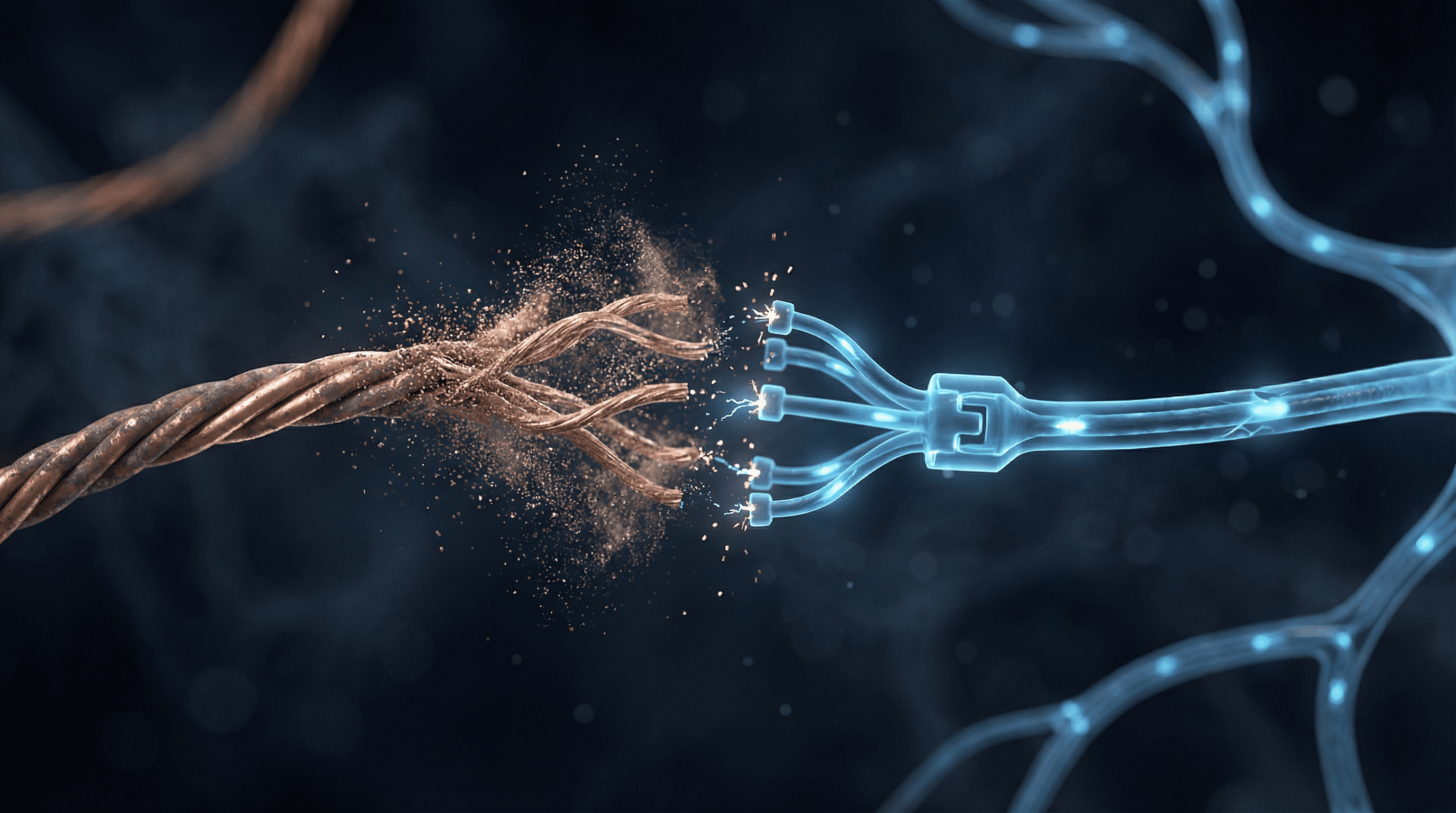
The Additional Burden of Chronic Occupational Stress
There is a second mechanism at work. Research establishes that uncontrollable stress triggers elevated norepinephrine and dopamine levels that chemically weaken prefrontal cortex connections. The prefrontal cortex is the brain region responsible for values-based career decision-making, long-term planning, and self-authoring. With chronic exposure, this region undergoes structural change: gray matter thins and synaptic connections are lost. Simultaneously, uncontrollable stress strengthens more primitive circuits. This shifts the brain away from deliberative, identity-driven decisions toward reactive, habitual ones.
The cruel paradox is that the very cognitive infrastructure required to plan and execute a career change has been degraded by the conditions creating the need for that change. The professional who most needs to make a transition is operating with impaired prefrontal function. Research confirms that stress relief and targeted intervention allow prefrontal connections to regrow. But the recovery requires intervention, not merely rest.
How Dr. Ceruto Approaches Career Transitions
Dr. Ceruto’s methodology — Real-Time Neuroplasticity™ — works at the level where career identity is actually maintained: the default mode network’s self-referential architecture and the ventromedial prefrontal cortex’s identity-updating mechanisms.
What I see repeatedly in professionals navigating these transitions is a default mode network so thoroughly structured around a single professional identity that it lacks flexibility. It cannot construct a coherent alternative self-in-context model. The methodology does not attempt to override the brain’s protective function through willpower or strategic reframing. Instead, it works with the brain’s architecture, facilitating identity evolution through neuroplasticity rather than demanding cognitive override.
For default mode network reconfiguration, the work creates conditions under which this network can begin constructing a new self-in-context model without abandoning the coherence the brain requires. Research confirms that these self-models are highly malleable — reshaped by structured interventions. The evidence that these models can be changed is the scientific foundation for this work.
For prefrontal restoration, the protocol addresses the synaptic weakening that chronic occupational stress produces. It rebuilds the regulatory capacity that enables values-based career decision-making rather than reactive repetition of familiar patterns.
The shift becomes visible when the client stops experiencing career change as identity loss and begins experiencing it as identity expansion. That shift is not motivational. It is neurological — a measurable self-narrative change — in how the brain processes identity-relevant information.
The NeuroSync program addresses focused career transitions, such as a specific pivot or a defined professional identity restructuring. The NeuroConcierge program provides comprehensive embedded partnership for professionals whose career questions are entangled with family systems and financial complexity. It also addresses the broader pressures of navigating high-stakes life decisions simultaneously.
What to Expect
The engagement begins with a Strategy Call — a focused initial conversation — in which Dr. Ceruto maps the specific neural patterns maintaining your career stasis. This is not a career planning session. It is a strategy assessment of which circuits are holding your professional identity in place. It identifies which intervention pathways offer the most direct route to restructuring them.
From there, the protocol is designed around your specific neural architecture. Sessions address default mode network flexibility, identity-updating mechanisms, and prefrontal restoration in a sequence calibrated to your particular pattern. The work does not follow a generic career transition template. It follows the specific neurology that determines why you have been unable to make the change you know you need.
Progress is measured against observable shifts in decision-making, identity flexibility, and the relationship between intention and action. The work is virtual-first and designed to integrate into demanding professional schedules.
The Neural Architecture of Professional Identity Change
The brain does not store career identity as a file that can be edited and saved. It encodes professional selfhood across a distributed network that connects memory, emotion, motor planning, and self-referential processing into a unified structure that operates continuously in the background. Understanding this architecture is essential to understanding why career transitions that seem logically straightforward can feel biologically impossible.
The default mode network — the brain’s primary self-referential system — maintains your professional narrative with the same neural commitment it applies to your name, your family bonds, and your sense of personal history. The medial prefrontal cortex evaluates every career-relevant thought against this existing narrative: does this new direction fit who I am? The posterior cingulate cortex integrates autobiographical memory with current self-evaluation, anchoring your sense of professional identity in decades of accumulated experience. The hippocampal system encodes career milestones as emotionally weighted memories that resist revision because the brain treats them as foundational data about who you are.
When a professional contemplates a career transition, these systems do not simply update to accommodate the new information. They defend the existing structure. The default mode network generates a continuous stream of self-referential processing that reinforces the current identity: you are a banker, you are a litigator, you are a surgeon. Every alternative career scenario that the imagination constructs is evaluated by the same network that maintains the current identity, and the evaluation is structurally biased toward the familiar. This is not resistance to change in the motivational sense. It is the neural architecture doing exactly what it was designed to do — maintaining a coherent identity in the face of disruption.
Compounding this, the brain’s predictive coding system treats career identity as a high-confidence prior. Predictive coding is the mechanism by which the brain generates expectations about the world and then updates those expectations based on new evidence. When a prior has been reinforced over twenty or thirty years of professional experience, the weight the brain assigns to it is enormous. New career possibilities are processed as low-confidence prediction errors that the system actively suppresses in favor of the established model. The professional who says they cannot see themselves in a different career is describing a genuine perceptual limitation: the predictive system has made the current identity so dominant that alternatives are literally difficult to mentally simulate.
Why Traditional Career Guidance Falls Short
Conventional career coaching operates through assessment, strategy, and accountability. The client takes assessments to identify strengths and interests. A career strategy is developed. Accountability structures ensure execution. The model assumes that the barrier to career change is informational — that the client does not know what they want, or does not know how to get it.

For the professionals who reach my practice, the barrier is never informational. They have done the assessments. They know their strengths. They have identified viable alternatives. Many have received outstanding strategic advice. And they remain stuck, because the problem was never a lack of clarity. The problem is that the neural architecture encoding their current professional identity is actively resisting the transition, and no amount of strategic planning addresses architectural resistance.
Goal-setting approaches face a specific neurological limitation in the context of identity change. Goal-directed behavior is governed by the dorsolateral prefrontal cortex working in concert with the striatum’s reward circuitry. This system excels at executing plans within an established identity framework — pursuing a promotion, changing firms, adding a credential. But when the goal requires a fundamental identity shift, the system encounters a conflict: the goal-directed circuitry is attempting to execute a plan that the self-referential network is simultaneously undermining. The client experiences this as motivation that evaporates, plans that stall for no apparent reason, and a persistent sense that something unnamed is preventing forward motion. That unnamed something is a neural conflict between two systems with incompatible directives.
Accountability structures, far from helping, can deepen the problem. External pressure activates the same threat-detection systems that are already destabilized by the identity disruption. The client now has two sources of alarm: the internal threat of identity dissolution and the external pressure of failing to meet commitments. The brain’s response is frequently to shut down the transition attempt entirely and return to the stable baseline of the current identity — which registers as another failure, further reinforcing the narrative of stuckness.
How Identity-Level Restructuring Works
The methodology I apply does not attempt to override the brain’s identity-maintenance architecture. That architecture exists for sound biological reasons — a self that could be rewritten by any new input would be dangerously unstable. Instead, the work engages the plasticity mechanisms within the self-referential network itself, building the brain’s capacity to maintain coherent identity while incorporating genuinely new self-concepts.
The first target is the default mode network’s rigidity. In professionals with entrenched career identities, the self-referential network has become so tightly coupled to the occupational self-concept that it cannot flexibly incorporate alternatives. The work involves systematically engaging this network under conditions that promote loosening — not destabilization, but increased flexibility. The medial prefrontal cortex’s evaluative function is engaged with progressively more distant professional self-concepts, building the circuit’s capacity to simulate alternative identities without triggering the threat response that normally accompanies identity challenge.
The second target is the predictive coding system’s confidence weighting. The established career identity operates as an over-weighted prior that suppresses alternative predictions. Through targeted neural engagement, the weighting is recalibrated — not by attacking the existing identity, but by building the brain’s capacity to assign genuine probability to alternative futures. When the predictive system begins treating new career possibilities as plausible rather than impossible, the experiential shift is dramatic. Clients describe it as suddenly being able to see options that were theoretically available all along but neurologically invisible.
The restructuring is structural, not motivational. When the default mode network’s flexibility increases and the predictive system’s confidence distribution broadens, the changes persist because they represent actual architectural modifications to the neural circuits involved. This is the biological basis of lasting career transition: not a decision sustained by willpower, but a neural architecture that has genuinely reorganized to accommodate a new professional identity.
What This Looks Like in Practice
The engagement begins with a Strategy Call focused on mapping the specific neural signature of your career paralysis. The presenting patterns vary enormously: some clients have rigid default mode networks that cannot simulate alternatives, others have flexible cognition paired with a predictive system that assigns zero probability to change, others have both systems functioning but a threat response that activates the moment transition becomes real rather than theoretical. The intervention depends entirely on which pattern is operating, and that determination requires precision that generic assessments cannot provide.
In session, the work feels unlike any career guidance you have experienced. There are no personality inventories, no strength-finder profiles, no vision boards. The engagement targets the neural systems directly, under conditions calibrated to your specific resistance pattern. You will likely experience moments of genuine cognitive discomfort — not because the work is punitive, but because architectural change requires engaging circuits that the brain has been protecting from disruption. That discomfort is the neurological signature of plasticity in action.
What clients describe consistently is a shift from paralysis to directed motion that does not feel like a decision. It feels like a constraint being removed. The career alternatives that were cognitively available but emotionally impossible become genuinely accessible — not because something was added, but because the architectural barrier that prevented access was restructured. The transition that follows is not sustained by discipline or accountability. It is sustained by a neural architecture that now supports the new identity with the same structural integrity that once maintained the old one.
For deeper context, explore neuroscience coaching for career development.