





The Strategic Ceiling
“By four o'clock on a demanding day, your prefrontal cortex is not the same organ it was at nine in the morning. The degradation is neurochemical, measurable, and predictable — and it explains why executives make their worst decisions at the moments that matter most.”
You are not short on strategic intelligence. You have built or scaled operations across markets. You understand competitive dynamics, regulatory environments, and the mechanics of growth. The frameworks are there. The experience is there.
And yet your strategic output has hit a ceiling. Decisions that should be crisp take weeks of circular deliberation. Planning sessions that should produce clarity produce fatigue. You default to familiar strategies even when you know the situation demands something different. The creativity that once defined your thinking has been replaced by a grinding competence that keeps operations moving but generates no breakthroughs.
This is not a knowledge gap. It is not a motivation problem. It is the neurological signature of a prefrontal cortex operating under conditions that systematically degrade the exact cognitive functions strategic planning depends on.
The professionals who arrive at this ceiling have typically exhausted the standard approaches. Strategy consultants delivered excellent frameworks that sit in slide decks. Advisory boards offered perspectives that made sense in the meeting but dissolved in execution. Every external input confirmed the strategic direction should be clear — which makes the internal experience of foggy, depleted decision-making even more frustrating. The information is there. The brain that needs to process it is not functioning at capacity.
The Neuroscience of Strategic Cognition
The prefrontal cortex is the brain’s most evolutionarily recent region. It is the neurological foundation of everything strategic planning requires: working memory, abstract thinking, goal maintenance, inhibitory control. The prefrontal cortex also integrates emotional and rational inputs into coherent decisions.
The prefrontal cortex functions as the central executive. It maintains competing scenarios in working memory, shifts between frameworks to evaluate each option’s implications, and suppresses habitual patterns that would pull decisions toward comfortable but suboptimal choices.
How Stress Takes Strategic Planning Offline
Even mild, acute uncontrollable stress causes a rapid and dramatic loss of prefrontal cognitive abilities. The mechanism is specific. High-level stress hormones activate receptors in the prefrontal cortex that effectively disconnect its networks, taking it offline. Simultaneously, the amygdala — the brain’s threat-alarm system — gains control, shifting behavior from reflective planning to reactive emotional processing.
The executive who operates with genuine cognitive flexibility under calm conditions becomes rigid, defensive, and reactive under stress load. This is not a metaphorical description. It is a documented neurochemical process that produces measurable impairment in exactly the cognitive functions that strategic planning demands.
Decision Fatigue and the Planning Center
Research shows that repeated cognitive exertion leads to miscalibrated activity in the prefrontal cortex and shifts decision-making toward lower-effort, lower-reward options. This is the neuroscience of playing it safe at the worst possible moment — strategic passivity masquerading as prudence.
What I see repeatedly in this work is the executive who arrives at their most consequential strategic decisions with a prefrontal cortex already depleted by the day’s accumulated load. This load includes regulatory complexity, cross-cultural team management, investor communications, operational decisions. By the time the strategic planning session begins, the neural architecture that should drive it is already compromised.

The Multilingual Executive Advantage and Its Limits
Multilingual individuals demonstrate enhanced cognitive flexibility — the ability to shift thinking between concepts — superior executive control, and improved task-switching. Operating across multiple languages functions as a neurocognitive exercise in managing uncertainty, strengthening proactive control strategies that transfer directly to strategic decision environments.
This is directly relevant for Lisbon’s bilingual and trilingual executive population operating across Portuguese, English, and Spanish. The multilingual advantage is real. But it has a critical limitation: the cognitive flexibility benefit is rapidly negated by chronic stress. Under sustained pressure, the same prefrontal circuits that provide the multilingual advantage are the first to be impaired. The executive who should have a cognitive edge from their multilingual operation instead finds that edge eroded by the very conditions of their professional environment.
How Dr. Ceruto Approaches Strategic Planning
Dr. Ceruto’s Real-Time Neuroplasticity methodology addresses strategic planning at the neurological level. It targets the prefrontal architecture that computes strategy, the stress pathways that degrade it, and the decision fatigue mechanisms that systematically reduce strategic quality.
The work begins by mapping the executive’s current prefrontal function through assessment of how the planning center and cognitive flexibility circuits are operating in specific professional contexts. This assessment evaluates where strategic decisions are made. Where is the prefrontal cortex being depleted before it reaches the strategic planning table? What chronic stressors are taking prefrontal function offline? How is decision fatigue accumulating across the executive’s daily demands?
From that assessment, Dr. Ceruto builds a protocol targeting the specific patterns of prefrontal degradation. For executives depleted by high decision volume, the protocol restructures how neural resources are allocated to protect prefrontal capacity for the highest-stakes strategic work. For executives whose stress response routinely disconnects prefrontal networks during critical planning sessions, the work interrupts that cascade before it propagates. For executives operating across multiple cultural and linguistic frameworks, the protocol builds more efficient cognitive flexibility pathways that preserve the multilingual advantage under real-world stress conditions.
Whether the engagement unfolds through NeuroSync for a focused strategic planning challenge or through NeuroConcierge for a comprehensive embedded partnership, the methodology operates at the same level. It optimizes the neural architecture where strategy is actually computed.
The changes are structural. A prefrontal cortex that has been restored and optimized does not require ongoing intervention to maintain. The strategic clarity it produces is self-sustaining because the neural infrastructure generating it has been permanently restructured.
What to Expect
The engagement begins with a Strategy Call in which Dr. Ceruto assesses the neurological dimensions of your strategic planning challenge. During this focused conversation, Dr. Ceruto determines whether Real-Time Neuroplasticity is the appropriate intervention.
If the fit is confirmed, the assessment phase maps your prefrontal function across the specific contexts where your strategic cognition is most tested. This includes how the planning center handles working memory under load, how cognitive flexibility operates across your cultural and linguistic demands, and where the stress response is most likely to compromise strategic quality.
The protocol phase targets the specific prefrontal circuits identified in your assessment. Each session is designed to produce measurable shifts in strategic cognition through direct optimization of the neural architecture that processes them. Sessions are conducted primarily by secure video, with the format set by the program and the schedule, maintaining continuity for executives who operate across geographies.
Progress is measured through the quality and clarity of strategic decisions, not through self-report metrics. The goal is permanent prefrontal optimization that operates at peak regardless of ambient stress, decision volume, or cross-cultural cognitive load.
The Neural Architecture of Strategic Thinking
Strategic thinking is a distinct cognitive mode — not an enhanced version of analytical thinking, and not a personality trait distributed randomly among executives. It is a specific configuration of neural activity, centered on the default mode network and its interaction with the prefrontal executive system, that can be deliberately cultivated and that degrades under specific and identifiable conditions.
The default mode network — historically misnamed as the brain’s resting state — is now understood to be the substrate of prospective cognition: the capacity to mentally simulate future scenarios, to construct hypothetical worlds and test decisions within them, and to identify patterns that extend across long time horizons. It is the network that is active when you are not processing immediate sensory input, and it is the network that generates the insights that surface during the apparently unproductive spaces in a busy executive’s schedule — the shower, the walk, the unscheduled hour. These are not accidents. They are the default mode network doing its actual work, which requires withdrawal from the continuous sensory processing and reactive task management that dominate most professional days.
The prefrontal executive system, by contrast, is the substrate of analytical and deliberate reasoning — the capacity to hold a problem in working memory, apply structured frameworks, and generate explicit conclusions through traceable logical steps. This system is essential for evaluating strategic options once they have been generated. It is not the system that generates them. Strategic thinking at its highest level involves a productive collaboration between these two networks: the default mode generating hypotheses, simulations, and pattern recognitions, and the prefrontal system evaluating, testing, and refining them.
The conditions of modern executive work are almost perfectly designed to suppress this collaboration. The continuous reactive demands of senior leadership — the meeting cadence, the decision queue, the communication volume — keep the prefrontal system in constant engagement, which by design suppresses default mode activity. The result is executives who are analytically sophisticated but strategically constrained: highly capable of evaluating options presented to them, less capable of generating the genuinely novel framings that separate transformative strategic decisions from merely competent ones.
Why Conventional Strategic Planning Falls Short
Most organizational strategic planning processes are, in neurological terms, analytical exercises disguised as strategic ones. They involve gathering data, applying frameworks, generating option sets within the constraints of current assumptions, and selecting among those options according to pre-specified criteria. These are valuable activities. They are also, largely, prefrontal activities — precisely the cognitive mode that executives are already overusing and that is actively suppressing the default mode function that generates genuine strategic insight.

The frameworks themselves — SWOT analyses, competitive positioning matrices, scenario planning templates — are useful as organizing structures for analysis that has already been generated through strategic thinking. When they are used as the primary generative tool, they constrain the output to the solution space that the framework was designed to illuminate, which by definition excludes the framings and possibilities that the framework’s designers did not anticipate. Innovation in strategic thought rarely emerges from applying the current best practice framework with greater rigor. It emerges from a cognitive mode that is not currently being cultivated in most strategic planning processes.
How Neural-Level Strategic Development Works
My approach to strategic planning works at two levels simultaneously. At the individual level, we develop the specific cognitive conditions that allow genuine strategic thinking to emerge — which includes restructuring the executive’s relationship to unstructured thinking time, building the capacity to sustain the mental space that default mode function requires, and developing the metacognitive awareness to recognize when analytical mode is substituting for strategic mode rather than complementing it.
At the organizational and decision-content level, we apply a structured process for developing strategic options that begins with assumption excavation — identifying the premises that current strategy takes for granted, stress-testing them against available evidence, and deliberately generating alternative framings of the competitive situation that violate those premises. This is not devil’s advocacy for its own sake. It is a systematic method for accessing solution spaces that conventional strategic analysis excludes by design.
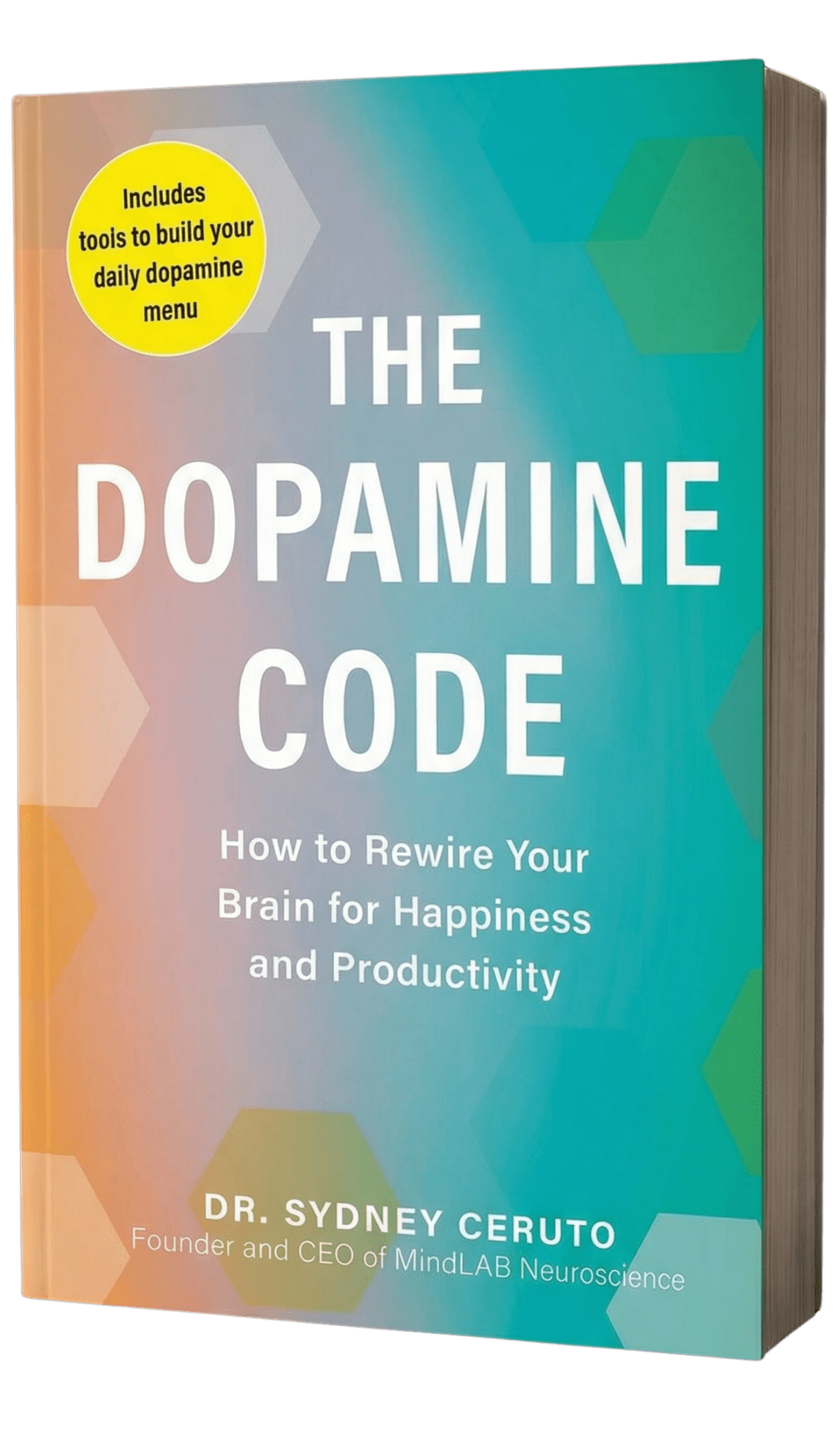
The Dopamine Code framework informs this work directly: the same neural mechanisms that govern individual motivation and decision-making also govern organizational behavior and culture. Strategic plans that do not account for the motivational architecture of the people who must execute them are not strategic plans. They are intentions.
What This Looks Like in Practice
The most consistent observation from clients is a qualitative shift in the character of their strategic thinking — not just in what they decide, but in how the thinking feels. The sense of operating within a constrained solution space, of being driven by reactive demands rather than leading from a clear directional conviction, gives way to something more spacious: a felt sense of operating with genuine strategic agency, of choosing direction rather than managing circumstances.
Practically, this manifests as improved signal-to-noise ratio in strategic decision-making: faster identification of which decisions are genuinely strategic and which are tactical matters that have been elevated by urgency rather than importance, cleaner separation of short-term operational pressures from long-horizon directional commitments, and more durable confidence in strategic choices because those choices are grounded in a clearer map of the actual competitive landscape rather than inherited assumptions about it.
We begin with a strategy call — one hour of focused strategy conversation that maps the specific constraints on your current strategic thinking, identifies where conventional planning processes are limiting rather than enabling your strategic capacity, and establishes the development pathway that will produce the most significant and durable improvement in your strategic output.
For deeper context, explore cognitive distortions that block strategic thinking.