





Health Anxiety in Lisbon

Distance from familiar healthcare and an unfamiliar medical system keep the monitoring elevated in Lisbon. The body's signals do not become less alarming in a language you cannot fully read.

There is a specific kind of fear that lives in the body itself — the one that notices every sensation and files it as evidence. A flutter in the chest. A headache that has lasted three days. A muscle twitch that was not there last week. For most people, those sensations arrive and pass. For someone whose brain's internal monitoring system is stuck in threat mode, each one becomes a signal that demands investigation. The search for reassurance does not end the search. It only resets the timer.

At MindLAB Neuroscience, I work with people whose nervous system has recalibrated its internal body-monitoring so acutely that normal physiological signals are being processed as danger. The work is not about learning to ignore your body. It is about recalibrating the brain system responsible for interpreting what the body reports — so that sensation returns to being information rather than an alarm.

Book a Strategy Call

Why the Body Feels Like a Source of Threat

The brain has a sophisticated system for monitoring the body’s internal state — tracking heartbeat, breath, gut activity, temperature, and dozens of other physiological signals in real time. This system, called interoception — the brain’s monitoring of internal bodily states, is supposed to provide information. A rapid heartbeat during exercise is data: effort is occurring. A racing pulse during a panic response is data: the threat system is activated. The signal is accurate. The problem is what the brain does with it.

In people living with health anxiety, this monitoring system has been recalibrated to interpret normal bodily variation as potential danger. The interoceptive signal that reaches awareness is not raw sensation — it has already been processed through the brain’s threat-evaluation circuitry, particularly the amygdala — the brain’s threat-detection and alarm system. When that circuitry has a low activation threshold for bodily signals, normal variation becomes alarming. The heart skipping a beat is not a quirk of cardiac rhythm. It is evidence.

This is not hypochondria in the dismissive, casual sense. The fear is genuine. The physical sensations are real. The distress is not performed. What has gone wrong is an architectural error in how the brain assigns threat value to the body’s constant stream of physiological information.

The Reassurance Loop and Why It Reinforces the Pattern

The immediate instinct when a bodily sensation triggers fear is to seek resolution — to check the symptom, research the possible cause, or ask someone whether it is serious. This produces momentary relief. And then it produces more anxiety, because the cycle has been reinforced rather than interrupted.

Reassurance — whether from internet research, a doctor’s visit, or a friend’s calm response — does not reach the threat-detection circuitry directly. It reaches the reasoning brain. The reasoning brain accepts the reassurance and updates its conclusions. The amygdala does not have access to that transaction in any durable way. It resets. The next sensation arrives. The monitoring resumes. The pattern cycles through the same sequence because reassurance-seeking addresses the output of the pattern, not the architecture that produces it.

There is a second mechanism operating simultaneously. Attention amplifies interoceptive signal. When someone directs focused attention toward a bodily sensation, that sensation becomes more prominent in awareness — not because it has worsened, but because the brain is allocating monitoring resources toward it. The more attention the sensation receives, the stronger it registers. The stronger it registers, the more alarming it becomes. The more alarming it becomes, the more attention it attracts. This is a loop the pattern maintains automatically, without requiring any external input to keep running.

What Keeps the Internal Monitoring Elevated

Several factors sustain the elevated monitoring threshold. One is the brain’s prediction architecture: having once associated a bodily sensation with a frightening possibility, the brain anticipates that sensation and pre-loads a threat interpretation before the sensation has fully registered in awareness. The signal arrives pre-labeled. The alarm fires before the evaluation has occurred.

A second factor is the reinforcement pattern of medical confirmation. When a scan or test result comes back clean, the immediate relief is real — but it is filed by the brain as evidence that the monitoring was necessary. The brain does not conclude that the symptom was not dangerous. It concludes that the danger was caught in time. The monitoring is therefore reinforced as useful rather than excessive. Each clean result strengthens the case for continued vigilance.

A third factor is the role of general nervous system activation. When the stress-response system is chronically elevated — when cortisol and its cascade are running at above-baseline levels — bodily symptoms become more numerous and more intense. Muscle tension produces soreness. Gut-brain dysregulation produces digestive irregularity. Altered breathing patterns produce chest tightness and lightheadedness. The brain then has more material to monitor, more genuine physical symptoms to evaluate, and a lower threshold for assigning threat value to them. The anxiety generates the symptoms that sustain the anxiety.

The Intelligence Inside the Pattern

Health anxiety is almost never random. The brain’s choice of which bodily signals to amplify, which catastrophic possibilities to generate, and which domains of health to surveil most intensely is usually patterned in ways that trace back to a specific origin. A family history in which illness arrived without warning and changed everything. A personal medical event that was genuinely frightening and that taught the body to stay alert for recurrence. An environment that communicated that health was fragile and required constant management. These are not irrational origins. They are the brain doing exactly what it learned it should do.

Understanding the pattern’s origin is not the same as resolving it — but it provides the precision needed to work on the architecture itself. The brain that learned to monitor intensely because the environment provided genuine reasons to do so requires a different approach than the brain whose monitoring escalated gradually without a clear precipitating event. Identifying the architecture is the starting point. What was learned can be recalibrated.

What Changes When the Monitoring Recalibrates

When the interoceptive threat-processing system adjusts its threshold — when the amygdala stops pre-labeling bodily sensations as danger — the experience is not silence. The body continues producing the same signals. The difference is in what those signals mean in awareness. A heartbeat variation becomes background data rather than an alarm. A new sensation is noted and filed rather than interrogated. The search for the symptom’s meaning does not begin automatically.

People who work through health anxiety typically describe a shift in their relationship to their own body — from adversarial to informational. The body’s signals become something that can be observed rather than immediately investigated. Rest becomes possible because the monitoring is no longer running at full resource allocation. The hours that previously went to researching, checking, and seeking reassurance become available for other things. That is not a minor change. For someone whose daily experience has been organized around the body as a source of threat, it is fundamental.

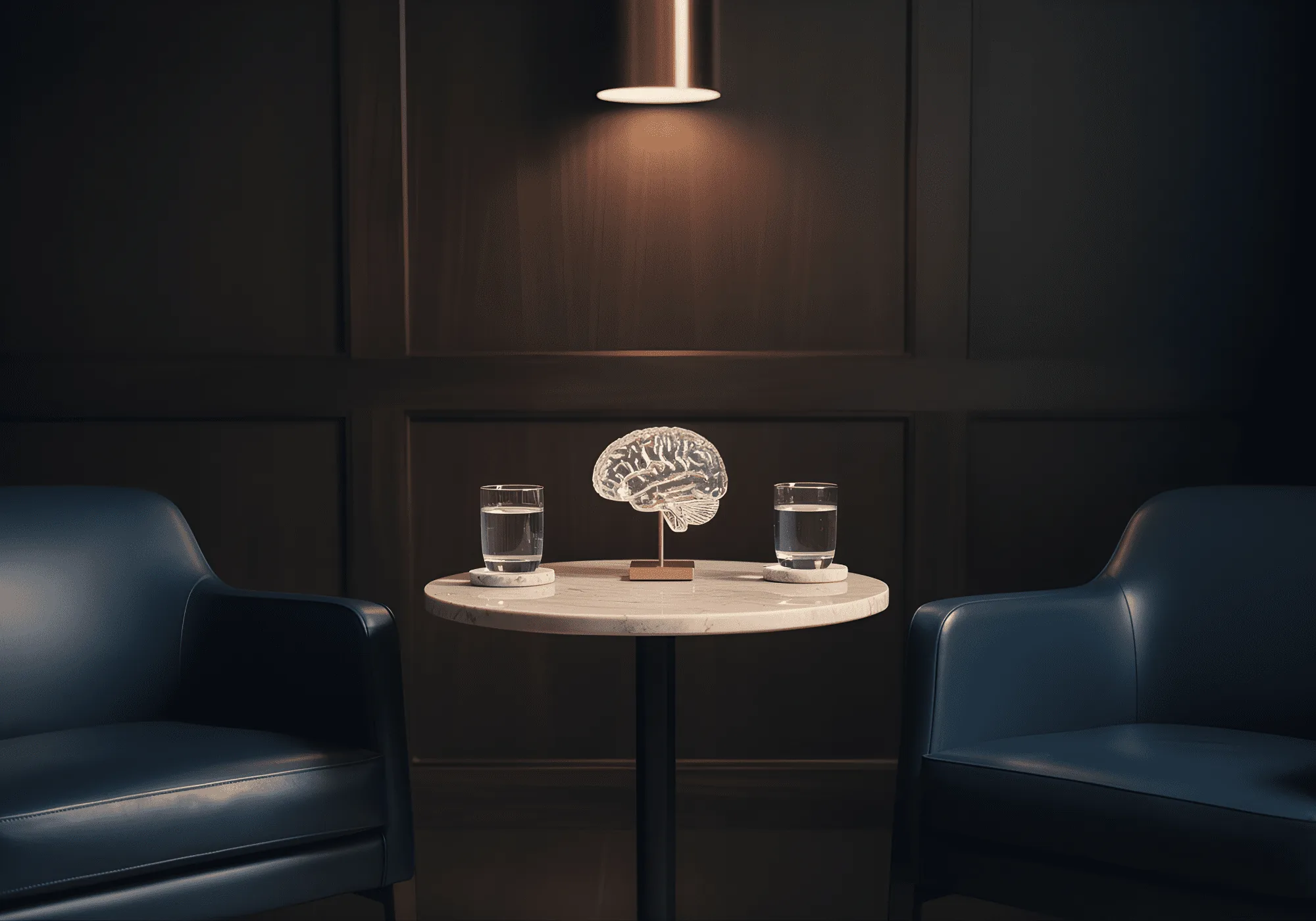
Antique rosewood desk with crystal brain sculpture and MindLAB journal in warm amber Lisbon afternoon light with historic European wood paneling

If the description of a brain that treats every sensation as potential evidence of something serious is recognizable — if health anxiety is structuring significant parts of your daily experience — a Strategy Call is the right first step. One hour, by phone, to examine what the pattern actually involves and what the work would target.

Why Health Anxiety Matters in Lisbon

Health anxiety takes on a specific character when the healthcare system around you is unfamiliar. For expats in Lisbon, the Portuguese medical system — genuinely competent, often excellent — is nonetheless a system in a language that many residents do not fully read, organized around processes that differ from what they learned to navigate, staffed by practitioners whose communication style and cultural frame of reference are different from what feels legible. When the body produces a symptom and the person experiencing it cannot fluently navigate the system designed to evaluate it, the monitoring system fills the gap with what it knows: uncertainty, and the threat associations that uncertainty generates.

Language barrier anxiety is not trivial. For someone whose health anxiety is partly driven by the need for precise information — to understand the specific term, the exact significance of a reading, the precise meaning of a clinical finding — operating in a second language at a stressful moment is an information loss that the monitoring system cannot tolerate. The inability to ask the follow-up question fluently, the uncertainty about whether the reassurance received was fully understood, the need to rely on translation that may not capture the nuance — all of these sustain the monitoring at elevated levels even after a medical encounter that was objectively reassuring.

Distance from familiar healthcare is a distinct layer. Many Lisbon expats built their health monitoring history in healthcare systems they knew well — the specific GP who understood their history, the specialist who knew their file, the ER that would have access to their records. That continuity is gone. The body in Lisbon is being managed by practitioners who are starting from zero with the patient’s history. For a health-monitoring brain, this is an infrastructure vulnerability: the system responsible for catching what the monitoring system fears is less equipped to do so because it lacks context. The anxiety fills the gap that the unfamiliar system leaves.

The expat community’s transience adds a social dimension to health management. Healthcare decisions typically involve a trusted network — the friend who had the same symptom and can report what it turned out to be, the colleague who knows a good specialist, the community member who has navigated the Portuguese system and can guide. In a community where people rotate every six to eighteen months, that knowledge network is shallow and constantly rebuilding. The health-anxious brain in Lisbon is navigating its monitoring without the social reassurance infrastructure it depended on at home.

Lisbon’s physical environment produces specific bodily sensations that a monitoring system will process as material. The hills — genuinely steep in Alfama, Mouraria, and Graça — produce cardiovascular effort that is a normal adaptation demand for anyone unaccustomed to gradient walking. For someone monitoring heartbeat and breath with an elevated threat threshold, the physical demands of the city’s topography are a daily source of interoceptive input. A racing heart on the 116 steps to Portas do Sol is physiologically appropriate. The monitoring system does not always receive it that way.

If you came to Lisbon and brought the health monitoring with you — if distance from familiar healthcare and the Portuguese medical system’s unfamiliarity have elevated the vigilance rather than lowered it — a Strategy Call is scheduled to your timezone, conducted by phone. $250. One hour to examine the pattern and what it would take to recalibrate it at the level it actually lives.

Dr. Sydney Ceruto, PhD — Founder, MindLAB Neuroscience

Dr. Sydney Ceruto, PhD — Founder & CEO, MindLAB Neuroscience

Dr. Ceruto holds a PhD in Behavioral & Cognitive Neuroscience from NYU and two Master’s degrees from Yale University. She lectures at the Wharton Executive Development Program at the University of Pennsylvania and has been an Executive Contributor to the Forbes Coaching Council since 2019. Dr. Ceruto is the author of The Dopamine Code (Simon & Schuster, June 2026). She founded MindLAB Neuroscience in 2000 and has spent over 26 years pioneering Real-Time Neuroplasticity™ — a methodology that permanently rewires the neural pathways driving behavior, decisions, and emotional responses.

References

Critchley, H. D., & Garfinkel, S. N. (2017). Interoception and emotion. *Current Opinion in Psychology*, 17, 7–14. https://doi.org/10.1016/j.copsyc.2017.04.020

Paulus, M. P., & Stein, M. B. (2010). Interoception in anxiety and depression. *Brain Structure and Function*, 214(5–6), 451–463. https://doi.org/10.1007/s00429-010-0258-9

Abramowitz, J. S., & Braddock, A. E. (2008). Psychological treatment of health anxiety and hypochondriasis: A biopsychosocial approach. *Hogrefe & Huber*. https://doi.org/10.1037/e529302013-001

Van den Bergh, O., Witthöft, M., Petersen, S., & Brown, R. J. (2017). Symptoms and the body: Taking the inferential leap. *Neuroscience & Biobehavioral Reviews*, 74, 185–203. https://doi.org/10.1016/j.neubiorev.2017.01.015

Success Stories

“The moment two priorities competed for bandwidth, my attention collapsed — and I'd convinced myself my brain was fundamentally broken. Dr. Ceruto identified the specific attentional pattern that was causing the collapse and restructured it. My prefrontal cortex wasn't broken. It was misfiring under competing demands. Once that pattern changed, everything I was trying to hold together stopped requiring so much effort.”

Rachel M. — Clinical Researcher Boston, MA

“My kids had been sleeping through the night for three years, but my brain hadn't caught up. I was still waking every ninety minutes like clockwork — no amount of sleep hygiene or supplements touched it. Dr. Ceruto identified the hypervigilance loop that had hardwired itself during those early years and dismantled it at the source. My brain finally learned the threat was over. I sleep through the night now without effort.”

Catherine L. — Board Director Greenwich, CT

“I'd relocated internationally before, but this time my nervous system wouldn't settle. Everything unfamiliar registered as danger — new people, new routines, even the sound of a different language outside my window. Pushing through it only deepened the pattern. Dr. Ceruto identified that my nervous system was coding unfamiliarity itself as threat and restructured the response at its source. The world stopped feeling hostile. I stopped bracing.”

Katarina L. — Gallerist Zurich, CH

“Anxiety and depression had been running my life for years. Dr. Ceruto helped me see them not as permanent conditions but as neural patterns with identifiable roots. Once I understood the architecture, everything changed.”

Emily M. — Physician Portland, OR

“Four hours a night for over two years — that was my ceiling. Supplements, sleep protocols, medication — nothing touched it because nothing addressed why my brain wouldn't shut down. Dr. Ceruto identified the cortisol loop that was keeping my nervous system locked in a hypervigilant state and dismantled it. I sleep now. Not because I learned tricks — because the pattern driving the insomnia no longer exists.”

Adrian M. — Hedge Fund Manager New York, NY

“Endocrinologists, sleep clinics, functional medicine — every specialist cleared me, and no one could tell me why I was exhausted every single day. Dr. Ceruto identified that my HPA axis was locked in a low-grade stress activation I couldn't feel consciously. Once that pattern was disrupted at the neurological level, my energy came back in a way that felt completely foreign. I'd forgotten what it was like to not be tired.”

Danielle K. — Luxury Hospitality Beverly Hills, CA

“Three months. That's how long it took to go from debilitating panic to leading with clarity. Years of conventional approaches hadn't moved the needle — Dr. Ceruto identified the root neural pattern and eliminated it. She didn't teach me to manage the panic. She made it unnecessary. I didn't know that was possible.”

Ella E. — Media Executive Manhattan, NY

“My communication was damaging every relationship in my professional life and I couldn't see it. Dr. Ceruto's neuroscience-based approach didn't just improve how I communicate — it rewired the stress response that was driving the pattern in the first place. The people around me noticed the change before I fully understood what had happened. That tells you everything.”

Bob H. — Managing Partner London, UK

“Willpower, accountability systems, cutting up cards — none of it worked because none of it addressed what was actually driving the behavior. Dr. Ceruto identified the reward prediction error that had been running my purchasing decisions for over a decade. Once the loop was visible, it lost its power. The compulsion didn't fade — it stopped.”

Priya N. — Fashion Executive New York, NY

Frequently Asked Questions About Health Anxiety

What is health anxiety — is it the same as being a hypochondriac?

The word "hypochondriac" carries a dismissiveness that does not fit what is actually happening. Health anxiety describes a real, involuntary pattern in which the brain's internal body-monitoring system has been recalibrated toward threat — so that normal physiological sensations are processed as potential danger signals rather than as background data. The concern is genuine. The distress is not imagined or performed. What has gone wrong is at the level of how the brain assigns threat value to the body's constant stream of signals — an architectural issue, not a personality trait or a choice to be irrational.

Why doesn't getting a clear test result make the anxiety go away?

Because the reassurance reaches your reasoning brain but not the system that is actually generating the alarm. The brain's threat-detection circuitry evaluates safety independently from your conscious conclusions — and when it is recalibrated toward bodily threat, a clean result registers as "caught in time" rather than "evidence of safety." The monitoring resets. The next sensation arrives. The cycle runs again from the beginning. This is not a failure of rationality. It is a structural feature of how the threat-detection architecture operates when its threshold has been set too low.

Why does paying attention to a symptom seem to make it worse?

Because attention amplifies interoceptive signal. When the brain directs monitoring resources toward a bodily sensation, that sensation registers more prominently in awareness — not because the physical state has worsened, but because more neural processing capacity is being allocated to it. The more attention the sensation receives, the stronger it registers. The stronger it registers, the more alarming it becomes. The more alarming it becomes, the more attention it attracts. The symptom does not need to change for this loop to escalate. Directed attention is sufficient to sustain it indefinitely.

Is health anxiety related to general anxiety, or is it its own thing?

Health anxiety shares the same elevated threat-detection threshold that characterizes anxiety broadly, but its specific mechanism is interoceptive — the brain's monitoring of internal bodily states has become the domain where that elevated threshold most intensely operates. Many people with health anxiety also experience anxiety in other domains: social situations, performance, the future. But the body-specific monitoring can also appear in relative isolation, particularly when it has been shaped by a specific medical event or family experience that calibrated the monitoring toward health threat in particular. The shared architecture and the domain-specific expression are both real.

Can health anxiety cause physical symptoms?

Yes — and this is one of the pattern's most self-sustaining features. Elevated stress-response activation produces genuine physical effects: muscle tension generates soreness and tightness, altered breathing patterns produce chest pressure and lightheadedness, gut-brain communication disrupted by sustained threat activation produces digestive irregularities, and sustained cortisol elevation affects sleep quality and fatigue. These are real physical symptoms, not imagined ones. The monitoring system then has genuine bodily evidence to process — which sustains the vigilance, which sustains the stress response, which produces more symptoms. The anxiety generates the material that justifies the anxiety.

Why do I always jump to the worst possible explanation for a symptom?

The brain's threat-detection system is built to overestimate danger rather than underestimate it — false positives are less costly than false negatives from an evolutionary standpoint. When the monitoring threshold is recalibrated toward threat, this overestimation bias is amplified: ambiguous signals are interpreted through the most threatening available frame. There is also a prediction component. Once the brain has associated bodily sensations with frightening possibilities, it begins pre-loading those interpretations before the sensation has fully registered in awareness. The worst-case scenario does not arrive after reflection. It arrives before it.

Does health anxiety mean something is wrong with me psychologically?

No. It means your brain learned — for reasons that were usually completely understandable — to treat bodily signals as requiring urgent evaluation. That learning may have come from a family history in which illness arrived without warning, a personal medical event that was genuinely frightening, a cultural or community environment that treated health vigilance as necessary, or a period of sustained stress that amplified interoceptive monitoring. The pattern is not a character flaw or a psychological weakness. It is a learned architectural state that can be recalibrated. Understanding what produced it is usually the first step toward working on it effectively.

What does working on health anxiety actually involve?

The work engages the brain systems responsible for how bodily signals are interpreted — specifically the threat-detection circuitry that has been recalibrated to assign danger value to normal physiological variation. It is not about learning to ignore your body or convince yourself that symptoms are not real. It is about updating the threat threshold so that sensation becomes information rather than alarm. The monitoring does not disappear. Its interpretation changes. The body's signals remain available to you — they stop requiring urgent investigation before you can move on with your day.

Is health anxiety worse in certain environments?

Yes. Environments that provide more interoceptive inputs — physical demands, sensory density, heat, exertion — give an elevated monitoring system more material to work with. Environments saturated with health messaging, optimization culture, or proximity to illness amplify the vigilance further. Healthcare access paradoxically sustains it: when reassurance-seeking is always possible, the brain learns to seek more frequently, and the seeking threshold falls. Environments where the healthcare system is unfamiliar add a specific layer — the inability to navigate the system fluently produces information gaps that the monitoring system fills with threat assumptions.

What is a Strategy Call, and is it right for someone dealing with health anxiety?

A Strategy Call is a one-hour phone conversation — $250, no commitment beyond that. We examine your specific pattern: which sensations activate the monitoring most intensely, what the reassurance-seeking loop looks like, what the origin of the elevated threshold appears to be, and what the work would actually target. You leave with precision about what is happening and what would be required to change it at the level it lives. For health anxiety specifically, the call is useful because the pattern varies significantly by origin — what was learned, and what is keeping it running, shapes what the work involves. That picture is clearer after an hour of examination than it is before.

Also available in: Miami · Wall Street · Midtown Manhattan · Beverly Hills

Take the First Step

The Strategy Call is a focused conversation with Dr. Ceruto that maps the specific neural mechanisms driving your concerns and determines the right path forward.

Book a Strategy Call
MindLAB Neuroscience consultation room
Locations

The Intelligence Brief

Neuroscience-backed analysis on how your brain drives what you feel, what you choose, and what you can’t seem to change — direct from Dr. Ceruto.