









Career Transition Planning in Westchester County

The brain does not release a professional identity willingly. Career transitions stall not from lack of strategy, but because the neural architecture encoding your current role resists replacement.

Career transition is a neurological event the brain's self-referential thought system — and medial prefrontal cortex, where your brain constructs, maintains, and can be guided to restructure the identity. This identity governs every professional decision you make.

Book a Strategy Call
ForbesUSA TodayHuffPostNewsweekAssociated PressCosmopolitanBusiness InsiderForbesUSA TodayHuffPostNewsweekAssociated PressCosmopolitanBusiness Insider

Key Points

  1. Career transitions stall because the brain's threat-detection system classifies professional identity change as a survival-level risk — not a strategic opportunity.
  2. The anterior cingulate cortex generates sustained anxiety during transitions by continuously monitoring the gap between current reality and the expected professional state.
  3. Loss of professional status activates neural circuits identical to those processing physical pain, creating avoidance behavior that masquerades as practical caution.
  4. Successful transitions require the brain to build new predictive models for professional identity — a neuroplasticity process that has specific biological requirements and timelines.
  5. The cognitive load of maintaining performance in a current role while planning a transition depletes the prefrontal resources needed for strategic career decision-making.

The Transition That Will Not Complete

“The brain that built your career through its current phase physically reorganized itself around those demands. Now you need it to do something different — and the neural architecture that made you successful is the same architecture resisting the change.”

You made the decision. You may have even taken the first steps — updated your profile, explored opportunities, had the conversations. And then something happened. Or more precisely, something did not happen. The momentum stalled. The clarity faded. The new direction that felt so clear three months ago now feels distant, theoretical, not quite real.

This is the career transition pattern that brings most professionals to MindLAB Neuroscience. Not a lack of options. Not a shortage of information. A stall in the transition itself, a persistent inability to fully step out of one professional identity and into another.

The conventional explanation is fear. Uncertainty. Lack of commitment. But these surface-level accounts miss what is actually occurring. Professionals in the middle of career transitions are not paralyzed by emotion. They are caught in a neurological conflict between two identity states, the one their brain has spent years encoding as self-defining and the one they are trying to construct from scratch.

What I see repeatedly in this work is a professional who has done everything right strategically. The plan is sound. The opportunity is real. The market supports the move. And still, the transition will not complete. The obstacle is not in the strategy. It is in the neural architecture.

For professionals navigating career transitions in Miami this stall carries compounding costs. Every month of incomplete transition is a month of misaligned energy, strained cognitive resources, and professional momentum lost to internal resistance.

The Neuroscience of Career Transition

Career transition is, at its neurological core, a default mode network event. When a professional identity changes — or when the brain contemplates that change — the self-referential processing systems of the default mode network are directly challenged.

Two decades of research on the brain’s self-referential network have established its core role in narrative identity construction. This network’s key nodes form a system that activates above resting baseline during self-trait judgments such as those occurring during major life transitions, impairing the subjective sense of narrative selfhood.

This is the precise neural mechanism behind the transition stall. When a professional’s title, employer, or industry role changes, the mPFC must update its self-concept encoding. The posterior cingulate must re-anchor the narrative self to new experiences. Without deliberate support for this architecture, the brain defaults to conserving the old self-concept. It experiences the transition as identity threat rather than identity expansion.

The Future-Self Construction Problem

A second mechanism compounds the difficulty. The hippocampus — the brain’s memory-formation center — plays a causal role in future-scenario construction, the ability to build vivid mental simulations of possible future events. When this system is disrupted, people generate significantly fewer details when imagining future events, a large and measurable deficit. The memory center’s forward-looking function degrades, and the capacity to picture yourself in a new role narrows.

Career transition requires not just releasing a past identity but vividly constructing a future one. The hippocampus does not merely store memories. It actively recombines episodic details to simulate potential futures — including novel professional roles, new industries, and reinvented self-concepts. When professionals describe their transition as “not being able to picture myself doing that,” they are reporting a specific neural impairment. This reflects insufficient hippocampal prospection to generate the vivid, detailed, credible future-self simulation that would drive committed action.

Research mapping the DMN’s tripartite architecture has confirmed an anterior mPFC core that shows the strongest activation during self-trait judgments. This functions as the brain’s primary self-encoding interface where new professional information is evaluated against the existing self-concept. The dorsal mPFC subsystem additionally activates when deliberating about new roles, effectively modeling “what kind of person would do this job.” When professionals resist a transition they intellectually want to make, the anterior mPFC self-concept is producing a mismatch signal. This does not fit who I am.
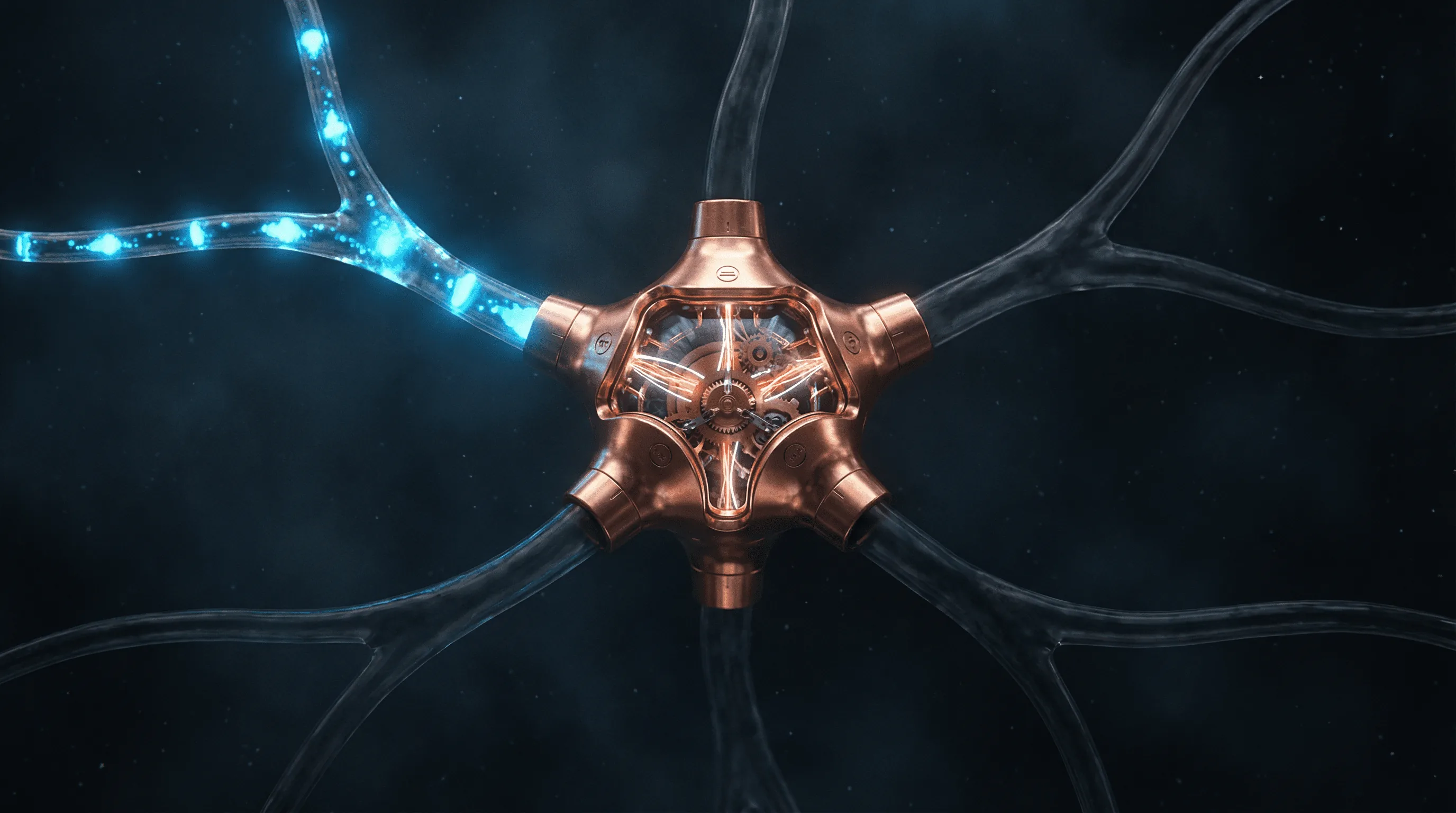
Career counseling and career assessment — copper neural crossroads with selected pathway representing professional direction

How Dr. Ceruto Approaches Career Transitions

Dr. Ceruto’s Real-Time Neuroplasticity, the brain’s ability to rewire itself, methodology intervenes at both the identity-release and identity-construction phases of career transition simultaneously.

On the release side, the process works with the mPFC’s self-concept encoding to reduce the neural weight of the prior professional identity. It does not erase it, but reclassifies it from a core self-defining attribute to a historical component of a larger narrative. This is how a professional who has been “the finance person” for a decade can begin to experience that identity as one chapter rather than the entire story.

On the construction side, the methodology builds hippocampal prospection capacity, strengthening the brain’s ability to generate rich, episodically specific, emotionally resonant simulations of the new professional direction. This is not visualization in the motivational sense. It is targeted engagement of the neural circuit that actually processes future-self scenarios.

The NeuroSync program addresses focused career transitions relocation, relationship changes, family responsibilities, where multiple identity nodes require coordinated recalibration. For professionals navigating the compound disruptions that Miami’s high-velocity environment frequently produces, this comprehensive approach addresses what a narrower engagement cannot.

The pattern that presents most often is a professional operating between two identities, neither fully committed to the old nor fully inhabiting the new. This liminal state is cognitively expensive. It drains working memory, degrades decision quality, and produces the chronic unease that professionals often mistake for ambivalence. It is not ambivalence. It is two competing neural identity states running simultaneously.

What to Expect

Every engagement begins with a Strategy Call, a focused conversation where Dr. Ceruto evaluates the transition landscape, identifies the specific neural patterns maintaining the stall. He determines whether a structured engagement is the appropriate next step.

The process that follows is individualized. Initial assessment maps the existing identity architecture, which professional self-concepts the brain currently encodes as core and which it treats as peripheral. Targeted protocols then address the specific points of resistance: updating mPFC self-concept hierarchies, strengthening hippocampal future-self simulation, and recalibrating the social identity networks maintained by the dorsal mPFC subsystem.

The standard is durable change. Completion means the new professional identity is neurally stable, the default mode network self-references the new role automatically, the hippocampus simulates the new future with ease, and the transition no longer registers as threat. The timeline adapts to the neural landscape each professional presents. Precision matters more than speed.

References

Menon, V. (2023). 20 years of the default mode network: A review and synthesis. Neuron, 111(16), 2443–2460. https://doi.org/10.1016/j.neuron.2023.04.023

Thakral, P. P., Madore, K. P., Kalinowski, S. E., & Schacter, D. L. (2020). Modulation of hippocampal brain networks produces changes in episodic simulation and divergent thinking. Proceedings of the National Academy of Sciences, 117(23), 12729–12740. https://doi.org/10.1073/pnas.2003535117

Wen, T., Mitchell, D. J., & Duncan, J. (2020). The functional convergence and heterogeneity of social, episodic, and self-referential thought in the default mode network. Cerebral Cortex, 30(11), 5926–5942. https://doi.org/10.1093/cercor/bhaa166

The Neural Architecture of Transition Readiness

A career transition is one of the most neurologically demanding events a professional brain processes. It requires simultaneous engagement of systems that typically operate independently: the identity network must reconstruct the self-concept, the reward system must recalibrate its value assignments, the threat-detection system must tolerate extraordinary uncertainty, and the executive control network must maintain strategic function throughout a period of destabilization that can last months or years.

The brain’s response to transition is governed by a principle that neuroscience calls uncertainty intolerance, and this principle explains much of what makes career transitions feel disproportionately difficult. The anterior cingulate cortex monitors the gap between the brain’s predictions about the world and what is actually occurring. When a professional is established in their career, the predictions are well-calibrated: the brain knows what tomorrow looks like, what the professional’s role entails, how success is measured, where the rewards come from. During transition, these predictions collapse. The anterior cingulate registers the prediction failure as a continuous error signal, and this signal activates the same neural alarm that accompanies genuine environmental danger.

Neuroscience consultation — rosewood table with crystal brain sculpture and branded journal for strategy call preparation

The uncertainty is not just cognitive. The dorsal striatum, which encodes habitual behavior patterns, has automated the routines of the current career over years of repetition. Commute patterns, email habits, meeting rhythms, social hierarchies, professional language — all have been encoded as procedural knowledge that requires minimal conscious resources. Transition disrupts these automated routines simultaneously, forcing the executive control system to manage consciously what was previously automatic. The cognitive load of navigating a new professional environment is not just the load of learning new content. It is the load of manually executing hundreds of micro-behaviors that the previous career had automated, and this load consumes the very executive resources needed for strategic thinking about the transition itself.

The default mode network compounds the challenge through a process that resembles rumination. During periods of uncertainty, the default mode network’s self-referential processing intensifies. The brain runs continuous simulations of possible futures, evaluating each against the current self-concept. When the self-concept is itself in flux — which is the defining feature of career transition — these simulations become recursive: the brain is trying to evaluate future scenarios using a self-model that is being reconstructed as the evaluation occurs. The result is the cognitive exhaustion and decision paralysis that characterize the transition experience.

Why Traditional Transition Planning Falls Short

Conventional career transition planning focuses on the strategic and logistical dimensions: market research, skill gap analysis, networking strategy, financial planning, resume optimization. These components are necessary but structurally insufficient for the professionals who find themselves stuck despite thorough preparation.

The insufficiency is biological. Strategic planning is a prefrontal function that requires sustained working memory, cognitive flexibility, and the capacity to evaluate multiple options against complex criteria. These capacities are precisely what the transition state degrades: the uncertainty signal from the anterior cingulate consumes attentional resources, the loss of automated routines overloads executive function, and the default mode network’s recursive self-simulation produces cognitive fatigue that further reduces planning capacity. The professional who has done comprehensive transition planning and cannot execute it is not lacking discipline. They are attempting to use neural systems that the transition state has partially incapacitated.

Networking and relationship-building face a parallel challenge. Social engagement during career transition requires the social cognition network to operate under conditions of identity instability. The professional must present themselves to new contacts while their own sense of who they are is in flux. The temporoparietal junction, which generates mental models of others’ perceptions, is simultaneously processing the professional’s uncertainty about their own identity, creating a noisy signal that the professional experiences as social anxiety, inauthenticity, or the inability to clearly articulate their value. The networking that transition planning prescribes requires the very social-cognitive stability that the transition has disrupted.

How Neural Transition Support Works

My approach treats career transition as a neural event that requires biological support, not just strategic guidance. The work targets the specific systems that the transition state destabilizes, building the brain’s capacity to maintain strategic function, identity coherence, and social effectiveness during a period of maximum uncertainty.

The anterior cingulate’s uncertainty signal is the first priority. The continuous error signal generated by collapsed predictions produces a chronic alarm state that degrades every other system. The work involves recalibrating the anterior cingulate’s tolerance for prediction failure — not by reducing the uncertainty, which is real and should not be minimized, but by restructuring the neural response to uncertainty so that the alarm signal is informative rather than debilitating. When the anterior cingulate can register uncertainty without activating the full threat cascade, the executive control system recovers the resources it needs for strategic planning.

The default mode network’s recursive processing is addressed through targeted engagement that builds the network’s capacity to simulate alternative futures without collapsing into rumination. The distinction is precise: productive future simulation generates new possibilities and evaluates them against flexible criteria. Rumination generates the same scenarios repeatedly and evaluates them against rigid criteria, consuming resources without producing useful output. The work involves strengthening the executive control network’s capacity to guide default mode processing, converting recursive self-reference into productive identity exploration.

The identity reconstruction itself is supported through the methodology I have developed over two decades for working with the self-referential network during periods of transformation. As I describe in The Dopamine Code (Simon & Schuster, June 2026), the reward system’s recalibration during identity transitions follows specific patterns that, when properly supported, produce not just a new career direction but a more resilient self-structure. The brain that successfully navigates a supported identity transition builds architectural features — greater default mode flexibility, higher uncertainty tolerance, more efficient self-referential processing — that persist well beyond the transition itself.

What This Looks Like in Practice

The Strategy Call assesses the specific neural dimensions of your transition state. The pattern of destabilization varies: some professionals are primarily impaired by the uncertainty signal, others by identity fragmentation, others by the cognitive overload of lost routines, others by social-cognitive disruption. Most present with a compound pattern, and the relative contribution of each factor determines the intervention priority.

The work proceeds in parallel with whatever strategic planning you are already doing. It is not a substitute for market research, financial planning, or networking. It is the neural foundation that allows those activities to proceed with the cognitive and emotional resources they require. Clients consistently describe the experience as regaining access to their full capability during a period when they had accepted diminished function as the inevitable cost of transition. The cost is real — transition is neurologically expensive. But the expense can be managed at the architectural level, preserving the strategic, social, and emotional resources that determine whether the transition leads to a genuinely new chapter or an unsatisfying compromise.


Marker Traditional Approach Neuroscience-Based Approach Why It Matters
Focus Transition planning with networking strategies, skill gap analysis, and timeline management Restructuring the neural threat and identity circuits that create biological resistance to professional transition
Method Career transition coaching with action plans, accountability milestones, and market positioning Targeted intervention in the prediction, threat, and identity circuits that determine transition success or paralysis
Duration of Change Plan-dependent; anxiety and avoidance reassert when transition difficulty increases Permanent recalibration of how the brain processes professional identity change so transitions generate clarity rather than threat

Why Career Transition Planning Matters in Westchester County

Career Transition Planning in Westchester County

Career transitions in Westchester carry a structural weight that transitions in more transient communities do not. The family in Larchmont or Pelham has built a life architecture around the current career: the house within walking distance of the train station, the school district chosen for its rankings, the social network formed through years of community participation. A career transition threatens not just income but the entire infrastructure that the current career supports. The brain’s threat-prediction system processes this comprehensively — every element of the suburban architecture that depends on the current career becomes a reason not to change.

The Westchester professional in involuntary transition — the restructured executive, the displaced mid-career professional, the partner whose industry has contracted — faces the additional challenge of managing the transition’s visibility. In a community where professional identity is known and tracked, the period between roles is not merely uncomfortable — it is socially exposed. The brain’s social threat-detection system activates in contexts that were previously neutral: the school event, the neighborhood encounter, the dinner party where the inevitable question is asked.

My work addresses career transition at the level of the neural systems that govern how change is processed: the threat-detection architecture that treats professional uncertainty as survival-level danger, the identity circuits that must update to accommodate a new professional self-concept, and the reward prediction system that must learn to generate motivational drive toward an unfamiliar trajectory.

Dr. Sydney Ceruto, PhD — Founder, MindLAB Neuroscience

Dr. Sydney Ceruto, PhD — Founder & CEO, MindLAB Neuroscience

Dr. Ceruto holds a PhD in Behavioral & Cognitive Neuroscience from NYU and two Master’s degrees from Yale University. She lectures at the Wharton Executive Development Program at the University of Pennsylvania and has been an Executive Contributor to the Forbes Coaching Council since 2019. Dr. Ceruto is the author of The Dopamine Code (Simon & Schuster, June 2026). She founded MindLAB Neuroscience in 2000 and has spent over 26 years pioneering Real-Time Neuroplasticity™ — a methodology that permanently rewires the neural pathways driving behavior, decisions, and emotional responses.

References

Taren, A. A., Creswell, J. D., & Gianaros, P. J. (2013). Dispositional mindfulness co-varies with smaller amygdala and caudate volumes in community adults. PLOS ONE, 8(5), e64574. https://doi.org/10.1371/journal.pone.0064574

Arnsten, A. F. T. (2009). Stress signalling pathways that impair prefrontal cortex structure and function. Nature Reviews Neuroscience, 10(6), 410–422. https://doi.org/10.1038/nrn2648

Doll, B. B., Hutchison, K. E., & Frank, M. J. (2011). Dopaminergic genes predict individual differences in susceptibility to confirmation bias. Journal of Neuroscience, 31(16), 6188–6198. https://doi.org/10.1523/JNEUROSCI.6486-10.2011

Mobbs, D., Hassabis, D., Seymour, B., Marchant, J. L., Weiskopf, N., Dolan, R. J., & Frith, C. D. (2009). Choking on the money: Reward-based performance decrements are associated with midbrain activity. Psychological Science, 20(8), 955–962. https://doi.org/10.1111/j.1467-9280.2009.02399.x

Success Stories

“Every few months I'd blow up my life in a different way — new venture, new relationship, new fixation — and call it ambition. Dr. Ceruto identified the reward prediction error that was running the cycle. My brain had learned to chase escalation because it was the only thing that overrode what I was actually avoiding. Once she restructured the dopamine loop at the root, the compulsion to escalate just stopped. I didn't lose my drive — I lost the desperation underneath it.”

Kofi A. — Brand Strategist London, UK

“Slower processing, foggier recall, decisions that used to be instant taking longer than they should — I'd been accepting it all as inevitable decline for two years. Dr. Ceruto identified the prefrontal efficiency pattern that was degrading and restructured it at the neurological level. The sharpness didn't just come back. It came back faster and more precise than it was a decade ago. Nothing I'd tried before even addressed the right problem.”

Elliott W. — Wealth Advisor Atherton, CA

“Everyone around me had decided I was just 'wired differently' — creative but unreliable, brilliant but scattered. Years of trying to build systems around the chaos never worked because nobody identified what was actually driving it. Dr. Ceruto mapped the default mode network pattern that was hijacking my focus and recalibrated it at the source. The ideas still come fast — but now my prefrontal cortex decides what to do with them, not the noise.”

Jonah T. — Serial Entrepreneur New York, NY

“The divorce wasn't destroying me emotionally — it was destroying me neurologically. My amygdala was treating every interaction with my ex, every legal update, every quiet evening as a survival-level threat. Years of talk-based approaches hadn't touched it. Dr. Ceruto identified the attachment disruption driving the response and restructured it at the root. The threat response stopped. Not because I learned to tolerate it — because the pattern was no longer running.”

Daniela M. — Attorney North Miami Beach, FL

“My body had simply stopped knowing when to sleep. Crossing time zones weekly for over two years had broken something fundamental, and every protocol, supplement, and device I tried couldn't hold longer than a few days. Dr. Ceruto identified the disruption at the level of my suprachiasmatic nucleus and recalibrated the signaling pattern driving the dysfunction. Within weeks, my circadian rhythm locked back in. I sleep now. Consistently. Regardless of where I land.”

Jonathan K. — Diplomat Geneva, CH

“The moment two priorities competed for bandwidth, my attention collapsed — and I'd convinced myself my brain was fundamentally broken. Dr. Ceruto identified the specific attentional pattern that was causing the collapse and restructured it. My prefrontal cortex wasn't broken. It was misfiring under competing demands. Once that pattern changed, everything I was trying to hold together stopped requiring so much effort.”

Rachel M. — Clinical Researcher Boston, MA

Frequently Asked Questions About Career Transition Planning in Westchester County

Why does my career transition feel stuck even though I have a clear plan?

The plan exists at the cognitive level. The stall exists at the neural level. Your brain has spent years encoding your current professional identity as a core self-concept in the medial prefrontal cortex, the brain's executive control center. When you attempt to transition, the default mode network — neural circuits active during rest — generates a mismatch signal even when intellectually you want the change. Neuroscience-based transition planning addresses this mismatch at its source rather than layering more strategy on top of a structural resistance.

How is neuroscience-based career transition planning different from standard career services?

Standard career services operate at the behavioral level — resume optimization, networking strategy, interview preparation, job market intelligence. These are valuable but they do not address the neural architecture that determines whether you can actually inhabit a new professional identity. MindLAB's methodology works with the default mode network — the brain's self-referential thought system — and the medial prefrontal cortex. We also target the hippocampal prospection circuits — identity construction and future-self simulation. The difference is the depth of the intervention.

I was laid off from a Miami tech company and feel like I have lost my professional identity. Is that a normal response?

It is a neurologically expected response. Professional role is one of the most robust self-concept encodings the brain maintains. When a position is eliminated, the default mode network — the brain's self-referential thought system — experiences genuine disruption — the same regions that process self-referential information, autobiographical continuity, and social identity are all affected. This is not a personal failing or a sign of excessive attachment to a job title. It is a predictable neural response to identity threat that responds to structured intervention.

Can career transition planning help me move from corporate finance in Brickell to a startup role?

The corporate-to-startup transition is one of the most neurologically demanding career pivots because the institutional identity scaffolding — title, team, organizational status — must be replaced with a self-concept that can hold weight. This new identity must function without external validation. Your mPFC has encoded institutional affiliation as core to who you are. Building a founder or startup executive identity requires constructing that neural architecture before the external reality exists. Dr. Ceruto's methodology creates this internal validation system systematically.

How long does career transition planning take to produce durable results?

Timeline depends on the depth of identity reconstruction required. A lateral industry shift may require months of intensive work to update self-concept encoding and stabilize a new identity. Corporate-to-entrepreneur transitions typically require longer engagement because the mPFC must build a genuinely new identity architecture. The marker of completion is not landing a new role — it is neural stability: the default mode network — the brain's self-referential thought system — self-references the new direction automatically. The hippocampus simulates that future with ease.

Is career transition planning available virtually for professionals across Miami-Dade?

Yes. MindLAB Neuroscience is located at 17301 Biscayne Blvd in North Westchester County Beach and serves professionals throughout Westchester County-Dade, including Brickell, Coral Gables, Wynwood, Westchester County Beach, and Aventura, through both in-person and virtual engagement. The methodology delivers full precision regardless of format, and many professionals choose a combination based on their schedule and transition demands.

What happens during the Strategy Call?

The Strategy Call is a focused strategy conversation. Dr. Ceruto uses it to evaluate the nature of your transition, identify the specific neural patterns that may be maintaining the stall, and determine whether a structured engagement is the right approach. It is designed to produce clarity for both sides — about the transition itself and about whether MindLAB's methodology matches the specific challenge you are facing. This single conversation often reframes how professionals understand their own resistance to change.

How does this approach help when I know I need to make a career change but cannot bring myself to act?

The gap between knowing and acting is one of the most common and frustrating experiences in career transitions — and it has a precise neurological explanation. The prefrontal cortex has evaluated the situation and determined that change is necessary. But the amygdala classifies the transition as threatening, and the default mode network's identity model resists updating. These deeper systems generate resistance that conscious intention cannot override.

Dr. Ceruto addresses the neural circuits maintaining the gap: the threat classification that makes action feel dangerous, the identity architecture that makes the current state feel safer than the desired one, and the loss-aversion circuits that overweight what will be given up relative to what will be gained.

What does a successful career transition look like neurologically?

A neurologically successful transition has several observable markers: the individual processes the change without sustained threat activation, maintains cognitive clarity during the uncertainty of transition, experiences genuine forward momentum rather than anxiety-driven urgency, and integrates the new professional identity into their self-concept without prolonged identity conflict.

These markers reflect updated neural architecture: the threat-detection system has reclassified the transition from danger to opportunity, the default mode network has updated its self-model to incorporate the new professional identity, and the reward system is generating engagement signals aligned with the new direction.

How long does the neural adjustment period typically last during a career transition?

Without targeted intervention, the brain's identity and prediction models can take 6-18 months to fully adjust to a significant career transition — a period during which the individual often experiences doubt, second-guessing, and identity confusion that they mistake for evidence that the decision was wrong.

With Dr. Ceruto's targeted neural intervention, the adjustment period compresses significantly. The identity architecture updates faster when specifically targeted, the threat system recalibrates more rapidly with precise intervention, and the prediction models that generate the feeling of normalcy in the new role establish themselves weeks to months earlier than they would through natural adaptation alone.

Also available in: Miami · Wall Street · Midtown Manhattan · Beverly Hills · Lisbon

Career Transitions in Westchester County Move at the Speed of the Market — Your Neural Architecture Should Too

From Brickell's corporate corridors to Wynwood's startup hubs, Miami professionals face career pivots that demand more than a plan. They demand a brain that can inhabit the new direction. One conversation with Dr. Ceruto maps where the stall actually lives.

Book a Strategy Call
MindLAB Neuroscience consultation room

The Dopamine Code

Decode Your Drive

Why Your Brain Rewards the Wrong Things

Your brain's reward system runs every decision, every craving, every crash — and it was never designed for the life you're living. The Dopamine Code is Dr. Ceruto's framework for understanding the architecture behind what drives you, drains you, and keeps you locked in patterns that willpower alone will never fix.

Published by Simon & Schuster, The Dopamine Code is Dr. Ceruto's framework for building your own Dopamine Menu — a personalized system for motivation, focus, and enduring life satisfaction.

Order Now

Ships June 9, 2026

The Dopamine Code by Dr. Sydney Ceruto — Decode Your Drive
Locations

The Intelligence Brief

Neuroscience-backed analysis on how your brain drives what you feel, what you choose, and what you can’t seem to change — direct from Dr. Ceruto.
