Organizational Development Consulting in Bergen County

Organizational change fails at a rate exceeding seventy percent — not because of poor strategy, but because the neural architecture of the leadership team was never addressed. MindLAB diagnoses the circuit first.

Organizational change is a neurobiological event. Every restructuring, relocation, and cultural integration imposes measurable demands on the threat-detection and regulatory circuits of every leader involved. MindLAB Neuroscience addresses organizational development at the level of neural architecture — where genuine transformation actually occurs.

Book a Strategy Call
ForbesUSA TodayHuffPostNewsweekAssociated PressCosmopolitanBusiness InsiderForbesUSA TodayHuffPostNewsweekAssociated PressCosmopolitanBusiness Insider

Key Points

  1. Organizational dysfunction is collective neural dysfunction — the same threat responses, cognitive biases, and social processing errors that affect individuals scale predictably across groups.
  2. Group decision-making quality depends on the social cognition capacity of key individuals — the neural architecture of a few leaders determines organizational intelligence.
  3. The SCARF model identifies five domains of social threat — status, certainty, autonomy, relatedness, fairness — each processed through dedicated neural circuits.
  4. Organizational trust is mediated by oxytocin and social bonding circuits that are remarkably sensitive to leadership behavior — and remarkably slow to rebuild once damaged.
  5. Sustainable organizational development requires restructuring the neural patterns of the individuals whose behavior sets the norms others unconsciously mirror.

The Organizational Change Paradox

“Seventy percent of organizational change initiatives fail to achieve their stated objectives. This is not a management failure — it is a neuroscience failure. The brain's threat-detection architecture, evolved for physical survival, cannot distinguish between a territorial predator and an ambiguous organizational announcement.”

The initiative was sound. The strategy was clear. The leadership team understood the business case. And yet the change program stalled — not with dramatic resistance, but with the quiet, persistent reversion to prior patterns that every organizational leader recognizes but cannot explain.

This is the central frustration of organizational development work. The frameworks are sophisticated. The consultants are credentialed. The communication cascades are carefully designed. And the results, documented across decades of research, hover around a thirty percent success rate. Seventy percent of organizational change initiatives fail to achieve their stated objectives. This is not a management failure. It is a neuroscience failure.

The reason is mechanistically specific. When an organization announces a restructuring, relocates its headquarters, or integrates a workforce from a different cultural context, every leader in that organization experiences the same neural event: their amygdala begins firing threat signals. Not because they lack resilience. Not because they resist change philosophically. Because their brain’s threat-detection architecture, evolved for physical survival, cannot distinguish between a territorial predator and an ambiguous organizational announcement. The behavioral signature is identical: restricted information processing, centralized control, suppression of non-compliant alternatives, and increased reliance on prior-learned behaviors. This threat-rigidity response activates with mechanical reliability every time genuine uncertainty enters the organizational system.

Standard organizational development consulting addresses the downstream behavioral symptoms of this response. It designs communication strategies, builds stakeholder engagement plans, and creates accountability frameworks. None of these interventions touch the neural architecture generating the resistance. They are prescribing behavioral solutions to a biological problem.

What I see repeatedly in this work is leadership teams that intellectually understand the need for change but physiologically cannot execute it. Their prefrontal cortex, the seat of cognitive flexibility and adaptive decision-making, is operating at reduced capacity because sustained cortisol exposure from organizational uncertainty has degraded its regulatory function. They are attempting strategic adaptation with a brain that is, functionally, in partial shutdown.

The Neuroscience of Organizational Change

The amygdala — the brain’s threat-detection center — is the primary architecture driving this response. It communicates in both directions with the prefrontal cortex: one pathway encodes threat-amplifying signals, and the other encodes threat-dampening signals. Organizational change activates precisely this threat circuitry.

Under threat, organizations restrict information processing, centralize control, and increase reliance on prior-learned dominant behaviors — even when those behaviors are inappropriate to changed conditions. This is not a management problem. It is a neural circuit running on inherited survival architecture.

Psychological Safety as Neural Architecture

Team psychological safety is the strongest predictor of team learning behavior and organizational performance. Psychological safety correlates with reduced amygdala activation and increased prefrontal engagement. When psychological safety is absent, the amygdala interprets interpersonal risk as equivalent to physical threat, generating avoidance behavior that is neurologically indistinguishable from physical threat-response shutdown.

Analysis across one hundred and eighty teams confirmed psychological safety as the single most important variable in team performance. The SCARF model — Status, Certainty, Autonomy, Relatedness, Fairness — provides the operational framework: these five domains function as the primary threat and reward signal generators in organizational social environments. Corporate relocation, leadership transitions, and cultural integration simultaneously threaten all five domains, creating a compounding threat load that degrades executive function across the entire leadership population at once.
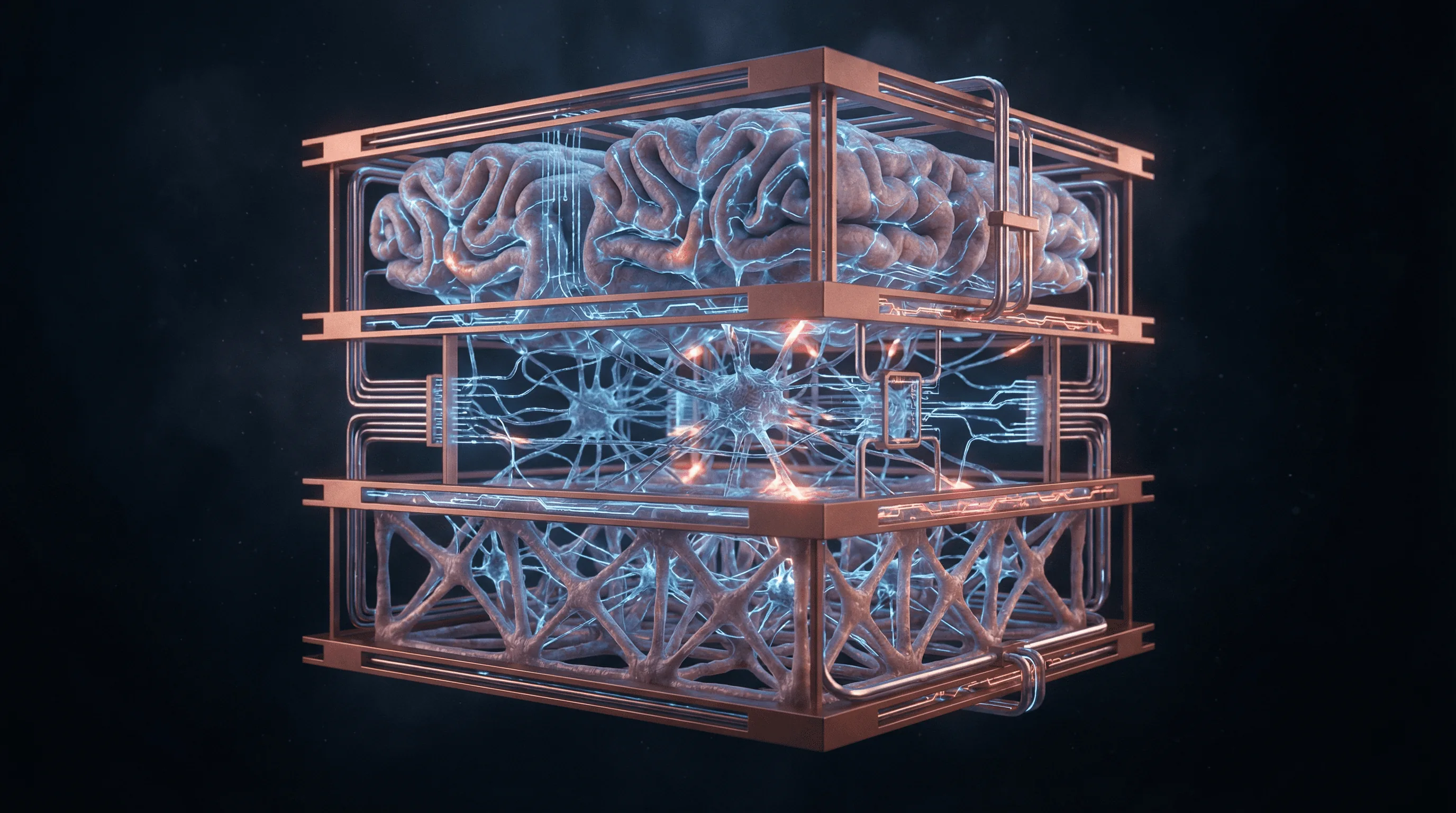
Strategy consulting and organizational development — layered copper neural blueprint connecting operational tiers

A meta-analysis of seventy-six brain imaging studies with over four thousand participants identified nine distinct activation clusters during uncertainty processing, centering on the brain’s internal awareness, cognitive control, and threat-detection regions. Uncertainty activates a comprehensive distributed network — not a single region — which has direct implications for organizational intervention design.

How Dr. Ceruto Approaches Organizational Development

Dr. Ceruto’s methodology is categorically distinct from traditional organizational development consulting. Where conventional firms run stakeholder interviews and culture surveys, MindLAB maps the specific neural regulatory states of leadership teams. We identify the actual threat-reward circuit configurations, cortisol load indicators, and prefrontal-limbic balance states producing current organizational behavior. The diagnosis is mechanistic, not interpretive.

Real-Time Neuroplasticity targets the biological substrate of organizational resistance. The intervention occurs at the level of the neural circuit, not the behavioral symptom. Traditional organizational development changes the environment hoping the brain adapts. MindLAB changes the brain’s regulatory architecture so that adaptive behavior becomes the default output.

The pattern that presents most often during organizational transitions is leadership teams whose allostatic load has already reached a level that biologically constrains their capacity for further adaptive change. Allostatic load is the cumulative physiological cost of sustained stress adaptation. Seventy percent of studies report a positive association between allostatic load and work-related stress outcomes. An executive team that has navigated hypergrowth, a corporate relocation, and multicultural workforce integration carries allostatic load that conventional organizational development consulting simply layers more change onto.

MindLAB begins with neurobiological assessment. Corporate relocation, Latin American market entry, fintech scaling — Dr. Ceruto’s approach addresses the specific neural demands of cross-cultural adaptation, building trust architectures across cultural frameworks, and maintaining executive function across dual-market complexity. The NeuroConcierge model provides comprehensive embedded partnership for leadership teams navigating sustained organizational complexity, while NeuroSync targets specific organizational bottlenecks with focused precision.

What to Expect

The process begins with a Strategy Call — a strategy conversation where Dr. Ceruto assesses the neural landscape of the organization’s leadership team and the specific change challenge they are navigating. This is not a general consultation. It is a precision assessment of which circuits are limiting organizational adaptive capacity.

From there, Dr. Ceruto designs a structured protocol calibrated to the organization’s specific neurobiological reality. The work follows a clear arc: regulatory assessment of the leadership team, identification of the specific threat-activation patterns and prefrontal-limbic imbalances limiting change capacity, targeted recalibration through Real-Time Neuroplasticity. Then we provide measurable verification of adaptive behavioral output.

The engagement measures regulatory change not surface engagement scores or pulse survey results. This produces organizational transformation that consolidates at the structural level because it addresses the actual causal mechanism rather than the downstream behavioral symptom.

References

Kredlow, M. A., Fenster, R. J., Laurent, E. S., Ressler, K. J., & Phelps, E. A. (2022). Prefrontal cortex, amygdala, and threat processing: Implications for PTSD. Neuropsychopharmacology, 47, 247–259. https://www.nature.com/articles/s41386-021-01155-7

Edmondson, A. C. (1999). Psychological safety and learning behavior in work teams. Administrative Science Quarterly, 44(2), 350–383. https://doi.org/10.2307/2666999

Staw, B. M., Sandelands, L. E., & Dutton, J. E. (1981). Threat rigidity effects in organizational behavior: A multilevel analysis. Administrative Science Quarterly, 26(4), 501–524.

The Neural Architecture of Organizational Performance

Organizational development is, at its most precise, the study of how collective human neural architecture produces organizational behavior — and how to modify that architecture to produce different behavior at scale. The structures, systems, and culture that OD consulting addresses are not independent of the people who inhabit them. They are the aggregate output of the neural prediction systems, reward architectures, threat responses, and social neural circuits of every individual in the organization, operating in interaction with each other and with the organizational environment. Changing organizational performance requires changing these neural systems, not just the structures that express them.

Neuroscience consultation — rosewood table with crystal brain sculpture and branded journal for strategy call preparation

The prefrontal capacity of the organizational leadership layer is the primary constraint on organizational development. The structures and systems that OD consultants design cannot be more sophisticated than the prefrontal capacity of the leadership population implementing them. A governance structure that requires sustained cognitive flexibility, nuanced contextual judgment, and complex multi-stakeholder integration to function effectively will be simplified by the brains operating it to a level they can manage — regardless of how well it was designed. This simplification is not a conscious decision. It is the brain’s predictive coding system finding the most efficient operating pattern given its current regulatory capacity.

The social neural architecture of the organization is the second critical variable. Every organizational structure exists within a social neural environment — a distributed network of threat responses, status hierarchies, belonging signals, and social reward patterns that determines which of the structure’s intended functions are actually reinforced by the social environment and which are quietly overridden by social neural imperatives. An accountability structure that creates social threat for the behaviors it is trying to reinforce will be systematically subverted by the social neural imperative to minimize threat, regardless of its logical coherence.

Why Traditional Approaches Fall Short

Organizational development consulting has built sophisticated frameworks for diagnosing organizational dysfunction and designing structural, systemic, and cultural interventions. The best OD practice combines rigorous diagnostic methodology, evidence-based intervention design, and skilled change management to produce genuine organizational improvement. The fundamental limitation is that these frameworks operate at the level of organizational systems and professional behavior without directly addressing the neural architecture generating the behavior the systems are designed to modify.

This produces a characteristic pattern: structural interventions that improve organizational performance in the short term, followed by a progressive reversion to previous performance patterns as the neural architectures of the people inhabiting the new structures reassert their established patterns. The new accountability structure is adopted and then gradually re-interpreted to be consistent with existing threat avoidance patterns. The new collaborative model is implemented and then progressively undermined by the status and belonging dynamics that the social neural architecture generates. The performance management redesign produces initial behavioral compliance and then the normative drift that always follows when the system conflicts with the neural environment it is embedded in.

The missing element is neural-level diagnosis and intervention. OD consulting that can identify the specific neural architectures most powerfully maintaining the organizational patterns that need to change, and design interventions that address those architectures directly, can produce organizational development that holds — because the neural substrate generating the organizational behavior has been modified, not just the systems expressing it.

How Neural OD Consulting Works

My approach to organizational development consulting begins with a neural diagnostic layer that operates beneath the conventional OD assessment. The standard diagnostic — organizational surveys, leadership interviews, process analysis, structural mapping — reveals the behavioral and systemic expression of organizational patterns. The neural diagnostic examines the circuits generating those patterns: the threat architectures most powerfully shaping decision behavior, the reward systems most powerfully sustaining the existing performance patterns, the social neural dynamics most powerfully overriding the intended functions of existing structures, and the prefrontal capacity available in the leadership layer to sustain and model the organizational development the change requires.

From this layered diagnostic, I design OD interventions that address both the structural and neural dimensions simultaneously. The structural interventions — the governance redesign, the process architecture, the accountability systems, the role clarity — are designed not just for their logical coherence but for their compatibility with the neural architectures that will implement them. This means designing structures that work with the brain’s reward and threat systems rather than against them — creating environments in which the neural imperatives of the professional population and the intended functions of the organizational systems are aligned rather than in conflict.

The neural development component focuses on the leadership layer, because leadership neural architecture is the primary determinant of whether organizational development holds or reverts. Leaders whose regulatory capacity is rebuilt, whose reward systems are recalibrated to the actual reward landscape of organizational leadership, and whose threat responses are recalibrated to the specific threat signals most undermining their organizational development effectiveness are the most powerful OD intervention available. They are the social neural models that the rest of the organization’s prediction systems are most powerfully calibrated to.

What This Looks Like in Practice

Organizational development consulting engagements begin with a Strategy Call in which I map the presenting organizational performance challenge against its most likely neural substrates. This conversation identifies whether the presenting challenge is primarily a structural problem, a neural architecture problem, or the more common combination of the two — and designs an engagement accordingly.

For organizations addressing a specific, well-defined organizational development challenge — a particular team’s dysfunction, a specific process failure, a leadership transition requiring organizational realignment — the NeuroSync model provides focused consulting designed around both the structural and neural dimensions of that specific challenge. For organizations undertaking broad organizational development initiatives spanning multiple years and affecting the full professional population, the NeuroConcierge model provides the embedded consulting partnership required to address organizational development at the neural depth that lasting change requires. The engagement is calibrated to organizational and neural development timelines simultaneously — because the rate of lasting organizational change is ultimately constrained by the rate of neural change in the people generating organizational behavior.


Marker Traditional Approach Neuroscience-Based Approach Why It Matters
Focus Organizational design, process optimization, and structural alignment Restructuring the neural patterns of key leaders whose social cognition signals determine organizational behavior
Method OD consulting with assessments, design sprints, and implementation roadmaps Targeted intervention in the social brain circuits of leaders whose neural outputs set the norms others mirror
Duration of Change Structure-dependent; organizational behavior reverts when consulting engagement ends Permanent neural changes in key individuals that continuously generate the leadership signals driving organizational function

Why Organizational Development Consulting Matters in Bergen County

Organizational Development in Bergen County, New Jersey

Organizational development for Bergen County-based firms addresses the specific challenge that arises when the leader's GW Bridge commute shapes the organization's culture. The founder who is fatigued from bridge traffic makes different decisions than the rested founder. The executive whose patience was depleted by the crossing manages the team differently than they would with full regulatory capacity. Over time, the organization's culture adapts to the leader's commute-shaped presentation — the team learns to navigate around the post-bridge-crossing mood, to defer difficult conversations until the afternoon when the commute's effects have diminished. The organization develops patterns that are actually adaptations to the leader's transit-depleted neural state.

My work addresses organizational development at the intersection of organizational systems and the leader's neural architecture — the specific patterns the organization has inherited from its leadership's commute-shaped presentation, the neural conditions under which those patterns can be modified, and the organizational improvement that becomes possible when the leader's commute depletion is addressed as the organizational development issue it actually is.

Dr. Sydney Ceruto, PhD — Founder, MindLAB Neuroscience

Dr. Sydney Ceruto, PhD — Founder & CEO, MindLAB Neuroscience

Dr. Ceruto holds a PhD in Behavioral & Cognitive Neuroscience from NYU and two Master’s degrees from Yale University. She lectures at the Wharton Executive Development Program at the University of Pennsylvania and has been an Executive Contributor to the Forbes Coaching Council since 2019. Dr. Ceruto is the author of The Dopamine Code (Simon & Schuster, June 2026). She founded MindLAB Neuroscience in 2000 and has spent over 26 years pioneering Real-Time Neuroplasticity™ — a methodology that permanently rewires the neural pathways driving behavior, decisions, and emotional responses.

References

Rock, D. (2008). SCARF: A brain-based model for collaborating with and influencing others. NeuroLeadership Journal, 1(1), 44–52.

Lieberman, M. D. (2007). Social cognitive neuroscience: A review of core processes. Annual Review of Psychology, 58, 259–289. https://doi.org/10.1146/annurev.psych.58.110405.085654

Adolphs, R. (2009). The social brain: Neural basis of social knowledge. Annual Review of Psychology, 60, 693–716. https://doi.org/10.1146/annurev.psych.60.110707.163514

Hazy, J. K., & Uhl-Bien, M. (2015). Towards operationalizing complexity leadership: How generative, administrative and community-building leadership practices enact organizational outcomes. Leadership, 11(1), 79–104. https://doi.org/10.1177/1742715013511483

Success Stories

“When I started working with Dr. Ceruto, I was feeling stuck, not happy whatsoever, detached from family and friends, and definitely not confident. I’d never tried a neuroscience-based approach before, so I wasn’t sure what to expect — but I figured I had nothing to lose. My life has completely changed for the better. I don’t feel comfortable discussing publicly why I sought help, but I was made to feel safe, secure, and consistently supported. Just knowing I could reach her day or night was a relief.”

Algo R. — Fund Manager Dubai, UAE

“The dopamine optimization program is unlike anything I’ve tried before. The personalized assessments revealed insights about my brain I’d never considered, and the custom dopamine menu gave me practical, science-backed strategies that actually worked. My motivation and focus have never been higher — and what surprised me most is how sustainable it is, not just a temporary boost you lose after a few weeks. If you’ve tried other approaches and hit a wall, this is the one that finally delivers real, lasting results.”

Gloria F. — Physician Sydney, AU

“Nothing was wrong — and that's exactly why no one could help me. I wasn't struggling. I wanted to know what my brain was actually capable of if its resting-state architecture was optimized. Dr. Ceruto mapped my default mode network and restructured how it allocates resources between focused and diffuse processing. The cognitive clarity I operate with now isn't something I'd ever experienced before — and I had no idea it was available.”

Nathan S. — Biotech Founder Singapore

“The way I was processing decisions under pressure had a cost I couldn't see — until Dr. Ceruto mapped it. She identified the neural pattern driving my reactivity in high-stakes situations and restructured it at the root. I don't just perform better under pressure now. I think differently under pressure. That's not something any executive coach or performance program ever came close to delivering.”

Rob W. — Portfolio Manager Manhattan, NY

“Dr. Ceruto's methodology took me from a founder on the verge of quitting to a leader capable of building the team and culture that drove Liquid IV's success. Her ability to restructure how I make decisions and lead under pressure changed the trajectory of the entire company. I don't say that lightly. The company I built after working with her was fundamentally different from the company I was building before — because I was fundamentally different.”

Brandin C. — Tech Founder Los Angeles, CA

“What sets Dr. Ceruto’s dopamine work apart is the deep dive into how dopamine actually affects motivation and focus — not surface-level advice, but real science applied to your specific brain. The assessments were spot-on, and the strategies were tailored to my individual dopamine profile rather than a generic template. I noticed real improvements in my drive and mental clarity within weeks, not months. This is a must for anyone wanting to optimize their brain with real science rather than guesswork or generic programs.”

Maria P. — University Dean Monaco

Frequently Asked Questions About Organizational Development Consulting in Bergen County

How is MindLAB's organizational development advisory different from traditional change management consulting?

Traditional change management operates at the behavioral layer — designing communication strategies and stakeholder engagement plans. MindLAB operates at the neural architecture layer, mapping the specific threat-activation patterns and prefrontal-limbic imbalances in leadership teams that are producing resistance to change. The intervention targets the biological circuits generating organizational behavior, not the downstream behavioral symptoms. This is why conventional change initiatives fail at seventy percent while neuroscience-based intervention produces structural transformation.

We are relocating our headquarters to Miami. Where do we start with organizational development?

Corporate relocation is a neural architecture challenge. Every leader managing the transition is operating a brain under sustained threat-uncertainty load, which degrades the prefrontal cortex, the brain's executive control center,'s capacity for adaptive decision-making. Dr. Ceruto begins with a neurobiological assessment of the leadership team's regulatory state — mapping which circuits are in threat activation — what the allostatic load looks like, and where prefrontal-limbic balance has been compromised. The organizational change protocol is designed from that assessment, not from a generic change management template.

How do you address the organizational challenges of integrating a Latin American culture with a US workforce?

Latin American and US-native organizational cultures operate on fundamentally different social-neural programs — relationship-first trust architectures versus process-first accountability structures. The integration failure that most organizations experience is not a communication problem. It is a neural mismatch between regulatory systems. MindLAB diagnoses the specific points of social-neural friction and recalibrates the leadership team's capacity to build trust and maintain authority across both cultural operating systems simultaneously.

What is psychological safety, and how does it relate to our organizational performance?

Psychological safety, the shared belief that a team is safe for interpersonal risk-taking, has been identified as the single most important variable in team performance across major research programs. At the neural level, it maps directly to amygdala — the brain's threat-detection center — activation: when psychological safety is absent, the brain treats interpersonal risk as equivalent to physical threat. MindLAB provides clinical-neuroscience-based assessment and intervention protocols that address psychological safety at the circuit level, moving beyond surveys into the neural architecture that determines whether people can actually perform under uncertainty.

We are a fast-growing fintech in Miami. How do we build organizational culture without slowing down?

The fintech scaling inflection — from startup agility to enterprise structure — is one of the most neurologically demanding organizational transitions. The founder's brain is wired for threat-activated, high-speed decision-making, which is structurally misaligned with the systems-building and psychological-safety requirements of a larger organization. Dr. Ceruto identifies the exact neural configurations producing organizational bottlenecks at this inflection point and designs protocols that build institutional-grade organizational architecture without requiring the organization to stop moving.

How long does a neuroscience-based organizational development engagement take?

The timeline depends on the scope and complexity of the organizational challenge. Dr. Ceruto assesses this during the initial Strategy Call. Engagements are structured around the actual regulatory state of the leadership team and the biological consolidation timelines required for neural recalibration — not arbitrary consulting project durations. The NeuroConcierge™ model provides embedded partnership for complex, sustained transitions, while NeuroSync™ targets specific organizational bottlenecks with focused precision.

Can MindLAB work with our organization virtually?

Yes. Dr. Ceruto delivers organizational advisory both in-person at MindLAB's North Bergen County Beach location and through secure virtual sessions. The neural assessment and protocol delivery are effective across both formats. For organizations with distributed leadership teams — common among Bergen County's multinational and recently relocated companies — virtual delivery ensures that every member of the leadership team can participate regardless of location.

How does organizational dysfunction trace to the neural patterns of specific individuals?

Organizations are neural networks — the collective behavior emerges from the individual neural states of key members, propagated through mirror neuron systems and social cognition circuits. When leaders carry elevated threat responses, rigid decision patterns, or impaired social cognition, these neural states transmit through the organization via the same mechanisms that transmit culture, trust, and psychological safety.

Organizational dysfunction that appears systemic — poor communication, low trust, resistance to change, siloed behavior — frequently traces to the neural patterns of a small number of individuals at influential nodes. The dysfunction is not organizational design. It is the predictable output of specific neural architectures operating under specific conditions.

Can this approach complement existing organizational development consulting engagements?

Yes — and it addresses the layer that organizational development consulting typically cannot reach. OD consulting excels at structural design, process optimization, and systemic analysis. It assumes the individuals operating within the system have the neural capacity to implement recommendations effectively. When they do not, even excellent organizational design fails to produce the intended outcomes.

Dr. Ceruto's work ensures the biological infrastructure of key individuals supports the organizational changes being implemented. This complementary approach produces outcomes that neither organizational design nor individual intervention alone can achieve — sound structure operated by individuals with optimized neural capacity.

How does Dr. Ceruto identify which individuals in an organization should be prioritized for neural optimization?

Organizational influence does not follow the org chart. The individuals whose neural states most powerfully shape organizational behavior are those at the intersection of high social influence and high decision impact — often, but not always, senior leaders. Some mid-level managers at critical information or cultural nodes exert disproportionate neural influence over their surrounding teams.

Dr. Ceruto identifies these individuals through analysis of organizational decision flows, cultural transmission patterns, and the social cognition networks that determine where neural signals propagate most powerfully. Optimizing the architecture of 3-7 individuals at these nodes typically produces organizational impact that far exceeds what individual development of the same number of randomly selected leaders would achieve.

Also available in: Miami · Wall Street · Midtown Manhattan · Beverly Hills · Lisbon

The Neural Architecture Behind Every Organizational Transition Happening in Bergen County Right Now

From Brickell's corporate relocations to Wynwood's scaling startups, organizational change is a neurobiological event — and the brain that leads it determines whether it succeeds. Dr. Ceruto maps the regulatory landscape in one conversation.

Book a Strategy Call
MindLAB Neuroscience consultation room

The Dopamine Code

Decode Your Drive

Why Your Brain Rewards the Wrong Things

Your brain's reward system runs every decision, every craving, every crash — and it was never designed for the life you're living. The Dopamine Code is Dr. Ceruto's framework for understanding the architecture behind what drives you, drains you, and keeps you locked in patterns that willpower alone will never fix.

Published by Simon & Schuster, The Dopamine Code is Dr. Ceruto's framework for building your own Dopamine Menu — a personalized system for motivation, focus, and enduring life satisfaction.

Order Now

Ships June 9, 2026

The Dopamine Code by Dr. Sydney Ceruto — Decode Your Drive
Locations

The Intelligence Brief

Neuroscience-backed analysis on how your brain drives what you feel, what you choose, and what you can’t seem to change — direct from Dr. Ceruto.