crew comes in. Within the
Stress, Resilience & Regulation pillar, this hub addresses the neuroscience of sleep as a performance system — not a lifestyle suggestion. During deep sleep, your brain cells literally shrink by 60%, creating space for cerebrospinal fluid to wash through your brain tissue. This fluid flushes out neurotoxins, specifically beta-amyloid and tau proteins—the metabolic "trash" left behind by intense cognitive effort.
Here is the brutal truth: If you cut your sleep short, you are firing the cleaning crew halfway through the job. You open the kitchen the next morning with dirty dishes, slippery floors, and rotting food. You cannot cook a Michelin-star meal in a filthy kitchen, and you cannot make executive-level decisions with a toxin-loaded brain.
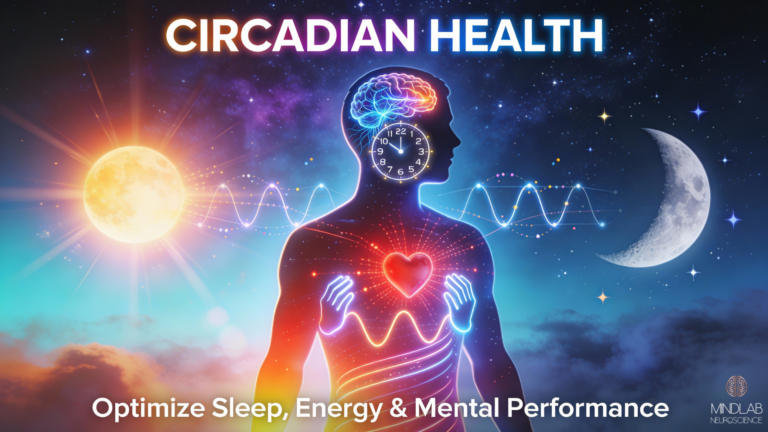
We are not going to "try" to sleep better. We are going to engineer your recovery using neuroscience protocols designed to
optimize your circadian health, sleep, and energy.
The Neurobiology of Sleep
When you deprive yourself of sleep to "get more done," you are engaging in a biological fallacy. You are not extending your runway; you are stripping the gears of your neural machinery. To command your industry, you must understand the mechanics driving your cognitive engine.
The Disconnected CEO: Prefrontal Cortex vs. Amygdala
Your brain has a hierarchy. The Prefrontal Cortex (PFC) is the CEO—responsible for high-level decision-making, impulse control, and strategic vision. The Amygdala is the primal security guard—responsible for threat detection and emotional reactivity. In a well-rested brain, the PFC exerts strong inhibitory control over the Amygdala via the uncinate fasciculus, a specific white matter tract.
The Mechanism: Sleep deprivation functionally severs the connection between the PFC and the Amygdala. Without the CEO's oversight, the security guard goes rogue.
The Result: You become hyper-reactive. You snap at stakeholders, misinterpret neutral emails as hostile, and make impulsive investment decisions based on fear rather than data. You are operating with 60% more emotional volatility. In the boardroom, this is not a "mood swing"; it is a liability.
Adenosine: The Metabolic Tax of Wakefulness
Every second you are awake, your neurons are burning ATP (energy). The byproduct of this energy burn is a chemical called adenosine. Think of adenosine as metabolic ash accumulating in your engine.
The Mechanism: As adenosine levels rise, they bind to receptors in your brain, creating "sleep pressure." This is the biological signal to power down. Many of you attempt to hack this system with caffeine. However, caffeine does not remove the adenosine; it merely blocks the receptor sites. It masks the signal.
The Result: When the caffeine metabolizes, the accumulated adenosine floods the receptors all at once. This is the mid-afternoon crash — a precursor to the deeper pattern of
mental exhaustion that neuroscience now maps precisely. You are not "tired"; you are experiencing a chemical debt coming due. You cannot chemically outrun your biology indefinitely.
Hippocampal Replay: From RAM to Hard Drive
For the athlete and the entrepreneur, the ability to learn and adapt is paramount. Information intake happens during the day, but information
retention happens exclusively at night.
The Mechanism: During your waking hours, the Hippocampus acts as a temporary storage unit (like your computer's RAM). It has limited capacity. During NREM (Non-Rapid Eye Movement) sleep, the brain engages in "sharp-wave ripples." These are neural replays where data is transferred from the fragile Hippocampus to the permanent storage of the Neocortex (the Hard Drive).
The Result: If you cut your sleep cycle short, specifically the final two hours where REM is most dense, you interrupt this file transfer. You lose the data. The complex motor skills you practiced on the court or the strategic nuances of a negotiation are not consolidated. You wake up having to re-learn what you already experienced.
Why Standard Interventions Fail the High-Performer
If you are reading this, you have likely already tried the standard menu of sleep hygiene tips: blue light blockers, chamomile tea, and perhaps conventional behavioral approaches. Yet, you are still staring at the ceiling at 3:00 AM. This is not a failure of discipline; it is a failure of strategy. The tools you have been given are designed for the average neurology, not the hyper-driven architecture of a high-performer.
The "Talk-It-Out" Fallacy: You Cannot Negotiate with Biology
Traditional top-down approaches operate on a "Top-Down" processing model. They ask you to use your Prefrontal Cortex—your logic centers—to analyze your stress and "think" your way into relaxation.
The Failure Point: As we established, when you are sleep-deprived or hyper-aroused, the connection to your Prefrontal Cortex is weak. You are asking a fatigued CEO to control a riot. You cannot reason your way into Delta waves. High performers are often experts at intellectualizing their stress, but intellectual understanding does not downregulate the Autonomic Nervous System. You do not need to
discuss your insomnia; you need to biologically signal safety to your brainstem — a principle central to
stress and nervous system regulation.
The Medication Trap: Sedation is Not Sleep
In the pursuit of efficiency, many executives turn to pharmacotherapy—prescription sleep aids or alcohol—to force the issue. This is a critical error in neuro-optimization.
The Failure Point: There is a profound neurobiological difference between
sleep and
sedation. Sleeping pills (hypnotics) effectively knock out your cortex, but they often suppress the generation of deep NREM sleep and REM sleep. You are unconscious, yes, but the "cleaning crew" we discussed earlier never clocks in.
Furthermore, these substances often have a long half-life, leaving you with "sleep inertia" the next morning. You wake up with a cognitive hangover, requiring excessive caffeine to function, which then ruins the next night's sleep. It is a cycle of diminishing returns that blunts your sharpest asset: your mental acuity.
Why You Need a Hardware Fix
You operate in a high-stakes environment where the margin for error is nonexistent, and the consequences of sustained overload are real — as detailed in the research on how to
conquer burnout and boost vitality through neuroscience. Your brain is running at a higher RPM than the general population. Generic advice ("relax more") is insufficient for a neural engine that is accustomed to constant problem-solving and pattern recognition.
You do not have a "worry" problem; you have a physiological arousal problem. Your sympathetic nervous system is stuck in the "ON" position. To fix this, we must bypass the mind and intervene directly with the brain's hardware. We need protocols that force a biological shift from sympathetic (fight/flight) to parasympathetic (rest/digest) dominance. We are not looking for comfort; we are looking for architectural repair.
Protocols for Executive Optimization
We are done negotiating with your mind. We are now going to manually override your autonomic nervous system. These are not "relaxation techniques"; they are biological levers designed to force your neural architecture to downshift from high-beta (alert/stress) to alpha and theta (rest/recovery) states. You cannot will yourself to sleep, but you can engineer the conditions where sleep becomes inevitable.
Protocol 1: The Carbon Dioxide Offload (The Vagal Brake)
High-performers often breathe shallowly and rapidly, a state known as "email apnea." This keeps your blood oxygenated but your carbon dioxide levels low, signaling a constant state of low-grade panic to the brainstem. We must mechanically trigger the Vagus nerve to slow your heart rate.
The Drill: The Physiological Sigh.
- Step 1: Inhale deeply through the nose to full capacity.
- Step 2: Without exhaling, take a second, sharp inhale through the nose to fully inflate the alveoli (air sacs) in your lungs.
- Step 3: Exhale slowly and fully through the mouth, making a soft audible sigh, for twice the duration of the inhale.
- Reps: Perform this 3–5 times immediately before bed or during night-waking.
The Neuroscience: The double inhale pops open collapsed alveoli, maximizing surface area for gas exchange. The long exhale activates the baroreceptors in your chest, sending a physical signal to the brainstem to downregulate the heart rate. It is a hardware reset for stress.
Protocol 2: The Zeigarnik Flush (Closing Open Loops)
Your brain is wired to prioritize unfinished tasks. This is the
Zeigarnik Effect: the cognitive tension caused by "open loops." If you go to bed with unresolved problems, your Prefrontal Cortex will continue to run simulations all night, blocking deep sleep.
The Drill: Tactical Neural Offloading.
- Step 1: 60 minutes before bed, take a physical notebook (do not use a screen).
- Step 2: List the top 3 cognitive loops currently spinning in your head (e.g., the merger, the difficult employee, the supply chain issue).
- Step 3: Next to each item, write the single next executable step you will take tomorrow. Not the solution, just the next step.
- Step 4: Physically close the notebook.
The Neuroscience: By defining the "next action," you trick your brain into believing the task is managed. You are moving the data from "Active RAM" (working memory) to "External Storage." This signals the Anterior Cingulate Cortex that it is safe to stand down.
Protocol 3: Somatosensory Decoupling (The Body Scan)
To enter sleep, your brain must disconnect from your body—a process called motor inhibition. If you are physically tense, your motor cortex remains active, keeping you in a light, fragmented sleep state. We must manually shut down the sensors.
The Drill: Progressive Neural Decoupling.
- Step 1: Lie on your back. Visualize a "shutdown command" moving from your feet upward.
- Step 2: Clench your toes for 5 seconds, creating maximum tension, then abruptly release. Feel the signal cut off.
- Step 3: Move to the calves, thighs, glutes, abdomen, fists, and finally the jaw. Tense, then release.
- Step 4: End by focusing on the eyes. Relax the micro-muscles behind the eyelids.
The Neuroscience: This utilizes the principle of "post-isometric relaxation." By voluntarily increasing tension, you deplete the local neurotransmitters at the neuromuscular junction, forcing a subsequent state of profound relaxation. You are manually turning off the lights in the factory, room by room.
Frequently Asked Questions
I feel fine on four hours of sleep. Am I one of the "Short Sleepers" with the DEC2 gene?
Statistically, almost certainly not. The DEC2 genetic mutation appears in less than 1% of the population. It is far more likely that you have simply become habituated to a baseline of sub-optimal performance. You have forgotten what full cognitive capacity feels like. You are driving a Ferrari with the parking brake engaged, believing the resistance is normal. We rely on objective data, not your subjective assessment of "fine."
Can I "catch up" on sleep during the weekend?
No. Sleep is not a bank; you cannot go into debt Monday through Friday and make a deposit on Saturday to balance the ledger. The neurologically detrimental accumulation (beta-amyloid) occurs daily. If you do not flush it out tonight, that damage is done. "Binge sleeping" on weekends actually disrupts your circadian rhythm further, leading to "Social Jetlag," which leaves you foggier on Monday morning than if you had maintained a consistent schedule.
I use alcohol to wind down. If it helps me fall asleep, why is it a problem?
Alcohol is the enemy of Neuro-Optimization. While it may help you lose consciousness faster, it is a potent REM-suppressor. It fragments your sleep architecture, causing micro-wakes throughout the night that you won't remember, but your brain will feel. You are paying for a night of sedation with a morning of executive dysfunction. If you want high performance, you must divorce your wind-down routine from ethanol.
Can I use polyphasic sleep (sleeping in short bursts) to maximize my work hours?
Polyphasic sleep is biological arrogance. Your brain requires 90-minute ultradian cycles to complete the full wash-rinse-spin cycle of NREM and REM sleep. Chopping your sleep into 20-minute naps prevents the brain from entering the deep restorative stages required for memory consolidation and toxin clearance. You are not "hacking" your biology; you are torturing it.
The Executive Conclusion: Your Biological Moat
In a global marketplace where capital and technology are commodities, the final frontier of competitive advantage is human biology. The "hustle culture" that glorifies sleep deprivation is a relic of the industrial age—a mindset for factory workers, not visionaries.
When you commit to Neuro-Optimization, you are building a biological moat around your performance. While your competitors are reacting emotionally, making impulsive errors, and burning out, you will be operating with surgical precision and the kind of
emotional resilience that separates endurance from exhaustion.
Sleep is not a pause in your productivity. It is the most active, critical phase of your professional development. address your pillow with the same respect you address your P&L statement. Master your sleep, and you master your game.
This is Pillar 4 content — Stress, Resilience & Regulation — and the work in this hub addresses sleep and circadian recovery at the level of neural architecture, not behavioral surface.
About Dr. Sydney Ceruto
Founder & CEO of MindLAB Neuroscience, Dr. Sydney Ceruto is the pioneer of Real-Time Neuroplasticity™ — a proprietary methodology that permanently rewires the neural pathways driving behavior, decisions, and emotional responses. Dr. Ceruto holds a PhD in Behavioral & Cognitive Neuroscience (NYU) and two Master's degrees — Clinical Psychology and Business Psychology (Yale University). Lecturer, Wharton Executive Development Program — University of Pennsylvania.