Key Points
- Major life transitions trigger a neural reorganization period where the brain is exceptionally receptive to permanent structural change.
- Without guided intervention, the brain defaults to threat-based wiring that prioritizes survival over growth.
- Real-Time Neuroplasticity™ works during the live consolidation window, not after patterns have already hardened.
- Identity, decision-making capacity, and emotional regulation all restructure simultaneously during major transitions.
- Dr. Ceruto’s methodology produces permanent architectural change, eliminating the need for ongoing maintenance or coping strategies.
| Marker | Traditional Approach | Neuroscience-Based Approach | Why It Matters |
|---|---|---|---|
| Approach | Conventional Support | Self-Directed Adaptation | Real-Time Neuroplasticity™ |
| Timing | After patterns solidify | Reactive, unstructured | During the neural consolidation window |
| Target | Emotional coping | Surface-level habit changes | Neural pathway architecture |
| Duration of results | Requires ongoing maintenance | Inconsistent, often temporary | Permanent structural rewiring |
| Identity integration | Narrative processing only | Trial and error | Guided neural identity reconstruction |
| Personalization | Protocol-based frameworks | Generic advice and books | Mapped to your specific neural patterns |
Why Life Transition Navigation Matters in Bergen County
Why Bergen County Transitions Carry Generational Weight
Bergen County, New Jersey is home to over 950,000 residents spread across communities that rank among the most affluent and educationally competitive in the northeast. Towns like Ridgewood, Tenafly, Alpine, Demarest, and Englewood Cliffs attract families who invest deeply in community infrastructure — school systems, sports programs, religious institutions, and social networks that span decades.
This investment creates a powerful identity architecture. The brain wires itself around the school district, the neighborhood, the daily schedule, the professional identity that funds it all. When a major transition disrupts any component of this structure, the neurological impact extends far beyond the specific event. The brain treats it as a systemic threat because in Bergen County, these systems are genuinely interconnected.
The Palisades communities — Alpine, Cresskill, Closter — house some of the highest-value residential properties in New Jersey. The commuting professionals who live in these towns built family lives around a specific economic model. When a career transition, a divorce, or a health event disrupts that model, the brain’s entire operating framework destabilizes. The George Washington Bridge, which connects Bergen County to Manhattan, carries more than vehicles. It carries the daily rhythm that organizes thousands of professional identities.
The Family-Centered Transition Challenge
Bergen County’s demographics skew toward established families with school-age children. Transitions here often carry a parental dimension that compounds the individual neurological burden. A divorce in Ridgewood involves not just the adults but the children’s school community, the sports leagues at Saddle River County Park, and the social fabric of a town where family identity is public.
The prefrontal cortex — responsible for planning and decision-making — faces an impossible dual load: managing your own transition while protecting your children’s stability. Cortisol rises. Sleep quality degrades. Decision-making narrows to short-term survival. These responses are predictable neuroscience, not personal failure. But the Bergen County environment, with its emphasis on competence and composure, provides no framework for acknowledging them. The school hallways of Tenafly, the youth sports sidelines in Demarest, and the community events in Englewood Cliffs all become environments where the transition is visible but unspoken.
How Dr. Ceruto Works With Bergen County Transitions
Dr. Ceruto’s Real-Time Neuroplasticity™ methodology provides structured intervention during the consolidation window when the brain is forming new patterns. For Bergen County residents, this means the neural architecture that emerges from a transition gets guided direction rather than defaulting to threat-based wiring under community pressure.
The work is conducted by phone, offering complete privacy in communities where social visibility is high. Dr. Ceruto addresses the identity systems that Bergen County’s environment builds so effectively. The parental role architecture, professional identity circuits, and community belonging patterns all get restructured to accommodate the new reality without collapsing.

From the corporate professionals in Tenafly and Alpine to the families anchored in Ridgewood’s school system to the established residents of Englewood Cliffs and Demarest, Bergen County transitions carry stakes that span generations. Dr. Ceruto’s methodology works at the level where both personal identity and family stability originate, producing permanent structural change that holds under the unique pressures of this community.

Dr. Sydney Ceruto, PhD — Founder & CEO, MindLAB Neuroscience
Dr. Ceruto holds a PhD in Behavioral & Cognitive Neuroscience from NYU and two Master’s degrees from Yale University. She lectures at the Wharton Executive Development Program at the University of Pennsylvania and has been an Executive Contributor to the Forbes Coaching Council since 2019. Dr. Ceruto is the author of The Dopamine Code (Simon & Schuster, June 2026). She founded MindLAB Neuroscience in 2000 and has spent over 26 years pioneering Real-Time Neuroplasticity™ — a methodology that permanently rewires the neural pathways driving behavior, decisions, and emotional responses.
Success Stories
“I'd optimized everything — diet, fitness, sleep — but my cognitive sharpness was quietly declining and no one could explain why. Dr. Ceruto identified the synaptic density patterns that were thinning and built a protocol to reverse the trajectory. This wasn't prevention in theory. My neuroplasticity reserve is measurably stronger now than it was three years ago. Nothing I'd tried before even addressed the right problem.”

“Dr. Ceruto's methodology took me from a founder on the verge of quitting to a leader capable of building the team and culture that drove Liquid IV's success. Her ability to restructure how I make decisions and lead under pressure changed the trajectory of the entire company. I don't say that lightly. The company I built after working with her was fundamentally different from the company I was building before — because I was fundamentally different.”

“Four hours a night for over two years — that was my ceiling. Supplements, sleep protocols, medication — nothing touched it because nothing addressed why my brain wouldn't shut down. Dr. Ceruto identified the cortisol loop that was keeping my nervous system locked in a hypervigilant state and dismantled it. I sleep now. Not because I learned tricks — because the pattern driving the insomnia no longer exists.”

Identifying details withheld to protect client confidentiality.
All outcomes represent genuine engagements with Dr. Ceruto.
Frequently Asked Questions About Life Transition Navigation
What qualifies as a major life transition?
Any event that fundamentally disrupts your established patterns, identity, or direction. Divorce, career changes, family restructuring, empty nest, loss of a spouse or parent, health events, relocation, or retirement. The defining feature is that the brain’s existing wiring no longer matches current reality.
Why do transitions feel so overwhelming when I have a strong support system in Bergen County?
Because community support and neurological processing are different systems. Your friends and neighbors provide emotional comfort, but the brain’s identity architecture requires structural intervention to reorganize. Bergen County’s close communities can also add pressure — the visibility of your transition within a tight social network keeps the brain’s threat-detection system activated.
How does Real-Time Neuroplasticity™ work during a transition?
Dr. Ceruto identifies the neural patterns consolidating during your transition and intervenes while they are still forming. The methodology works in the live window when the brain is most receptive to permanent change, ensuring new wiring supports clarity and agency rather than survival defaults.
What does the Strategy Call involve?
A focused phone conversation with Dr. Ceruto. She maps the neural mechanisms driving your current experience and determines whether her methodology is the right fit. The call costs $250 and uses a phone-only format — eliminating visual stimuli activates deeper processing pathways and produces greater clarity.
Is this confidential?
Absolutely. All sessions are conducted by phone — no office visits, no waiting rooms, no encounters in shared spaces. No client information is ever disclosed. For Bergen County residents navigating transitions within tight-knit communities, this structural privacy is fundamental.
How long does the process take?
Duration depends on the transition’s complexity. Single-domain changes often produce measurable shifts within weeks. Multi-layered transitions involving family, career, and community dynamics may require longer engagement. Program structure and investment details are discussed during the Strategy Call.
Can this help if my transition involves my children’s stability?
Yes. Parental transitions activate specific neural systems — protective circuits, future-projection anxiety, and identity patterns tied to the caregiving role. Dr. Ceruto’s methodology addresses these layers. A parent whose neural architecture is stable and clear provides better stability for their children than a parent running on cortisol and survival instincts.
Is this relevant for someone approaching retirement from a demanding career?
Very much so. The brain builds decades of identity architecture around professional function. Retirement removes those inputs without providing replacement structure. In Bergen County, where professional identity is deeply tied to community standing, the transition carries additional social dimensions. Dr. Ceruto rebuilds the identity architecture for the next chapter.
How is this different from conventional approaches?
Conventional approaches focus on emotional processing after patterns have formed. Dr. Ceruto’s methodology works during the consolidation window at the level of neural architecture, producing permanent structural change rather than coping strategies that require ongoing repetition.
Do I need to be located in Bergen County?
No. All sessions are conducted by phone. MindLAB Neuroscience serves clients globally. The Bergen County content reflects the community dynamics that shape transitions in this region, but the methodology applies regardless of location.
Also available in: Miami · Wall Street · Midtown Manhattan · Beverly Hills · Lisbon
Take the First Step
The Strategy Call is a focused conversation with Dr. Ceruto that maps the specific neural mechanisms driving your concerns and determines the right path forward.
Book a Strategy Call
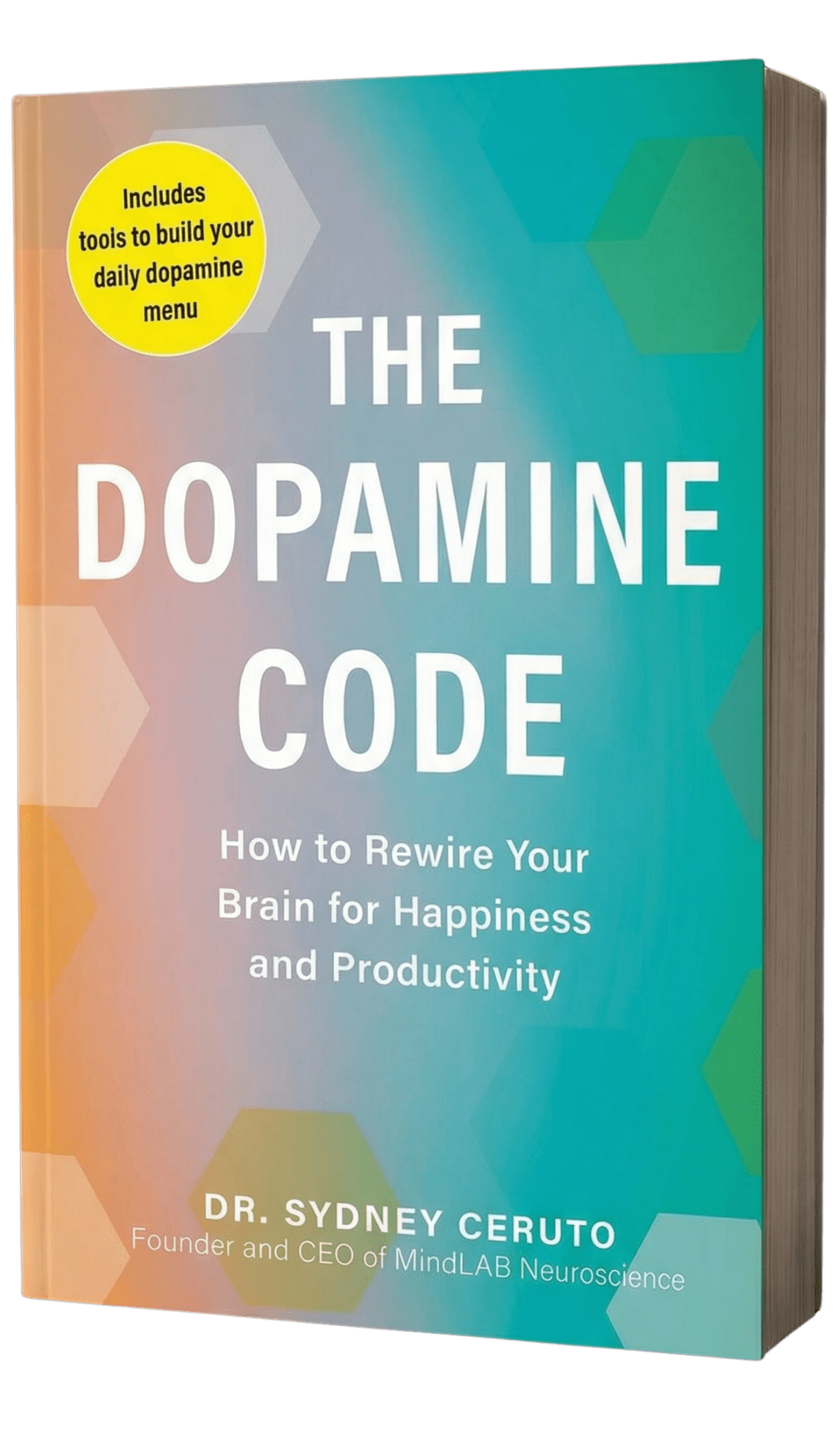
The Dopamine Code
Decode Your Drive
Why Your Brain Rewards the Wrong Things
Your brain's reward system runs every decision, every craving, every crash — and it was never designed for the life you're living. The Dopamine Code is Dr. Ceruto's framework for understanding the architecture behind what drives you, drains you, and keeps you locked in patterns that willpower alone will never fix.
Published by Simon & Schuster, The Dopamine Code is Dr. Ceruto's framework for building your own Dopamine Menu — a personalized system for motivation, focus, and enduring life satisfaction.
Order NowShips June 9, 2026