





Stress Response Recalibration in Bergen County

Bergen County offers the aesthetic of ease without the neurological relief. The stress load that followed transplants south is still running — at the HPA axis level, the backdrop is irrelevant.

There is a point at which stress stops being a response to difficult circumstances and starts being a default state. The transition is gradual and almost invisible: the pressure remains high for long enough that the nervous system stops treating it as an emergency and starts treating it as the environment. The brain recalibrates. What was once the alarm becomes the baseline. Stressed stops feeling like a response to something and starts feeling like who you are.

At MindLAB Neuroscience, I work with people whose stress-response system has been running at elevated activation for so long that the brain has reset its definition of normal. The goal is not to teach coping strategies for a system that is functioning correctly under difficult conditions. The work targets the recalibration itself — restoring the stress-response architecture to a baseline that reflects present-tense reality, not the accumulated history of sustained pressure.

Book a Strategy Call
ForbesUSA TodayHuffPostNewsweekAssociated PressCosmopolitanBusiness InsiderForbesUSA TodayHuffPostNewsweekAssociated PressCosmopolitanBusiness Insider

Key Points

  1. When the system activates, it produces a cascade of hormones, most prominently cortisol — the body's primary stress hormone , that mobilize energy, sharpen certain kinds of attention, and prepare the body for sustained effort.
  2. The brain and body have a built-in system for responding to threat and demand — the HPA axis — the hypothalamic-pituitary-adrenal system that governs the body's stress response .
  3. The HPA axis operates with a feedback mechanism: cortisol signals the brain that the stress response is running, and under normal conditions, this signal dampens the activation once the demand has passed.
  4. This is the dopamine dimension of stress recalibration — the reconnection between the effort being made and the experience of it as meaningful.
  5. This is not depression in the clinical sense — it is the reward circuitry running on depleted substrate.
  6. Calm does not feel rewarding because the reward circuitry has calibrated its expectations to stress-state inputs.
  7. When the HPA axis recalibrates — when the feedback loop's sensitivity is restored and cortisol returns to a rhythm that reflects present-tense demand rather than accumulated stress history — the changes are not dramatic in their presentation.

When the Alarm Becomes the Baseline

“The person sitting across from you is more fully present in your awareness because your brain is no longer running the activation load that was crowding them out.”

The brain and body have a built-in system for responding to threat and demand — the HPA axis — the hypothalamic-pituitary-adrenal system that governs the body’s stress response. When the system activates, it produces a cascade of hormones, most prominently cortisol — the body’s primary stress hormone, that mobilize energy, sharpen certain kinds of attention, and prepare the body for sustained effort. This is the stress response, and under normal conditions, it is adaptive. The problem is not the activation. It is what happens when activation becomes chronic.

The HPA axis operates with a feedback mechanism: cortisol signals the brain that the stress response is running, and under normal conditions, this signal dampens the activation once the demand has passed. The system returns to baseline. With chronic stress — sustained activation across months or years — this feedback loop becomes less sensitive. The dampening signal that should produce recovery is less effective. The baseline rises. The system runs hotter as its new normal, and what previously felt like high stress now feels neutral. This is HPA axis dysregulation: the stress-response architecture has been recalibrated by extended use.

This matters because the recalibration is structural. It is not about mindset, resilience, or perspective. The brain’s threat-response system has genuinely changed its operating parameters. The person who tells you they perform better under pressure, or that they do not feel stressed anymore, may not be reporting a coping success. They may be reporting that the alarm has been running so long that they can no longer hear it — not because the alarm has stopped, but because the brain has adjusted its perception threshold to accommodate the constant noise.

What Chronic Cortisol Elevation Actually Does

The cortisol cascade was not designed for extended deployment. Its effects are specific and time-limited in intent. When it runs continuously, those effects compound in ways that reach every system in the body and brain.

Sleep is typically the first casualty. Cortisol follows a diurnal rhythm — it should be highest in the early morning to provide alertness and lowest at night to allow recovery. When the HPA axis is dysregulated, this rhythm flattens or inverts: elevated cortisol at night disrupts the sleep architecture that would allow the system to recover, which sustains the dysregulation into the following day. The person wakes tired, manages the day on elevated cortisol, and arrives at sleep onset in an activation state that prevents the recovery the next day requires. This cycle is self-sustaining once established.

Cognitive function changes in specific ways. The regions of the brain responsible for complex decision-making, working memory, and long-term planning are sensitive to sustained cortisol elevation. Attention becomes more reactive and less sustained — faster to respond to immediate demands, less capable of sustained focus on anything that does not feel urgent. The narrowing of attention that serves acute stress is maladaptive for the kind of thinking that complex professional and personal situations require. Judgment under chronic stress is not the same as judgment at baseline.

The brain’s reward circuitry is significantly affected by sustained cortisol elevation. Dopamine — the neurotransmitter central to motivation, anticipation, and the experience of satisfaction — is depleted under chronic stress conditions. The person who used to feel genuine pleasure from professional achievement, creative work, or personal connection finds that the signals are muted. The work gets done, but the satisfaction does not arrive. Motivation requires effort that was not previously necessary. This is not depression in the clinical sense — it is the reward circuitry running on depleted substrate. The fuel for feeling rewarded is gone because the stress response has been consuming it.

The Recalibration Problem

The most significant obstacle to addressing chronic stress is that the recalibrated baseline has been accepted as reality. The person who has been running at elevated activation for three years does not have a clear recent memory of what a genuine baseline state feels like. Calm, when it briefly appears, reads as suspicious — as the moment before something goes wrong, not as the appropriate resting state. The absence of crisis does not register as safety. It registers as a gap in the problem-monitoring.

This creates a specific trap. The environments and habits that the elevated baseline has normalized — the perpetual checking, the inability to disengage from work in evenings, the difficulty fully inhabiting leisure, the body that remains braced through a holiday — do not feel like symptoms of dysregulation. They feel like appropriate responses to a world that demands constant readiness. The case for maintaining the activation feels rational because the world is genuinely demanding and the elevated system has been managing those demands. The cost of the elevated system is paid in the domains where vigilance is not useful: sleep, intimate relationships, creative thinking, physical health, and any experience that requires the capacity to simply be present.

There is also a hormonal habituation element. The dopamine system that provides motivation and reward becomes accustomed to the cortisol-driven activation state. Calm does not feel rewarding because the reward circuitry has calibrated its expectations to stress-state inputs. The absence of pressure does not produce relief — it produces flatness. This can drive the person back toward high-activation situations not because they want to be stressed but because the recalibrated reward system has associated stimulation with the only version of engagement that feels real.

What Recalibration Actually Requires

Stress management techniques address the output of HPA axis dysregulation. They reduce symptoms at the level of experience without changing the architectural state that produces those symptoms. They are useful. They are not the same as recalibration. The difference is the difference between managing a thermostat that is set wrong and resetting the thermostat.

Actual recalibration requires engaging the brain systems responsible for the feedback loop that controls HPA axis activation — specifically, rebuilding the sensitivity of the dampening mechanism that is supposed to signal the stress response to stand down. This is not metaphorical. The feedback loop’s insensitivity is a concrete neurological state that changes under specific conditions. Those conditions require working at the level of the brain’s stress-architecture directly — not at the level of behavior, schedule management, or symptom reduction, though all of those may be part of a complete approach.

Neuroscience consultation — rosewood table with crystal brain sculpture and branded journal for strategy call preparation

The work also requires confronting the recalibrated baseline directly — examining what the nervous system has been encoding as normal, what genuine rest and recovery feel like compared to the current experience of downtime, and what the brain is doing with the brief intervals between demands. People who have been running at elevated activation for years are often surprised to discover that what they experience as calm is still a significantly activated state by any objective measure. That gap — between the subjectively experienced rest state and the neurologically measured activation level — is the target.

What Becomes Possible When the Baseline Drops

When the HPA axis recalibrates — when the feedback loop’s sensitivity is restored and cortisol returns to a rhythm that reflects present-tense demand rather than accumulated stress history — the changes are not dramatic in their presentation. They are mundane in a way that is profound: sleep deepens. Waking does not immediately involve a to-do list assembling itself. The gap between finishing work and genuinely disengaging from it shortens. Food tastes better. Music reaches further. The person sitting across from you is more fully present in your awareness because your brain is no longer running the activation load that was crowding them out.

The reward circuitry that was depleted by sustained cortisol elevation begins to recover. Work that was being done but not felt becomes satisfying again. The motivation that required discipline and effort becomes more intrinsic. This is the dopamine dimension of stress recalibration — the reconnection between the effort being made and the experience of it as meaningful.

If the description of a stress response that has been running so long you cannot hear the alarm anymore is recognizable — if stressed has become who you are rather than how you feel — a Strategy Call is the right first step. One hour, by phone, to examine what the baseline actually looks like and what recalibrating it would involve.


Marker What You Experience What's Happening Neurologically What We Restructure
How the Stress Alarm Becomes the Baseline State The person who tells you they perform better under pressure, or that they do not feel stressed anymore, may not be reporting a coping success — they may be reporting that the stress response has become their new normal, with the original resting state no longer accessible for comparison The HPA axis operates with a feedback mechanism: cortisol signals the brain that the stress response is running, and under normal conditions, this signal dampens the activation once the demand has passed. Extended high-demand periods degrade the feedback sensitivity This is HPA axis dysregulation: the stress-response architecture has been recalibrated by extended use — the target is restoring the feedback sensitivity of the dampening mechanism so the system can return to baseline after demand passes, rather than remaining in a persistent activation state
What Chronic Cortisol Elevation Does to the Brain Attention becomes more reactive and less sustained — faster to respond to immediate demands, less capable of sustained focus on anything that does not feel urgent. The brain's reward circuitry is significantly affected by sustained cortisol elevation. Cognitive function changes in specific ways.
Recalibration Problem The person who has been running at elevated activation for three years does not have a clear recent memory of what a genuine baseline state feels like. The dopamine system that provides motivation and reward becomes accustomed to the cortisol-driven activation state. The most significant obstacle to addressing chronic stress is that the recalibrated baseline has been accepted as reality.
What Recalibration Actually Requires They reduce symptoms at the level of experience without changing the architectural state that produces those symptoms — which is why the relief is temporary and the baseline, once removed, returns to its prior level Actual recalibration requires engaging the brain systems responsible for the feedback loop that controls HPA axis activation — specifically, rebuilding the sensitivity of the dampening mechanism that is supposed to signal the stress response to deactivate once demand resolves Restoring the cortisol feedback loop's sensitivity so the HPA axis completes its activation cycle rather than sustaining it — building the neural infrastructure that allows stress activation to be proportionate to present demand rather than locked at a recalibrated chronic elevation
Becomes Possible When the Baseline The person sitting across from you is more fully present in your awareness because your brain is no longer running the activation load that was crowding them out. The reward circuitry that was depleted by sustained cortisol elevation begins to recover. When the HPA axis recalibrates — when the feedback loop's sensitivity is restored and cortisol returns to a rhythm that reflects present-tense demand rather than accumulated stress history — the changes are not dramatic in.

Why Stress Response Recalibration Matters in Bergen County

Stress Response Recalibration in Bergen County, New Jersey

The Bergen County stress profile carries a specific signature created by the GW Bridge corridor's unpredictability. Unlike the Metro-North commuters whose stress follows a predictable schedule, the Bergen County commuter's stress-response system has been trained on variability — the bridge may add fifteen minutes or seventy-five minutes to the commute on any given day. This unpredictability trains the HPA axis to maintain elevated readiness rather than calibrating to a predictable demand cycle. The stress-response system's set point has shifted upward because the environment has taught it that readiness must accommodate the worst case, not the average case.

The allostatic load specific to Bergen County's commuter corridor is compounded by the property tax stress that the state's tax structure imposes. New Jersey's property taxes are among the highest in the nation, and Bergen County's affluent communities — Tenafly, Ridgewood, Demarest, Closter — carry tax burdens that generate a fixed financial stress floor regardless of career performance. The brain's stress-response system processes this structural financial obligation as a permanent background threat that the current income must continuously cover.

The cultural dimension adds a stress-response variant in Bergen County's diverse communities. The first-generation professional carrying the expectations of the extended family, the immigrant entrepreneur managing business stress within a cultural framework that does not normalize mental health support, the bicultural individual managing stress across two cultural contexts with different expectations about how stress should be processed and expressed — each carries a stress architecture shaped by cultural variables that the dominant suburban stress profile does not capture.

My work addresses stress-response recalibration at the HPA axis level — the set point that Bergen County's unpredictable commuter corridor has elevated, the financial stress floor that the property tax structure maintains, the cultural stress architectures that the county's diverse communities carry, and the conditions under which the stress-response system can be recalibrated to produce adaptive rather than chronic activation.

Dr. Sydney Ceruto, PhD — Founder, MindLAB Neuroscience

Dr. Sydney Ceruto, PhD — Founder & CEO, MindLAB Neuroscience

Dr. Ceruto holds a PhD in Behavioral & Cognitive Neuroscience from NYU and two Master’s degrees from Yale University. She lectures at the Wharton Executive Development Program at the University of Pennsylvania and has been an Executive Contributor to the Forbes Coaching Council since 2019. Dr. Ceruto is the author of The Dopamine Code (Simon & Schuster, June 2026). She founded MindLAB Neuroscience in 2000 and has spent over 26 years pioneering Real-Time Neuroplasticity™ — a methodology that permanently rewires the neural pathways driving behavior, decisions, and emotional responses.

References

McEwen, B. S. (2007). Physiology and neurobiology of stress and adaptation: Central role of the brain. *Physiological Reviews*, 87(3), 873–904. https://doi.org/10.1152/physrev.00041.2006

Ulrich-Lai, Y. M., & Herman, J. P. (2009). Neural regulation of endocrine and autonomic stress responses. *Nature Reviews Neuroscience*, 10(6), 397–409. https://doi.org/10.1038/nrn2647

Sapolsky, R. M., Romero, L. M., & Munck, A. U. (2000). How do glucocorticoids influence stress responses? Integrating permissive, suppressive, stimulatory, and preparative actions. *Endocrine Reviews*, 21(1), 55–89. https://doi.org/10.1210/edrv.21.1.0389

Doom, J. R., & Gunnar, M. R. (2013). Stress physiology and developmental psychopathology: Past, present, and future. *Development and Psychopathology*, 25(4pt2), 1359–1373. https://doi.org/10.1017/S0954579413000667

Success Stories

“Four hours a night for over two years — that was my ceiling. Supplements, sleep protocols, medication — nothing touched it because nothing addressed why my brain wouldn't shut down. Dr. Ceruto identified the cortisol loop that was keeping my nervous system locked in a hypervigilant state and dismantled it. I sleep now. Not because I learned tricks — because the pattern driving the insomnia no longer exists.”

Adrian M. — Hedge Fund Manager New York, NY

“Willpower, accountability systems, cutting up cards — none of it worked because none of it addressed what was actually driving the behavior. Dr. Ceruto identified the reward prediction error that had been running my purchasing decisions for over a decade. Once the loop was visible, it lost its power. The compulsion didn't fade — it stopped.”

Priya N. — Fashion Executive New York, NY

“I'd relocated internationally before, but this time my nervous system wouldn't settle. Everything unfamiliar registered as danger — new people, new routines, even the sound of a different language outside my window. Pushing through it only deepened the pattern. Dr. Ceruto identified that my nervous system was coding unfamiliarity itself as threat and restructured the response at its source. The world stopped feeling hostile. I stopped bracing.”

Katarina L. — Gallerist Zurich, CH

“My communication was damaging every relationship in my professional life and I couldn't see it. Dr. Ceruto's neuroscience-based approach didn't just improve how I communicate — it rewired the stress response that was driving the pattern in the first place. The people around me noticed the change before I fully understood what had happened. That tells you everything.”

Bob H. — Managing Partner London, UK

“Anxiety and depression had been running my life for years. Dr. Ceruto helped me see them not as permanent conditions but as neural patterns with identifiable roots. Once I understood the architecture, everything changed.”

Emily M. — Physician Portland, OR

“My kids had been sleeping through the night for three years, but my brain hadn't caught up. I was still waking every ninety minutes like clockwork — no amount of sleep hygiene or supplements touched it. Dr. Ceruto identified the hypervigilance loop that had hardwired itself during those early years and dismantled it at the source. My brain finally learned the threat was over. I sleep through the night now without effort.”

Catherine L. — Board Director Greenwich, CT

“Three months. That's how long it took to go from debilitating panic to leading with clarity. Years of conventional approaches hadn't moved the needle — Dr. Ceruto identified the root neural pattern and eliminated it. She didn't teach me to manage the panic. She made it unnecessary. I didn't know that was possible.”

Ella E. — Media Executive Manhattan, NY

“Endocrinologists, sleep clinics, functional medicine — every specialist cleared me, and no one could tell me why I was exhausted every single day. Dr. Ceruto identified that my HPA axis was locked in a low-grade stress activation I couldn't feel consciously. Once that pattern was disrupted at the neurological level, my energy came back in a way that felt completely foreign. I'd forgotten what it was like to not be tired.”

Danielle K. — Luxury Hospitality Beverly Hills, CA

“The moment two priorities competed for bandwidth, my attention collapsed — and I'd convinced myself my brain was fundamentally broken. Dr. Ceruto identified the specific attentional pattern that was causing the collapse and restructured it. My prefrontal cortex wasn't broken. It was misfiring under competing demands. Once that pattern changed, everything I was trying to hold together stopped requiring so much effort.”

Rachel M. — Clinical Researcher Boston, MA

Frequently Asked Questions About Stress Response Recalibration

What is stress response recalibration — is it different from stress management?

Yes, meaningfully different. Stress management addresses the output of a stress-response system — reducing symptoms, improving coping, building practices that make sustained stress more tolerable. Those things have genuine value. Recalibration targets the architecture itself: the HPA axis feedback loop that has been recalibrated by extended stress exposure so that the elevated activation state has become the brain's definition of normal. The goal is not to manage a system that is set wrong. It is to reset the system — to restore the baseline so that recovery, genuine rest, and the full range of cognitive and emotional function become neurologically accessible again, not just theoretically possible.

How do I know if my stress response has been recalibrated, versus just being under a lot of pressure?

The distinguishing marker is what happens when the pressure drops. Under normal HPA axis function, reducing external demand produces genuine recovery — the system returns toward baseline and the rest state is qualitatively different from the activated state. When the axis has been recalibrated, reducing external demand does not produce recovery. The baseline does not drop. Calm feels suspicious rather than restful. The absence of pressure feels like a gap in the problem-monitoring. Vacations do not refresh — they feel like activation events with different content. If your off periods feel subjectively identical to your on periods, the system is not responding to the reduction in demand. That is recalibration, not situation.

What does cortisol have to do with how I'm feeling day to day?

Cortisol is the primary mechanism through which the stress-response system produces its effects throughout the body and brain. At appropriate levels and rhythms, it governs morning alertness, energy regulation, immune function, and the body's ability to manage inflammation. When it runs at elevated levels for extended periods, it disrupts sleep architecture, narrows cognitive function toward reactive attention and away from sustained planning, depletes the neurotransmitter systems responsible for motivation and reward, suppresses immune and digestive function, and maintains the body in a mobilized state that was designed for short-term use. The daily experience of feeling tired but wired, functional but not satisfied, competent but not present — these are the signature of a cortisol system that has been running above its intended operating range for too long.

Why has everything I used to enjoy stopped feeling rewarding?

Sustained cortisol elevation depletes the dopaminergic systems responsible for motivation, anticipation, and the experience of reward. When the stress response runs at elevated baseline for months or years, the reward circuitry — which requires a neurochemical environment that chronic stress disrupts — loses its ability to register and sustain the signals that make effort feel meaningful and achievement feel satisfying. The work is still being done. The dopamine signal that would make it feel worthwhile is running on depleted substrate. This is not a crisis of values or a problem with your goals. It is a predictable consequence of what chronic cortisol elevation does to the reward architecture. It reverses when the architecture is addressed.

Can chronic stress cause physical symptoms even if I am not consciously feeling anxious?

Yes. The HPA axis dysregulation that produces recalibrated baseline stress does not require the subjective experience of anxiety to produce its physical effects. Sustained cortisol elevation disrupts sleep quality regardless of whether the person reports feeling anxious. Muscle tension, gut irregularity, suppressed immune response, disrupted inflammatory regulation — these are physiological consequences of the hormonal state, not of the subjective experience. Many people who have been running at elevated baseline for years do not identify as stressed because their subjective threshold for what stress feels like has risen with the baseline. The body is carrying the physiological load while the brain has stopped registering it as abnormal.

I've been told I perform better under pressure. Doesn't that mean my stress level is working for me?

Some kinds of performance do improve under moderate stress-system activation — reactive attention sharpens, energy mobilizes, short-term output can intensify. This is the adaptive function the stress response was built for. What chronic stress does not improve — and consistently degrades — is the kind of performance that requires sustained focus, complex judgment, creative thinking, accurate risk assessment, and the long-term perspective that distinguishes strategic decision-making from tactical reaction. The profile of someone who performs better under pressure is often the profile of someone whose cognitive function has adapted to a depleted baseline — functioning at a level that feels high-performance but has a lower ceiling than the same person would have at genuine neurological baseline.

Will addressing my stress response change how I function professionally?

It will change how the function feels and expand its range. The reactive attention and urgency-responsiveness that elevated cortisol produces do not disappear when the baseline drops — they become more selectively available rather than the only operating mode. What tends to return is the capacity for extended focus, for genuine strategic thinking, for accurately calibrated risk judgment, and for the kind of motivated engagement where the work itself is rewarding rather than requiring constant external pressure to sustain. Most people who do this work find that their professional performance does not decrease. Their range expands and the cost of sustaining it drops significantly.

Why do I feel flat even when things are going well?

Flatness during objectively positive circumstances is a specific signature of dopamine system depletion under chronic cortisol. The reward circuit is built to produce anticipatory activation before a positive event and a satisfaction signal when the event occurs. Both signals require an intact dopaminergic substrate. When that substrate has been depleted by sustained stress, the signals do not fire with their intended intensity. The event occurs. The brain registers its objective characteristics. The rewarding feeling does not arrive proportionately. This reads subjectively as flatness, ingratitude, or a sense that something is wrong with you — none of which is accurate. The circuit is depleted, not broken. It recovers when the conditions that are depleting it are addressed.

How long does it take for a chronically elevated stress baseline to return to normal?

There is no single answer because the timeline depends on how long the activation has been sustained, what neural systems have been most affected, what the person's current environmental demands are, and what the work actually engages. What is consistent is that the return requires active work at the architectural level — the baseline does not drop because external circumstances improve. It drops because the HPA axis feedback loop's sensitivity is restored and the brain's threat-assessment system is recalibrated to current-tense reality rather than accumulated stress history. Some people notice meaningful baseline shifts in a matter of weeks. Full recalibration of a system that has been running elevated for years typically takes longer. Precision about the individual pattern is what a Strategy Call provides.

What does a Strategy Call involve for chronic stress?

A Strategy Call is a one-hour phone conversation — $250, no commitment beyond that. We examine your specific pattern: how long the elevated activation has been running, what domains it is most affecting, what genuine baseline you have access to versus what you are experiencing as rest, and what the HPA axis recalibration would actually require in your case. Chronic stress looks different depending on its origin — professional demand, sustained uncertainty, compounded life events, or the accumulated activation of a high-pressure environment over years. The picture that emerges from an hour of precise examination shapes what the work would target and whether the fit for deeper engagement is there.

Also available in: Miami · Wall Street · Midtown Manhattan · Beverly Hills · Lisbon

Take the First Step

The Strategy Call is a focused conversation with Dr. Ceruto that maps the specific neural mechanisms driving your concerns and determines the right path forward.

Book a Strategy Call
MindLAB Neuroscience consultation room

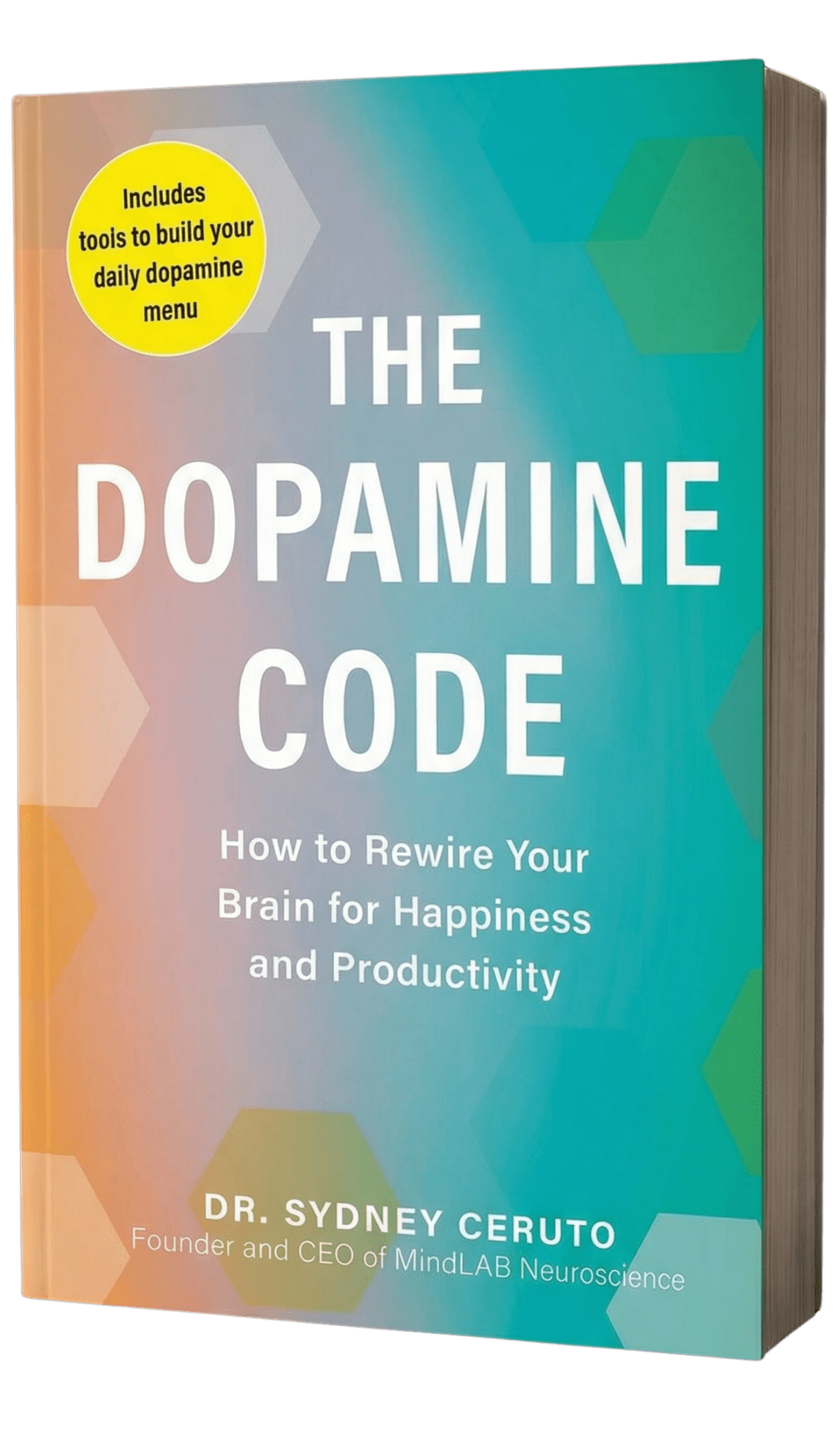
The Dopamine Code

Decode Your Drive

Why Your Brain Rewards the Wrong Things

Your brain's reward system runs every decision, every craving, every crash — and it was never designed for the life you're living. The Dopamine Code is Dr. Ceruto's framework for understanding the architecture behind what drives you, drains you, and keeps you locked in patterns that willpower alone will never fix.

Published by Simon & Schuster, The Dopamine Code is Dr. Ceruto's framework for building your own Dopamine Menu — a personalized system for motivation, focus, and enduring life satisfaction.

Order Now

Ships June 9, 2026

The Dopamine Code by Dr. Sydney Ceruto — Decode Your Drive
Locations

The Intelligence Brief

Neuroscience-backed analysis on how your brain drives what you feel, what you choose, and what you can’t seem to change — direct from Dr. Ceruto.