Business Management Consultant in Beverly Hills

Beverly Hills' most consequential leadership and organizational challenges demand more than management frameworks — they demand the neuroscience of how leaders think, decide, and transform.

The Beverly Hills and Century City corridor is one of the most management-consultant-dense markets in the United States, with offices of Bain, BCG, and boutique advisory firms serving institutional clients at engagement fees that start in six figures. Yet none of these firms address the individual leader's cognitive architecture — the prefrontal, limbic, and reward systems that determine how strategy is actually processed, how change is resisted or adopted, and how leadership teams succeed or fail at the neural level. Dr. Sydney Ceruto brings a fundamentally different approach to business management consulting: one grounded in peer-reviewed neuroscience, designed for individual senior leaders and their teams, and focused on restructuring the brain systems where organizational outcomes originate.
Schedule a Strategy Call

Executive Coaching

The prefrontal cortex maintains goal representations, supports flexible goal-directed behavior over habitual responding, and mediates the working memory, interference resistance, and strategic planning that define executive effectiveness. Friedman and Robbins (2021) in Neuropsychopharmacology established that these functions are not fixed traits but trainable competencies with identifiable neural substrates — and that better performance on executive control tasks correlates with larger PFC volume and greater PFC thickness. Frisina (2024) in Frontiers in Health Services Management confirmed that integrating neuroscience into executive development significantly increases effectiveness by targeting the PFC through interactive and experiential engagement. Spence and colleagues (2023) found that 75% of professionals showed gains on a validated BrainHealth Index after structured brain health training, with significant reductions in emotional exhaustion (p=0.003) and depersonalization (p=0.016). I work with the prefrontal cortex directly — restoring and strengthening the neural architecture that executive performance demands — rather than providing accountability frameworks that assume a fully functioning brain that chronic professional stress has often degraded.

Learn more about Executive Coaching in Beverly Hills →

Leadership Development

Neuroleadership represents the convergence of neuroscience and leadership science into a discipline that produces measurably superior outcomes. Ruiz-Rodríguez and colleagues (2023) in Humanities and Social Sciences Communications conducted a bibliometric analysis of 30 years of neuroleadership research and established that applications of neuroscience to organizational management boost cognitive power, productivity, efficiency, and diversity. Frisina (2024) confirmed that neuroscience-informed leadership programs outperform conventional programs by targeting the brain regions responsible for decision-making, emotional regulation, and stress management. Boukarras and colleagues (2022) in Frontiers in Psychology demonstrated that leader-follower neural synchrony is a measurable biological phenomenon — high-status individuals lead physiological synchronization, and team performance is predicted by cognitive complementarity and inter-brain coupling. I develop leadership capacity at the neural level, targeting the specific circuits and interpersonal synchrony patterns that determine whether a leader produces organizational alignment or organizational friction.

Learn more about Leadership Development in Beverly Hills →

Strategic Planning

Strategic planning relies on the prefrontal cortex’s hierarchical control system. Friedman and Robbins (2021) mapped this hierarchy: frontopolar PFC regions implement abstract rules from working memory, mid-lateral PFC applies contextual rules, and caudal PFC responds to immediate stimulus features. This neurological architecture provides the brain basis for multi-level strategic thinking. Sarmiento and colleagues (2024) in Brain, Behavior, and Immunity — Health demonstrated that acute stress shifts strategic decision-making from flexible, PFC-mediated processes to rigid, habitual reflexive responses by impairing dlPFC function and amplifying amygdala processing. Mulay and colleagues (2025) confirmed via fMRI that the right fronto-opercular cortex and left anterior dlPFC show significantly lower activation during decisions made post-stress. For Beverly Hills executives making strategic decisions during entertainment industry restructuring, venture capital cycle pressure, or organizational transformation, I restore and strengthen the prefrontal systems that strategic planning requires — ensuring the brain performing the planning is operating at full capacity rather than in stress-degraded mode.

Learn more about Strategic Planning in Beverly Hills →

Performance Management

Performance management at the organizational level is a brain science problem. Spence and colleagues (2023) demonstrated that structured brain health training produced measurable, multi-domain performance improvements — gains in cognitive clarity, social connectedness, and emotional balance — that can be tracked against organizational performance metrics. Guardiano and Matthews (2024) in International Archives of Occupational and Environmental Health conducted a 9-year longitudinal study and found that high workplace reward is significantly associated with improved cognitive function, particularly in episodic memory and executive functioning, while effort-reward imbalance drives cognitive decline. Kerrissey, Edmondson, and Bahadurzada (2024) at Harvard found that workplaces with higher psychological safety showed significantly lower burnout across 27,000-plus workers — with psychological safety functioning through neurobiological mechanisms that reduce amygdala threat response and enable prefrontal collaboration and creativity. I design performance management approaches that operate on these neural mechanisms — producing sustainable high performance through brain-science-informed reward structures and psychological safety rather than through surveillance and accountability frameworks that trigger the threat responses they are supposed to prevent.

Learn more about Performance Management in Beverly Hills →

Change Management Consulting

Organizational change is inherently a neural threat event. Sarmiento and colleagues (2024) established the neurobiological cascade by which uncertainty and change impair prefrontal executive function and rational decision-making — shifting behavior from flexible, goal-directed responses toward rigid, habitual patterns. This is why change management initiatives fail: the people asked to change are neurologically predisposed to resist it. Boukarras and colleagues (2022) demonstrated that organizational culture is sustained through social neural synchrony — shared norms and behaviors transmitted through observational learning and inter-brain coupling — and that emotional contagion from leaders impacts group mood and performance during organizational transitions. Friedman and Robbins (2021) confirmed that cognitive flexibility is mediated by distinct PFC circuits and is trainable. I approach change management as a neuroscience intervention: building the neural flexibility in leaders that enables them to model and drive change rather than unconsciously signal resistance, and designing change processes that work with the brain’s social circuitry rather than against it.

Learn more about Change Management Consulting in Beverly Hills →

Succession Planning

Succession failure has identifiable neural roots. Friedman and Robbins (2021) documented that goal neglect — a key succession failure mode where incoming leaders lose track of organizational goals under complexity — is directly linked to PFC function and the multi-demand network. Effective succession requires the incoming leader to develop abstract goal representations, hierarchical planning, and adaptive cognitive control — all frontopolar and lateral PFC-mediated competencies. Spence and colleagues (2023) demonstrated that brain health training improves multi-dimensional cognitive performance across clarity, connectedness, and emotional balance — the three factors that predict a leader’s readiness to assume more complex organizational responsibilities. For Beverly Hills organizations navigating leadership transitions — from entertainment companies restructuring executive teams to Silicon Beach startups transitioning from founder-CEO to professional management — I develop successor readiness at the neurological level, targeting the specific PFC competencies that determine whether a transition succeeds or stalls.

Learn more about Succession Planning in Beverly Hills →

Culture Transformation

Culture is a neurobiological phenomenon. Boukarras and colleagues (2022) in Frontiers in Psychology established that organizational culture is transmitted through social neural synchrony — patterns of inter-brain coupling and emotional contagion through which norms, behaviors, and expectations are reproduced. Teams in competitive cultures show different patterns of physiological and neural synchronization than those in cooperative cultures. Kerrissey and colleagues (2024) at Harvard demonstrated that psychological safety — a core target of culture transformation — reduces amygdala threat activation and enables prefrontal engagement in creative problem-solving and collaboration. Ruiz-Rodríguez and colleagues (2023) found that neuroleadership-informed culture produces measurable improvements in employee cognitive power, productivity, and resilience. I approach culture transformation as the neural repatterning it actually is — changing the inter-brain synchrony and emotional contagion dynamics through which culture perpetuates itself, rather than introducing values statements and hoping behavior follows.

Learn more about Culture Transformation in Beverly Hills →

Business Transformation Consulting

Business transformation demands the most from the brain at precisely the moment when the brain is least equipped to deliver. Sarmiento and colleagues (2024) documented that the chronic high-stress conditions of major transformation impair prefrontal decision-making, increase risk-taking and impulsivity, and drive preference for immediate gains over strategic long-term outcomes. Leaders executing transformation without neuroscience-informed support are biologically predisposed to suboptimal decisions at the most consequential moments. Spence and colleagues (2023) demonstrated that brain-focused capacity-building training is viable and effective during active transformation periods — their study was conducted during a period of organizational upheaval and showed measurable gains in the human dimensions most stressed by transformation. Friedman and Robbins (2021) established that the cognitive functions transformation requires — simultaneous management of competing priorities, working memory updating, mental framework shifting, and habitual response inhibition — are all PFC-mediated and trainable. I enter transformation alongside the leadership team, strengthening the neural systems that transformation degrades and ensuring that the brain making the decisions is operating at the level the decisions demand.

Learn more about Business Transformation Consulting in Beverly Hills →

Beverly Hills and the surrounding West LA corridor house one of the most concentrated clusters of senior leadership talent in the country — and each professional sector generates distinct organizational and management challenges that converge on the same neurological bottleneck.

The entertainment industry’s structural upheaval is the most acute driver. Sound stage occupancy in Los Angeles dropped to 63% in 2024, studios are restructuring C-suites, and the executive layer navigating this contraction faces simultaneous demands for strategic planning, change management, and organizational transformation. Entertainment companies in the Beverly Hills corridor — from major studio operations to talent agencies like WME and CAA — are undergoing the kind of business transformation that exposes every weakness in conventional management consulting: the strategy may be sound, but the leaders executing it are operating with stress-degraded prefrontal function.

Century City’s legal and financial district produces its own management consulting demand. Major law firms including Morgan Lewis, Seyfarth Shaw, and Wilson Sonsini maintain Century City offices serving the intersection of technology and entertainment. These firms — and the financial services institutions alongside them — face succession planning challenges, culture transformation needs driven by generational shifts in associate expectations, and performance management complexity in high-autonomy professional environments. Beverly Hills’ luxury real estate sector adds another dimension: commission-based team structures, high-producing agents with significant individual leverage, and succession dynamics in family-founded agencies.

The Silicon Beach technology corridor generates demand among founder-CEOs transitioning to professional management. Snap, TikTok’s U.S. operations, and hundreds of VC-backed startups employ executive teams that have often scaled faster than their leadership capabilities. Succession planning for founder-to-CEO transitions, culture transformation from startup to scale-up, and performance management in high-growth environments represent high-value consulting needs that standard management frameworks are poorly equipped to address — because the challenges are cognitive, not procedural.

Beverly Hills’ demographic profile — 62.4% of residents holding a bachelor’s degree or higher, median age of 47.9, and over 52% of households earning above $100,000 — produces a buyer class that demands evidentiary rigor, rejects generic frameworks, and has typically exhausted conventional advisory before arriving at MindLAB Neuroscience. The therapy-saturated market has conditioned these buyers to distinguish between credentialed science and branded methodology. Dr. Ceruto’s PhD from NYU and more than 26 years of applied neuroscience practice meet this market’s standard of proof.

Dr. Sydney Ceruto, PhD — Founder, MindLAB Neuroscience

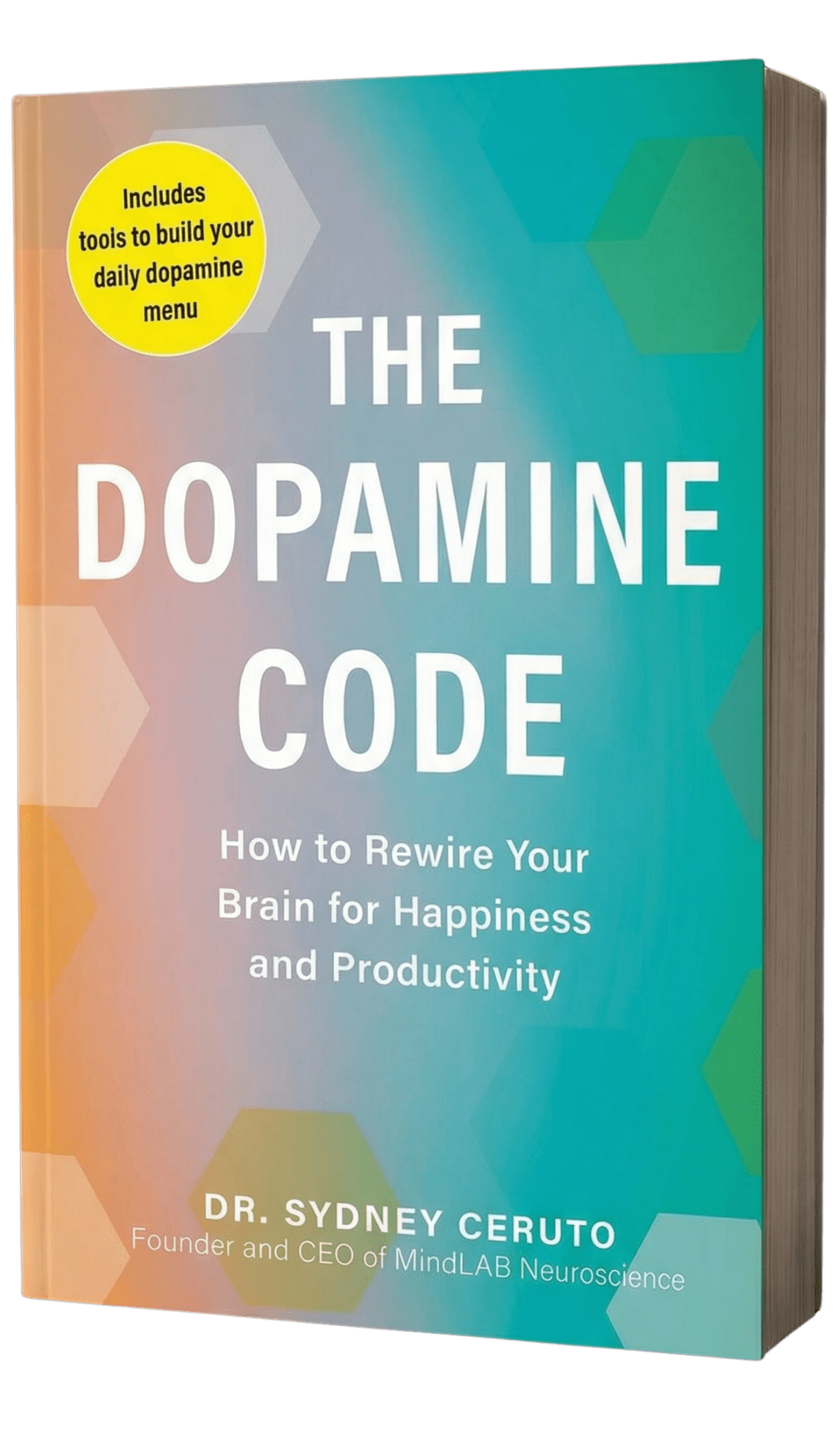
Dr. Sydney Ceruto holds a PhD in Behavioral & Cognitive Neuroscience from NYU and Master’s degrees in Clinical Psychology and Business Psychology from Yale University. She is a Lecturer in the Wharton Executive Development Program at the University of Pennsylvania, an Executive Contributor to Forbes Coaching Council, and an inductee in Marquis Who’s Who in America. Dr. Ceruto founded MindLAB Neuroscience in 2000 and has spent more than 26 years developing and refining her proprietary methodology, Real-Time Neuroplasticity™. She is the author of The Dopamine Code (Simon & Schuster, June 2026).

Frequently Asked Questions

How is neuroscience-based business consulting different from the executive coaches I've already tried in Beverly Hills?
I work with the prefrontal and limbic circuits where behavioral and strategic outputs originate. Peer-reviewed research confirms that executive functions are neurologically mediated and trainable, and that chronic stress causes measurable structural degradation in the PFC. When the neural architecture changes, behavior changes durably. When it does not, even the best strategic frameworks fail at the execution level.
I run a production company and my senior team is in total chaos post-restructuring. How quickly can neuroscience-based change management produce results?
Change resistance has a specific neurobiological mechanism: uncertainty activates the amygdala — the brain's threat-detection center —'s threat detection system, shifting behavior from flexible, goal-directed responses toward rigid, habitual patterns. I address this mechanism directly in the leadership team first — building the neural flexibility that enables leaders to model adaptive behavior rather than unconsciously signal resistance. Detectable changes in team dynamics typically emerge within the first weeks of intensive engagement, with durable restructuring over a 90-day program.
Is this the same as therapy? I'm not looking for therapy — I need someone who can help me think and lead better.
MindLAB Neuroscience is not therapy. I am a neuroscientist, not a therapist. My methodology — Real-Time Neuroplasticity™ — applies peer-reviewed brain science to restructure the neural patterns that drive professional performance, leadership effectiveness, and organizational outcomes. The work is forward-looking, performance-focused, and grounded in the same caliber of research published in Nature, PNAS, and Neuropsychopharmacology.
My business transformation project has stalled because my executive team keeps reverting to old habits. What's the neuroscience explanation?
The brain defaults to established neural patterns under cognitive load — and business transformation creates sustained cognitive load. Chronic stress during transformation periods impairs prefrontal function and amplifies habitual responding through amygdala — the brain's threat-detection center — activation. Your team is not lacking discipline or commitment. Their brains are doing exactly what the neuroscience predicts under these conditions. I intervene at the neural level to break the cycle, strengthening the PFC circuits that enable new behavior to override habitual responses.
How is Dr. Ceruto's Real-Time Neuroplasticity™ approach validated?
Every element of my methodology is grounded in peer-reviewed neuroscience from journals including Neuropsychopharmacology (Nature Publishing Group), Frontiers in Psychology, PNAS, and Brain, Behavior, and Immunity. I cite specific researchers and findings because the science is the methodology. Real-Time Neuroplasticity — the brain's ability to rewire itself —™ applies documented mechanisms of neural restructuring during the live moments when circuits are active and therefore most amenable to change.
I'm a founder-CEO in Santa Monica and my company just hit $50M ARR. What does brain-based work look like at my growth stage?
The founder-to-professional-CEO transition is one of the most neurologically demanding leadership shifts. The cognitive architecture that produced success at startup scale frequently becomes the constraint at scale-up. Meta-analytic research confirms that professional role demands literally reshape brain connectivity. I identify where your neural patterns are anchored to a previous business stage and restructure them for the complexity of current organizational demands — including succession planning, culture transformation, and performance management at scale.
My leadership team is dispersed across Beverly Hills, Culver City, and New York. Does this work virtually?
Yes. My practice is virtual-first by design. Real-Time Neuroplasticity — the brain's ability to rewire itself —™ operates through the quality and timing of cognitive engagement, not geographic proximity. For distributed leadership teams — which are increasingly the norm across Beverly Hills' entertainment, technology, and professional services sectors — the virtual model provides full effectiveness while accommodating the realities of modern organizational geography.

Ready to Perform at Your Highest Level?

In Beverly Hills' most demanding organizational environments — from entertainment companies in structural upheaval to Silicon Beach startups scaling through hypergrowth — the leaders who transform their organizations first transform their neural architecture.

Schedule a Strategy Call
MindLAB Neuroscience consultation room
Locations

The Intelligence Brief

Neuroscience-backed analysis on how your brain drives what you feel, what you choose, and what you can’t seem to change — direct from Dr. Ceruto.