The Career Paralysis No One Explains
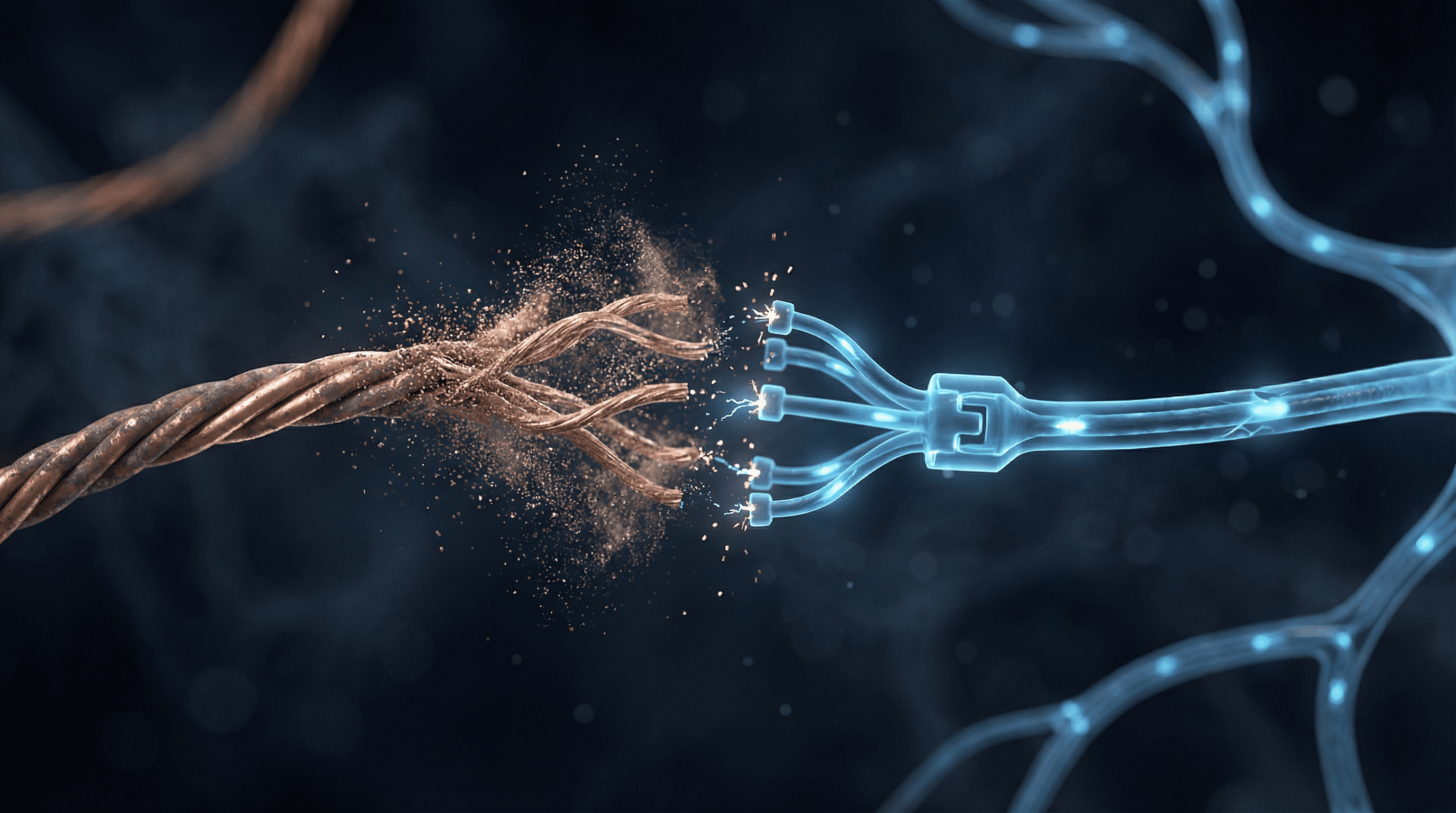
“Career stagnation is rarely a strategy problem. It is a neural architecture problem — the circuits governing risk evaluation, reward anticipation, and identity flexibility have settled into patterns that no amount of planning can override without addressing the architecture itself.”
You know the direction. Or at least, you know the direction is not this one. You have the analytical capability to evaluate options, the professional network to open doors, and the financial runway to make a move. And yet you remain exactly where you are.
The paralysis does not respond to logic. You have made the spreadsheets. You have listed the pros and cons. You have had the conversations with trusted advisors who tell you what you already know. None of it moves the needle. The reason is biological: the neural architecture maintaining your current career identity receives constant external reinforcement.
The default mode network, which maintains your sense of who you are, does not operate in isolation. It is continuously shaped by the social signals around you. Beverly Hills produces those signals with unrelenting density. Your title, your firm, your industry position — all of these are reinforced daily by every professional interaction in your environment.
The Neuroscience of Career Identity
Career identity is not a metaphor. It has a specific neural foundation documented across multiple peer-reviewed studies.
Two decades of research show that the default mode network maintains your autobiographical self — your running story of who you are and what you do. When life circumstances shift significantly, this network must reactivate and re-reference your identity against the new reality. This re-referencing process is essential for adapting to any new domain. Without it, the brain continues operating from the prior identity architecture even when the external situation has fundamentally changed.
Career transitions rank among the most significant identity shifts a person undergoes. The experience is neurologically disorienting because the brain’s self-referential system is in active, effortful reconfiguration. Without structured support, this process can stall indefinitely. Forward planning and the ability to imagine future professional states depend on successfully updating that identity architecture first.
Career decision-making draws on the same neural regions that govern autobiographical memory and self-referential processing. Clients who describe career paralysis are rarely failing to analyze their options. They are stuck in an identity architecture that has not caught up to their circumstances. What needs to change is not more information or a better strategy. It is how the brain encodes and narrates the professional self.
How Dr. Ceruto Approaches Career Transitions
Dr. Sydney Ceruto’s methodology addresses career transitions where the constraint actually lives — the gap between an old career identity and a new one not yet consolidated. In over two decades of clinical neuroscience practice, the most reliable predictor of career stagnation is not the complexity of the decision. It is the degree to which the professional self-concept has become structurally embedded in the medial prefrontal cortex — the brain’s identity hub — and reinforced by social and professional environment.
The methodology does not ask clients to cognitively override their identity. It works with the brain’s own plasticity mechanisms to restructure the self-referential architecture. This is for the professional who knows what is next but cannot neurologically release what was.
NeuroConcierge addresses the deeper architecture for clients navigating transitions where career identity intersects with relational identity, financial identity, and the question of who they are becoming. In Beverly Hills, where professional and personal identity are publicly interwoven through social networks, industry events, and community dynamics, the approach addresses the full neural landscape rather than isolating the career dimension.
What to Expect
Every engagement begins with a Strategy Call — a direct phone conversation with Dr. Ceruto. During this call, she maps the self-referential patterns and default-mode activity maintaining your existing professional self-concept. This mapping informs a structured protocol designed to produce the specific neuroplastic changes the transition requires.
The process is not open-ended exploration. It is targeted, structured, and built on published neuroscience. The brain’s plasticity mechanisms are precise, and the intervention matches that precision. Clients consistently describe the experience as fundamentally different from any prior approach. Not because it feels radically unusual, but because for the first time, the constraint they have been fighting actually moves.
References
Menon, V. (2023). 20 years of the default mode network: A review and synthesis. Neuron, 111(16), 2469-2487. https://doi.org/10.1016/j.neuron.2023.04.023
Elder, J., Davis, T., & Hughes, B. (2023). A Fluid Self-Concept: How the Brain Maintains Coherence and Positivity across an Interconnected Self-Concept While Incorporating Social Feedback. The Journal of Neuroscience, 43(22), 4110-4128. https://doi.org/10.1523/JNEUROSCI.1951-22.2023
Matsuura, S., Suzuki, S., Motoki, K., Yamazaki, S., Kawashima, R., & Sugiura, M. (2021). Ventral–Dorsal Subregions in the Posterior Cingulate Cortex Represent Pay and Interest, Two Key Attributes of Job Value. Cerebral Cortex Communications, 2(2). https://doi.org/10.1093/texcom/tgab018
Yeshurun, Y., Nguyen, M., & Hasson, U. (2021). The default mode network: where the idiosyncratic self meets the shared social world. Nature Reviews Neuroscience, 22(3), 181-192. https://doi.org/10.1038/s41583-020-00420-w
The Neural Architecture of Professional Identity Change
The brain does not store career identity as a file that can be edited and saved. It encodes professional selfhood across a distributed network that connects memory, emotion, motor planning, and self-referential processing into a unified structure that operates continuously in the background. Understanding this architecture is essential to understanding why career transitions that seem logically straightforward can feel biologically impossible.
The default mode network — the brain’s primary self-referential system — maintains your professional narrative with the same neural commitment it applies to your name, your family bonds, and your sense of personal history. The medial prefrontal cortex evaluates every career-relevant thought against this existing narrative: does this new direction fit who I am? The posterior cingulate cortex integrates autobiographical memory with current self-evaluation, anchoring your sense of professional identity in decades of accumulated experience. The hippocampal system encodes career milestones as emotionally weighted memories that resist revision because the brain treats them as foundational data about who you are.
When a professional contemplates a career transition, these systems do not simply update to accommodate the new information. They defend the existing structure. The default mode network generates a continuous stream of self-referential processing that reinforces the current identity: you are a banker, you are a litigator, you are a surgeon. Every alternative career scenario that the imagination constructs is evaluated by the same network that maintains the current identity, and the evaluation is structurally biased toward the familiar. This is not resistance to change in the motivational sense. It is the neural architecture doing exactly what it was designed to do — maintaining a coherent identity in the face of disruption.
Compounding this, the brain’s predictive coding system treats career identity as a high-confidence prior. Predictive coding is the mechanism by which the brain generates expectations about the world and then updates those expectations based on new evidence. When a prior has been reinforced over twenty or thirty years of professional experience, the weight the brain assigns to it is enormous. New career possibilities are processed as low-confidence prediction errors that the system actively suppresses in favor of the established model. The professional who says they cannot see themselves in a different career is describing a genuine perceptual limitation: the predictive system has made the current identity so dominant that alternatives are literally difficult to mentally simulate.
Why Traditional Career Guidance Falls Short
Conventional career coaching operates through assessment, strategy, and accountability. The client takes assessments to identify strengths and interests. A career strategy is developed. Accountability structures ensure execution. The model assumes that the barrier to career change is informational — that the client does not know what they want, or does not know how to get it.
For the professionals who reach my practice, the barrier is never informational. They have done the assessments. They know their strengths. They have identified viable alternatives. Many have received outstanding strategic advice. And they remain stuck, because the problem was never a lack of clarity. The problem is that the neural architecture encoding their current professional identity is actively resisting the transition, and no amount of strategic planning addresses architectural resistance.
Goal-setting approaches face a specific neurological limitation in the context of identity change. Goal-directed behavior is governed by the dorsolateral prefrontal cortex working in concert with the striatum’s reward circuitry. This system excels at executing plans within an established identity framework — pursuing a promotion, changing firms, adding a credential. But when the goal requires a fundamental identity shift, the system encounters a conflict: the goal-directed circuitry is attempting to execute a plan that the self-referential network is simultaneously undermining. The client experiences this as motivation that evaporates, plans that stall for no apparent reason, and a persistent sense that something unnamed is preventing forward motion. That unnamed something is a neural conflict between two systems with incompatible directives.

Accountability structures, far from helping, can deepen the problem. External pressure activates the same threat-detection systems that are already destabilized by the identity disruption. The client now has two sources of alarm: the internal threat of identity dissolution and the external pressure of failing to meet commitments. The brain’s response is frequently to shut down the transition attempt entirely and return to the stable baseline of the current identity — which registers as another failure, further reinforcing the narrative of stuckness.
How Identity-Level Restructuring Works
The methodology I apply does not attempt to override the brain’s identity-maintenance architecture. That architecture exists for sound biological reasons — a self that could be rewritten by any new input would be dangerously unstable. Instead, the work engages the plasticity mechanisms within the self-referential network itself, building the brain’s capacity to maintain coherent identity while incorporating genuinely new self-concepts.
The first target is the default mode network’s rigidity. In professionals with entrenched career identities, the self-referential network has become so tightly coupled to the occupational self-concept that it cannot flexibly incorporate alternatives. The work involves systematically engaging this network under conditions that promote loosening — not destabilization, but increased flexibility. The medial prefrontal cortex’s evaluative function is engaged with progressively more distant professional self-concepts, building the circuit’s capacity to simulate alternative identities without triggering the threat response that normally accompanies identity challenge.
The second target is the predictive coding system’s confidence weighting. The established career identity operates as an over-weighted prior that suppresses alternative predictions. Through targeted neural engagement, the weighting is recalibrated — not by attacking the existing identity, but by building the brain’s capacity to assign genuine probability to alternative futures. When the predictive system begins treating new career possibilities as plausible rather than impossible, the experiential shift is dramatic. Clients describe it as suddenly being able to see options that were theoretically available all along but neurologically invisible.
The restructuring is structural, not motivational. When the default mode network’s flexibility increases and the predictive system’s confidence distribution broadens, the changes persist because they represent actual architectural modifications to the neural circuits involved. This is the biological basis of lasting career transition: not a decision sustained by willpower, but a neural architecture that has genuinely reorganized to accommodate a new professional identity.
What This Looks Like in Practice
The engagement begins with a Strategy Call focused on mapping the specific neural signature of your career paralysis. The presenting patterns vary enormously: some clients have rigid default mode networks that cannot simulate alternatives, others have flexible cognition paired with a predictive system that assigns zero probability to change, others have both systems functioning but a threat response that activates the moment transition becomes real rather than theoretical. The intervention depends entirely on which pattern is operating, and that determination requires precision that generic assessments cannot provide.
In session, the work feels unlike any career guidance you have experienced. There are no personality inventories, no strength-finder profiles, no vision boards. The engagement targets the neural systems directly, under conditions calibrated to your specific resistance pattern. You will likely experience moments of genuine cognitive discomfort — not because the work is punitive, but because architectural change requires engaging circuits that the brain has been protecting from disruption. That discomfort is the neurological signature of plasticity in action.
What clients describe consistently is a shift from paralysis to directed motion that does not feel like a decision. It feels like a constraint being removed. The career alternatives that were cognitively available but emotionally impossible become genuinely accessible — not because something was added, but because the architectural barrier that prevented access was restructured. The transition that follows is not sustained by discipline or accountability. It is sustained by a neural architecture that now supports the new identity with the same structural integrity that once maintained the old one.
For deeper context, explore neuroscience coaching for career development.