Family Grief & Loss in Beverly Hills

Public loss, disenfranchised grief, and family systems built to manage visibility — Beverly Hills creates specific conditions in which the actual neural work of grief is deferred.

The loss reorganized everything. The family system has not caught up.

Family grief is both individual and systemic. Both levels can be addressed.

Book a Strategy Call

Key Points

  1. The goal of working at the level of neural architecture in family grief is not the resolution of grief as an experience.
  2. The brain must gradually build a new internal representation of the lost person — one that can provide regulatory function without requiring physical presence — and this is not a conscious or voluntary process.
  3. Most do not, because the cognitive load of active grief makes high-level restructuring feel impossible, and because the family system does not typically have a mechanism for doing this kind of work.
  4. The grief itself — the actual neural reorganization event happening in each person — may go almost entirely unaddressed while the system-stabilization process consumes the available energy.
  5. Each of these arrangements creates a grief profile for the family that does not reflect the actual distribution of loss.
  6. That work requires getting the specifics right: the actual architecture of this loss, in this family, with its particular distribution of grief and vacancy and suppressed experience.
  7. The family does not typically convene and discuss what functions the deceased held and how those functions will now be distributed.

Why Family Grief Is Different From Individual Loss

“The brain must gradually build a new internal representation of the lost person — one that can provide regulatory function without requiring physical presence — and this is not a conscious or voluntary process.”

The brain’s attachment system is organized around specific people. Over years of relationship, the nervous system uses the presence, predictability, and emotional attunement of an attachment figure to regulate its own baseline state. The amygdala’s threat-detection threshold, the prefrontal system’s capacity to stay online under stress, the general sense that the environment is navigable. When an attachment figure dies, the regulatory function they provided disappears alongside the person. The brain’s prediction architecture loses a node it had organized itself around. It must now run without a resource it had encoded as load-bearing.

This is the individual dimension of family grief. But the systemic dimension runs beneath it and compounds it in ways that are rarely examined directly. Every family develops a functional architecture: informal roles that distribute the cognitive, emotional, and organizational labor of the system. One person holds the emotional temperature of the group. One person carries the family’s shared memory. One person initiates connection during dormant periods. One person translates between family members who cannot communicate directly without help. These functions are not formally assigned and are often invisible until the person who held them is no longer present. When they die, the functions go with them — and the remaining family members discover the gaps not through reflection but through the failure of things that used to work automatically.

The conflict that emerges in grieving families is rarely about what it appears to be about. Disputes over belongings, over how the funeral was managed, over who visited enough before the death, over whose grief is more visible or more legitimate. These surface conflicts are the family system trying to redistribute the absent member’s functions through whatever organizing mechanism remains available to it. The system is destabilized. It is attempting to re-establish equilibrium. The mechanism it uses is whatever the family already knows: negotiation, alliance, conflict, withdrawal. The grief itself — the actual neural reorganization event happening in each person — may go almost entirely unaddressed while the system-stabilization process consumes the available energy.

What the Brain Is Actually Processing

Grief, at the neural level, is a prediction error of enormous magnitude. The brain has spent years — sometimes decades — building a model of the world that includes this person. Their presence was encoded as part of the expected environment. Every morning that unfolded within that relational context confirmed the model. When the death occurs, the brain’s prediction system receives information that directly contradicts the encoded expectation: the person the model anticipates is no longer present and will never be present again. The error is total and irreversible — which is unlike any other prediction failure the brain processes.

The disorientation of acute grief is partly this: the prediction system has not yet updated, so it continues generating expectations that reality immediately contradicts. The impulse to reach for the phone to call them. The moment of forgetting, followed by re-remembering. The way the house carries the expectation of their presence in rooms they occupied. These are not signs of denial or pathological attachment. They are the prediction architecture doing what it always does — generating models based on prior experience — while the executive system attempts to integrate information that would require the entire model to be rewritten. That rewriting takes time and is metabolically costly in ways that produce the physical exhaustion characteristic of grief.

The attachment dimension compounds the prediction dimension. The attachment system’s primary function is to maintain proximity to and regulate through connection with specific others. When a primary attachment figure dies, the attachment system has lost its organizing reference point. The activation state it enters — the searching behavior, the heightened vigilance, the oscillation between yearning and despair — is the system running its proximity-seeking program against an unavailability that is permanent. It cannot resolve through the usual mechanism, because the usual mechanism requires contact with the figure who is no longer available. The brain must gradually build a new internal representation of the lost person — one that can provide regulatory function without requiring physical presence — and this is not a conscious or voluntary process. It happens through time, through the repeated experience of survival without the person, through the gradual reconfiguration of the attachment architecture.

When Grief Stalls in the Family System

Grief that is not moving has a distinct character. It is not the same as grief that is still early, still raw, still in the period when disorganization is appropriate and expected. Grief that has stalled returns to the same level of acute destabilization each time the loss is encountered. Not diminishing in intensity across time, not developing the capacity to hold the absence without being overwhelmed by it. For individuals, stalled grief usually means the neural reorganization that needs to happen is not finding the conditions it requires: enough safety, enough time, enough relational support, enough honest engagement with what the loss actually was rather than what the family’s agreed-upon narrative says it was.

In family systems, grief stalls for an additional reason: the system itself may be organized against the reorganization. The family that has established a tacit agreement that grief is finished, or that grief belongs only to one member, or that the deceased is not to be spoken about directly, has created a structural barrier to the process that each individual member still needs to complete. The individual’s nervous system continues to carry the unprocessed reorganization event. The family system actively inhibits the conditions under which that processing could occur. The two things — individual need and systemic constraint — operate simultaneously and in opposition.

Families also stall grief through the mechanism of premature meaning-making. The rush to find a lesson, to name a legacy, to establish that something good came from the loss. These are often the family system’s attempts to end the destabilization by producing a stable narrative around it. The narrative is not wrong. But when it arrives before the actual neural reorganization has had time to proceed, it functions as a lid placed over a process that is not finished. The grief goes underground. It continues running, unseen, at the level of the nervous system. Surfacing as irritability, as a persistent low-level flatness, as the inability to fully inhabit the present because the unfinished past is still drawing on the system’s resources. Stalled grief is not a failure of the individual or the family. It is a neural architecture that has not found what it needs. My work is to identify what is actually stalling the process and to address that specifically — not to accelerate the grief, but to remove the structural obstacles that are preventing it from moving.

The Role Vacancy Problem

When a family member dies, they take their functions with them. This is the role vacancy problem: the family that once distributed its labor across a certain number of people now has the same labor and fewer people. Some of that labor is practical — the person who handled the finances, managed the medical appointments, maintained the social calendar, organized the holiday logistics. Some of it is relational — the person who held the emotional temperature of the group, who mediated between siblings who could not speak to each other directly, who maintained connection with branches of the family that would otherwise drift. Both kinds of vacancy create real disruption. Both are often invisible until the absence makes them concrete through failure.

The practical vacancies are usually identified and addressed first, because they generate immediate visible failures: bills not paid, appointments missed, logistics that no one coordinates. The relational vacancies take longer to surface, because the relational architecture of a family system can coast for a period on accumulated structure before the absence of active maintenance becomes apparent. Siblings who managed their conflict through the deceased’s mediation function may sustain a surface equilibrium for months before the lack of that buffer produces open fracture. The branch of the family that connected primarily through the person who died may maintain some contact for a year before the drift becomes visible.

Role vacancies are rarely filled consciously. The family does not typically convene and discuss what functions the deceased held and how those functions will now be distributed. Instead, the redistribution happens implicitly — through whoever is willing to take on the function, through whoever the family’s existing hierarchy positions as the next holder, or through no one, in which case the function simply goes unfilled and the system absorbs the loss by contracting. When a family contracts around a role vacancy — when the relational function is not redistributed but instead the system reduces its scope — the contraction is rarely experienced as a choice. It is experienced as a natural cooling, as a gradual reduction in closeness that no one planned and that produces its own grief: the secondary loss of the family as it was, added to the primary loss of the person who held it together.

Working with role vacancies requires naming them explicitly — something that families rarely do on their own. Bringing the implicit vacancy into conscious view allows the family to make deliberate choices about redistribution rather than defaulting to whatever the system’s existing dynamics produce. Some functions cannot be redistributed — they were too specific to the person who held them. And those losses deserve their own acknowledgment rather than being papered over by a new arrangement that mimics the function without supplying its substance. Naming what cannot be replaced is part of honest grief. It is also part of building a family architecture that is realistic about what it now is, rather than one organized around the pretense that the function still exists.

The Family System After Loss

Individual grief processes and systemic disruption operate on different timelines and respond to different conditions. A family member may be making genuine progress in their individual grief. Rebuilding prediction models, developing regulatory capacity that does not depend on the deceased — while simultaneously being destabilized by the family system’s dysfunction. The family’s grief is not the sum of each person’s individual grief. It has its own character, its own stuck points, its own organizational logic.

Families often develop a tacit agreement about whose grief is the most legitimate, the most visible, or the most central. The widow’s grief absorbs the family’s attention and shapes how grief is discussed, displayed, and supported. The adult children’s grief — equally real and architecturally significant — may be deferred, minimized, or organized around the task of supporting the more visible griever. The grandchildren’s grief may be managed rather than metabolized — explained away, protected from, or addressed with vocabulary that keeps it at a surface level. Each of these arrangements creates a grief profile for the family that does not reflect the actual distribution of loss. The gaps between the tacit arrangement and the actual neural experience of each member can persist for years.

The question of what the family now is without the person who died is not a sentimental one. It is structural. The family’s sense of itself — the narratives it carries about who it is, the rituals that organized its shared time, the relational patterns that distributed meaning and belonging. Were built with this person as a participant. When they are gone, every one of those structures requires renegotiation. Some families do this explicitly and consciously. Most do not, because the cognitive load of active grief makes high-level restructuring feel impossible, and because the family system does not typically have a mechanism for doing this kind of work. The restructuring happens implicitly — through conflict, through distance, through the emergence of new relational patterns that no one consciously chose but that the system settled into because they were stable, even if they were not good.

What Completing the Family’s Grief Process Requires

Completing the grief process is not the same as finishing grief. Grief does not finish in the sense of ceasing to exist. What completes is the acute neural destabilization — the state in which the prediction architecture has not yet updated, the attachment system is still running its proximity-seeking program against an irresolvable absence. The cognitive load of the unfinished reorganization is pulling constantly on the available resources. When grief completes, the loss is integrated: the person who died exists as a stable internal representation rather than as an active unresolvable absence. The loss remains fully real. The destabilization does not.

For the family system, completing the grief process requires something that many families never do: a reckoning with what actually changed. Not a curated narrative about legacy and meaning — though meaning is real and can be built — but a direct, honest account of what the family now is without the person who died. What functions went with them. What relationships they maintained that the family must now sustain through other means, or honestly acknowledge as reduced. What the family’s sense of itself was organized around that it can no longer organize around in the same way. This reckoning is not comfortable. It requires the family to hold a grief that is larger than individual loss: the grief of a collective structure that has been permanently altered.

Walnut desk with marble inlay crystal brain sculpture and MindLAB journal in warm California afternoon light in Beverly Hills private study

For individuals inside the family, completing the process requires the conditions that neural reorganization events generally require: adequate safety, the presence of at least some relational co-regulation. Honest engagement with the actual dimensions of the loss rather than the socially managed version. This means not suppressing the grief beneath performance, not organizing the process around the most visible griever at the expense of less visible grief. Not rushing the process toward a meaning-making conclusion before the underlying neural work is complete. It also means — in cases where the relationship with the deceased was complicated, where the loss comes with relief or ambivalence or old anger alongside sorrow. That the full complexity of the experience is addressed rather than flattened to what the family and culture find acceptable to grieve.

My work at the level of neural architecture addresses the actual reorganization event with the precision that event deserves. This is not comfort, and it is not the production of a better story about the loss. It is the work of restructuring what remains — in the individual nervous system and in the family system — so that the family can carry the person who died and still inhabit the present. That work requires getting the specifics right: the actual architecture of this loss, in this family, with its particular distribution of grief and vacancy and suppressed experience. General reassurance does not address that. Architectural precision does.

What Changes When the Architecture Reorganizes

The goal of working at the level of neural architecture in family grief is not the resolution of grief as an experience. Grief reorganizes — it does not disappear, and expecting it to disappear is a framework that creates additional suffering by defining the ongoing presence of loss as a failure of the process. The goal is reorganization: a restructuring of the brain’s prediction and attachment architecture such that the person who died is integrated into the system as a stable internal representation rather than as an active, unresolvable absence. The loss remains. The destabilization does not.

For the family as a system, the goal is the recovery of a coherent operating structure that does not require the absent member to function. This means the implicit functional redistribution that was happening chaotically in conflict and distance becomes something the system can navigate with greater awareness. The grief that was being managed by organizational conflict gets addressed as the grief it actually is. The members whose loss was deferred find conditions in which their actual experience can be present. The family begins to carry the person who died in a way that sustains connection to shared history without requiring the impossible work of operating as though nothing fundamental has changed.

This is not comfort. It is architecture. It requires working at the level of neural systems — the attachment system, the prediction architecture, the prefrontal regulatory capacity — with the precision that serious neural reorganization demands.


Marker What You Experience What's Happening Neurologically What We Restructure
Family Grief Is Different From Over years of relationship, the nervous system uses the presence, predictability, and emotional attunement of an attachment figure to regulate its own baseline state. The amygdala's threat-detection threshold, the prefrontal system's capacity to stay online under stress, the general sense that the environment is navigable. The grief itself — the actual neural reorganization event happening in each person — may go almost entirely unaddressed while the system-stabilization process consumes the available energy.
the Brain Is Actually Processing It happens through time, through the repeated experience of survival without the person, through the gradual reconfiguration of the attachment architecture. Grief, at the neural level, is a prediction error of enormous magnitude. The disorientation of acute grief is partly this: the prediction system has not yet updated, so it continues generating expectations that reality immediately contradicts.
Grief Stalls in the Family It is not the same as grief that is still early, still raw, still in the period when disorganization is appropriate and expected. But when it arrives before the actual neural reorganization has had time to proceed, it functions as a lid placed over a process that is not finished. My work is to identify what is actually stalling the process and to address that specifically — not to accelerate the grief, but to remove the structural obstacles that are preventing it from moving.
Role Vacancy Problem This is the role vacancy problem: the family that once distributed its labor across a certain number of people now has the same labor and fewer people. This is the role vacancy problem: the family that once distributed its labor across a certain number of people now has the same labor and fewer people. The practical vacancies are usually identified and addressed first, because they generate immediate visible failures: bills not paid, appointments missed, logistics that no one coordinates.
Family System After Loss The gaps between the tacit arrangement and the actual neural experience of each member can persist for years. The gaps between the tacit arrangement and the actual neural experience of each member can persist for years. Rebuilding prediction models, developing regulatory capacity that does not depend on the deceased — while simultaneously being destabilized by the family system's dysfunction.
Completing the Family's Grief Process That the full complexity of the experience is addressed rather than flattened to what the family and culture find acceptable to grieve. What completes is the acute neural destabilization — the state in which the prediction architecture has not yet updated, the attachment system is still running its proximity-seeking program against an irresolvable absence. It is the work of restructuring what remains — in the individual nervous system and in the family system — so that the family can carry the person who died and still inhabit the present.

Why Family Grief & Loss Matters in Beverly Hills

Family Grief & Loss in Beverly Hills

Public family loss in Beverly Hills carries a dimension that private grief does not: the loss happens inside a scrutinized environment where the family’s response is observed, interpreted. Commented on by people who have no relational standing to do so. When a public figure’s family member dies — a parent, a partner, a child. The grief immediately becomes a performed object, visible to an audience that processes it through whatever narrative the public relationship with the figure has established. The family member is grieving; simultaneously, their grief is being consumed as content. These two things are not easily separated in the nervous system, because the same experience is happening at both levels simultaneously.

The disenfranchised grief particular to entertainment communities is less often discussed. The partner of a character actor whose death was not publicly significant. The parent of a below-the-line crew member whose death was not newsworthy. The friend who was a primary attachment figure but not a spouse, not a blood relative, not someone the culture’s grief hierarchy recognizes as a legitimate primary griever. Disenfranchised grief is grief without social permission — loss that the community around the griever does not register as significant, which eliminates the communal acknowledgment that would otherwise provide co-regulation. The person must grieve without social scaffolding, which places the entire neural reorganization burden on individual resources that are rarely adequate to carry it alone.

Behind the gates, within the family systems built around wealth and visibility, there is a specific pattern of grief that involves the management of family image alongside the management of loss. The family whose member dies must process the internal reorganization event while simultaneously making decisions about what to communicate publicly, how to navigate the estate and its public-facing implications. How to manage the social environment that watches closely. These are not trivial demands. They are added to the neural cost of grief rather than replacing it, and they often consume the cognitive and emotional resources that would otherwise be available for the actual reorganization work.

The entertainment industry’s relationship to mortality is complex and specific. Death is aestheticized in the work; celebrated in retrospectives and tributes; framed in the language of legacy and lasting contribution. This cultural framing can make the actual experience of family grief — which is not aesthetic, not legacy-oriented, and not organized around contribution — harder to access directly. The griever in Beverly Hills may find themselves surrounded by culturally produced framings of loss that are more comfortable than the unmediated neural experience. Those framings may serve the image management function while the actual reorganization work waits.

The role vacancies that open inside Beverly Hills family systems often carry a specific weight: the person who died was frequently the one who maintained the family’s grounding. The relational anchor in a social environment organized almost entirely around performance and presentation. When that anchor is gone, the family system that was built around the contrast between the private person and the public surface loses the private center. What remains is the surface, and the surface cannot regulate a nervous system the way that genuine relational presence does. The grief in these cases is not only for the individual. It is for the only place in a demanding social environment where the performance could be set down. That particular vacancy is difficult to name and nearly impossible to fill.

Dr. Sydney Ceruto, PhD — Founder, MindLAB Neuroscience

Dr. Sydney Ceruto, PhD — Founder & CEO, MindLAB Neuroscience

Dr. Ceruto holds a PhD in Behavioral & Cognitive Neuroscience from NYU and two Master’s degrees from Yale University. She lectures at the Wharton Executive Development Program at the University of Pennsylvania and has been an Executive Contributor to the Forbes Coaching Council since 2019. Dr. Ceruto is the author of The Dopamine Code (Simon & Schuster, June 2026). She founded MindLAB Neuroscience in 2000 and has spent over 26 years pioneering Real-Time Neuroplasticity™ — a methodology that permanently rewires the neural pathways driving behavior, decisions, and emotional responses.

References

Bowlby, J. (1980). Attachment and loss: Vol. 3. Loss: Sadness and depression. Basic Books.

Shear, M. K. (2015). Complicated grief. New England Journal of Medicine, 372(2), 153–160. https://doi.org/10.1056/NEJMcp1315618

Bonanno, G. A. (2004). Loss, trauma, and human resilience: Have we underestimated the human capacity to thrive after extremely aversive events? American Psychologist, 59(1), 20–28. https://doi.org/10.1037/0003-066X.59.1.20

Walsh, F. (2016). Applying a family resilience framework in training, practice, and research: Mastering the art of the possible. Family Process, 55(4), 616–632. https://doi.org/10.1111/famp.12237

Success Stories

“I'd relocated internationally before, but this time my nervous system wouldn't settle. Everything unfamiliar registered as danger — new people, new routines, even the sound of a different language outside my window. Pushing through it only deepened the pattern. Dr. Ceruto identified that my nervous system was coding unfamiliarity itself as threat and restructured the response at its source. The world stopped feeling hostile. I stopped bracing.”

Katarina L. — Gallerist Zurich, CH

“When my youngest left for college, I didn't just feel sad — I felt erased. My entire sense of self had been wired to caregiving for two decades, and I didn't know who I was without it. Years of talk-based approaches hadn't touched it. Dr. Ceruto mapped the identity circuitry that had fused with the role and restructured it. I didn't find a new purpose — I found the one that had been underneath the whole time.”

Diane L. — Nonprofit Director Chicago, IL

“The divorce wasn't destroying me emotionally — it was destroying me neurologically. My amygdala was treating every interaction with my ex, every legal update, every quiet evening as a survival-level threat. Years of talk-based approaches hadn't touched it. Dr. Ceruto identified the attachment disruption driving the response and restructured it at the root. The threat response stopped. Not because I learned to tolerate it — because the pattern was no longer running.”

Daniela M. — Attorney North Miami Beach, FL

“When the inheritance came, it didn't feel like a gift — it felt like a grenade in every family relationship I had. I couldn't make a single financial decision without a flood of guilt and second-guessing. Years of talking through it hadn't changed anything. Dr. Ceruto identified the neural loop connecting money to fear of family rejection and dismantled it. The paralysis didn't fade — it stopped.”

Vivienne R. — Philanthropist Palm Beach, FL

“I reached out to Dr. Ceruto for help with an ongoing issue I couldn’t resolve. Having discussed it with friends and family, I thought it would be challenging for her to offer a fresh perspective. I was absolutely wrong. She asked all the right questions that pushed me to articulate my thoughts differently than anyone else had. After eight weeks, she made the answer seem so clear. Dr. Ceruto is warm, objective, and open-minded — it leaves no doubt how much she genuinely cares.”

Claudia S. — Physician Wellesley, MA

“I attended a lecture Dr. Ceruto was giving at my graduate school in New York and was blown away by how much I could relate to. Everything about the mind and brain made sense in a way it never had before. I booked a consultation that same day. I was confused, anxious, and unable to commit to any decision — my career and personal life were at a standstill. Dr. Ceruto changed my entire perspective. She utilizes cognitive neuroscience so practically that results come almost immediately.”

Patti W. — Graduate Student Manhattan, NY

Frequently Asked Questions About Family Grief & Loss

Why does family grief feel so much harder than individual grief?

Because it is two simultaneous events that compound each other. There is the individual attachment loss — the neural reorganization each person must do around their own relationship with the person who died. And there is the systemic disruption — the family's collective operating architecture has lost a functional component, and the remaining members must now navigate both their own grief and a social system that is destabilized and attempting to re-establish equilibrium through whatever mechanisms the family already knows. Often those mechanisms are conflict, withdrawal, or the tacit agreement that one person's grief is more legitimate and should organize everyone else's. The individual work and the systemic work do not happen on the same timeline, and they can actively interfere with each other. A family member may be making real progress in their own neural reorganization while the family system is pulling hard in the other direction.

Why do families fight so much after a death — over belongings, over who visited, over the funeral?

Because the family system has lost a functional component and is attempting to reorganize under the additional cognitive and emotional load of grief. The conflicts that surface after a death are rarely about what they appear to be about. Disputes over belongings are often about who holds the deceased's memory most legitimately. Conflicts about who visited enough are about guilt and relational history that the death has made suddenly urgent. Arguments about funeral decisions are often about whose grief is central and whose is peripheral. These are the family system's destabilization responses — attempts to redistribute functional roles and resolve implicit hierarchies of grief through the only mechanisms the system has available. The grief itself, the actual neural reorganization each person is doing, often goes almost entirely unaddressed while the system-stabilization process consumes the available energy.

What happens in the brain during grief?

Grief is, at the neural level, a prediction error of enormous scale. The brain has spent years building a model of the world that includes this person — their presence encoded as part of the expected environment. When the death occurs, the prediction system receives information that directly contradicts the encoded model: the person it continues to anticipate will never be present again. The error is total and irreversible. The brain must rewrite a model it has confirmed thousands of times. This rewriting is metabolically costly, which is why grief produces the physical exhaustion that it does — not as a symptom of something wrong, but as the resource cost of a massive prediction architecture update. Simultaneously, the attachment system has lost a regulatory reference point and is running the proximity-seeking program against an unavailability that cannot be resolved through the usual mechanism. Both processes are happening at once, drawing on the same attentional and physiological resources.

Why do I feel disoriented and forgetful in grief — like I keep "forgetting" they're gone?

Because the prediction architecture does not update all at once. The brain has spent years confirming the model that includes this person — tens of thousands of small confirmations that they are a reliable feature of the environment. When the death occurs, the verbal information of the loss arrives quickly. The deep encoding of the prediction model updates slowly. In the gap between those two timelines, the brain continues generating expectations based on the prior model while the executive system attempts to integrate what it now knows. The impulse to reach for the phone to call them. The moment of forgetting, followed by re-remembering. The way certain rooms or objects carry the expectation of their presence. These are the prediction architecture doing what it is designed to do — modeling the expected environment based on accumulated experience — not signs that the grief is pathological or that you are failing to accept the reality of the loss.

Is it normal to feel relief after a family member dies, especially after a long illness?

Relief is a normal and neurobiologically predictable response after a prolonged period of caregiving, anticipatory grief, or watching someone suffer. The nervous system has been sustaining an elevated stress response for an extended period, and the death marks the end of that sustained activation. The relief is the stress response releasing — a physiological event, not a measure of how much the person was loved or how significant the loss is. It can coexist with profound sorrow, with guilt, with the full weight of the attachment loss. The combination often produces its own additional layer — the confusion about whether relief is acceptable, whether it reveals something troubling about the relationship. It reveals nothing troubling. It reveals that the nervous system was under significant strain for a significant period, and that strain has now reduced. Both things — the relief and the grief — can be fully real simultaneously.

How does grief affect the rest of the family even when individuals seem to be managing?

The family system's disruption operates at a level beneath individual presentation. Family members may be managing effectively at the individual level — maintaining work function, showing up to obligations, presenting as stable — while the system's operating architecture is quietly reorganizing in ways that may not be visible until much later. The tacit redistribution of the deceased's functional roles may be settling into arrangements that are stable but not healthy. The implicit agreement about whose grief is most legitimate may be suppressing loss that needs to be processed. The conflict that was managed by the deceased's mediating function may be beginning to surface. Family grief has a latency quality: the systemic effects often become visible months or years after the loss, when the arrangements the system settled into immediately after the death reveal their costs.

Can grief affect physical health, and why?

Yes, substantially. The sustained activation of the stress-response system that acute grief produces — the elevated cortisol, the disrupted sleep architecture, the immune modulation that follows chronic stress — has measurable effects on physical health that are not metaphorical. The nervous system is running a major reorganization event that draws on physiological resources continuously. Sleep disruption is particularly significant: the memory consolidation and neural reorganization that occur during sleep are central to the grief process itself, and when sleep is disrupted by grief activation — the 3am alert, the early-morning weight of remembering — the very process that enables the reorganization is impaired. The fatigue of grief is not weakness. It is the metabolic cost of one of the most demanding neural reorganization events the brain performs.

What is the difference between grief that is reorganizing and grief that is stuck?

Grief that is reorganizing has movement to it — even when the movement is painful. The prediction architecture is updating, slowly but progressively. The person is developing the capacity to hold the internal representation of the lost person without the acute destabilization of early loss. They can speak about the person who died, encounter reminders of them, visit the relationships and places that carry the loss — with increasing capacity to remain present rather than being dysregulated. Grief that is stuck does not have this quality of movement. The acute destabilization returns with the same intensity at each encounter with the loss. The internal representation of the person has not developed the stability that enables ongoing connection without ongoing overwhelm. The family system may be maintaining arrangements that keep the grief suppressed rather than enabling the reorganization to proceed. Stuck grief is not a character failure — it is a neural architecture that has not found the conditions it needs to continue reorganizing.

Is a Strategy Call conducted in person or virtually?

The Strategy Call is a one-hour phone consultation — not a virtual session and not an in-person meeting. Before the call takes place, I review what you share about your situation to confirm that I can offer something specifically useful for what you are navigating. The fee is $250. This does not apply toward any program investment. The call is a genuine assessment of fit: I evaluate your specific grief architecture, the neural and systemic dimensions of what you are dealing with, and whether my methodology addresses what the situation actually requires. If it does not, I will tell you that directly. If it does, you will leave the call with a clear picture of what the work involves and what outcomes are realistic. Family grief is among the most significant neural reorganization events a person faces. The work it requires deserves that level of precision at the outset.

How do I take the first step?

The entry point is a one-hour Strategy Call by phone, at a fee of $250. I review what you share before the call to make sure I can offer something genuinely useful for your situation — I do not take every inquiry, and the call is a real assessment, not a formality. Family grief is complex: the individual attachment loss and the systemic disruption are both real, and the work needs to address both. During the call, I evaluate the specific architecture of what you are dealing with — the nature of the loss, the state of the family system, where the stuck points are — and whether my methodology is the right fit. If it is, you will have a clear and honest picture of what the work involves. If it is not, I will tell you that and point you toward what would actually help.

Also available in: Miami · Wall Street · Midtown Manhattan · Lisbon

Take the First Step

The Strategy Call is a focused conversation with Dr. Ceruto that maps the specific neural mechanisms driving your concerns and determines the right path forward.

Book a Strategy Call
MindLAB Neuroscience consultation room

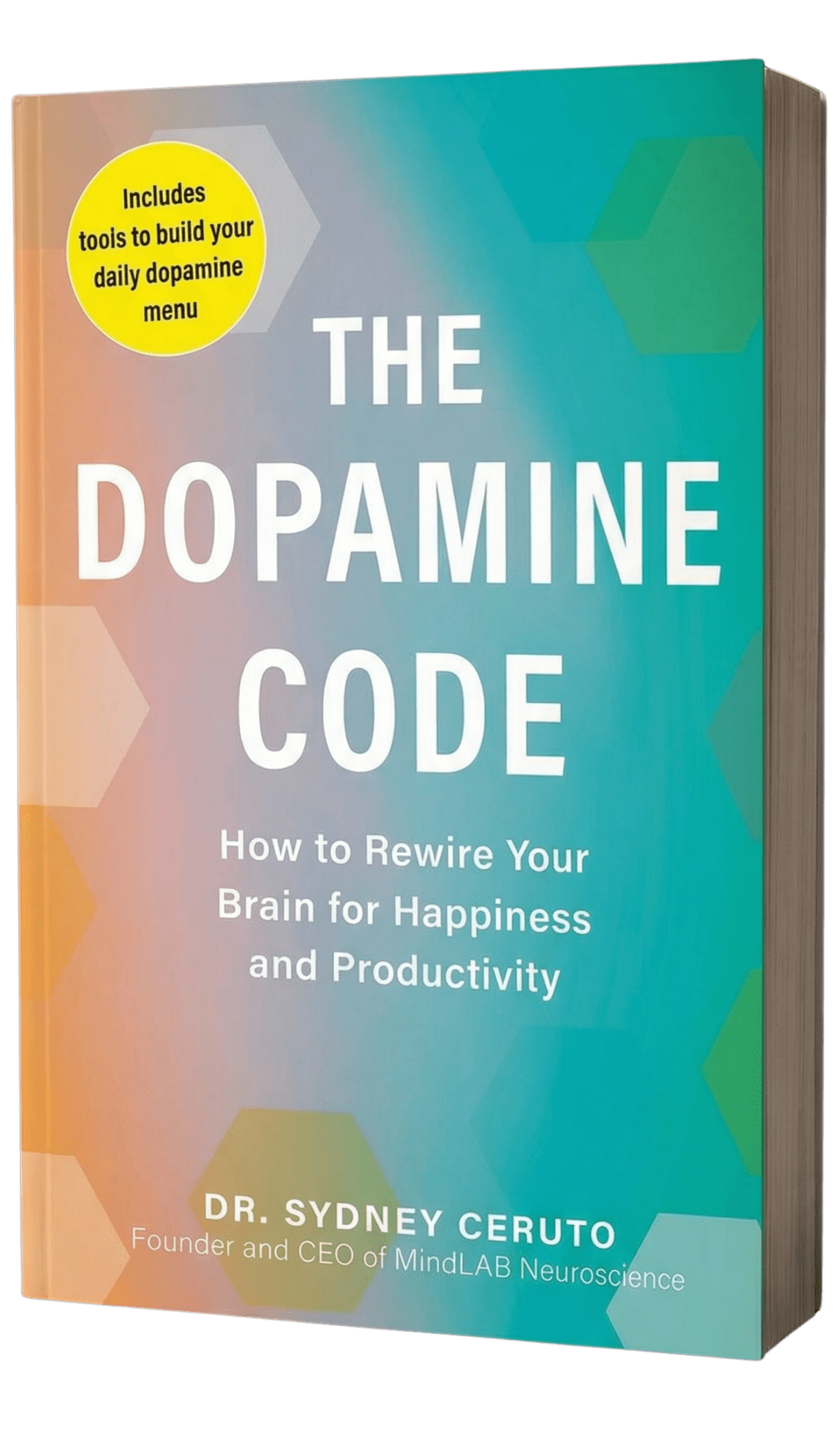
The Dopamine Code

Decode Your Drive

Why Your Brain Rewards the Wrong Things

Your brain's reward system runs every decision, every craving, every crash — and it was never designed for the life you're living. The Dopamine Code is Dr. Ceruto's framework for understanding the architecture behind what drives you, drains you, and keeps you locked in patterns that willpower alone will never fix.

Published by Simon & Schuster, The Dopamine Code is Dr. Ceruto's framework for building your own Dopamine Menu — a personalized system for motivation, focus, and enduring life satisfaction.

Order Now

Ships June 9, 2026

The Dopamine Code by Dr. Sydney Ceruto — Decode Your Drive
Locations

The Intelligence Brief

Neuroscience-backed analysis on how your brain drives what you feel, what you choose, and what you can’t seem to change — direct from Dr. Ceruto.