Investor Relations Coaching in Beverly Hills

Investor meetings are neural performance events. The circuits governing conviction, composure, and credibility under scrutiny determine deal outcomes no amount of narrative preparation can override.

Every LP meeting, venture pitch, and capital raise activates brain circuits that determine whether your narrative lands with conviction or collapses under the weight of the room. MindLAB Neuroscience addresses investor relations at the neurological level where deal outcomes are actually decided.

Book a Strategy Call

Key Points

  1. Investor communication activates the brain's social evaluation circuits — the same systems that process status hierarchy and social judgment create measurable interference with strategic messaging.
  2. The neural architecture governing persuasion operates through social cognition circuits in the medial prefrontal cortex — circuits that must align intent, emotion, and narrative simultaneously.
  3. Under investor scrutiny, the brain's self-monitoring systems consume prefrontal resources that would otherwise support confident, strategic communication.
  4. Credibility signals are processed through the mirror neuron system faster than content is evaluated — meaning neural congruence determines investor confidence before the pitch deck opens.
  5. Effective investor communication requires neural architecture that maintains strategic processing under social evaluation — a biological capacity distinct from presentation skill.

When the Room Decides Before You Finish

“The brain circuits that govern how you process threat, frame value, and build trust in real time are the actual determinants of investor conversion. When those circuits are miscalibrated, every interaction carries a neurological signature that sophisticated investors can read — even when the words are perfect.”

You have the thesis. You have the financials. You have rehearsed the pitch, prepared for the hard questions, and built a narrative that should move capital. Yet something happens between the moment you walk into the room and the moment you walk out that no amount of preparation can explain.

It might be the shift in your vocal quality when a family office principal asks the one question you did not anticipate. These are moments when the brain’s threat detection systems override the prefrontal circuits responsible for strategic communication. The narrative was there. The delivery mechanism broke down.

This pattern carries unique intensity in Beverly Hills. The capital ecosystem here operates through family offices, entertainment-adjacent venture funds, and private equity firms where deal dynamics are simultaneously relationship-driven and analytically rigorous. The founder raising capital from a Beverly Hills family office must project personal chemistry while delivering institutional precision. The founder pitching a celebrity venture fund must translate creative vision into financial narrative in rooms where both storytelling and spreadsheet fluency are evaluated in real time.

Silicon Beach venture funding reached 3.1 billion dollars across 144 deals in a single recent quarter. Entertainment technology companies raised 2.4 billion across 190 deals in 2025. Family Office Club’s Beverly Hills Super Summit draws over six hundred attendees and two hundred fifty ultra-wealthy investors annually. The capital is here. The question is whether the neural architecture driving your investor communication can capture it.

The Neuroscience of Investor-Facing Performance

An investor meeting is a multi-circuit neural event. Capital allocation decisions are influenced by signals the presenter’s conscious mind does not control — not just stated opinions, but involuntary cues that sophisticated investors read instinctively.

The amygdala — the brain’s threat alarm — is the neural mechanism that produces defensive micro-expressions, over-qualification, and excessive hedging. LP panels read these signals as lack of conviction. Elevated amygdala activation in high-stakes capital conversations produces a physiological state that contradicts verbal confidence regardless of preparation quality. Sophisticated investors detect this contradiction within the first ninety seconds.

The anterior insula — the brain’s internal risk monitor — calibrates the risk signals that shape communication tone and delivery authority. Research identifies this circuit as the primary region for risk representation. Critically, it is trainable through targeted neuroplasticity protocols.

The ventromedial prefrontal cortex — the brain’s value-assessment center — governs value-based confidence in live communication. When this region underperforms, the founder’s delivery shifts from conviction to hedging. Investors interpret that shift as uncertainty about the business itself.

Business growth consulting and founder coaching — copper neural scaffolding under active construction representing development architecture

The dorsolateral prefrontal cortex — the brain’s planning and reasoning center — manages working memory under the simultaneous load of prepared narrative, live questioning, and audience monitoring. When this circuit is overtaxed, it creates a neural error loop. The result is visible hesitation and self-correction in investor rooms, undermining credibility precisely when conviction matters most.

How Dr. Ceruto Approaches Investor Relations Performance

Dr. Ceruto’s methodology operates on the neural substrate of investor-facing performance. The most common pattern she identifies is amygdala hyperactivation driven by the neurological inability to separate personal self-worth from business performance. When the brain codes a tough investor question as a personal threat, the prefrontal circuits governing strategic communication go partially offline.

The work restructures this architecture. The goal is a nervous system that registers high-stakes investor pressure without triggering the defensive cascade — one where the prefrontal circuits governing strategic communication operate at full capacity regardless of room pressure.

For founders facing an immediate capital event, the NeuroSync program delivers concentrated circuit recalibration on the most acute performance constraints. For those managing ongoing investor relationships across fund cycles, LP communication calendars, and multi-year capital strategies, the NeuroConcierge partnership provides continuous neural calibration embedded across the entire investor relations landscape.

The pattern that presents most often is someone who has been told their communication needs work. What actually needs work is the neural architecture from which the communication originates.

What to Expect

The engagement begins with a Strategy Call where Dr. Ceruto evaluates the specific investor communication challenges, performance patterns, and high-stakes contexts you navigate. This is a strategy conversation designed to identify whether neural architecture is the actual constraint and which circuits require attention.

The structured protocol moves through neural baseline assessment in investor-facing contexts, targeted recalibration of the circuits driving performance gaps, and integration into live capital environments — actual LP meetings, actual venture pitches, actual deal rooms. The work is calibrated for the real world, not simulated presentations.

Progress is measured against specific outcome markers: investor response quality, follow-on meeting rates, capital commitment outcomes, and the professional’s experience of composure and conviction under pressure. The goal is permanent neural restructuring that produces a different performer in every investor room going forward.

The Neural Architecture of Investor Communication

The investor relations context is one of the most neurologically demanding communication environments that executives navigate. The audience has financial stakes that create heightened threat-detection states. The information asymmetry — the executive knowing far more about the business than the investor — creates a fundamental trust calibration challenge. The questions are often adversarial, designed to probe for inconsistency, test confidence under pressure, and detect the gap between what is being said and what is actually known. And the executive must sustain credible, precise communication while managing an activated threat response in themselves, in real time, in front of people whose decisions about the business depend on their read of the conversation.

The prefrontal-limbic regulatory system is the governing architecture in this context. Under conditions of elevated social evaluation — the experience of being assessed by high-stakes observers — the amygdala activates threat circuits that progressively constrain the prefrontal capacity required for clear, precise, strategically calibrated communication. The executive who has a sophisticated understanding of their business and genuine confidence in the investment thesis can still find themselves in an investor meeting where the quality of their communication does not match the quality of their thinking — because the neural state generated by the high-stakes observer context has degraded the prefrontal integration that would translate strategic clarity into compelling, precise communication.

The reward prediction dimension is equally relevant. Investor relations involves sustained engagement with audiences whose reward signals — financial commitment, expressed confidence, continued partnership — are delayed, uncertain, and often withheld during the engagement itself. The dopaminergic motivation architecture that sustains effective investor communication across cycles of pitches, updates, difficult questions, and extended evaluation periods is not automatically built by career experience. It requires specific calibration to the reward landscape of the investor relations context, which is structurally different from the reward landscapes of most operational leadership roles.

Why Traditional Approaches Fall Short

Investor relations coaching and communications training address the content and delivery of investor communication: the narrative structure of the investment thesis, the metrics that matter to different investor types, the language that builds confidence versus the language that creates uncertainty, the question-handling techniques that maintain credibility under adversarial probing. This is genuinely valuable preparation. It addresses the cognitive layer of investor communication without addressing the neural state layer.

The gap is most visible under pressure. An executive who has been thoroughly prepared on content and delivery can still produce communication that reads as uncertain, evasive, or under-informed when the investor conversation generates sufficient neural pressure. The content has not degraded. The delivery has not degraded. The neural state governing the real-time integration of content, delivery, and moment-to-moment calibration to the room has degraded — and this is precisely what the sophisticated investor is reading, consciously or not.

Investors are exceptionally good at reading the gap between confident stated belief and the neural signals that indicate underlying uncertainty. The micro-variations in vocal quality, response latency, postural alignment, and eye contact that indicate activated threat circuits communicate to the investor’s own neural evaluation system faster than any explicit signal. Investor relations coaching that does not address the neural state of the communicator is preparing the script without preparing the instrument delivering the script.

How Neural Investor Relations Coaching Works

My approach to investor relations coaching begins with the neural state and works outward to the communication. The first question is not what should the executive say but what is the regulatory architecture that will be generating communication quality in the actual investor context, and what does it need to look like for this executive to communicate at the level their strategic understanding and business confidence merit.

From this foundation, I work on two parallel tracks. The regulatory track builds the prefrontal-limbic balance required for sustained, high-quality communication under the specific pressure conditions of investor evaluation contexts: the elevated social assessment load, the adversarial questioning, the extended precision demands across multi-hour conversations or multi-day roadshows. The communication track develops the specific language, narrative, and response architectures that accurately translate the executive’s strategic thinking into investor-facing communication — calibrated to their specific neural communication profile rather than a generic IR best-practice framework.

Walnut desk with marble inlay crystal brain sculpture and MindLAB journal in warm California afternoon light in Beverly Hills private study

Rehearsal is designed around neural state simulation. Preparation under conditions of low threat activation does not prepare the nervous system for conditions of high threat activation. I design practice environments that progressively build the neural capacity to sustain communication quality under elevated pressure — not by habituating the executive to fake investor conversations, but by recalibrating the threat response to the specific signals that investor contexts generate, so that those signals no longer activate the limbic override that degrades communication quality.

What This Looks Like in Practice

Investor relations coaching engagements are structured around the specific investor context: fundraising rounds, earnings calls, analyst days, LP updates, board presentations. Each context has a specific neural demand profile, and the coaching protocol is calibrated to that profile rather than to a generic IR communication framework.

A Strategy Call with Dr. Ceruto maps the specific investor relations challenge against the executive’s neural communication architecture. For executives preparing for a specific high-stakes investor engagement — a Series C fundraise, a public market debut, a major LP review — the NeuroSync model provides focused, intensive preparation calibrated to that specific context. For investor relations teams or executives navigating sustained, multi-cycle investor communication complexity, the NeuroConcierge model provides the ongoing partnership required to build investor communication as a durable, high-quality neural capacity rather than a situation-specific preparation exercise.

For deeper context, explore neurodivergent thinking and investor relations.

Marker Traditional Approach Neuroscience-Based Approach Why It Matters
Focus Pitch development, financial narrative construction, and presentation skill-building Restructuring the neural circuits governing social evaluation processing so strategic communication operates without self-protective interference
Method IR coaching with pitch practice, Q&A preparation, and investor psychology training Targeted intervention in the social cognition and self-monitoring circuits that determine credibility signaling and communication quality under scrutiny
Duration of Change Practice-dependent; performance anxiety and self-monitoring return in novel investor contexts or under hostile questioning Permanent recalibration of social evaluation processing so confident, strategic communication is the neural default across all investor interactions

Why Investor Relations Coaching Matters in Beverly Hills

Beverly Hills concentrates a capital ecosystem unlike any other in the United States. The convergence of entertainment wealth, celebrity-backed venture capital, legacy family office money, and private equity creates an investor relations environment where relationship chemistry and institutional rigor must coexist in every room.

Platinum Equity, headquartered at 360 North Crescent Drive, manages approximately fifty billion dollars in assets. The Gores Group operates from Beverly Hills. Sound Ventures is headquartered in the Golden Triangle. These are not passive capital sources. They are sophisticated investment organizations that evaluate founder performance through a lens calibrated by thousands of previous meetings.

The family office ecosystem adds a distinct dimension. The Beverly Hills Super Summit at the Sofitel Hotel draws over two hundred fifty ultra-wealthy investors annually. The Prestel and Partner Family Office Forum at the Maybourne Hotel concentrates over one hundred family office decision-makers in a single venue. In these rooms, capital allocation decisions are based on live performance — not deck quality, not financial models, but the neural state the founder projects in a forty-five-minute conversation.

The celebrity-to-credible-founder transition defines a significant segment of the Beverly Hills investor relations landscape. The 2025 correction in celebrity-backed businesses saw private equity investors become increasingly selective. They now demand financial narrative sophistication alongside star power. Founders accustomed to closing on charisma discovered that institutional capital requires a different register — precision, conviction under skeptical questioning, and the capacity to hold a financial thesis under analytical pressure.

Beverly Hills’ proximity to the Silicon Beach venture corridor means founders pitching from Santa Monica, Venice, and Culver City frequently navigate investor meetings in Beverly Hills proper. Family office conversations at the Jonathan Club, VC meetings along Wilshire Boulevard, and LP presentations in Century City and Bel Air each carry distinct dynamics that activate different neural circuit patterns.

The capital is concentrated. The deal flow is active. The question for every founder operating in this ecosystem is whether the neural architecture driving their investor performance matches the sophistication of the rooms they are entering.

Array

Investor communications in Beverly Hills span entertainment, technology, and consumer sectors where the asset being evaluated — creative intellectual property, brand equity, talent relationships — resists the quantitative analysis that institutional investors prefer. Fund managers and founders raising capital must translate qualitative value propositions into language that satisfies analytical due diligence while preserving the narrative quality that makes entertainment and consumer investments compelling. This translation function engages both the analytical and social cognition circuits of the presenter simultaneously.

The family office investor audience concentrated in Beverly Hills adds a relational dimension to investor communications that institutional settings do not: family office principals make allocation decisions based on personal trust and relationship quality alongside analytical evaluation. The neural architecture required to build genuine personal connection with family office decision-makers while maintaining professional investment discipline represents a specific social cognition capability that Dr. Ceruto’s methodology develops.

Dr. Sydney Ceruto, PhD — Founder, MindLAB Neuroscience

Dr. Sydney Ceruto, PhD — Founder & CEO, MindLAB Neuroscience

Dr. Ceruto holds a PhD in Behavioral & Cognitive Neuroscience from NYU and two Master’s degrees from Yale University. She lectures at the Wharton Executive Development Program at the University of Pennsylvania and has been an Executive Contributor to the Forbes Coaching Council since 2019. Dr. Ceruto is the author of The Dopamine Code (Simon & Schuster, June 2026). She founded MindLAB Neuroscience in 2000 and has spent over 26 years pioneering Real-Time Neuroplasticity™ — a methodology that permanently rewires the neural pathways driving behavior, decisions, and emotional responses.

References

Bechara, A., Damasio, H., & Damasio, A. R. (2000). Emotion, decision making and the orbitofrontal cortex. Cerebral Cortex, 10(3), 295–307. https://doi.org/10.1093/cercor/10.3.295

Rangel, A., Camerer, C., & Montague, P. R. (2008). A framework for studying the neurobiology of value-based decision making. Nature Reviews Neuroscience, 9(7), 545–556. https://doi.org/10.1038/nrn2357

Adolphs, R. (2001). The neurobiology of social cognition. Current Opinion in Neurobiology, 11(2), 231–239. https://doi.org/10.1016/S0959-4388(00)00202-6

Rizzolatti, G., & Craighero, L. (2004). The mirror-neuron system. Annual Review of Neuroscience, 27, 169–192. https://doi.org/10.1146/annurev.neuro.27.070203.144230

Success Stories

“After years of burnout, the dopamine optimization work helped me finally understand and balance my dopamine levels in a way nothing else had. The personalized plan made all the difference — I’m now motivated, focused, and performing at my best without the crashes that used to follow every productive stretch. The science behind this approach is real and the results are measurable. It gave me a daily framework I still rely on to stay consistent, sharp, and fully in control of my energy.”

Larz D. — Tech Founder Palo Alto, CA

“After the concussion, my processing speed collapsed — I couldn't hold complex information the way I used to, and no one could explain why the fog wasn't lifting. Dr. Ceruto mapped the damaged pathways and built compensatory networks around them. My brain doesn't work the way it did before the injury. It works differently — and in some ways, more efficiently than it ever did.”

Owen P. — Orthopedic Surgeon Scottsdale, AZ

“What I appreciate about Dr. Ceruto is her candid, direct approach — truly from a place of warmth and support. Every week delivered concrete value, and I never felt like I was wasting time the way I had with traditional methods. She draws from her clinical and academic expertise to dig deeper into the roots of issues. She helped me make enormous progress after a year of personal loss, including getting my faltering career back on track. She follows up after every session with additional materials.”

Eric F. — Surgeon Coral Gables, FL

“The same relational patterns my mother and grandmother lived through kept repeating in my own life — the hypervigilance, the emotional shutdown, the inability to feel safe even when nothing was wrong. Talking through it changed nothing. Dr. Ceruto identified the epigenetic stress signatures driving the pattern and restructured them at the neurological level. The cycle that ran through three generations stopped with me.”

Gabriela W. — Real Estate Developer Miami, FL

“Working with Dr. Ceruto was one of the most transformative experiences of my life. I was stuck in a cycle of dissatisfaction, unsure of where I was headed or why I felt so unfulfilled. From the very first session, she helped me peel back the layers and uncover what truly mattered. Her ability to connect neuroscience with practical life strategies was incredible. She guided me to clarify my goals, break free from limiting beliefs, and align my actions with my values. I finally feel real purpose.”

Nichole P. — Wealth Advisor Sarasota, FL

“From our first meeting, Sydney made me think about what I actually wanted and helped me change my perspective. She immediately put me at ease. I’ve only been working with her a short time, but I already have a more positive outlook — for the first time, I really see that I can find a career I’ll be happy in. What I like most is her honesty and ability to make you examine what’s holding you back in a way that doesn’t make you feel judged.”

Nyssa — Creative Director Berlin, DE

Frequently Asked Questions About Investor Relations Coaching in Beverly Hills

What is investor relations coaching, and how does the neuroscience approach differ?

Investor relations advisory typically focuses on narrative development, presentation technique, and messaging strategy. Dr. Ceruto's methodology addresses the neural circuits that determine whether prepared messaging lands with conviction under live pressure. The amygdala threat responses, prefrontal cortex capacity, and mirror neuron — specialized cells that activate when observing others — rapport systems govern performance in investor-facing rooms. Research confirms that investor neural responses to founder behavioral signals predict deal outcomes and funding amounts.

I have strong vision but keep losing deals in the room. Can this be addressed neurologically?

This is one of the most common presentations Dr. Ceruto encounters — a founder with genuine conviction and a sound business thesis whose investor-facing performance does not match the quality of the underlying business. The gap is almost always neural: amygdala threat activation producing defensive micro-expressions, vmPFC going offline under social pressure, or dlPFC collapse degrading working memory — the brain's short-term mental workspace — during Q&A. These are specific, treatable circuit patterns.

How does this apply to pitching Beverly Hills family offices?

Family office meetings in Beverly Hills are relationship-driven performance events where live chemistry and analytical rigor are evaluated simultaneously. The neural circuits governing rapport — mirror neuron synchrony, vmPFC social valuation, amygdala regulation — are as important as the financial narrative. Dr. Ceruto calibrates the full circuit constellation required to project both interpersonal alignment and institutional credibility in these specific rooms.

What does the Strategy Call involve?

The Strategy Call is a strategy conversation where Dr. Ceruto evaluates your specific investor communication patterns, identifies the neural circuits most relevant to your performance constraints, and determines whether Real-Time Neuroplasticity — the brain's ability to rewire itself —™ is the appropriate intervention. The conversation delivers clarity about the biological drivers of your investor-facing performance.

Can I work with Dr. Ceruto before a specific capital event?

Yes. The NeuroSync program is designed for founders and professionals facing immediate investor events — family office meetings, venture pitches, LP presentations, or fund launches. Concentrated circuit recalibration ahead of a specific capital event addresses the most acute neural performance constraints within a compressed timeframe. Many Beverly Hills professionals engage for event-specific preparation and then continue with ongoing calibration.

Is virtual delivery available?

Yes. Virtual sessions are fully effective for investor relations neural calibration. Many founders combine virtual sessions for ongoing calibration with in-person work during concentrated protocol periods or ahead of major capital events.

How is this different from working with a pitch consultant or communications advisor?

Pitch consultants and communications advisors optimize the message — the words, the deck, the delivery technique. Dr. Ceruto optimizes the neural state from which the message is delivered. Research confirms that investor decisions are driven by behavioral signals rooted in the presenter's subcortical brain activity, not by the content of the presentation alone. When the neural state is right, the communication follows. When it is not, no amount of messaging preparation can compensate.

Why do accomplished business leaders sometimes lose their composure and effectiveness during investor interactions?

Investor interactions trigger a specific combination of neural pressures that most professional situations do not: social evaluation by individuals with significant power over your outcomes, performance scrutiny of your judgment and competence, and the financial stakes that activate loss-aversion circuits. This combination produces a neural state that is qualitatively different from — and often more disruptive than — the professional challenges these leaders handle with ease daily.

The loss of composure is not nervousness in the conventional sense. It is the prefrontal cortex losing regulatory capacity as the amygdala's social threat processing consumes neural resources that would otherwise support calm, strategic communication.

How does this approach improve investor communication beyond what pitch coaching provides?

Pitch refinement improves the content of investor communication. Dr. Ceruto's approach improves the neural infrastructure delivering that content. The distinction is critical because investor credibility assessment operates through social cognition circuits that evaluate the speaker's neural congruence — authenticity, confidence, and composure — before processing the content of the pitch.

When the neural architecture supports genuine confidence under investor scrutiny, the communication quality improves across all dimensions simultaneously: vocal quality, eye contact, adaptive responsiveness to questions, recovery from challenging moments, and the subtle social signals that investors process as credibility markers. These are neural outputs, not presentation techniques.

Can this work help with ongoing investor relationships, not just initial pitch situations?

Yes — and ongoing investor relationship management is often more neurologically demanding than initial pitches because it involves sustained performance under continuous evaluation. Board meetings, quarterly updates, capital calls, and difficult conversations about missed targets each trigger social evaluation circuits that compound across the relationship.

Dr. Ceruto's approach produces permanent recalibration of how the brain processes investor scrutiny, meaning the improvement applies across all investor touchpoints — not just the prepared presentation but the spontaneous Q&A, the difficult update call, and the informal conversation where credibility is built or eroded. The neural architecture supporting effective investor communication operates continuously, not just during rehearsed moments.

Also available in: Miami · Wall Street · Midtown Manhattan · Lisbon

The Circuits Running Every Investor Conversation in Beverly Hills

From family office meetings in Bel Air to venture pitches along Wilshire Boulevard, investor-facing performance is biological. Your neural architecture under pressure determines whether capital commits. One conversation changes the wiring.

Book a Strategy Call
MindLAB Neuroscience consultation room

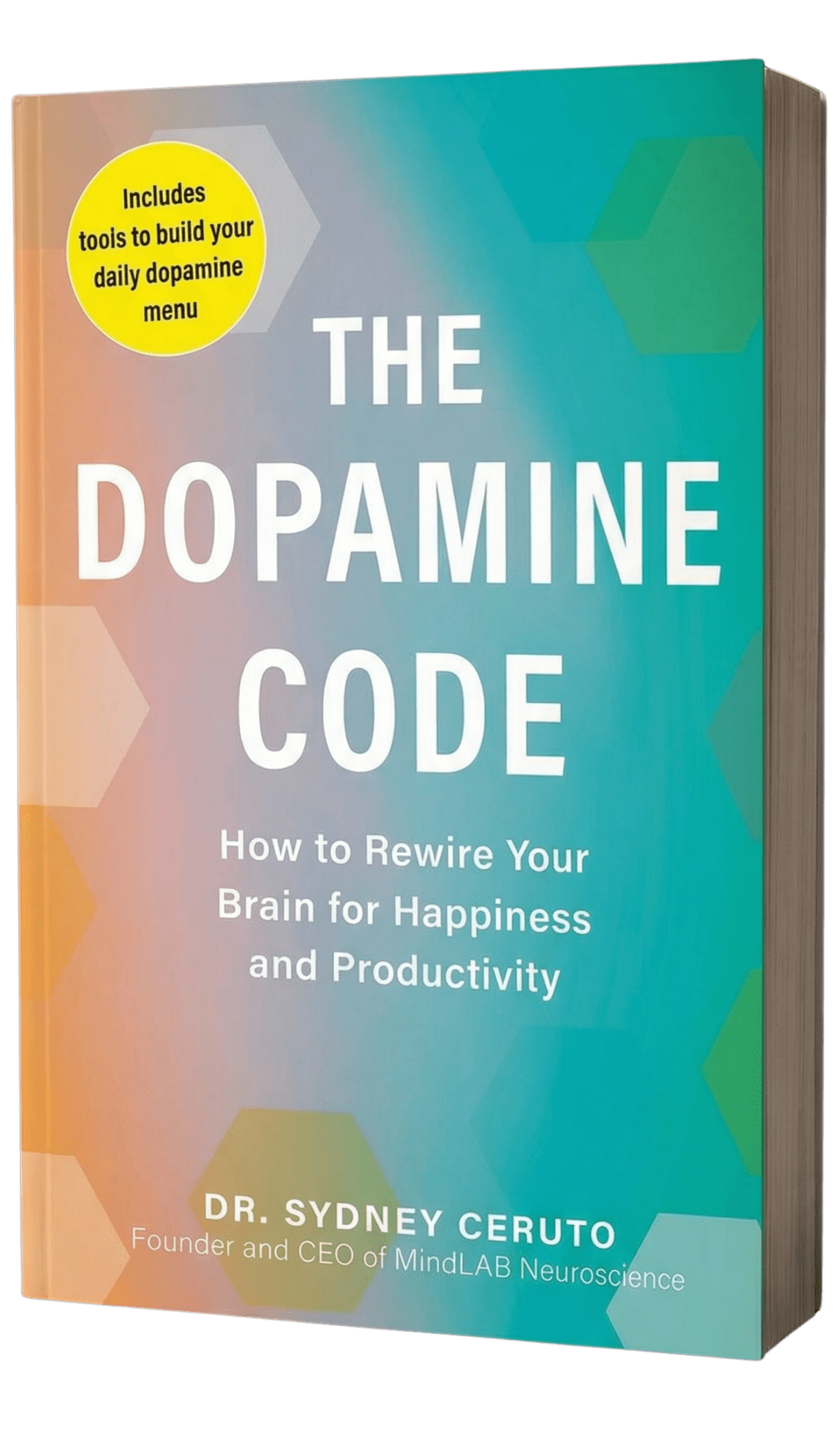
The Dopamine Code

Decode Your Drive

Why Your Brain Rewards the Wrong Things

Your brain's reward system runs every decision, every craving, every crash — and it was never designed for the life you're living. The Dopamine Code is Dr. Ceruto's framework for understanding the architecture behind what drives you, drains you, and keeps you locked in patterns that willpower alone will never fix.

Published by Simon & Schuster, The Dopamine Code is Dr. Ceruto's framework for building your own Dopamine Menu — a personalized system for motivation, focus, and enduring life satisfaction.

Order Now

Ships June 9, 2026

The Dopamine Code by Dr. Sydney Ceruto — Decode Your Drive
Locations

The Intelligence Brief

Neuroscience-backed analysis on how your brain drives what you feel, what you choose, and what you can’t seem to change — direct from Dr. Ceruto.