Strategic Planning in Beverly Hills

Strategic clarity is not an analytical skill. It is a neural state — dependent on prefrontal cortex function, cognitive flexibility, and executive attention networks that degrade predictably under the decision loads Beverly Hills demands.

Every strategic decision runs through the same neural substrate — prefrontal circuits governing cognitive flexibility — the ability to shift thinking between concepts —, long-horizon planning, and value integration. MindLAB Neuroscience addresses strategic performance at the brain level where decision quality is actually determined.

Book a Strategy Call

Key Points

  1. Strategic thinking requires sustained activation of the brain's default mode network for creative synthesis — a state that organizational urgency systematically suppresses.
  2. The prefrontal cortex processes strategic and tactical demands through competing neural pathways, meaning operational pressure directly reduces strategic capacity.
  3. Cognitive biases in strategic planning are not errors of logic — they are features of neural architecture designed for short-term survival, not long-term organizational positioning.
  4. Under uncertainty, the brain's risk-assessment system overweights potential losses by a factor of approximately two to one — systematically distorting strategic risk evaluation.
  5. Effective strategic capacity requires neural architecture that maintains access to integrative, long-horizon thinking even under the operational pressures that typically suppress it.

The Decision Fatigue Spiral

“By four o'clock on a demanding day, your prefrontal cortex is not the same organ it was at nine in the morning. The degradation is neurochemical, measurable, and predictable — and it explains why executives make their worst decisions at the moments that matter most.”

You are making more consequential decisions than ever, with less certainty, in more compressed timeframes. The strategic thinking that built your career now feels unreliable. Not consistently, but in patterns you have started to notice. Afternoon decisions are weaker than morning decisions. Complex situations that once energized you now trigger avoidance. The creative strategic thinking that used to come naturally now requires a level of effort that leaves you depleted before the decision is even made.

This is not aging. It is not a failure of intelligence. The professionals experiencing this pattern are operating at the highest cognitive levels in their industries. The conventional response is to add better analytical tools, more structured decision protocols, and additional data sources. These approaches share a common blind spot: they add more cognitive load — the total demand on mental processing capacity — to a brain already depleted by cognitive load. They are asking you to think harder with hardware that needs recalibration, not more demands.

The frustration is specific: you have the knowledge, the experience, and the strategic instinct to make excellent decisions. But the neural substrate executing those decisions is operating under conditions it was never designed to sustain. In over two decades of clinical neuroscience practice, the most reliable predictor of strategic underperformance is not insufficient information or poor analytical frameworks. It is the functional state of the prefrontal circuits at the moment of decision.

Why Strategic Thinking Fails First

Cognitive flexibility is the highest-order core executive function. It builds on working memory and inhibitory control. Research confirms it is directly linked to creativity, adaptive problem-solving, and resilience under novel challenges. Critically, cognitive flexibility is selectively impaired by stress, sleep loss, and sustained cognitive load before other cognitive capacities degrade. This selective vulnerability explains why strategic thinking is the first capacity to decline under pressure, even when other professional functions remain intact.

The mechanism of that decline is now documented. Sustained cognitive work produces glutamate — the brain’s primary excitatory chemical — accumulation in the prefrontal cortex. This is not metaphorical fatigue. It is a measurable chemical buildup that progressively impairs the circuits responsible for high-quality deliberation. When professionals push through this depletion, they are not demonstrating grit. They are attempting to maintain output on a chemically compromised substrate.

For professionals making dozens of high-consequence decisions daily, this creates a specific and measurable pattern. As the day progresses, the brain systematically shifts away from effortful, high-quality deliberation toward lower-effort defaults. Strategic decisions made later in high-decision-load days carry neurologically compromised quality. The executive who regularly makes decisions they later recognize as suboptimal is not experiencing inconsistent judgment. They are experiencing a predictable neural depletion cycle.

How Dr. Ceruto Approaches Strategic Performance

Dr. Ceruto’s methodology works by rebuilding the circuits that govern cognitive flexibility, long-horizon planning, and sustained executive attention under the actual conditions of your professional life.

The approach operates on a distinguishing principle. The quality of a strategic decision is determined not by the information available but by the neural state in which the decision is made. Two executives with identical information and identical experience will arrive at different strategic conclusions depending on the functional state of their prefrontal circuits at the moment of decision. Dr. Ceruto’s work ensures that the neural substrate supporting strategic reasoning operates at its designed capacity.

Many accomplished professionals recognize, in hindsight, that they made decisions they later consider suboptimal. That recognition is itself evidence that their strategic capacity is intact. The gap is not in their thinking. It is in the neural conditions under which the thinking occurs.

Executive coaching and leadership development — precision copper neural switching junction directing strategic decision pathways

For professionals facing a defined strategic inflection, the NeuroSync program provides focused restructuring of the prefrontal circuits most relevant to that specific challenge. For those whose professional demands involve sustained strategic complexity across multiple domains, the NeuroConcierge program provides comprehensive partnership that maintains prefrontal performance across the full scope of strategic responsibility.

What to Expect

The engagement begins with a Strategy Call in which Dr. Ceruto assesses your current decision patterns and identifies the specific prefrontal circuits affecting your strategic performance. This evaluation maps where cognitive flexibility, executive attention, and long-horizon planning are being compromised — across conditions, across complexity levels, and across the sustained demands of professional life at the highest levels.

From this assessment, Dr. Ceruto designs a protocol targeting the specific neural bottlenecks undermining your strategic quality. The process is structured, evidence-based, and calibrated to produce durable change in how your brain handles the computational demands of high-stakes decision-making.

References

Grace Steward, Vivian Looi, Vikram S. Chib (2025). The Neurobiology of Cognitive Fatigue and Its Influence on Decision-Making. The Journal of Neuroscience. https://doi.org/10.1523/JNEUROSCI.1612-24.2025

Weidong Cai, Jalil Taghia, Vinod Menon (2024). A Multi-Demand Operating System Underlying Diverse Cognitive Tasks. Nature Communications. https://doi.org/10.1038/s41467-024-46511-5

Katharina Zühlsdorff, Jeffrey W. Dalley, Trevor W. Robbins, Sharon Morein-Zamir (2022). Cognitive Flexibility and Changing One’s Mind: Neural Correlates. Cerebral Cortex. https://doi.org/10.1093/cercor/bhac431

Mickaël Causse, Evelyne Lepron, Kevin Mandrick, Vsevolod Peysakhovich, Isabelle Berry, Daniel Callan, Florence Rémy (2021). Facing Successfully High Mental Workload and Stressors. Human Brain Mapping. https://doi.org/10.1002/hbm.25703

The Neural Architecture of Strategic Thinking

Strategic thinking is a distinct cognitive mode — not an enhanced version of analytical thinking, and not a personality trait distributed randomly among executives. It is a specific configuration of neural activity, centered on the default mode network and its interaction with the prefrontal executive system, that can be deliberately cultivated and that degrades under specific and identifiable conditions.

The default mode network — historically misnamed as the brain’s resting state — is now understood to be the substrate of prospective cognition: the capacity to mentally simulate future scenarios, to construct hypothetical worlds and test decisions within them, and to identify patterns that extend across long time horizons. It is the network that is active when you are not processing immediate sensory input, and it is the network that generates the insights that surface during the apparently unproductive spaces in a busy executive’s schedule — the shower, the walk, the unscheduled hour. These are not accidents. They are the default mode network doing its actual work, which requires withdrawal from the continuous sensory processing and reactive task management that dominate most professional days.

The prefrontal executive system, by contrast, is the substrate of analytical and deliberate reasoning — the capacity to hold a problem in working memory, apply structured frameworks, and generate explicit conclusions through traceable logical steps. This system is essential for evaluating strategic options once they have been generated. It is not the system that generates them. Strategic thinking at its highest level involves a productive collaboration between these two networks: the default mode generating hypotheses, simulations, and pattern recognitions, and the prefrontal system evaluating, testing, and refining them.

The conditions of modern executive work are almost perfectly designed to suppress this collaboration. The continuous reactive demands of senior leadership — the meeting cadence, the decision queue, the communication volume — keep the prefrontal system in constant engagement, which by design suppresses default mode activity. The result is executives who are analytically sophisticated but strategically constrained: highly capable of evaluating options presented to them, less capable of generating the genuinely novel framings that separate transformative strategic decisions from merely competent ones.

Why Conventional Strategic Planning Falls Short

Most organizational strategic planning processes are, in neurological terms, analytical exercises disguised as strategic ones. They involve gathering data, applying frameworks, generating option sets within the constraints of current assumptions, and selecting among those options according to pre-specified criteria. These are valuable activities. They are also, largely, prefrontal activities — precisely the cognitive mode that executives are already overusing and that is actively suppressing the default mode function that generates genuine strategic insight.

The frameworks themselves — SWOT analyses, competitive positioning matrices, scenario planning templates — are useful as organizing structures for analysis that has already been generated through strategic thinking. When they are used as the primary generative tool, they constrain the output to the solution space that the framework was designed to illuminate, which by definition excludes the framings and possibilities that the framework’s designers did not anticipate. Innovation in strategic thought rarely emerges from applying the current best practice framework with greater rigor. It emerges from a cognitive mode that is not currently being cultivated in most strategic planning processes.

How Neural-Level Strategic Development Works

My approach to strategic planning works at two levels simultaneously. At the individual level, we develop the specific cognitive conditions that allow genuine strategic thinking to emerge — which includes restructuring the executive’s relationship to unstructured thinking time, building the capacity to sustain the mental space that default mode function requires, and developing the metacognitive awareness to recognize when analytical mode is substituting for strategic mode rather than complementing it.

Walnut desk with marble inlay crystal brain sculpture and MindLAB journal in warm California afternoon light in Beverly Hills private study

At the organizational and decision-content level, we apply a structured process for developing strategic options that begins with assumption excavation — identifying the premises that current strategy takes for granted, stress-testing them against available evidence, and deliberately generating alternative framings of the competitive situation that violate those premises. This is not devil’s advocacy for its own sake. It is a systematic method for accessing solution spaces that conventional strategic analysis excludes by design.

The Dopamine Code framework informs this work directly: the same neural mechanisms that govern individual motivation and decision-making also govern organizational behavior and culture. Strategic plans that do not account for the motivational architecture of the people who must execute them are not strategic plans. They are intentions.

What This Looks Like in Practice

The most consistent observation from clients is a qualitative shift in the character of their strategic thinking — not just in what they decide, but in how the thinking feels. The sense of operating within a constrained solution space, of being driven by reactive demands rather than leading from a clear directional conviction, gives way to something more spacious: a felt sense of operating with genuine strategic agency, of choosing direction rather than managing circumstances.

Practically, this manifests as improved signal-to-noise ratio in strategic decision-making: faster identification of which decisions are genuinely strategic and which are tactical matters that have been elevated by urgency rather than importance, cleaner separation of short-term operational pressures from long-horizon directional commitments, and more durable confidence in strategic choices because those choices are grounded in a clearer map of the actual competitive landscape rather than inherited assumptions about it.

We begin with a strategy call — one hour of focused strategy conversation that maps the specific constraints on your current strategic thinking, identifies where conventional planning processes are limiting rather than enabling your strategic capacity, and establishes the development pathway that will produce the most significant and durable improvement in your strategic output.

For deeper context, explore cognitive distortions that block strategic thinking.

Marker Traditional Approach Neuroscience-Based Approach Why It Matters
Focus Strategic frameworks, competitive analysis, and scenario planning methodologies Strengthening the neural circuits that support integrative strategic thinking under operational pressure and uncertainty
Method Strategy consulting engagements, facilitated offsites, and analytic tool deployment Targeted intervention in the prefrontal circuits governing long-horizon thinking, risk assessment, and creative synthesis
Duration of Change Framework-dependent; strategic clarity requires repeated consulting input as conditions change Permanent strengthening of the neural capacity for strategic thinking that leaders apply independently across all future decisions

Why Strategic Planning Matters in Beverly Hills

Beverly Hills may be the most decision-dense professional environment in the United States. Within the corridor from Wilshire Boulevard through Century City to the talent agencies of West Hollywood, professionals routinely make dozens of consequential decisions before noon. They greenlight creative projects, evaluate talent deals, structure investment terms, reposition brands, and navigate organizational transitions that carry reputational consequences measured in real time.

The entertainment industry’s current structural transformation amplifies this pressure. Studio executives managing the transition from content expansion to profitability-first strategy face a cognitive challenge conventional advisory cannot address. The neural circuits reinforced by a decade of scale-and-spend strategy are the same circuits that now need to be overridden. Reversing deeply habituated strategic frameworks requires the prefrontal cortex to actively inhibit automatic responses and generate genuinely novel approaches. This demands sustained cognitive effort under exactly the conditions of load and pressure these roles impose.

The generative AI disruption adds a layer of genuine uncertainty structurally different from prior technological transitions. It operates across entertainment, luxury, and technology simultaneously, creating decision environments where standard strategic playbooks do not apply. The brain responds to genuine uncertainty through elevated threat-detection activity that progressively crowds out the prefrontal cortex’s capacity for long-horizon planning.

Family offices managing generational wealth along Beverly Hills’ most prestigious corridors face a distinct strategic planning burden. Decisions about wealth transfer, legacy, and intergenerational stewardship carry emotional weight that systematically intrudes on the prefrontal circuits responsible for clear strategic reasoning. The luxury brand executives operating from Rodeo Drive face yet another variant — managing multiple contradictory strategic frameworks as the ultra-premium market expands while the aspirational segment contracts. Each of these environments demands prefrontal performance that sustained pressure erodes. Each demands a response at the neural level where strategic quality is actually determined.

Array

Strategic planning in entertainment requires neural architecture for evaluating opportunities whose value depends on cultural trends, creative talent, and audience sentiment — variables that resist the quantitative modeling most strategic frameworks assume. Studio executives, production company principals, and agency leaders in Beverly Hills make strategic bets involving hundreds of millions of dollars based on neural pattern recognition of cultural direction — an intuitive processing function that operates through circuits distinct from the analytical frameworks their business training emphasized.

The investment strategy decisions emanating from Beverly Hills’ family offices and wealth management firms involve time horizons spanning generations — a temporal processing demand that the brain’s evolutionary architecture, optimized for immediate and near-term evaluation, handles through workaround circuits in the prefrontal cortex. Strengthening these long-horizon processing circuits produces measurably better strategic outcomes for families and institutions whose planning horizons extend decades beyond the biological planning range the brain naturally supports.

Dr. Sydney Ceruto, PhD — Founder, MindLAB Neuroscience

Dr. Sydney Ceruto, PhD — Founder & CEO, MindLAB Neuroscience

Dr. Ceruto holds a PhD in Behavioral & Cognitive Neuroscience from NYU and two Master’s degrees from Yale University. She lectures at the Wharton Executive Development Program at the University of Pennsylvania and has been an Executive Contributor to the Forbes Coaching Council since 2019. Dr. Ceruto is the author of The Dopamine Code (Simon & Schuster, June 2026). She founded MindLAB Neuroscience in 2000 and has spent over 26 years pioneering Real-Time Neuroplasticity™ — a methodology that permanently rewires the neural pathways driving behavior, decisions, and emotional responses.

References

Miller, E. K., & Cohen, J. D. (2001). An integrative theory of prefrontal cortex function. Annual Review of Neuroscience, 24, 167–202. https://doi.org/10.1146/annurev.neuro.24.1.167

Rangel, A., Camerer, C., & Montague, P. R. (2008). A framework for studying the neurobiology of value-based decision making. Nature Reviews Neuroscience, 9(7), 545–556. https://doi.org/10.1038/nrn2357

Kahneman, D., & Klein, G. (2009). Conditions for intuitive expertise: A failure to disagree. American Psychologist, 64(6), 515–526. https://doi.org/10.1037/a0016755

Buckner, R. L., Andrews-Hanna, J. R., & Schacter, D. L. (2008). The brain’s default network: Anatomy, function, and relevance to disease. Annals of the New York Academy of Sciences, 1124(1), 1–38. https://doi.org/10.1196/annals.1440.011

Success Stories

“Everyone around me had decided I was just 'wired differently' — creative but unreliable, brilliant but scattered. Years of trying to build systems around the chaos never worked because nobody identified what was actually driving it. Dr. Ceruto mapped the default mode network pattern that was hijacking my focus and recalibrated it at the source. The ideas still come fast — but now my prefrontal cortex decides what to do with them, not the noise.”

Jonah T. — Serial Entrepreneur New York, NY

“I reached out to Dr. Ceruto for help with an ongoing issue I couldn’t resolve. Having discussed it with friends and family, I thought it would be challenging for her to offer a fresh perspective. I was absolutely wrong. She asked all the right questions that pushed me to articulate my thoughts differently than anyone else had. After eight weeks, she made the answer seem so clear. Dr. Ceruto is warm, objective, and open-minded — it leaves no doubt how much she genuinely cares.”

Claudia S. — Physician Wellesley, MA

“When the demands of my career began negatively impacting my quality of life, I knew I needed help beyond my usual coping mechanisms. I landed on Dr. Ceruto’s name and couldn’t be happier. Her credentials are impeccable, but upon meeting her, all uneasiness dissipated immediately. She has an innate ability to navigate the particulars of your profession no matter how arcane it may be. By the middle of the first session, you’re talking to a highly intelligent and intuitive friend. She is simply that good.”

Norine D. — Attorney Newport Beach, CA

“Working with Dr. Ceruto was one of the most transformative experiences of my life. I was stuck in a cycle of dissatisfaction, unsure of where I was headed or why I felt so unfulfilled. From the very first session, she helped me peel back the layers and uncover what truly mattered. Her ability to connect neuroscience with practical life strategies was incredible. She guided me to clarify my goals, break free from limiting beliefs, and align my actions with my values. I finally feel real purpose.”

Nichole P. — Wealth Advisor Sarasota, FL

“Endocrinologists, sleep clinics, functional medicine — every specialist cleared me, and no one could tell me why I was exhausted every single day. Dr. Ceruto identified that my HPA axis was locked in a low-grade stress activation I couldn't feel consciously. Once that pattern was disrupted at the neurological level, my energy came back in a way that felt completely foreign. I'd forgotten what it was like to not be tired.”

Danielle K. — Luxury Hospitality Beverly Hills, CA

“The same relational patterns my mother and grandmother lived through kept repeating in my own life — the hypervigilance, the emotional shutdown, the inability to feel safe even when nothing was wrong. Talking through it changed nothing. Dr. Ceruto identified the epigenetic stress signatures driving the pattern and restructured them at the neurological level. The cycle that ran through three generations stopped with me.”

Gabriela W. — Real Estate Developer Miami, FL

Frequently Asked Questions About Strategic Planning in Beverly Hills

Why do my strategic decisions feel less sharp than they used to, even though I have more experience now?

Decision fatigue represents a real neurochemical state where sustained cognitive work creates buildup in the prefrontal cortex. This makes effortful thinking more costly and reduces strategic clarity. Your capacity hasn't declined — the neural substrate executing decisions has been depleted by years of high-stakes choices. Real-Time Neuroplasticity — the brain's ability to rewire itself — rebuilds prefrontal function to operate at designed capacity.

How is neuroscience-based strategic planning different from working with a management consultant?

Management consultants operate at the level of information, analysis, and frameworks. MindLAB operates at the level of the neural substrate that determines the quality of every decision those frameworks inform. Two executives with identical information arrive at different strategic conclusions depending on the functional state of their prefrontal circuits. Dr. Ceruto ensures the brain executing your strategy is operating at full capacity, not on a depleted foundation.

What is decision fatigue, and how does it affect strategy?

Decision fatigue is the neurobiologically mediated decline in decision quality following sustained periods of complex choice-making. Research using magnetic resonance spectroscopy documented glutamate buildup in the prefrontal cortex — the brain's executive control center — during extended cognitive work. A study of over 1,100 judicial rulings demonstrated that decision quality dropped from 65 percent favorable to nearly zero as sessions progressed. The same mechanism degrades every strategic decision made later in high-decision-load days.

Can strategic thinking capacity actually be rebuilt, or is decline permanent?

Research confirms that cognitive flexibility — the ability to shift thinking between concepts — and executive function are both depletable and restorable neural capacities. The prefrontal circuits governing strategic reasoning demonstrate measurable plasticity in response to targeted training. Dr. Ceruto's Real-Time Neuroplasticity — the brain's ability to rewire itself — methodology produces permanent structural reorganization of these circuits — not temporary restoration, but durable rebuilding of the neural architecture that determines strategic clarity.

Is this program available virtually for professionals outside Beverly Hills?

Yes. Dr. Ceruto works with professionals across the country and internationally through virtual sessions. The prefrontal circuits governing strategic reasoning — dorsolateral PFC, anterior cingulate, frontopolar cortex — respond to Real-Time Neuroplasticity protocols regardless of location. Many Beverly Hills-based professionals also conduct sessions virtually given compressed schedules and demanding travel requirements.

What happens during the initial Strategy Call?

The Strategy Call is a precision assessment of your current decision-making patterns and the specific prefrontal circuits affecting your strategic performance. Dr. Ceruto evaluates where cognitive flexibility — the ability to shift thinking between concepts —, executive attention, and long-horizon planning are being compromised, under what conditions, and what a structured protocol would target. It is one conversation designed to determine whether your strategic challenges have a neurological basis that Real-Time Neuroplasticity — the brain's ability to rewire itself — can address.

I already have excellent advisors and plenty of data. Why would I need this?

The quality of any strategic decision is determined not by the information available but by the neural state in which it is processed. Professionals who have access to the best advisors, the best data, and the best analytical frameworks still make decisions they later recognize as suboptimal — because the neural substrate processing that information was compromised by fatigue, cognitive load — the total demand on mental processing capacity —, or stress. MindLAB addresses the one variable your existing advisors cannot reach: the brain executing the strategy.

Why does my strategic thinking become more conservative and narrow as organizational pressure increases?

This is a direct consequence of how the brain allocates resources under threat. Strategic thinking requires the default mode network and prefrontal cortex to engage in integrative, long-horizon processing. Organizational pressure activates the amygdala's threat system, which redirects neural resources from strategic processing to immediate threat management.

The result is predictable: as pressure increases, strategic vision narrows, risk tolerance decreases, and decisions become increasingly reactive and short-term. This is not a failure of strategic skill — it is the brain's survival architecture overriding its strategic architecture. Resolving this requires raising the threshold at which pressure triggers the strategic-to-reactive switch.

How does improving strategic neural capacity differ from applying better strategic frameworks?

Strategic frameworks are tools that require adequate prefrontal function to apply effectively. Under sustained organizational pressure, the cognitive resources needed to engage with frameworks — holding multiple variables, evaluating long-term consequences, challenging assumptions — are precisely the resources that stress degrades first.

Improving strategic neural capacity ensures that the biological infrastructure required for effective strategic processing remains available under the conditions where strategy matters most. The leader retains access to integrative, long-horizon thinking even when operational pressure would normally force the brain into reactive, short-term processing. Better frameworks applied with full cognitive capacity produce fundamentally different strategic outcomes.

Can this work improve strategic thinking in group settings, not just individual decision-making?

Group strategic thinking is heavily influenced by the neural states of the most senior participants. Social conformity circuits suppress dissenting analysis when the group leader signals certainty — even if that certainty is the product of stress-narrowed processing rather than genuine strategic confidence. Mirror neuron systems calibrate the group's cognitive risk tolerance to match the leader's.

When key leaders maintain accurate strategic processing under pressure — specifically, when their neural architecture sustains genuine openness to disconfirming evidence and alternative analyses — the group's strategic output improves dramatically. Dr. Ceruto frequently works with the 2-3 individuals whose neural states most powerfully influence group strategic dynamics.

Also available in: Miami · Wall Street · Midtown Manhattan · Lisbon

The Neural State Behind Every Strategic Decision You Make in Beverly Hills

From Wilshire Boulevard deal rooms to Century City strategy sessions, your prefrontal cortex is the most consequential variable in every decision. Dr. Ceruto maps your cognitive architecture in one conversation.

Book a Strategy Call
MindLAB Neuroscience consultation room

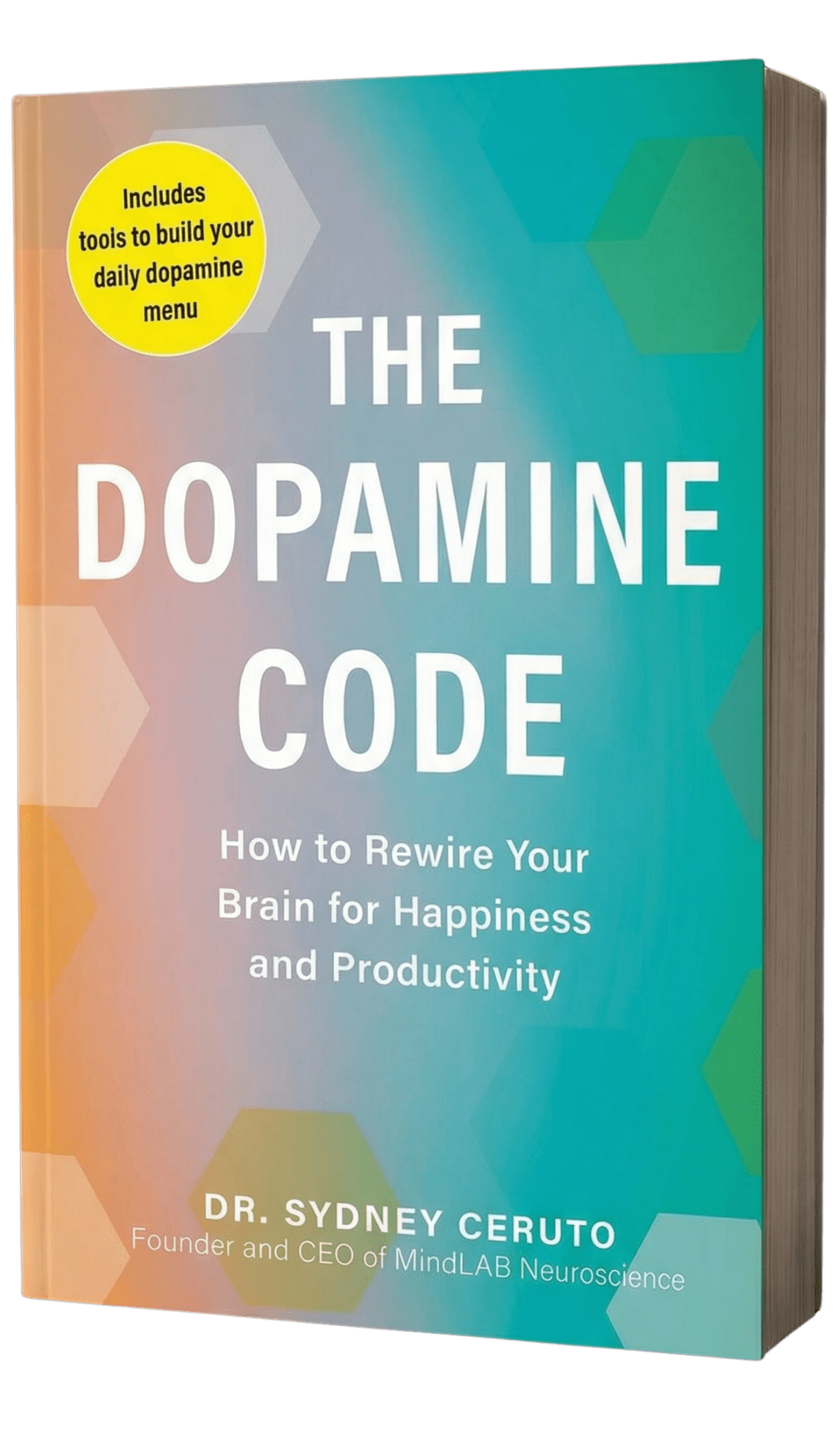
The Dopamine Code

Decode Your Drive

Why Your Brain Rewards the Wrong Things

Your brain's reward system runs every decision, every craving, every crash — and it was never designed for the life you're living. The Dopamine Code is Dr. Ceruto's framework for understanding the architecture behind what drives you, drains you, and keeps you locked in patterns that willpower alone will never fix.

Published by Simon & Schuster, The Dopamine Code is Dr. Ceruto's framework for building your own Dopamine Menu — a personalized system for motivation, focus, and enduring life satisfaction.

Order Now

Ships June 9, 2026

The Dopamine Code by Dr. Sydney Ceruto — Decode Your Drive
Locations

The Intelligence Brief

Neuroscience-backed analysis on how your brain drives what you feel, what you choose, and what you can’t seem to change — direct from Dr. Ceruto.