Neuroscience Advisory in Greenwich, CT

Where the densest concentration of private capital outside Manhattan meets the neuroscience to permanently rewire the patterns it creates.

Book a Strategy Call

Greenwich, Connecticut operates as the financial brain’s satellite — a town where the top quintile mean household income reaches $1,014,714 and the top 5% averages $1,575,147. Fifty-five percent of family households earn above $200,000 annually. From the private estates of Backcountry Greenwich — where mean household income ranges from $400,000 to over $600,000 — to the coastal density of Old Greenwich, where the median home value sits at $1.84 million and homeownership runs at 86%, this is a community defined by concentrated private wealth and the cognitive demands that sustain it.

More than 100 hedge funds operate within Greenwich’s borders, making it the single densest hedge fund community outside Manhattan. Private equity firms, family offices, and real estate investment operations cluster alongside them. The professional environment here does not permit coasting — it rewards pattern recognition at speed, risk calibration under uncertainty, and the capacity to sustain high-level cognitive output across years without visible degradation.

The patterns that emerge under this kind of sustained demand are neurological, not motivational. Decision architecture that once produced sharp outcomes begins generating hesitation. Sleep systems that once recovered overnight stop restoring fully. Relational dynamics that functioned under moderate pressure fracture when the cognitive load compounds beyond a threshold the brain was never designed to carry indefinitely. These are circuit-level problems — and they require circuit-level intervention.

How MindLAB Neuroscience Works with Clients in Greenwich, CT

Anxiety & Stress

When the brain’s threat-detection systems operate inside environments of constant financial risk, the calibration shifts. The amygdala — the brain’s threat-detection center — begins treating normal market volatility, portfolio reviews, and partner dynamics as genuine survival threats, flooding the prefrontal cortex with cortisol at precisely the moments that require the clearest thinking. Across Greenwich’s hedge fund and private equity landscape, this pattern compounds silently — showing up as shortened decision windows, a contracting tolerance for ambiguity, and the sense that every variable carries more weight than it should. Dr. Ceruto’s methodology identifies the specific circuits maintaining the elevated threat response and restructures them during live, high-pressure moments when the brain is most receptive to lasting change.

Sleep & Energy

The hypothalamic-pituitary-adrenal axis — the brain’s central stress-response system — is designed to downregulate when the environment signals safety. In a town where the professional rhythm rarely pauses, that signal never arrives. The result is a pattern familiar across Greenwich’s communities: full days of sharp cognitive output followed by nights where the brain refuses to stand down. Waking at 3 a.m. with a mind already running risk scenarios is not insomnia in the conventional sense — it is a stress-response system that has lost the ability to distinguish between active threat and residual activation. Dr. Ceruto works directly with the neural mechanisms governing arousal and restoration, restructuring the circuitry rather than layering behavioral strategies on top of a system that has been fundamentally miscalibrated.

Learn more

Career & Performance

Sustained high-level cognitive output creates a specific neural signature over time. The dorsolateral prefrontal cortex — the region responsible for strategic thinking and impulse control — gradually yields dominance to faster, more reactive subcortical systems. What emerges is a narrowing of cognitive flexibility — the capacity to hold multiple complex variables in working memory simultaneously — precisely when broader, more integrative thinking is required. Individuals managing concentrated portfolios, complex deal structures, or multi-entity family office operations often describe this as a plateau: external performance metrics remain strong while the internal experience of thinking has become shallower, faster, and less precise. Dr. Ceruto’s Real-Time Neuroplasticity™ protocol restores the balance between reactive and deliberative processing during actual professional demands.

Relationships & Dating

The neural systems that drive professional success and the systems that sustain intimate connection operate on fundamentally different circuits — and chronic activation of one suppresses the other. The ventromedial prefrontal cortex — the region governing emotional valuation and empathic processing — loses functional priority when the brain is locked in analytical, risk-assessing mode for extended periods. Across Greenwich’s communities, where professional demands intensify during the same life stages when personal relationships require the most investment, this competition between circuits produces a distinctive pattern: the ability to read a balance sheet with precision while struggling to read the emotional state of someone sitting across the dinner table. Dr. Ceruto maps the specific neural architecture driving this dissociation and restructures it during real relational moments.

Getting Here from Greenwich, CT

Greenwich connects to Midtown Manhattan via Metro-North’s New Haven Line, terminating at Grand Central Terminal. From Greenwich station, the ride is approximately 55 minutes. Old Greenwich and Cos Cob stations sit further along the line at 60 to 70 minutes depending on express service and time of day. Riverside residents typically board at the Riverside station for a similar travel time to Old Greenwich. All four stations offer frequent peak-hour service with reliable scheduling.

From Grand Central Terminal, MindLAB’s Midtown office at 31 West 34th Street, Suite 7118 is a 10-minute walk west — or one subway stop on the 1, 2, or 3 train to 34th Street–Penn Station.

Your New Haven Line ride is your transition space. The same commute that carries you into Manhattan for work carries you into a fundamentally different kind of engagement — one where the patterns you navigate daily in Greenwich’s high-demand professional environment become the raw material for permanent neural restructuring.

Dr. Sydney Ceruto, PhD — Founder, MindLAB Neuroscience

Dr. Sydney Ceruto holds a PhD in Behavioral & Cognitive Neuroscience from NYU and Master’s degrees in Clinical Psychology and Business Psychology from Yale University. She is a Lecturer in the Wharton Executive Development Program at the University of Pennsylvania, an Executive Contributor to Forbes Coaching Council, and an inductee in Marquis Who’s Who in America. Dr. Ceruto founded MindLAB Neuroscience in 2000 and has spent more than 26 years developing and refining her proprietary methodology, Real-Time Neuroplasticity™. She is the author of The Dopamine Code (Simon & Schuster, June 2026).

References

Arnsten, A. F. T. (2009). Stress signalling pathways that impair prefrontal cortex structure and function. Nature Reviews Neuroscience, 10(6), 410–422. https://doi.org/10.1038/nrn2648

Lupien, S. J., McEwen, B. S., Gunnar, M. R., & Heim, C. (2009). Effects of stress throughout the lifespan on the brain, behaviour and cognition. Nature Reviews Neuroscience, 10(6), 434–445. https://doi.org/10.1038/nrn2639

Ochsner, K. N., & Gross, J. J. (2005). The cognitive control of emotion. Trends in Cognitive Sciences, 9(5), 242–249. https://doi.org/10.1016/j.tics.2005.03.010

Walker, M. P. (2009). The role of sleep in cognition and emotion. Annals of the New York Academy of Sciences, 1156(1), 168–197. https://doi.org/10.1111/j.1749-6632.2009.04416.x

Success Stories

“I struggled with debilitating anxiety for years, trying countless therapies and medications with little success. Finding Dr. Ceruto and her neuroscience-based approach was truly life-changing. From our very first session, her deep knowledge of brain science and how it applies to anxiety gave me real hope. What sets her apart is that perfect blend of expertise and compassion — she genuinely cared about my progress and responded quickly even outside of our scheduled sessions. I can now enjoy social situations and excel at work.”

Brian T. — Architect Chicago, IL

“Four hours a night for over two years — that was my ceiling. Supplements, sleep protocols, medication — nothing touched it because nothing addressed why my brain wouldn't shut down. Dr. Ceruto identified the cortisol loop that was keeping my nervous system locked in a hypervigilant state and dismantled it. I sleep now. Not because I learned tricks — because the pattern driving the insomnia no longer exists.”

Adrian M. — Hedge Fund Manager New York, NY

“Color-coded calendars, alarms, accountability partners — I'd built an entire scaffolding system just to stay functional, and none of it addressed why my brain couldn't sequence and prioritize on its own. Dr. Ceruto identified the specific prefrontal pattern that was misfiring and restructured it. I don't need the scaffolding anymore. My brain actually does what I need it to do.”

Jordan K. — Venture Capitalist San Francisco, CA

“Every close relationship I had eventually hit the same wall — I'd flood emotionally and shut down or explode, and nothing I'd tried gave me real control over it. Dr. Ceruto identified that my autonomic nervous system was defaulting to fight-or-flight the moment real intimacy was on the line. She didn't give me coping tools. She restructured the default. The flooding stopped because the trigger architecture changed.”

Simone V. — Publicist New York, NY

“I came to Dr. Ceruto thinking I needed help with my career, but she quickly recognized that the real roadblocks were the relationships I was choosing and how I dealt with conflict. With her support, I finally left unhealthy situations I’d struggled to end for years. She helped me identify deep-seated patterns I didn’t realize were holding me back. I never feel rushed, and she follows up with detailed written insights I reflect on for weeks. She uncovered major blockers I would never have spotted alone.”

Rachel L. — Brand Strategist Montecito, CA

“Dr. Ceruto's methodology took me from a founder on the verge of quitting to a leader capable of building the team and culture that drove Liquid IV's success. Her ability to restructure how I make decisions and lead under pressure changed the trajectory of the entire company. I don't say that lightly. The company I built after working with her was fundamentally different from the company I was building before — because I was fundamentally different.”

Brandin C. — Tech Founder Los Angeles, CA

Frequently Asked Questions — Greenwich, CT

What is neuroscience advisory in Greenwich, CT?

Neuroscience advisory applies the science of how the brain forms, maintains, and restructures behavioral patterns to the specific challenges facing individuals in high-demand environments. Rather than revisiting past events or building coping strategies, Dr. Sydney Ceruto identifies the neural circuits — the specific pathways encoding the unwanted pattern — and restructures them during real-time, high-stakes moments when the brain is biologically primed for change. For individuals across Greenwich’s communities, from Backcountry to Old Greenwich and Riverside, this means addressing the root neural architecture driving anxiety, sleep disruption, relational strain, or performance plateaus — not managing their surface-level symptoms.

How does MindLAB Neuroscience work with clients in Greenwich, CT?

Dr. Ceruto operates as an embedded cognitive partner — available across every domain of a client’s life, not confined to scheduled interactions. The work is grounded in Real-Time Neuroplasticity™, a proprietary methodology that intervenes during live emotional and cognitive events rather than analyzing them after the fact. Clients across Greenwich access Dr. Ceruto’s Midtown Manhattan office via Metro-North’s New Haven Line to Grand Central Terminal, with the relationship extending continuously between engagements through text, call, and shared documentation.

How do I get to MindLAB's office from Greenwich, CT?

MindLAB’s Midtown Manhattan office is located at 31 West 34th Street, Suite 7118, New York, NY 10001. Metro-North’s New Haven Line runs from Greenwich, Old Greenwich, Cos Cob, and Riverside stations directly to Grand Central Terminal. Travel time ranges from approximately 55 minutes (Greenwich station) to 70 minutes (Cos Cob). From Grand Central, the office is a 10-minute walk west or one subway stop on the 1, 2, or 3 train to 34th Street–Penn Station. The commute is direct, predictable, and integrates seamlessly into an existing professional routine.

What does the Strategy Call involve?

The Strategy Call is a focused, phone-based conversation with Dr. Ceruto — conducted by phone intentionally, as research shows that eliminating visual stimuli activates deeper processing pathways and produces greater clarity. During the call, Dr. Ceruto assesses the specific patterns you want to address, identifies the likely neural mechanisms involved, and determines whether her methodology is the right fit. The call is $250 and serves as a mutual assessment — not a sales conversation. Program structure and investment details are discussed during the Strategy Call.

Why do patterns persist in Greenwich's high-performing professional community despite abundant resources and self-awareness?

The capacity to identify a problematic pattern and the neural architecture required to override it are two entirely separate processes. The prefrontal cortex can recognize a recurring pattern with precision — the same analytical sharpness that drives professional success in Greenwich’s hedge fund, private equity, and family office environment — while the subcortical circuits encoding that pattern continue firing automatically. This is why individuals who are exceptionally self-aware still experience the same anxiety responses, the same sleep disruption, and the same relational friction despite clearly understanding what is happening. The gap is not a failure of effort or insight. It is a structural feature of how neural pathways are encoded, and closing it requires restructuring the pathway itself through targeted, real-time intervention — not layering additional awareness on top of a circuit that is operating exactly as it was trained.

Begin with a Strategy Call

New Outcomes Require New Neural Pathways

Schedule Your Strategy Call
MindLAB Neuroscience consultation room

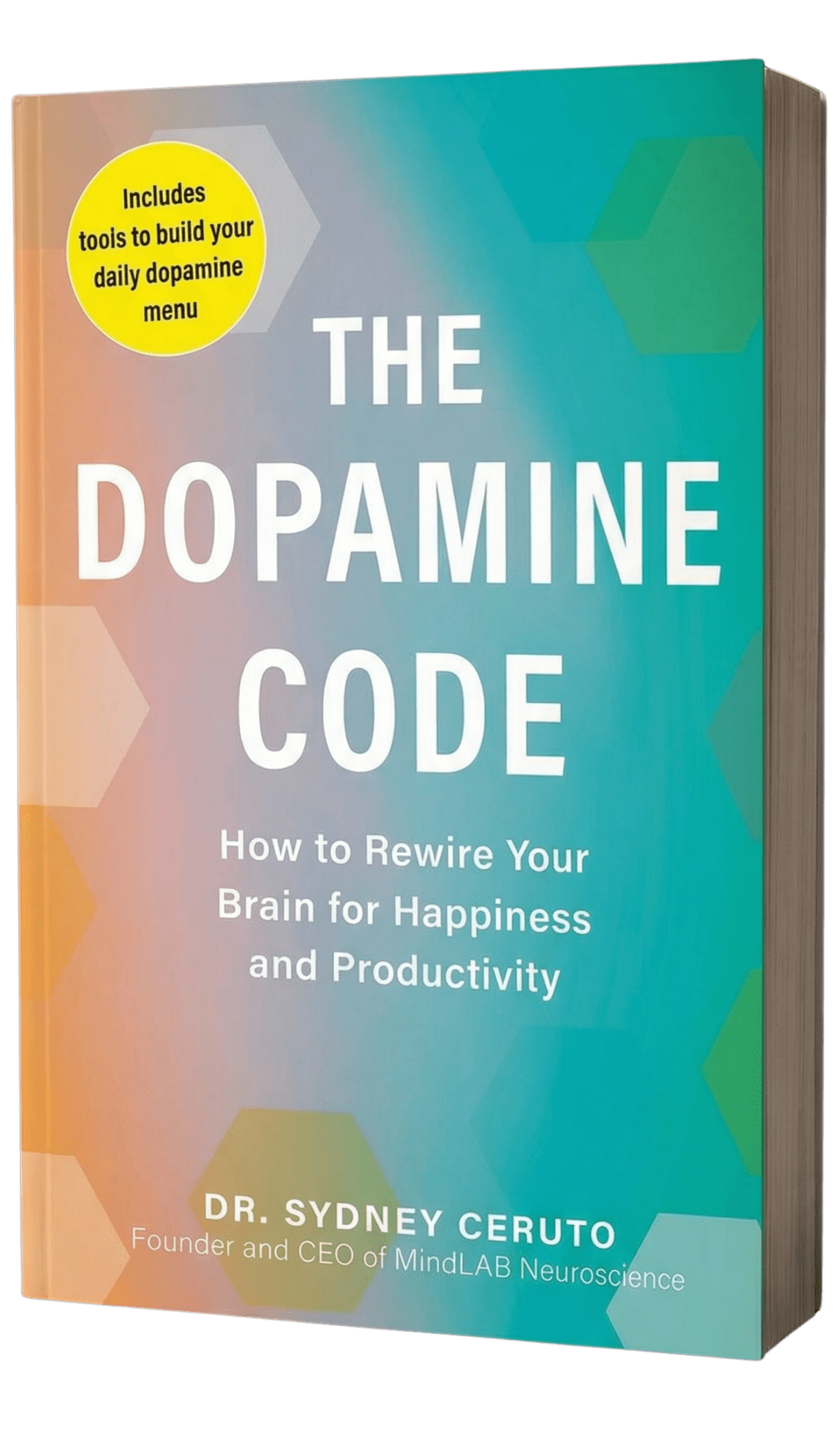
The Dopamine Code

Decode Your Drive

Why Your Brain Rewards the Wrong Things

Your brain's reward system runs every decision, every craving, every crash — and it was never designed for the life you're living. The Dopamine Code is Dr. Ceruto's framework for understanding the architecture behind what drives you, drains you, and keeps you locked in patterns that willpower alone will never fix.

Published by Simon & Schuster, The Dopamine Code is Dr. Ceruto's framework for building your own Dopamine Menu — a personalized system for motivation, focus, and enduring life satisfaction.

Order Now

Ships June 9, 2026

The Dopamine Code by Dr. Sydney Ceruto — Decode Your Drive
Locations

The Intelligence Brief

Neuroscience-backed analysis on how your brain drives what you feel, what you choose, and what you can’t seem to change — direct from Dr. Ceruto.