





Childhood Patterns & Adult Behavior in Lisbon

Lisbon drew people who came to create distance from the patterns they grew up in. The brain did not interpret distance as change. The patterns made the trip.

The patterns that feel most like personality — the reflexive self-protection, the relationships that repeat, the situations you keep finding yourself in despite knowing better — often have nothing to do with character. They are neural architecture, encoded before you had language to name them. At MindLAB Neuroscience, I work with adults whose earliest experiences wrote behavioral programs that have been running, largely unexamined, ever since.

Understanding why childhood experiences persist into adult behavior is not a philosophical question. It is a neuroscientific one. The brain encodes early relational and environmental experiences as foundational operating principles — not memories exactly, but structural patterns that shape perception, reaction, and relationship long after the original circumstances have ended. Insight into this fact rarely dissolves the patterns. The work that changes them operates at a different level.

Book a Strategy Call

How Early Experience Becomes Neural Architecture

The developing brain is not a passive recorder of childhood events. It is an active prediction engine — and in its earliest years, it is building its most fundamental model of the world. What are other people likely to do? Is the environment safe or threatening? Do needs get met or do they go unacknowledged? These are not beliefs the child consciously forms. They are encoded as structural biases in the brain’s prediction and response systems.

The hippocampus — involved in memory formation and contextual learning — is especially sensitive to early experience. It builds the templates that allow the adult brain to recognize and categorize situations: this is familiar, this is safe, this is the kind of moment where I need to be careful. When the early environment was unpredictable, chaotic, or emotionally withholding, those templates reflect that reality. The adult brain then perceives the world through a lens calibrated for conditions that may no longer exist.

This is why insight doesn’t dissolve the patterns. Knowing that a reaction is disproportionate — recognizing intellectually that the current situation is not as dangerous as it feels — does not override templates that were encoded before the reasoning brain was functional. The cortical systems responsible for self-awareness and rational reflection came online years after the subcortical systems that wrote the original operating manual. By the time the adult has the language to examine those early experiences, the behavioral programs have already been running for decades.

Attachment Patterns and the Relational Brain

Among the most consequential encoding that happens in early childhood is the attachment system — the brain’s template for what closeness feels like, how reliable other people are, and what to expect when vulnerability is expressed. This system is not a set of beliefs. It is a neural architecture, built in relationship with early caregivers and used by the adult brain as the baseline for reading every subsequent relationship.

When attachment patterns were formed in consistent, responsive environments, the adult brain approaches closeness with something close to ease. When those patterns were formed in environments marked by inconsistency, emotional unavailability, or unpredictability, the adult brain approaches closeness with a residual alertness that the conscious mind did not choose. Pulling away before being left. Monitoring for signs of rejection before rejection arrives. Suppressing needs because expressing them once produced nothing or made things worse.

These are not personality traits. They are survival adaptations that once had a function, and that the brain continues to deploy because they were encoded as reliable responses — not because the adult has decided to operate this way, but because the system encoded in early childhood is still running the relational calculus.

Why Repeating Patterns Persist Across Decades

The brain is wired for efficiency. Once a behavioral sequence has been encoded and used repeatedly, the neural pathways supporting it become increasingly automatic. The pattern runs with less and less conscious involvement. This is an asset when the encoded behaviors are adaptive. It becomes a liability when the encoded behaviors were survival strategies appropriate to an unsafe or unpredictable early environment — deployed now in contexts where they create the very outcomes the adult is trying to avoid.

The relationship that mirrors earlier relational dynamics. The professional environment that recreates the emotional atmosphere of the family of origin. The automatic response that arrives before thought — the shutdown, the over-explanation, the sudden withdrawal — that leaves the adult wondering why they keep ending up here. These repetitions are not failure of will or insight. They are the product of deeply encoded neural patterns doing exactly what they were designed to do: respond to familiar inputs with familiar outputs.

There is also an attentional mechanism at work. The brain does not process all environmental inputs neutrally. It has learned — from early experience — which signals to prioritize. If early relational environments required constant monitoring for shifts in mood, tone, or safety, the adult brain remains exquisitely attuned to exactly those signals. It perceives them faster, weights them more heavily, and responds more automatically than someone who did not require that level of vigilance to navigate childhood. The patterns do not just drive behavior. They shape what the brain notices in the first place.

What Changes When the Patterns Change

The encoded patterns from early experience are not fixed. The same plasticity that allowed early experience to write such durable programs allows those programs to be updated — when the work is targeted at the level of the brain rather than the level of insight and interpretation alone.

The changes that become possible when early-encoded patterns are genuinely addressed are not subtle. Relationships that previously triggered automatic defensive responses begin to feel different at the level of immediate perception — not just understood differently, but experienced differently. The familiar constriction at the moment of potential closeness changes. The hyper-vigilance that scanned for danger in ordinary social situations quiets. The pull toward repetitive situations weakens not because the adult has resolved to do better, but because the neural calculation underlying those pulls has genuinely shifted.

This is the distinction that matters: understanding childhood patterns is different from changing them. Many people have arrived, through years of reflection or prior work, at a very accurate account of where their patterns came from. The account is correct. The pattern is still running. What remains is not more insight. It is work at the level where the patterns actually live — the encoded architecture of a brain that learned its most fundamental operating principles before the reasoning mind was present to question them.

If you recognize the patterns — the relational repetitions, the reflexive responses, the situations you keep navigating despite knowing their terrain — and understanding them has not been enough to change them, that is a precise description of where neuroscience-based work begins.

Antique rosewood desk with crystal brain sculpture and MindLAB journal in warm amber Lisbon afternoon light with historic European wood paneling

Why Childhood Patterns & Adult Behavior Matters in Lisbon

Lisbon draws people who made a deliberate decision to put distance between themselves and the family systems they came from. The geographic fact is real. The neural fact is that the brain does not process distance as change. The attachment patterns, the relational templates, the reflexive responses that were encoded in childhood travel in the person’s nervous system — not in the house they left behind.

The digital nomad and expat community concentrated in Príncipe Real, Santos, and the LX Factory orbit is unusually self-aware about this dynamic, which makes it both easier and harder to address. Easier because the vocabulary for discussing family-of-origin patterns is present and relatively normalized in this community. Harder because the intellectual understanding — knowing that the patterns followed — coexists with a continued hope that the distance will eventually do what distance cannot do. The brain does not update childhood encoding through geography.

Portuguese families carry a specific generational pattern worth naming. The Salazar era encoded silence, endurance, and the management of authority as foundational social and relational principles across multiple generations. For Portuguese adults raised in families where these patterns were transmitted — and for expats in relationship with Portuguese partners or embedded in Portuguese social networks — this generational encoding shapes relational dynamics in ways that can be difficult to locate precisely because the pattern is so normalized within the culture. Authority is not questioned. Emotional expression has a ceiling. Endurance is a virtue that can also be a suppression mechanism.

The expat community’s social structure creates surrogate family systems that often replicate the essential dynamics of the original ones. The Sunday market ritual at LX Factory, the regular meetup group, the co-working community — these are not neutral social arrangements for people whose childhood attachment patterns were insecure or unpredictable. They are relational environments in which those patterns immediately become active. The brain scans for familiar dynamics because familiarity is what the attachment system knows. People end up, in their Lisbon social networks, navigating versions of the same relational architecture they left behind in Brooklyn or Toronto or São Paulo.

The most common presentation in this population is not acute distress. It is a low-grade confusion — the sense that the move worked in every practical respect, that Lisbon is genuinely better on the measurable dimensions that drove the decision, and that something is still not resolved in a way that geography was supposed to address. The relationship patterns are the same. The anxiety has relocated but not diminished. The family role — the one who manages, or the one who disappears, or the one who holds everyone together — has been recreated in the new social context without anyone intending it.

The work that addresses this is not about whether the move was the right decision. That is not the relevant question for the brain. The relevant question is what the encoding from the original family system is still telling the adult nervous system to do — and how to update that encoding now that the circumstances have genuinely changed.

If you are in Lisbon and the patterns followed — if the relational dynamics or emotional responses that were present before the move are present here too, in different costumes — a Strategy Call is the beginning of working on the architecture rather than the address. Phone only. $250. Scheduled to your timezone.

Dr. Sydney Ceruto, PhD — Founder, MindLAB Neuroscience

Dr. Sydney Ceruto, PhD — Founder & CEO, MindLAB Neuroscience

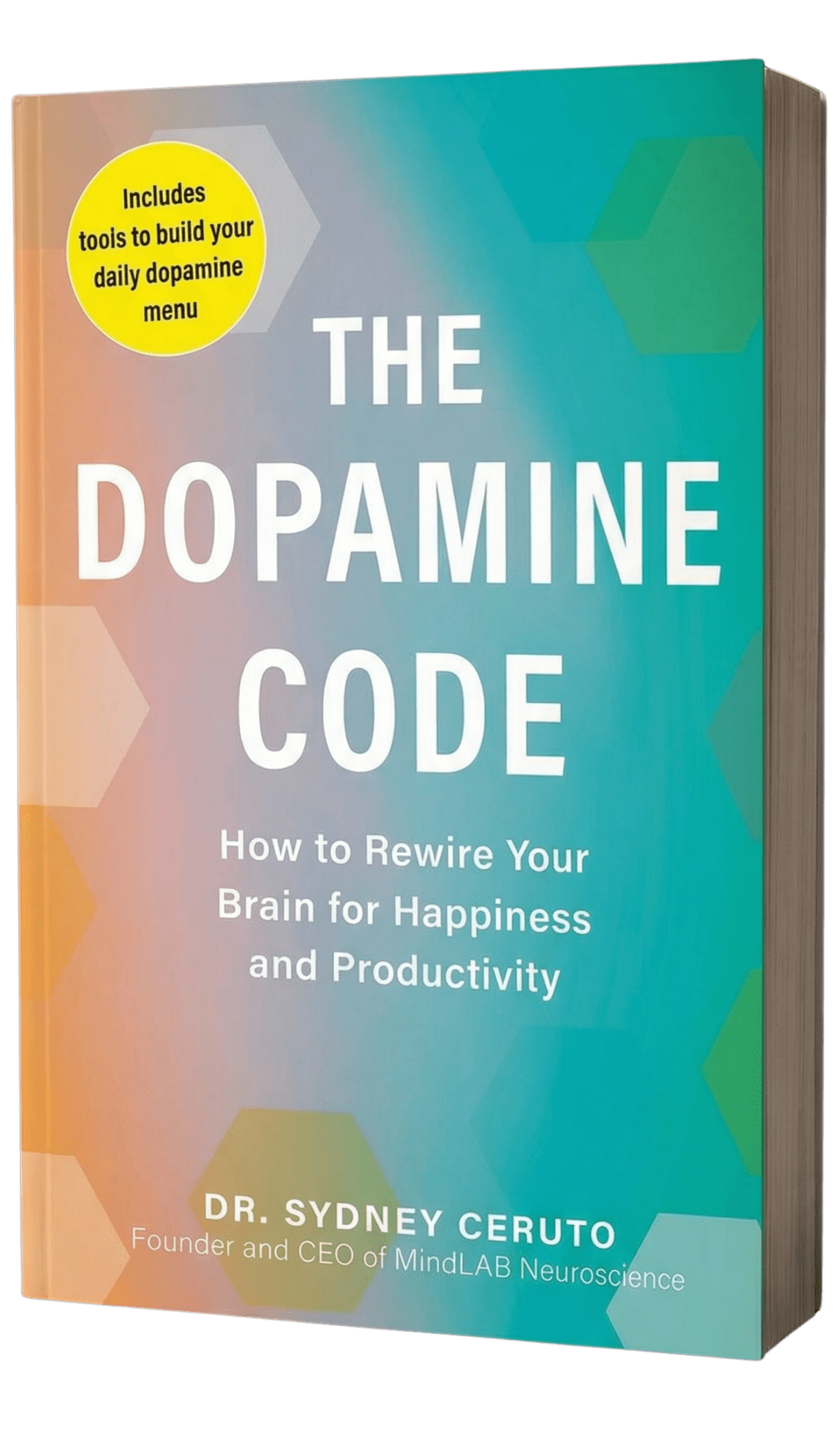
Dr. Ceruto holds a PhD in Behavioral & Cognitive Neuroscience from NYU and two Master’s degrees from Yale University. She lectures at the Wharton Executive Development Program at the University of Pennsylvania and has been an Executive Contributor to the Forbes Coaching Council since 2019. Dr. Ceruto is the author of The Dopamine Code (Simon & Schuster, June 2026). She founded MindLAB Neuroscience in 2000 and has spent over 26 years pioneering Real-Time Neuroplasticity™ — a methodology that permanently rewires the neural pathways driving behavior, decisions, and emotional responses.

References

Schore, A. N. (2001). Effects of a secure attachment relationship on right brain development, affect regulation, and infant mental health. *Infant Mental Health Journal*, 22(1–2), 7–66. https://doi.org/10.1002/1097-0355(200101/04)22:13.0.CO;2-N

Siegel, D. J. (1999). *The Developing Mind: How Relationships and the Brain Interact to Shape Who We Are*. Guilford Press.

Lupien, S. J., McEwen, B. S., Gunnar, M. R., & Heim, C. (2009). Effects of stress throughout the lifespan on the brain, behaviour and cognition. *Nature Reviews Neuroscience*, 10(6), 434–445. https://doi.org/10.1038/nrn2639

Tottenham, N. (2012). Human amygdala development in the absence of species-expected caregiving. *Developmental Psychobiology*, 54(6), 598–611. https://doi.org/10.1002/dev.20531

Success Stories

“I could perform at the highest level professionally and still feel hijacked emotionally in my closest relationships. Dr. Ceruto identified the limbic imprint — an amygdala encoding from childhood that was running every intimate interaction I had. She dismantled it. The reactivity isn't something I regulate anymore. The pattern that generated it is gone.”

Natasha K. — Art Advisor Beverly Hills, CA

“The numbness crept in so gradually I didn't notice until I couldn't feel anything — not stress, not connection, not even relief when things went well. Dr. Ceruto identified it as a dorsal vagal shutdown — my nervous system had flatlined as a survival strategy. Within ninety days, the signal came back. I feel things again, clearly and without overwhelm.”

Marcus H. — Fund Manager Dallas, TX

“Every close relationship I had eventually hit the same wall — I'd flood emotionally and shut down or explode, and nothing I'd tried gave me real control over it. Dr. Ceruto identified that my autonomic nervous system was defaulting to fight-or-flight the moment real intimacy was on the line. She restructured the default. The flooding stopped because the trigger architecture changed.”

Simone V. — Publicist New York, NY

“Unfortunate consequences finally forced me to deal with my anger issues. Nothing was clicking until I found Sydney's approach. Her insightfulness and warm manner helped me through a very low point in my life. Together we worked through all my pent-up anger and rage, and she gave me real tools to manage it going forward. I now work to help others learn how to control their own anger.”

Gina P. — Trial Attorney Naples, FL

“The same relational patterns my mother and grandmother lived through kept repeating in my own life — the hypervigilance, the emotional shutdown, the inability to feel safe even when nothing was wrong. Dr. Ceruto identified the epigenetic stress signatures driving the pattern and restructured them at the neurological level. The cycle that ran through three generations stopped with me.”

Gabriela W. — Real Estate Developer Miami, FL

“Dr. Ceruto restructured how I show up in high-stakes conversations. The blind spots I couldn’t see for years became visible in our first sessions. I went from an overwhelmed Managing Director to a leader people actually want to follow. The change wasn’t cosmetic — it was architectural. The way I process high-pressure interactions is fundamentally different now.”

Matteo R. — Investment Banker London, UK

Frequently Asked Questions About Childhood Patterns & Adult Behavior

Why do I keep ending up in the same kinds of relationships even when I know better?

Because knowing better is a cortical function — reasoning, self-awareness, conscious intention — and the patterns driving repetitive relationship dynamics were encoded in subcortical systems before the cortex was fully functional. The attachment templates built in early childhood operate faster than conscious thought. They shape what the brain finds familiar, what reads as safe or dangerous, and what relational dynamics feel natural — before the reasoning mind has an opportunity to weigh in. Insight into this fact is accurate and useful, but it doesn't override the encoding. The work that changes repetitive relationship patterns has to target the templates themselves, not the awareness of them.

What does it mean that childhood experiences are "encoded" in the brain?

Early experiences don't just leave memories — they shape the structure of the developing brain's prediction and response systems. When early environments were consistently responsive, the brain builds templates for navigating the world that reflect that consistency. When early environments were unpredictable, chaotic, or emotionally unavailable, the brain builds templates calibrated for those conditions. The encoding is not abstract. It is structural — it influences what the adult brain perceives, how it weighs information, which responses it generates automatically, and what feels familiar versus threatening. This is why early experience has such durable effects on adult behavior: it is part of the architecture, not just the history.

I've done a lot of work on myself. I understand my childhood clearly. Why haven't the patterns changed?

Understanding and changing operate through different neural systems. The prefrontal cortex — involved in self-reflection, narrative construction, and conscious insight — can develop an accurate and detailed account of childhood experiences and their effects. But the systems that generate the actual behavioral patterns were encoded earlier, in circuits that are not directly controlled by conscious awareness. Many people arrive with a very accurate account of their history and a pattern that is running exactly as it always has. The insight is not wrong. The mechanism it is trying to reach is simply not accessible through insight alone. Work that engages the encoding directly produces different results than work that adds more understanding to existing understanding.

How is what you do different from talking about my childhood in therapy?

I am not a therapist and this is not a therapeutic relationship. The difference is methodological: the focus is on the neural mechanisms generating the patterns, not on the narrative of the experiences that produced them. Many people have spent significant time in talk-based approaches developing a thorough account of their history — and the patterns are still running. The account may be entirely accurate. What it doesn't do is update the subcortical encoding that is producing the behavioral output. Working at the level of the brain rather than the level of the story produces changes that feel qualitatively different — not a better understanding of the pattern, but an actual change in what the pattern generates.

Are childhood-encoded patterns the same thing as attachment patterns?

Attachment patterns are one of the most consequential categories of childhood encoding, but not the only one. The brain encodes many foundational operating principles from early experience: what environments are safe or dangerous, how performance relates to belonging, what emotional expression is acceptable, how hierarchy functions, what to expect from caregivers and authority figures. Attachment patterns specifically concern the relational templates built through early caregiver relationships — the brain's baseline model for how closeness works, how reliable other people are, and what happens when vulnerability is expressed. These patterns are particularly durable because the attachment system is one of the earliest and most fundamental neural systems to develop.

My childhood wasn't traumatic. Can early experiences still drive adult patterns?

Yes. The childhood experiences that produce the most durable adult patterns are often not the dramatic or recognizable ones. A household that was consistently emotionally unavailable — not abusive, just not attuned — encodes a specific set of relational expectations that shape adult behavior as reliably as more acute experiences. A family system with high performance expectations and implicit conditional approval encodes patterns that run throughout adulthood regardless of whether any single event would register as traumatic. The encoding happens through the accumulated atmosphere of early experience, not only through specific incidents. The absence of rupture does not mean the absence of formative neural encoding.

Is it possible to fully change childhood-encoded patterns, or just manage them?

The neural systems underlying these patterns are plastic — they can be genuinely updated, not just managed. The experience of people who have done this work successfully is qualitatively different from management: the relational response that previously arrived automatically simply doesn't arrive at the same intensity or frequency. The familiar pull toward particular relational dynamics weakens. The threat detection calibrated for an early environment that no longer exists begins to recalibrate to current conditions. This is not suppression or compensation. It is structural change in the encoding — which means the change is stable rather than requiring ongoing conscious effort to maintain.

How do I know if my current difficulties are driven by childhood patterns or just current circumstances?

The clearest signal is the quality of repetition. Circumstances change; encoded patterns repeat across different circumstances. If the same relational dynamic appears in multiple relationships across different contexts, if the same emotional response arrives in situations that don't objectively warrant it, if a reaction feels larger or older than the current moment — these are markers of encoding rather than circumstance. Another signal is the gap between understanding and response: when someone can accurately predict how they will react to a situation, explains it clearly, and then reacts that way anyway despite not wanting to. That gap — between what is known and what the nervous system does — is the signature of a deeply encoded pattern running below the level of conscious intention.

What happens in a Strategy Call?

A Strategy Call is a focused, one-hour phone conversation — $250 — in which we examine your specific patterns, their likely neural origins, and what the work of addressing them at that level would actually involve. It is not a consultation designed to sell a program. It is a real assessment of where the patterns come from, what mechanisms are sustaining them, and what kind of work would produce genuine change. You will leave with a clearer understanding of what is happening in your nervous system and what would need to be different for the patterns to shift. If there is a fit for deeper work, we discuss what that looks like. If there isn't, the hour still produces useful clarity.

Can childhood patterns that were encoded before I have memories of them still be changed?

Yes — and this is one of the most important points about how this work functions. The neural encoding that produces the most durable adult patterns often happened before explicit memory was available. The brain's systems for building relational templates and foundational operating principles are active from birth, well before the hippocampal-dependent memory systems that store biographical narrative are mature. This means the patterns that run most automatically — the ones with no clear memory attached, that simply feel like "how things are" — are often the product of the earliest encoding. They do not require a narrative account to be changed. The work addresses the encoding directly, not through recovering the story behind it.

Also available in: Miami · Wall Street · Midtown Manhattan · Beverly Hills

Take the First Step

The Strategy Call is a focused conversation with Dr. Ceruto that maps the specific neural mechanisms driving your concerns and determines the right path forward.

Book a Strategy Call
MindLAB Neuroscience consultation room
Locations

The Intelligence Brief

Neuroscience-backed analysis on how your brain drives what you feel, what you choose, and what you can’t seem to change — direct from Dr. Ceruto.