Key Points
- Major life transitions trigger a neural reorganization period where the brain is exceptionally receptive to permanent structural change.
- Without guided intervention, the brain defaults to threat-based wiring that prioritizes survival over growth.
- Real-Time Neuroplasticity™ works during the live consolidation window, not after patterns have already hardened.
- Identity, decision-making capacity, and emotional regulation all restructure simultaneously during major transitions.
- Dr. Ceruto’s methodology produces permanent architectural change, eliminating the need for ongoing maintenance or coping strategies.
| Marker | Traditional Approach | Neuroscience-Based Approach | Why It Matters |
|---|---|---|---|
| Approach | Conventional Support | Self-Directed Adaptation | Real-Time Neuroplasticity™ |
| Timing | After patterns solidify | Reactive, unstructured | During the neural consolidation window |
| Target | Emotional coping | Surface-level habit changes | Neural pathway architecture |
| Duration of results | Requires ongoing maintenance | Inconsistent, often temporary | Permanent structural rewiring |
| Identity integration | Narrative processing only | Trial and error | Guided neural identity reconstruction |
| Personalization | Protocol-based frameworks | Generic advice and books | Mapped to your specific neural patterns |
Why Life Transition Navigation Matters in Lisbon
Why Lisbon Has Become a Transition Capital
Lisbon has absorbed one of Europe’s most concentrated waves of international relocation since 2019. Portugal’s Non-Habitual Resident tax regime, the D7 visa program, and the city’s emergence as a European tech hub drew thousands of professionals from the United States, United Kingdom, and Northern Europe. By 2024, Lisbon’s foreign-born population had grown by over 40%, transforming neighborhoods like Principe Real, Santos, and Estrela into international enclaves.
These relocations look like fresh starts. The brain experiences them as comprehensive identity disruptions. Language barriers, cultural recalibration, timezone straddling for those maintaining US or UK business relationships, and the loss of established social infrastructure all compound simultaneously. The prefrontal cortex — responsible for planning and self-regulation — faces a processing load that most people dramatically underestimate before they move.
The Avenida da Liberdade attracts luxury-sector professionals. The riverside neighborhoods of Belém and Alcântara draw families seeking quality of life. Each enclave represents a different version of the same neurological challenge. The brain has to build new identity architecture from scratch while the old architecture keeps running in the background, producing a persistent sense of displacement.
The Expatriate Transition Paradox
Lisbon’s startup ecosystem attracts founders and remote professionals who chose the move deliberately. Web Summit’s permanent relocation and the tech clusters in Parque das Nações anchored the city’s reputation as a European innovation center. The paradox is that voluntary transitions can be neurologically harder than forced ones. When the brain expects improvement and encounters disorientation instead, the mismatch between expectation and reality generates a specific form of cognitive distress.
The Chiado and Baixa districts pulse with an energy that masks the isolation many transplants experience. Portuguese social networks are deeply rooted and take years to penetrate. International residents often build surface-level social connections quickly but struggle with the deeper belonging that the brain requires for genuine settlement. The default mode network — the system governing self-narrative — keeps running the old identity in parallel with the new one, creating a persistent sense of living between two lives.
How Dr. Ceruto Works With Lisbon’s Transition Population
Dr. Ceruto’s Real-Time Neuroplasticity™ methodology is particularly well-suited to the international relocation transition. The work addresses the neural architecture directly during the consolidation window when new identity patterns are forming. For Lisbon’s expatriate population, this means the early months of relocation become a structured opportunity for genuine reinvention rather than an extended period of low-grade disorientation.
The amygdala — the brain’s threat-detection center — processes cultural unfamiliarity as potential danger. Simple daily tasks — navigating bureaucracy in Portuguese, reading social cues in a new cultural context, managing a household across different systems — each trigger small stress responses that accumulate. Dr. Ceruto recalibrates these responses at the neural level so the brain treats the new environment as home rather than hostile territory.

Sessions are conducted by phone, which accommodates Lisbon’s timezone overlap with US East Coast business hours. The methodology does not require geographic proximity, making it accessible to clients who split time between Lisbon and other cities. Whether the transition involves a full relocation, a dual-continent lifestyle, or a return home after years abroad, the work addresses the neural architecture that determines how that change integrates into who you become.

Dr. Sydney Ceruto, PhD — Founder & CEO, MindLAB Neuroscience
Dr. Ceruto holds a PhD in Behavioral & Cognitive Neuroscience from NYU and two Master’s degrees from Yale University. She lectures at the Wharton Executive Development Program at the University of Pennsylvania and has been an Executive Contributor to the Forbes Coaching Council since 2019. Dr. Ceruto is the author of The Dopamine Code (Simon & Schuster, June 2026). She founded MindLAB Neuroscience in 2000 and has spent over 26 years pioneering Real-Time Neuroplasticity™ — a methodology that permanently rewires the neural pathways driving behavior, decisions, and emotional responses.
Success Stories
“The way I was processing decisions under pressure had a cost I couldn't see — until Dr. Ceruto mapped it. She identified the neural pattern driving my reactivity in high-stakes situations and restructured it at the root. I don't just perform better under pressure now. I think differently under pressure. That's not something any executive coach or performance program ever came close to delivering.”

“Four hours a night for over two years — that was my ceiling. Supplements, sleep protocols, medication — nothing touched it because nothing addressed why my brain wouldn't shut down. Dr. Ceruto identified the cortisol loop that was keeping my nervous system locked in a hypervigilant state and dismantled it. I sleep now. Not because I learned tricks — because the pattern driving the insomnia no longer exists.”

“I'd optimized everything — diet, fitness, sleep — but my cognitive sharpness was quietly declining and no one could explain why. Dr. Ceruto identified the synaptic density patterns that were thinning and built a protocol to reverse the trajectory. This wasn't prevention in theory. My neuroplasticity reserve is measurably stronger now than it was three years ago. Nothing I'd tried before even addressed the right problem.”

Identifying details withheld to protect client confidentiality.
All outcomes represent genuine engagements with Dr. Ceruto.
Frequently Asked Questions About Life Transition Navigation
What qualifies as a major life transition?
Any event that fundamentally disrupts your established patterns, identity, or direction. International relocations, career pivots, relationship endings, family restructuring, retirement, or the loss of someone central to your life. The shared characteristic is that the brain’s existing wiring no longer matches current reality.
I moved to Lisbon by choice but feel more lost than before. Is that normal?
Extremely common. Voluntary transitions can be neurologically harder than forced ones because the brain expects improvement and encounters disorientation instead. The gap between expectation and reality generates a specific cognitive distress that many Lisbon transplants describe as feeling ungrateful or confused about a decision they are certain was right. It is a neural pattern, not a character flaw.
How does Real-Time Neuroplasticity™ work for international relocations?
Dr. Ceruto identifies the neural patterns consolidating during your relocation and intervenes while they are still forming. For international moves, this includes identity architecture, cultural processing circuits, and the threat-detection responses that treat unfamiliarity as danger. The methodology ensures new wiring supports genuine settlement rather than prolonged disorientation.
What does the Strategy Call involve?
A focused phone conversation with Dr. Ceruto. She maps the specific neural mechanisms driving your current experience and determines whether her methodology is the right fit. The call costs $250 and is conducted by phone — an intentional format that activates deeper processing by eliminating visual distractions.
Can Dr. Ceruto work across the Lisbon timezone?
Yes. Lisbon operates on Western European Time, which overlaps with US East Coast business hours in the morning. All sessions are conducted by phone, and scheduling accommodates international clients across multiple timezones. Many Lisbon-based clients maintain this flexibility as part of their dual-continent working patterns.
How long does the process take?
Duration depends on the transition’s complexity. Single-domain relocations often show measurable shifts within weeks. Layered transitions — relocation combined with career change, relationship restructuring, or family dynamics — may require longer engagement. Program structure and investment details are discussed during the Strategy Call.
What if I have been in Lisbon for over a year and still feel unsettled?
The brain does not resolve unstructured transitions on a timeline. If the patterns that formed during your relocation were never properly guided, they persist. Many long-term expatriates carry a low-grade identity fragmentation for years without recognizing it as a neurological pattern. Dr. Ceruto’s methodology intervenes at any stage.
Is this relevant for someone returning to their home country after living abroad?
Absolutely. Reverse culture shock is a documented neurological phenomenon. The brain adapted to the foreign environment and now treats the home country as unfamiliar. The identity architecture built abroad does not automatically deactivate upon return. The reintegration transition is often harder than the original move.
How is this different from conventional expatriate support?
Conventional approaches focus on practical logistics and emotional coping. Dr. Ceruto’s methodology works at the level of neural architecture during the consolidation window, producing permanent structural change. The result is genuine cognitive and emotional settlement, not surface-level adaptation.
Is everything confidential?
Yes. Confidentiality is absolute. No client information is ever disclosed. The phone-based format provides inherent privacy. For Lisbon’s international professional community, where reputation and business relationships cross borders, discretion is foundational.
Also available in: Miami · Wall Street · Midtown Manhattan · Beverly Hills
Take the First Step
The Strategy Call is a focused conversation with Dr. Ceruto that maps the specific neural mechanisms driving your concerns and determines the right path forward.
Book a Strategy Call
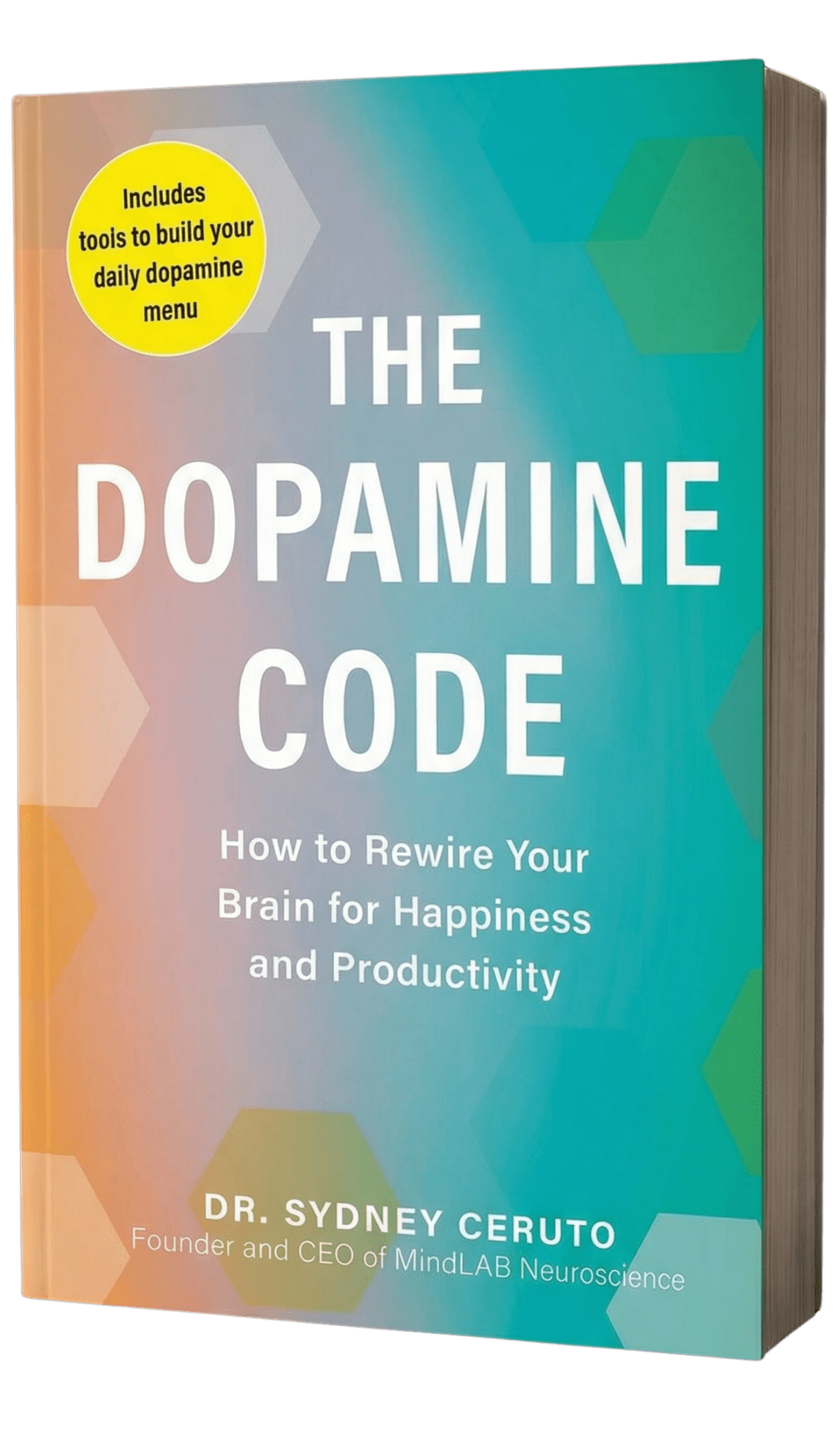
The Dopamine Code
Decode Your Drive
Why Your Brain Rewards the Wrong Things
Your brain's reward system runs every decision, every craving, every crash — and it was never designed for the life you're living. The Dopamine Code is Dr. Ceruto's framework for understanding the architecture behind what drives you, drains you, and keeps you locked in patterns that willpower alone will never fix.
Published by Simon & Schuster, The Dopamine Code is Dr. Ceruto's framework for building your own Dopamine Menu — a personalized system for motivation, focus, and enduring life satisfaction.
Order NowShips June 9, 2026