Resilience Coaching in Lisbon

Resilience is not a personality trait you either have or lack. It is an active neurobiological process — driven by specific brain circuits that can be identified, measured, and permanently strengthened.

The ability to recover from setbacks is not a character trait. It is circuit architecture — prefrontal regulation, BDNF — brain-derived neurotrophic factor, a growth protein for neurons — signaling, and anterior cingulate — the brain's cognitive braking system — working in coordination. MindLAB Neuroscience rebuilds resilience at the neural level where durable change originates.

Book a Strategy Call

Key Points

  1. Resilience is not mental toughness — it is the measurable capacity of prefrontal circuits to maintain regulatory control over the amygdala during sustained adversity.
  2. The brain builds resilience through specific patterns of stress exposure and recovery — not through endurance, which actually degrades resilient capacity over time.
  3. Cortisol receptor density in the hippocampus determines how effectively the brain terminates stress responses — a biological variable that conventional approaches cannot address.
  4. Emotional recovery speed depends on prefrontal-amygdala connectivity strength, a neural pathway that can be specifically targeted and reinforced.
  5. True resilience means the brain processes adversity without sustained threat activation — a fundamentally different state from suppressing or managing distress.

The Collapse That Willpower Cannot Reverse

“Resilience is not a mindset. It is the measurable capacity of the prefrontal cortex to regulate emotional responses — a structural, always-on property of the brain that can be tracked, eroded by sustained cortisol exposure, and rebuilt through targeted neuroplasticity.”

You have done everything that was supposed to work. You made the move, built the plan, committed to the chapter. And yet somewhere between the ambition and the execution, your capacity to absorb setbacks started eroding.

Not dramatically, not a breakdown, but in a way that is harder to name. A slower recovery from disappointments. A creeping inability to tolerate uncertainty. A sense that each new obstacle lands heavier than the last.

This is the pattern that brings people to search for resilience help. It is not weakness. It is depletion.

The difficulty is that most approaches to building resilience operate at the surface. Motivational frameworks, positive thinking, journaling, and gratitude practices are all mindset-based approaches. For someone whose bounce-back capacity has genuinely diminished, the advice to “reframe challenges” feels hollow. They are not failing to think positively. Something has changed in how their system processes adversity. No amount of cognitive reframing reaches the layer where that change occurred.

What makes this particularly insidious is that the people most affected are often those who have previously been highly resilient. They relocated countries. They left secure careers. They took genuine risks. The capacity was there, documented in years of evidence. Its absence now is confusing precisely because it contradicts their own track record.

The answer is neurobiological. Chronic uncertainty, sustained identity strain, and repeated low-grade stress do not merely tire a person out psychologically. They remodel the brain regions responsible for adaptive recovery. Prefrontal regulatory circuits thin under sustained cortisol exposure. The hippocampus loses volume as contextual memory processing degrades. The molecular signals, particularly BDNF, that drive synaptic repair become depleted. When these systems are structurally compromised, willpower cannot compensate for what the architecture no longer provides.

This is why the resilient person who has become fragile is not suffering from a mindset failure. They are carrying a biological deficit that operates beneath the reach of affirmation or positive reframing. The deficit is real and reversible when addressed at the correct biological level.

The Neuroscience of Resilience

A landmark review reframes the entire resilience conversation: resilience to chronic stress is not the passive absence of vulnerability. It is an active biological process driven by specific molecular and circuit-level adaptations. In animal models of chronic social defeat stress, resilient subjects showed two to three times more gene expression changes than susceptible subjects. They were biologically busier, not merely unaffected.

This distinction matters profoundly. Resilience involves coordinated adaptations across multiple brain systems. Resilient individuals show elevated BDNF signaling and inflammation-protective mechanisms. These adaptations are measurable, specific, and inducible. They are not fixed at birth.

Research studying individuals with high and low resilience found important differences. High-resilience individuals showed faster cortisol recovery after a psychosocial stress task. Low-resilience individuals showed elevated post-stress cortisol and a slower return to baseline. The brain’s interoceptive signal hub was implicated in the resilience-to-depression pathway. The value-assessment system mediated resilience-to-anxiety outcomes.

These are not correlations. They are identifiable, measurable pathways addressable through targeted neuroplasticity work.

The Structural Evidence

Resilience is not just a functional state. It is inscribed in brain tissue. Research with healthy adults found that higher dispositional resilience was associated with increased gray matter volume in the right inferior frontal gyrus. This emotional control region correlated directly with real-world physical functioning scores. That finding establishes a neuroanatomical link between resilience and wellbeing.

The largest neuroimaging analysis of resilience on record identified three brain regions consistently associated with resilience across all psychiatric risk categories: both amygdalae and the conflict-monitoring system. The amygdala’s appearance as a resilience substrate, not merely a threat alarm, reflects its bidirectional role. Properly regulated amygdala function supports adaptive threat discrimination and fear extinction. The anterior cingulate provides the cognitive braking system that prevents runaway stress reactivity.

Life coaching and personal development — neural pathway restructuring with copper fragments dissolving as new connections form

My clients describe this understanding as the moment the conversation shifts. Learning that resilience has a specific neural address removes the self-blame that accompanies its loss.

How Dr. Ceruto Approaches Resilience

Dr. Ceruto’s methodology targets the specific neural systems that resilience research has identified as the biological substrate of bounce-back capacity. Real-Time Neuroplasticity restructures the circuits that determine how quickly and completely you recover from adversity.

The primary targets are the amygdala’s regulatory relationships and the BDNF-driven mechanisms that underpin adaptive stress responses. A comprehensive 2025 review confirmed that BDNF is the key molecular regulator of the resilient brain. BDNF reverses hippocampal atrophy, expanded threat reactivity, and prefrontal thinning even after prior stress exposure.

The pattern that presents most often in this work is a combination of depleted prefrontal regulatory capacity and overactive threat signaling. The protocol creates conditions under which BDNF signaling recovers and the brain’s repair mechanisms reactivate.

Through NeuroSync, individuals addressing a specific resilience challenge receive focused protocol work targeting the circuits most relevant to their situation. For those whose lives involve ongoing high-stakes decisions and continuous adaptation demands, NeuroConcierge provides an embedded partnership. Dr. Ceruto serves as a strategic neural architect across all domains where resilience is tested.

What to Expect

The engagement begins with a Strategy Call, a focused assessment of your specific resilience architecture. Dr. Ceruto maps which circuits are depleted and which regulatory relationships have weakened. She identifies what patterns of stress exposure have produced the current state. This is not a wellness conversation. It is a precision assessment designed to identify the specific neural territory where your resilience infrastructure has been drawn down.

From there, a structured protocol targets your specific neural profile. The work is precise and individualized. Two people who both describe themselves as “less resilient than they used to be” may present with entirely different circuit signatures. One might be driven by overactive threat signaling, another by prefrontal-hippocampal disconnection. The protocol addresses your architecture, not a generic model.

Progress is measured through observable changes in recovery speed, stress tolerance, and the capacity to engage uncertainty without cascading reactivity. The trajectory moves from reduced alarm-system reactivity to restored regulatory function. The ultimate destination is durable bounce-back capacity that operates automatically under pressure. The goal is not temporary improvement. It is permanent restructuring of the neural systems that govern how you absorb and recover from whatever comes next.

References

Reinoud Kaldewaij, Saskia B.J. Koch, Mahur M. Hashemi, Wei Zhang, Floris Klumpers, Karin Roelofs (2021). Anterior Prefrontal Cortex Activation as a Neural Predictor of Resilience to Trauma. Nature Human Behaviour. https://doi.org/10.1038/s41562-021-01055-2

Alan P.L. Tai, Mei-Kei Leung, Xiujuan Geng, Way K.W. Lau (2023). Resting-State Neural Correlates of Psychological Resilience: Systematic Review of 19 Studies in Healthy Individuals. Frontiers in Behavioral Neuroscience. https://doi.org/10.3389/fnbeh.2023.1175064

Hyun-Ju Kim, Minji Bang, Chongwon Pae, Sang-Hyuk Lee (2024). Multimodal Structural Neural Correlates of Dispositional Resilience in Healthy Individuals. Scientific Reports. https://doi.org/10.1038/s41598-024-60619-0

Magdalena Degering, Roman Linz, Lara M.C. Puhlmann, Veronika Engert (2023). Cortisol Recovery After Acute Stress Predicts Resilient Allostatic State: The Stress Recovery Hypothesis Revisited. Brain, Behavior, and Immunity – Health. https://doi.org/10.1016/j.bbih.2023.100598

The Neural Architecture of Resilience

Resilience is not toughness. It is not the capacity to absorb punishment without reaction. At the neural level, resilience is a specific computational property of the brain’s stress-response and recovery systems — the speed and completeness with which the brain returns to baseline function after destabilizing events. Understanding this architecture reveals why some professionals navigate crisis after crisis with sustained effectiveness while others are progressively degraded by challenges of similar magnitude.

The architecture involves three systems. The first is the prefrontal-amygdala regulatory circuit, which determines how quickly the brain can contain the initial stress response and restore executive function. In resilient individuals, this circuit suppresses the amygdala’s alarm signal within seconds of the prefrontal cortex determining that the threat is containable. In less resilient individuals, the suppression is delayed or incomplete, allowing the stress cascade to run longer and consume more cognitive resources before executive function returns. The difference is not in the intensity of the initial stress response — resilient individuals experience stress as strongly as anyone — but in the recovery speed.

The second system is the hippocampal memory consolidation circuit, which determines how destabilizing events are encoded and stored. Resilient brains encode setbacks as bounded events — challenges that occurred, produced consequences, and ended. Less resilient brains encode the same events as ongoing threats, storing them in a way that maintains the emotional activation associated with the original event and generalizes the threat signature to similar future contexts. The difference between processing a setback as a bounded event and encoding it as an ongoing threat is the difference between learning from failure and being haunted by it.

The third system is the reward circuit’s recovery function. After destabilizing events, the dopaminergic reward system must recalibrate to restore motivational drive and the capacity to experience satisfaction from accomplishment. In resilient individuals, the reward system recovers its baseline activity relatively quickly, maintaining the motivational architecture that drives forward motion. In less resilient individuals, the reward system remains suppressed after setbacks, producing the motivational flatness that prevents the professional from re-engaging with full energy even after the crisis has passed.

The critical insight is that these three systems are not fixed traits. They are neural circuits with measurable properties that can be systematically developed. Resilience is not a quality some people have and others lack. It is an architectural feature that reflects the calibration of specific, identifiable brain systems — and calibration can be changed.

Antique rosewood desk with crystal brain sculpture and MindLAB journal in warm amber Lisbon afternoon light with historic European wood paneling

Why Resilience Training Programs Fall Short

Conventional resilience programs operate through cognitive reframing, stress inoculation, and motivational reinforcement. Learn to interpret setbacks as growth opportunities. Build tolerance for discomfort through progressive exposure. Maintain motivation through purpose connection and social support. Each element has a valid psychological basis, and none of them address the neural architecture that determines actual resilient function.

Cognitive reframing — the practice of reinterpreting negative events in a more positive light — engages the dorsolateral prefrontal cortex’s deliberate reasoning capacity. It does not reach the ventromedial prefrontal cortex and hippocampal system that determine how events are encoded and stored. A professional can consciously reframe a setback as a learning opportunity while their hippocampal system simultaneously encodes it as an ongoing threat. The reframe exists in conscious cognition; the threat encoding exists in the systems that generate automatic emotional responses. Under stress, the automatic responses override the conscious reframe, and the professional’s behavioral resilience matches their encoding, not their cognitive interpretation.

Stress inoculation — controlled exposure to manageable stressors — can build tolerance when the exposure is calibrated to engage the prefrontal-amygdala regulatory circuit without overwhelming it. But standard resilience programs cannot calibrate the exposure to individual neural architecture because they do not assess that architecture. The result is exposure that is either too mild to produce plasticity — building familiarity without building circuit capacity — or too intense, which reinforces the stress response rather than building the recovery capacity.

Purpose-based motivation provides a cognitive anchor during destabilizing events but does not address the reward system’s recovery dynamics. A professional who maintains clear purpose but whose dopaminergic system remains suppressed after setbacks experiences the uncomfortable state of knowing what matters without being able to generate the motivational energy to pursue it. Purpose without reward-circuit recovery produces the grim determination that eventually exhausts itself rather than the sustainable re-engagement that genuine resilience provides.

How Resilience Architecture Is Developed

My methodology targets the three resilience systems directly, building the neural architecture from which resilient function emerges rather than teaching cognitive strategies that overlay unchanged circuitry.

The prefrontal-amygdala regulatory circuit is strengthened through graduated engagement under conditions that activate the stress response and then require the regulatory system to contain it within progressively shorter timeframes. The work is precise — the activation must be sufficient to engage the circuit at its current limit, and the containment demand must be achievable but challenging. This produces the progressive strengthening of the inhibitory pathway that translates directly into faster recovery from real-world destabilizing events.

The hippocampal encoding system is addressed through targeted engagement during the post-event processing period when memories are being consolidated. The work involves restructuring how the brain processes destabilizing events at the moment of encoding, shifting the hippocampal system from threat-generalized storage toward bounded-event storage. This is not cognitive reframing — it does not change how the professional thinks about the event. It changes how the brain stores the event, which determines the emotional resonance the memory carries forward and the degree to which it generalizes to future contexts.

The reward system’s recovery dynamics are developed through structured re-engagement of the dopaminergic circuitry following destabilizing events. The critical timing is post-setback: the period immediately following a significant challenge is when the reward system is most vulnerable to sustained suppression and most responsive to targeted intervention. Building the system’s capacity to recover baseline activity after stress events — to restore the motivational and hedonic function that drives re-engagement — is the neural basis of the sustained forward motion that characterizes genuine resilience.

What This Looks Like in Practice

The Strategy Call assesses the specific architecture of your resilience pattern. The question is not whether you are resilient — it is which systems are limiting your resilience and under which conditions the limitation manifests. Some professionals have strong regulatory circuits but poor event encoding, processing stress quickly in the moment but carrying its emotional residue for weeks. Others encode events well but have slow regulatory recovery, meaning each stressor produces an extended period of degraded function even though the long-term impact is minimal. Others have intact regulatory and encoding systems but suppressed reward recovery, maintaining function after setbacks while gradually losing the motivational drive that sustains long-term performance.

The work develops whichever system or systems are limiting your resilient capacity, under conditions calibrated to your specific challenge threshold. Progress is measurable: the recovery time from destabilizing events shortens, the cognitive and emotional impact of setbacks diminishes, and the motivational recovery after challenge accelerates. The result is not imperviousness to difficulty — that would be pathological numbness, not resilience. It is a neural architecture that processes adversity efficiently, recovers fully, and maintains the sustained high function that allows a career built under genuine pressure to be sustainable rather than progressively depleting.

For deeper context, explore building emotional resilience with neuroscience.

Marker Traditional Approach Neuroscience-Based Approach Why It Matters
Focus Building mental toughness through positive reframing and coping strategies Strengthening the specific prefrontal-amygdala circuits that govern stress termination and emotional recovery
Method Resilience training programs, mindfulness practices, and cognitive behavioral strategies Targeted neural intervention that increases the brain's biological capacity to process adversity without sustained activation
Duration of Change Strategy-dependent; resilience degrades when coping techniques fail under extreme pressure Structural strengthening of stress-regulation circuits that maintains resilient processing regardless of external intensity

Why Resilience Coaching Matters in Lisbon

Lisbon occupies a paradox in the resilience landscape. The city draws people who have already been tested: professionals who left London, Amsterdam, or New York with a disrupted identity, remote workers who relocated specifically to reset. Digital nomads whose rootlessness is structural rather than temporary also arrive. Yet Lisbon itself generates a second arc of strain for these arrivals.

The compound uncertainty of bureaucratic systems produces what amounts to chronic low-grade ambiguity load. Severed social networks and the slow grief of leaving behind a professional identity that provided structure erode resilience. The identity dissonance of being accomplished yet feeling socially marginal in a new culture deepens this erosion. Conventional frameworks address this inadequately.

In Principe Real co-working spaces and Chiado cafes, the presentation is often one of reinvention and possibility. Beneath the surface, many in Lisbon's international community are quietly experiencing a second identity crisis. This one emerged not from the original disruption but from the failure to feel rooted within the expected timeline. For digital nomads, the challenge compounds further: resilience must operate across timezone fragmentation, repeated social bond-building and dissolution, and sustained ambiguity about whether the current chapter is working.

Career-pivot professionals, a substantial Lisbon cohort, experience resilience depletion in a form often mislabeled as creative block or decision fatigue. More precisely, it is the depletion of prefrontal regulatory reserve and BDNF availability after sustained uncertainty and identity strain. BDNF is a growth protein essential for neuronal health. The professionals arriving in Cascais or Parque das Nacoes with a plan to build something new are not lacking in capability. Their neural resilience infrastructure has been drawn down by the cumulative demands of transition. Rebuilding it requires a methodology that operates at the biological level where the depletion occurred.

Array

Building resilience in the context of an international life carries specific challenges that resilience frameworks built for domestic professional environments rarely address: the distance from established support systems, the cognitive demand of operating across cultures and time zones, the particular loneliness of being genuinely outside your home context, and the accumulated low-level stress of navigating unfamiliar systems every day. The professionals and entrepreneurs who choose Lisbon deliberately have often demonstrated significant resilience already—but come to MindLAB Neuroscience because they recognize that the demands of the life they've built require something more systematic than willpower and adaptation. Dr. Ceruto's neuroscience-based resilience coaching builds the cognitive and behavioral infrastructure that makes demanding lives genuinely sustainable: not by lowering the demands, but by expanding the internal capacity to meet them without the cumulative cost that most high-functioning people quietly pay.

Dr. Sydney Ceruto, PhD — Founder, MindLAB Neuroscience

Dr. Sydney Ceruto, PhD — Founder & CEO, MindLAB Neuroscience

Dr. Ceruto holds a PhD in Behavioral & Cognitive Neuroscience from NYU and two Master’s degrees from Yale University. She lectures at the Wharton Executive Development Program at the University of Pennsylvania and has been an Executive Contributor to the Forbes Coaching Council since 2019. Dr. Ceruto is the author of The Dopamine Code (Simon & Schuster, June 2026). She founded MindLAB Neuroscience in 2000 and has spent over 26 years pioneering Real-Time Neuroplasticity™ — a methodology that permanently rewires the neural pathways driving behavior, decisions, and emotional responses.

References

McEwen, B. S. (1998). Stress, adaptation, and disease: Allostasis and allostatic load. Annals of the New York Academy of Sciences, 840(1), 33–44. https://doi.org/10.1111/j.1749-6632.1998.tb09546.x

Lupien, S. J., McEwen, B. S., Gunnar, M. R., & Heim, C. (2009). Effects of stress throughout the lifespan on the brain, behaviour and cognition. Nature Reviews Neuroscience, 10(6), 434–445. https://doi.org/10.1038/nrn2639

Davidson, R. J., & McEwen, B. S. (2012). Social influences on neuroplasticity: Stress and interventions to promote well-being. Nature Neuroscience, 15(5), 689–695. https://doi.org/10.1038/nn.3093

Arnsten, A. F. T. (2009). Stress signalling pathways that impair prefrontal cortex structure and function. Nature Reviews Neuroscience, 10(6), 410–422. https://doi.org/10.1038/nrn2648

Success Stories

“Slower processing, foggier recall, decisions that used to be instant taking longer than they should — I'd been accepting it all as inevitable decline for two years. Dr. Ceruto identified the prefrontal efficiency pattern that was degrading and restructured it at the neurological level. The sharpness didn't just come back. It came back faster and more precise than it was a decade ago. Nothing I'd tried before even addressed the right problem.”

Elliott W. — Wealth Advisor Atherton, CA

“Anxiety and depression had been running my life for years. Dr. Ceruto helped me see them not as permanent conditions but as neural patterns with identifiable roots. Once I understood the architecture, everything changed.”

Emily M. — Physician Portland, OR

“The way I was processing decisions under pressure had a cost I couldn't see — until Dr. Ceruto mapped it. She identified the neural pattern driving my reactivity in high-stakes situations and restructured it at the root. I don't just perform better under pressure now. I think differently under pressure. That's not something any executive coach or performance program ever came close to delivering.”

Rob W. — Portfolio Manager Manhattan, NY

“Dr. Ceruto is truly exceptional. I’ve always been skeptical about anyone being able to get through to me, but she has a unique way of bringing about profound changes. She is incredibly intuitive and often knows the answers to complex matters before you even get there. In just a couple of months, I noticed significant changes in how I live my life. Sydney is honest and direct, yet compassionate. She personally relates to you without judgment and demonstrates real investment in your success.”

Ash — Neurologist La Jolla, CA

“Working with Dr. Ceruto was one of the most transformative experiences of my life. I was stuck in a cycle of dissatisfaction, unsure of where I was headed or why I felt so unfulfilled. From the very first session, she helped me peel back the layers and uncover what truly mattered. Her ability to connect neuroscience with practical life strategies was incredible. She guided me to clarify my goals, break free from limiting beliefs, and align my actions with my values. I finally feel real purpose.”

Nichole P. — Wealth Advisor Sarasota, FL

“What I appreciate about Dr. Ceruto is her candid, direct approach — truly from a place of warmth and support. Every week delivered concrete value, and I never felt like I was wasting time the way I had with traditional methods. She draws from her clinical and academic expertise to dig deeper into the roots of issues. She helped me make enormous progress after a year of personal loss, including getting my faltering career back on track. She follows up after every session with additional materials.”

Eric F. — Surgeon Coral Gables, FL

Frequently Asked Questions About Resilience Coaching in Lisbon

Is resilience something that can genuinely be built, or is it a fixed personality trait?

Resilience is not fixed. Research has established that resilience to chronic stress is an active biological process driven by specific molecular, cellular, and circuit-level adaptations. Resilient individuals show elevated BDNF — brain-derived neurotrophic factor, a growth protein for neurons — signaling, stronger prefrontal connectivity, and preserved anti-inflammatory markers. These adaptations are measurable and, critically, inducible through structured neuroplasticity — the brain's ability to rewire itself — work.

I relocated to Lisbon and feel less capable of handling setbacks than I expected. Can neuroscience-based resilience work help?

This pattern is common among Lisbon's international community. Relocation produces chronic low-grade stress — bureaucratic uncertainty, social network disruption, identity strain — that depletes the same neural systems responsible for bounce-back capacity. Dr. Ceruto's methodology targets the specific circuits that chronic ambiguity load depletes: prefrontal regulation, orbitofrontal integration, and BDNF — brain-derived neurotrophic factor, a growth protein for neurons — driven repair mechanisms. The goal is rebuilding the resilience architecture that sustained strain has drawn down.

How does MindLAB's resilience methodology work at the brain level?

Real-Time Neuroplasticity — the brain's ability to rewire itself —™ targets the neural systems that neuroimaging research consistently identifies as resilience substrates, including the amygdala-cingulate regulatory circuit and hippocampal memory systems. This includes BDNF-mediated synaptic plasticity — brain connections strengthening or weakening —. The methodology strengthens top-down regulation of the threat-detection system while rebuilding the molecular infrastructure — particularly BDNF signaling — that supports adaptive stress recovery. The result is measurable, durable change in how quickly and completely you recover from adversity.

What is the difference between resilience work and burnout prevention?

They address different stages of the same continuum. Resilience work targets the active neural systems that determine bounce-back speed and adaptive recovery capacity — strengthening circuits before they reach a breaking point. Burnout prevention addresses the cumulative endpoint of unchecked stress where those systems have already begun to collapse. If you are noticing slower recovery and diminished tolerance for uncertainty but are still functioning, resilience-focused work addresses the architecture before it progresses further.

I'm a digital nomad in Lisbon. Can online resilience work address the specific pressures of location-independent life?

MindLAB operates as a virtual-first practice specifically designed for professionals who move between locations. The isolation, timezone fragmentation, and repeated social rebuilding inherent to location-independent work create specific neurological demands on the resilience system. Dr. Ceruto's methodology addresses these circuit-level demands regardless of your physical location — whether you are in Lisbon this month, Berlin next month, or somewhere between.

How long does it take to rebuild resilience at the neurological level?

The timeline depends on your specific neural profile — which circuits are depleted, how long the depletion has been accumulating, and what ongoing stress exposures are present. Dr. Ceruto assesses your individual architecture during the Strategy Call and designs a protocol calibrated to your neurological baseline. Some clients experience measurable shifts in recovery speed within the early phases of structured work. Others require deeper protocol engagement across multiple circuit systems.

What happens during the Strategy Call?

The Strategy Call is a focused strategy conversation where Dr. Ceruto assesses the specific patterns driving your resilience challenges. She maps which neural systems are underperforming, what stress exposures have contributed to the current state, and whether a structured protocol is appropriate. This is not a motivational conversation — it is a precision assessment designed to determine exactly where your resilience architecture needs intervention.

Is resilience something you can develop at any age, or is it primarily shaped in childhood?

While early experiences significantly shape the brain's stress-response architecture, neuroplasticity ensures that resilience circuits can be strengthened throughout adulthood. The prefrontal-amygdala pathways governing stress regulation, the hippocampal circuits managing cortisol feedback, and the vagal tone influencing recovery speed all remain modifiable with targeted intervention.

The misconception that resilience is fixed after childhood comes from the difficulty of changing it through conventional methods. Resilience is an architectural property of the brain — it responds to structural intervention, not to motivational instruction or coping strategy accumulation.

How is genuine resilience different from the ability to push through difficulty?

Pushing through difficulty is endurance — the conscious suppression of distress signals while continuing to function. This depletes prefrontal resources, degrades decision quality, and eventually produces the very breakdown it is attempting to prevent. Endurance masquerading as resilience is one of the most common patterns Dr. Ceruto encounters.

Genuine resilience is an architectural property: the brain processes adversity without sustained threat activation, maintains regulatory control without conscious effort, and recovers to baseline rapidly after the stressor ends. The person is not suppressing distress — the brain is processing the same situation with less threat activation. This is a fundamentally different neural state.

What does the process of building neural resilience involve, and what should I expect?

Building genuine resilience involves strengthening specific circuits: the prefrontal cortex's capacity to maintain regulatory control over the amygdala, the hippocampus's efficiency in terminating cortisol release, and the vagal system's ability to shift the body from stress activation to recovery mode.

Dr. Ceruto targets these systems based on each individual's specific resilience profile — which circuits are weakest, which stress patterns are most disruptive, and where the architecture is most responsive to intervention. Most individuals notice improved stress recovery and emotional stability as the first observable changes, followed by a broader capacity to process difficulty without the sustained activation that previously defined their experience of pressure.

Also available in: Miami · Wall Street · Midtown Manhattan · Beverly Hills

Rebuilding Neural Resilience for the Demands Lisbon Actually Places on You

The relocation, the career pivot, the reinvention — Lisbon attracted you with possibility. The neural cost of sustained transition is biological, and so is the rebuild. Dr. Ceruto maps your resilience architecture in one conversation.

Book a Strategy Call
MindLAB Neuroscience consultation room

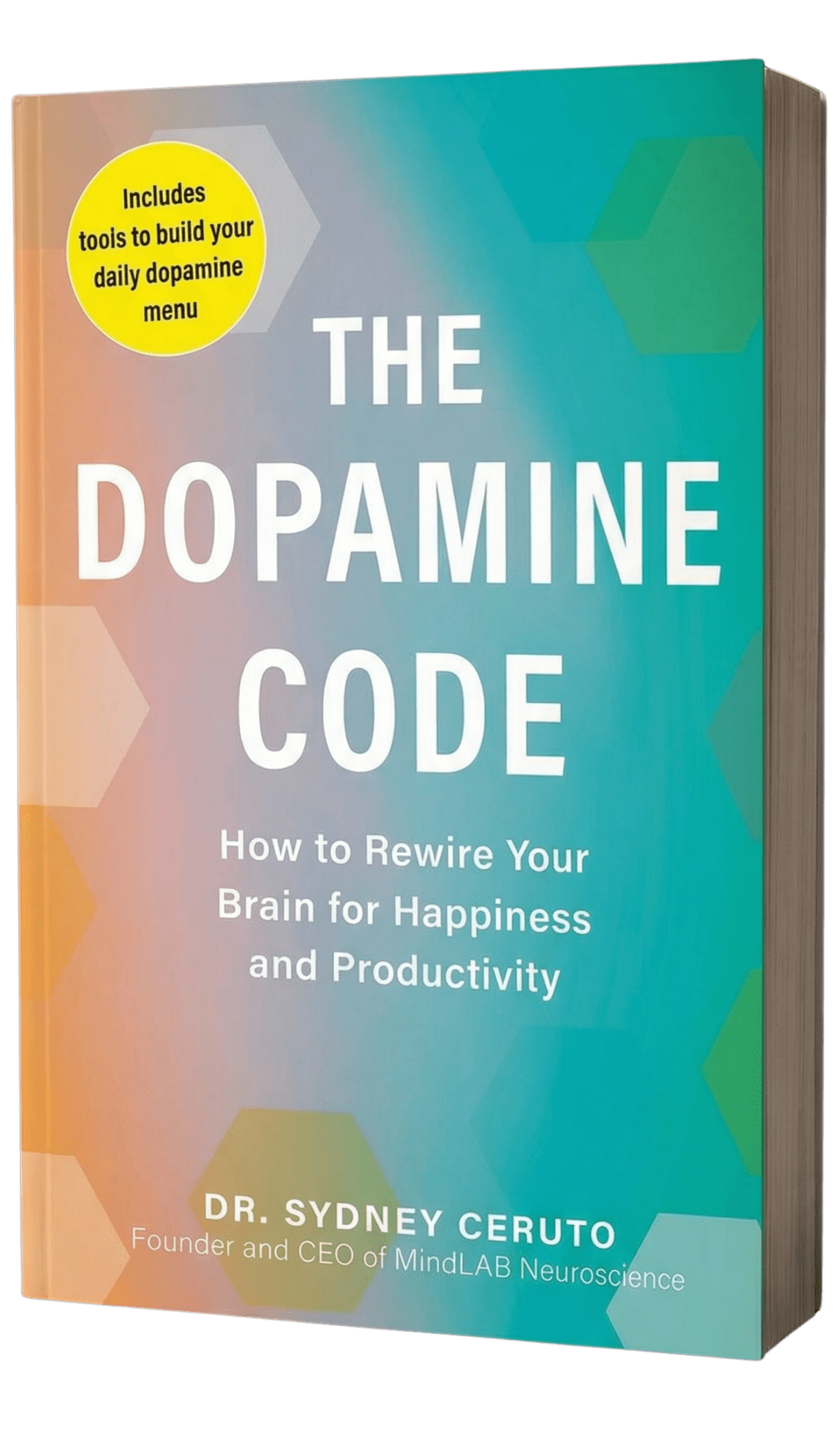
The Dopamine Code

Decode Your Drive

Why Your Brain Rewards the Wrong Things

Your brain's reward system runs every decision, every craving, every crash — and it was never designed for the life you're living. The Dopamine Code is Dr. Ceruto's framework for understanding the architecture behind what drives you, drains you, and keeps you locked in patterns that willpower alone will never fix.

Published by Simon & Schuster, The Dopamine Code is Dr. Ceruto's framework for building your own Dopamine Menu — a personalized system for motivation, focus, and enduring life satisfaction.

Order Now

Ships June 9, 2026

The Dopamine Code by Dr. Sydney Ceruto — Decode Your Drive
Locations

The Intelligence Brief

Neuroscience-backed analysis on how your brain drives what you feel, what you choose, and what you can’t seem to change — direct from Dr. Ceruto.