Addiction & Compulsive Behavior
The broader architecture of compulsive patterns — how the brain’s reward system gets hijacked, why the loop consolidates below conscious control, and what structural neural intervention looks like.


The broader architecture of compulsive patterns — how the brain’s reward system gets hijacked, why the loop consolidates below conscious control, and what structural neural intervention looks like.
When a substance has reorganized the brain’s reward circuitry, the compulsion operates independently of intention. Dr. Ceruto addresses the neural architecture driving the pattern, not the substance itself.
Gambling, shopping, gaming — the brain does not distinguish between chemical and behavioral reward hijacking. The same dopamine circuits drive the compulsion regardless of the delivery mechanism.
Hyper-palatable food exploits the same reward circuits as any other compulsion. The restrict-binge cycle is a neural oscillation, not a discipline failure — and it requires a structural solution.
Internet pornography exploits the brain’s novelty-seeking dopamine system with infinite variability and zero friction. The resulting desensitization pattern disrupts both the compulsive loop and real-world intimacy.
Every scroll, notification, and like is engineered to exploit reward prediction circuits. When the pattern consolidates into compulsion, the trigger lives in your pocket and the reinforcement never stops.
Breaking the compulsive loop is the first step. Preventing the brain from re-consolidating it is where most approaches fail. Dr. Ceruto addresses the reconsolidation mechanism that turns a single lapse back into a pattern.
Miami's social architecture is engineered around stimulation — the nightlife of South Beach, the food and entertainment culture of Wynwood and Brickell, the physical culture of outdoor fitness, and a social scene that operates year-round because the climate permits it. This is not accidental. Miami's tourism and hospitality economy — which generated $20.3 billion in 2024 — depends on creating environments where dopamine-seeking behavior is continuously rewarded. For most visitors, this is the experience they came for. For Miami residents whose dopaminergic reward systems are already dysregulated, the city's environment is a continuous provocation to patterns they are attempting to manage.
Miami's Latin American community carries specific cultural framings of substance use and compulsive behavior that shape help-seeking and recognition. In many of the Cuban, Venezuelan, and Colombian communities that constitute significant portions of Miami's population, substance use is socially embedded in celebration, family gathering, and professional relationship — and the line between culturally normative use and compulsive pattern is often not drawn until the consequences become undeniable. The cultural emphasis on loyalty and family privacy means that compulsive patterns affecting individual members are managed within family systems rather than surfaced to professional attention, which extends the duration and depth of impact before intervention occurs.
The startup and tech culture of Wynwood has created a performance-enhancement subculture that normalizes stimulant use in ways that mainstream professional culture does not. Adderall, modafinil, and their analogues circulate within founder and operator networks as productivity tools whose neurological costs are minimized. The entrepreneur who relies on prescription stimulants to maintain the output level their investors expect is not always aware that the enhancement is simultaneously suppressing the natural dopaminergic signaling that would otherwise motivate sustained effort — creating a pattern where the medication is maintaining the appearance of function while the underlying reward system further dysregulates.
Miami's gambling economy — the casinos of the surrounding area, the sports betting platforms that have aggressively targeted Florida's market since regulatory expansion, and the crypto speculation culture of Brickell — creates a specific behavioral compulsion context. Variable-ratio reinforcement schedules, which gambling exploits, produce the most resistant conditioning patterns in the brain's reward system. The dopamine spike of the win and the anticipatory spike of the near-miss activate the same circuits as substance use, and the compulsive pattern that develops is neurologically equivalent. Miami's market concentration means that behavioral addiction to gambling is significantly more prevalent in this population than national averages suggest.
The pattern I address with Miami clients is not the behavior itself — the drinking, the substance use, the gambling, the behavioral compulsion — but the dopaminergic architecture that maintains it. The behavior is the symptom. The neural circuitry that has learned to rely on external stimulation to produce the activation that internal motivation cannot reliably generate is the actual target. Recalibrating that circuitry in the context of an environment as stimulation-rich as Miami requires particular precision.

Dr. Sydney Ceruto, PhD — Founder & CEO, MindLAB Neuroscience
Dr. Ceruto holds a PhD in Behavioral & Cognitive Neuroscience from NYU and two Master’s degrees from Yale University. She lectures at the Wharton Executive Development Program at the University of Pennsylvania and has been an Executive Contributor to the Forbes Coaching Council since 2019. Dr. Ceruto is the author of The Dopamine Code (Simon & Schuster, June 2026). She founded MindLAB Neuroscience in 2000 and has spent over 26 years pioneering Real-Time Neuroplasticity™ — a methodology that permanently rewires the neural pathways driving behavior, decisions, and emotional responses.
Volkow, N. D., Koob, G. F., & McLellan, A. T. (2016). Neurobiologic advances from the brain disease model of addiction. *New England Journal of Medicine*, 374(4), 363-371. https://doi.org/10.1056/NEJMra1511480
Everitt, B. J., & Robbins, T. W. (2005). Neural systems of reinforcement for drug addiction: From actions to habits to compulsion. *Nature Neuroscience*, 8(11), 1481-1489. https://doi.org/10.1038/nn1579
Potenza, M. N. (2008). The neurobiology of pathological gambling and drug addiction: An overview and new findings. *Philosophical Transactions of the Royal Society B*, 363(1507), 3181-3189. https://doi.org/10.1098/rstb.2008.0100
Nader, K., Schafe, G. E., & Le Doux, J. E. (2000). Fear memories require protein synthesis in the amygdala for reconsolidation after retrieval. *Nature*, 406(6797), 722-726. https://doi.org/10.1038/35021052
“Ninety-hour weeks felt like discipline — the inability to stop felt like a competitive advantage. Nothing I tried touched it because nothing identified what was actually driving it. Dr. Ceruto mapped the dopamine loop that had fused my sense of identity to output. Once that circuit was visible, she dismantled it. I still work at a high level. I just don't need it to know who I am anymore.”

“Anxiety and depression had been running my life for years. Dr. Ceruto helped me see them not as permanent conditions but as neural patterns with identifiable roots. Once I understood the architecture, everything changed.”

Identifying details withheld to protect client confidentiality.
All outcomes represent genuine engagements with Dr. Ceruto.
The inability to stop despite genuine desire is the hallmark of hijacked reward circuitry. The brain's dopamine system has been retrained to classify the compulsive behavior as a survival-level priority — equivalent in neural urgency to food or water. Conscious intention, willpower, and genuine motivation operate through prefrontal circuits that have lost connectivity with the reward system driving the behavior. The desire to stop is real. The neural architecture overriding that desire is also real.
Traditional programs focus on behavioral abstinence, accountability, and support structures — managing the output of unchanged neural architecture. Dr. Ceruto's approach targets the architecture itself: rebuilding prefrontal regulatory connectivity with the reward system, recalibrating dopamine thresholds so natural engagement produces adequate reward signals, and restructuring the trigger patterns that activate craving circuits. The goal is architectural change that makes the compulsive behavior neurologically unnecessary.
Yes. Neuroplasticity research demonstrates that reward system recalibration, prefrontal regulatory restoration, and trigger-response restructuring remain possible throughout adulthood regardless of how long the pattern has been active. Duration affects the depth of intervention required but does not determine whether architectural change is possible. The neural systems maintaining the pattern remain modifiable.
The approach addresses the neural architecture maintaining the compulsive pattern — the reward system calibration, the prefrontal regulatory capacity, and the trigger-response circuits. The behavioral strategy that accompanies architectural intervention is individualized based on the specific pattern, its neurological severity, and the individual's circumstances. Dr. Ceruto's assessment identifies which approach to behavioral management supports the neural restructuring process most effectively.
Shame and identity distortion are produced by the same neural architecture maintaining the compulsive behavior — they are not separate psychological problems but features of how the altered reward system interacts with the brain's self-assessment circuits. When the reward architecture is restructured, the shame-generating mechanisms shift because the brain's self-model is no longer organized around the compulsive pattern.
Yes. The neural mechanisms of behavioral compulsions — gambling, compulsive spending, problematic sexual behavior, social media dependency, work compulsion — operate through the same reward circuitry as substance-related patterns. The dopamine system does not distinguish between chemical and behavioral reward sources. The architectural intervention addresses the reward system calibration regardless of what stimulus is activating it.
The Strategy Call maps the neural architecture maintaining the compulsive pattern — the reward system calibration, the prefrontal regulatory capacity, the trigger-response circuits, and the stress-response patterns that typically activate the behavior. It assesses the severity of the architectural changes and identifies where targeted intervention will produce the most effective restructuring.
The timeline depends on the depth of reward system recalibration required, which correlates with the duration and intensity of the compulsive pattern. Noticeable shifts in craving intensity and trigger response are typically experienced within weeks. Full architectural restructuring — where the brain no longer generates compulsive urges because the reward system has been recalibrated — develops over months of targeted intervention.
The Strategy Call is a focused conversation with Dr. Ceruto that maps the specific neural mechanisms driving your concerns and determines the right path forward.
Book a Strategy Call
Decode Your Drive
Why Your Brain Rewards the Wrong Things
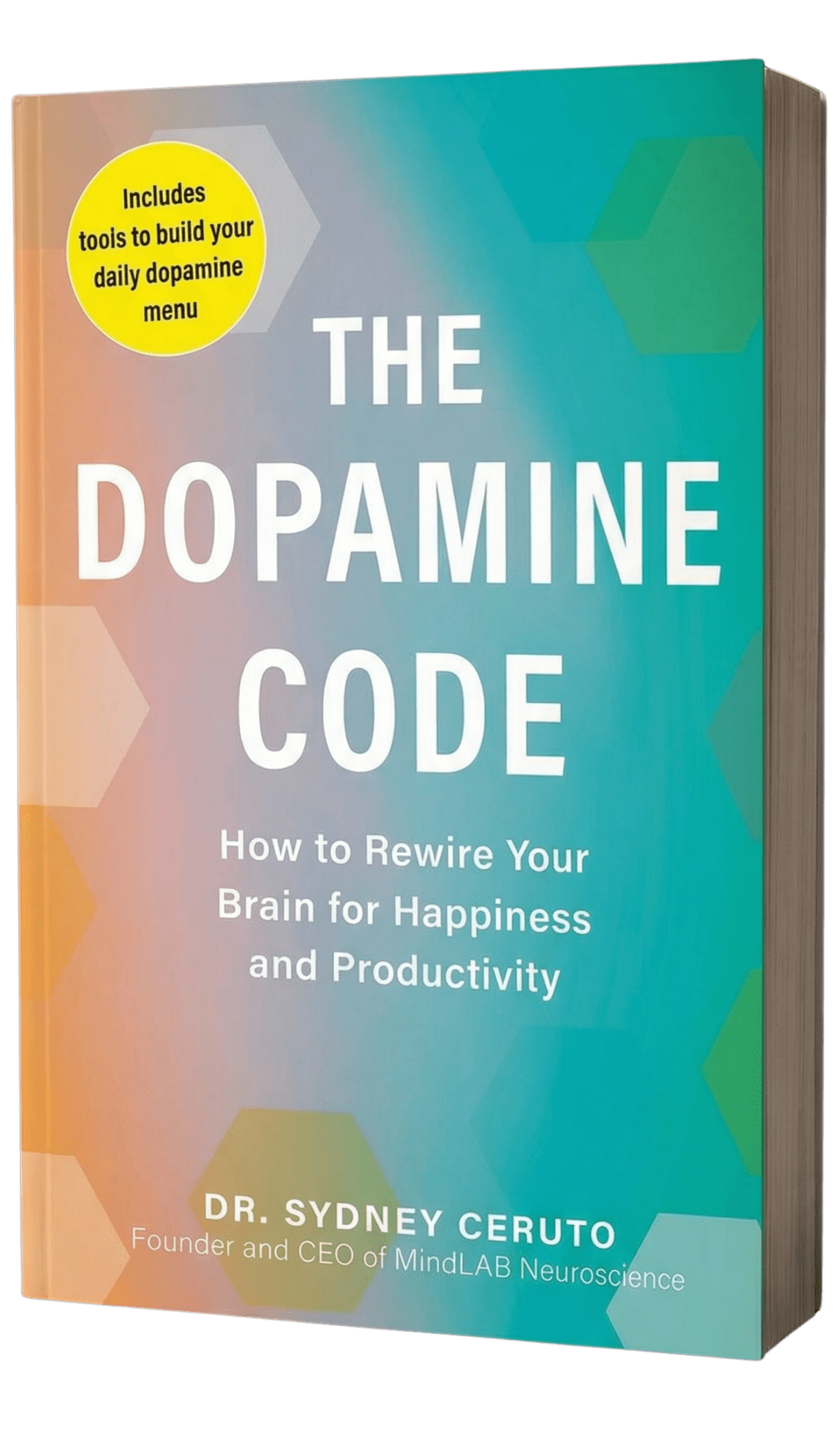
Your brain's reward system runs every decision, every craving, every crash — and it was never designed for the life you're living. The Dopamine Code is Dr. Ceruto's framework for understanding the architecture behind what drives you, drains you, and keeps you locked in patterns that willpower alone will never fix.
Published by Simon & Schuster, The Dopamine Code is Dr. Ceruto's framework for building your own Dopamine Menu — a personalized system for motivation, focus, and enduring life satisfaction.
Order NowShips June 9, 2026