The Organizational Change Paradox
“Seventy percent of organizational change initiatives fail to achieve their stated objectives. This is not a management failure — it is a neuroscience failure. The brain's threat-detection architecture, evolved for physical survival, cannot distinguish between a territorial predator and an ambiguous organizational announcement.”
The initiative was sound. The strategy was clear. The leadership team understood the business case. And yet the change program stalled — not with dramatic resistance, but with the quiet, persistent reversion to prior patterns that every organizational leader recognizes but cannot explain.
This is the central frustration of organizational development work. The frameworks are sophisticated. The consultants are credentialed. The communication cascades are carefully designed. And the results, documented across decades of research, hover around a thirty percent success rate. Seventy percent of organizational change initiatives fail to achieve their stated objectives. This is not a management failure. It is a neuroscience failure.
The reason is mechanistically specific. When an organization announces a restructuring, relocates its headquarters, or integrates a workforce from a different cultural context, every leader in that organization experiences the same neural event: their amygdala begins firing threat signals. Not because they lack resilience. Not because they resist change philosophically. Because their brain’s threat-detection architecture, evolved for physical survival, cannot distinguish between a territorial predator and an ambiguous organizational announcement. The behavioral signature is identical: restricted information processing, centralized control, suppression of non-compliant alternatives, and increased reliance on prior-learned behaviors. This threat-rigidity response activates with mechanical reliability every time genuine uncertainty enters the organizational system.
Standard organizational development consulting addresses the downstream behavioral symptoms of this response. It designs communication strategies, builds stakeholder engagement plans, and creates accountability frameworks. None of these interventions touch the neural architecture generating the resistance. They are prescribing behavioral solutions to a biological problem.
What I see repeatedly in this work is leadership teams that intellectually understand the need for change but physiologically cannot execute it. Their prefrontal cortex, the seat of cognitive flexibility and adaptive decision-making, is operating at reduced capacity because sustained cortisol exposure from organizational uncertainty has degraded its regulatory function. They are attempting strategic adaptation with a brain that is, functionally, in partial shutdown.
The Neuroscience of Organizational Change
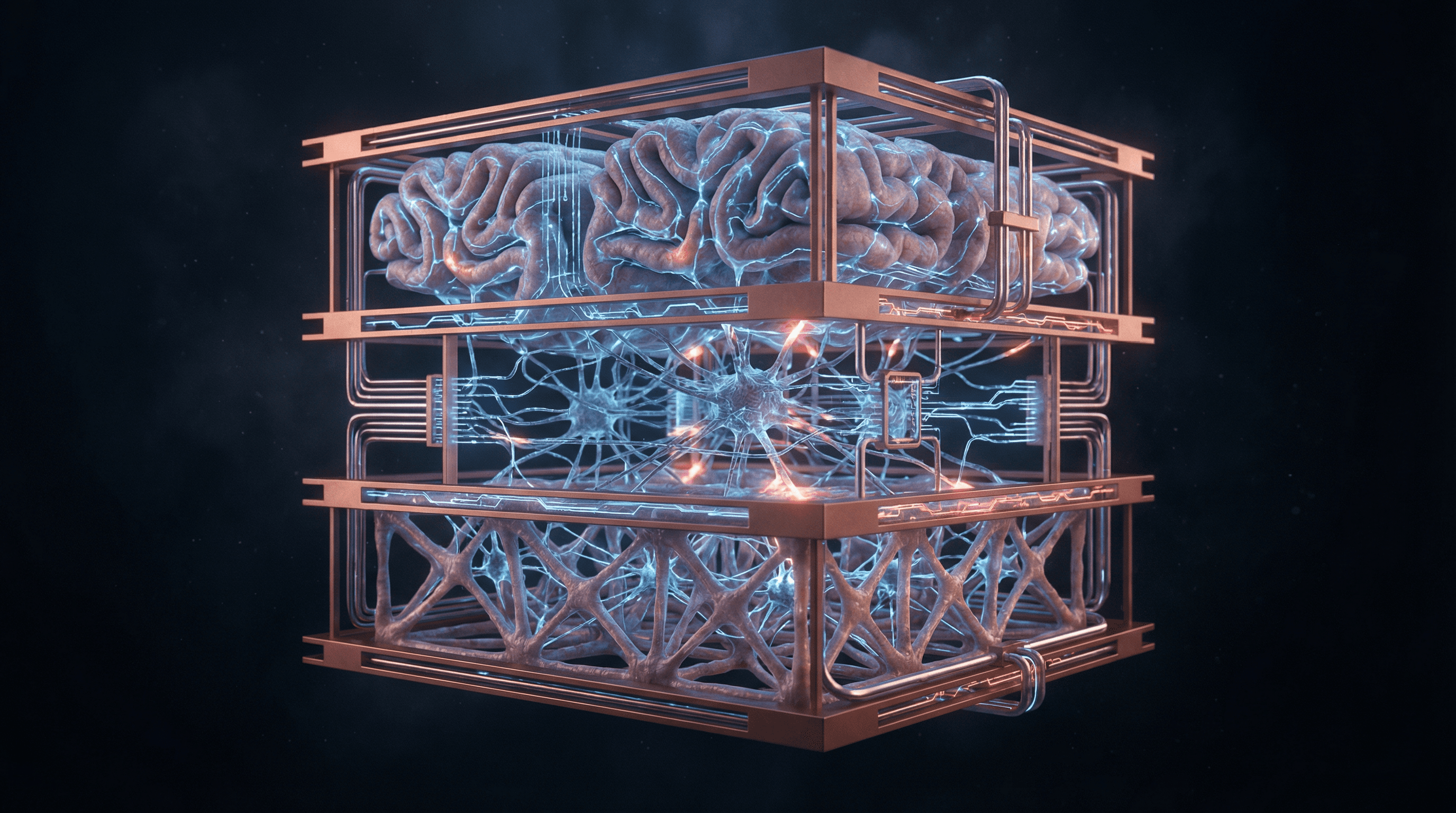
The amygdala — the brain’s threat-detection center — is the primary architecture driving this response. It communicates in both directions with the prefrontal cortex: one pathway encodes threat-amplifying signals, and the other encodes threat-dampening signals. Organizational change activates precisely this threat circuitry.
Under threat, organizations restrict information processing, centralize control, and increase reliance on prior-learned dominant behaviors — even when those behaviors are inappropriate to changed conditions. This is not a management problem. It is a neural circuit running on inherited survival architecture.
Psychological Safety as Neural Architecture
Team psychological safety is the strongest predictor of team learning behavior and organizational performance. Psychological safety correlates with reduced amygdala activation and increased prefrontal engagement. When psychological safety is absent, the amygdala interprets interpersonal risk as equivalent to physical threat, generating avoidance behavior that is neurologically indistinguishable from physical threat-response shutdown.
Analysis across one hundred and eighty teams confirmed psychological safety as the single most important variable in team performance. The SCARF model — Status, Certainty, Autonomy, Relatedness, Fairness — provides the operational framework: these five domains function as the primary threat and reward signal generators in organizational social environments. Corporate relocation, leadership transitions, and cultural integration simultaneously threaten all five domains, creating a compounding threat load that degrades executive function across the entire leadership population at once.
A meta-analysis of seventy-six brain imaging studies with over four thousand participants identified nine distinct activation clusters during uncertainty processing, centering on the brain’s internal awareness, cognitive control, and threat-detection regions. Uncertainty activates a comprehensive distributed network — not a single region — which has direct implications for organizational intervention design.
How Dr. Ceruto Approaches Organizational Development
Dr. Ceruto’s methodology is categorically distinct from traditional organizational development consulting. Where conventional firms run stakeholder interviews and culture surveys, MindLAB maps the specific neural regulatory states of leadership teams. We identify the actual threat-reward circuit configurations, cortisol load indicators, and prefrontal-limbic balance states producing current organizational behavior. The diagnosis is mechanistic, not interpretive.
Real-Time Neuroplasticity targets the biological substrate of organizational resistance. The intervention occurs at the level of the neural circuit, not the behavioral symptom. Traditional organizational development changes the environment hoping the brain adapts. MindLAB changes the brain’s regulatory architecture so that adaptive behavior becomes the default output.
The pattern that presents most often during organizational transitions is leadership teams whose allostatic load has already reached a level that biologically constrains their capacity for further adaptive change. Allostatic load is the cumulative physiological cost of sustained stress adaptation. Seventy percent of studies report a positive association between allostatic load and work-related stress outcomes. An executive team that has navigated hypergrowth, a corporate relocation, and multicultural workforce integration carries allostatic load that conventional organizational development consulting simply layers more change onto.
MindLAB begins with neurobiological assessment. Corporate relocation, Latin American market entry, fintech scaling — Dr. Ceruto’s approach addresses the specific neural demands of cross-cultural adaptation, building trust architectures across cultural frameworks, and maintaining executive function across dual-market complexity. The NeuroConcierge model provides comprehensive embedded partnership for leadership teams navigating sustained organizational complexity, while NeuroSync targets specific organizational bottlenecks with focused precision.
What to Expect
The process begins with a Strategy Call — a strategy conversation where Dr. Ceruto assesses the neural landscape of the organization’s leadership team and the specific change challenge they are navigating. This is not a general consultation. It is a precision assessment of which circuits are limiting organizational adaptive capacity.
From there, Dr. Ceruto designs a structured protocol calibrated to the organization’s specific neurobiological reality. The work follows a clear arc: regulatory assessment of the leadership team, identification of the specific threat-activation patterns and prefrontal-limbic imbalances limiting change capacity, targeted recalibration through Real-Time Neuroplasticity. Then we provide measurable verification of adaptive behavioral output.
The engagement measures regulatory change not surface engagement scores or pulse survey results. This produces organizational transformation that consolidates at the structural level because it addresses the actual causal mechanism rather than the downstream behavioral symptom.
References
Kredlow, M. A., Fenster, R. J., Laurent, E. S., Ressler, K. J., & Phelps, E. A. (2022). Prefrontal cortex, amygdala, and threat processing: Implications for PTSD. Neuropsychopharmacology, 47, 247–259. https://www.nature.com/articles/s41386-021-01155-7
Edmondson, A. C. (1999). Psychological safety and learning behavior in work teams. Administrative Science Quarterly, 44(2), 350–383. https://doi.org/10.2307/2666999
Staw, B. M., Sandelands, L. E., & Dutton, J. E. (1981). Threat rigidity effects in organizational behavior: A multilevel analysis. Administrative Science Quarterly, 26(4), 501–524.
The Neural Architecture of Organizational Performance
Organizational development is, at its most precise, the study of how collective human neural architecture produces organizational behavior — and how to modify that architecture to produce different behavior at scale. The structures, systems, and culture that OD consulting addresses are not independent of the people who inhabit them. They are the aggregate output of the neural prediction systems, reward architectures, threat responses, and social neural circuits of every individual in the organization, operating in interaction with each other and with the organizational environment. Changing organizational performance requires changing these neural systems, not just the structures that express them.
The prefrontal capacity of the organizational leadership layer is the primary constraint on organizational development. The structures and systems that OD consultants design cannot be more sophisticated than the prefrontal capacity of the leadership population implementing them. A governance structure that requires sustained cognitive flexibility, nuanced contextual judgment, and complex multi-stakeholder integration to function effectively will be simplified by the brains operating it to a level they can manage — regardless of how well it was designed. This simplification is not a conscious decision. It is the brain’s predictive coding system finding the most efficient operating pattern given its current regulatory capacity.
The social neural architecture of the organization is the second critical variable. Every organizational structure exists within a social neural environment — a distributed network of threat responses, status hierarchies, belonging signals, and social reward patterns that determines which of the structure’s intended functions are actually reinforced by the social environment and which are quietly overridden by social neural imperatives. An accountability structure that creates social threat for the behaviors it is trying to reinforce will be systematically subverted by the social neural imperative to minimize threat, regardless of its logical coherence.
Why Traditional Approaches Fall Short
Organizational development consulting has built sophisticated frameworks for diagnosing organizational dysfunction and designing structural, systemic, and cultural interventions. The best OD practice combines rigorous diagnostic methodology, evidence-based intervention design, and skilled change management to produce genuine organizational improvement. The fundamental limitation is that these frameworks operate at the level of organizational systems and professional behavior without directly addressing the neural architecture generating the behavior the systems are designed to modify.
This produces a characteristic pattern: structural interventions that improve organizational performance in the short term, followed by a progressive reversion to previous performance patterns as the neural architectures of the people inhabiting the new structures reassert their established patterns. The new accountability structure is adopted and then gradually re-interpreted to be consistent with existing threat avoidance patterns. The new collaborative model is implemented and then progressively undermined by the status and belonging dynamics that the social neural architecture generates. The performance management redesign produces initial behavioral compliance and then the normative drift that always follows when the system conflicts with the neural environment it is embedded in.
The missing element is neural-level diagnosis and intervention. OD consulting that can identify the specific neural architectures most powerfully maintaining the organizational patterns that need to change, and design interventions that address those architectures directly, can produce organizational development that holds — because the neural substrate generating the organizational behavior has been modified, not just the systems expressing it.

How Neural OD Consulting Works
My approach to organizational development consulting begins with a neural diagnostic layer that operates beneath the conventional OD assessment. The standard diagnostic — organizational surveys, leadership interviews, process analysis, structural mapping — reveals the behavioral and systemic expression of organizational patterns. The neural diagnostic examines the circuits generating those patterns: the threat architectures most powerfully shaping decision behavior, the reward systems most powerfully sustaining the existing performance patterns, the social neural dynamics most powerfully overriding the intended functions of existing structures, and the prefrontal capacity available in the leadership layer to sustain and model the organizational development the change requires.
From this layered diagnostic, I design OD interventions that address both the structural and neural dimensions simultaneously. The structural interventions — the governance redesign, the process architecture, the accountability systems, the role clarity — are designed not just for their logical coherence but for their compatibility with the neural architectures that will implement them. This means designing structures that work with the brain’s reward and threat systems rather than against them — creating environments in which the neural imperatives of the professional population and the intended functions of the organizational systems are aligned rather than in conflict.
The neural development component focuses on the leadership layer, because leadership neural architecture is the primary determinant of whether organizational development holds or reverts. Leaders whose regulatory capacity is rebuilt, whose reward systems are recalibrated to the actual reward landscape of organizational leadership, and whose threat responses are recalibrated to the specific threat signals most undermining their organizational development effectiveness are the most powerful OD intervention available. They are the social neural models that the rest of the organization’s prediction systems are most powerfully calibrated to.
What This Looks Like in Practice
Organizational development consulting engagements begin with a Strategy Call in which I map the presenting organizational performance challenge against its most likely neural substrates. This conversation identifies whether the presenting challenge is primarily a structural problem, a neural architecture problem, or the more common combination of the two — and designs an engagement accordingly.
For organizations addressing a specific, well-defined organizational development challenge — a particular team’s dysfunction, a specific process failure, a leadership transition requiring organizational realignment — the NeuroSync model provides focused consulting designed around both the structural and neural dimensions of that specific challenge. For organizations undertaking broad organizational development initiatives spanning multiple years and affecting the full professional population, the NeuroConcierge model provides the embedded consulting partnership required to address organizational development at the neural depth that lasting change requires. The engagement is calibrated to organizational and neural development timelines simultaneously — because the rate of lasting organizational change is ultimately constrained by the rate of neural change in the people generating organizational behavior.
For deeper context, explore personal development in organizational growth.