Business Management Consultant in Midtown Manhattan

As a neuroscientist in Midtown Manhattan, I partner with executives to rewire their decision-making and navigate organizational transformation with neurobiological precision.

In my 26 years of practice, I have observed a fundamental gap in executive guidance: most business advisors work backward from behavior, while neuroscience works forward from how the brain actually functions under pressure. The executives I work with in Midtown Manhattan—at JPMorgan Chase, Verizon, Morgan Stanley, and Pfizer—face an escalating paradox: organizational complexity has increased exponentially, but the neurobiological capacity to process uncertainty, make decisive choices, and lead through change has not. This is where a neuroscience-based approach to business management becomes not just an advantage, but a necessity.
Schedule a Strategy Call

Executive Coaching

The Problem: Executive burnout in Manhattan is endemic. Fifty-nine percent of Manhattan’s 2.13 million workers experience moderate-to-high burnout, and among managers the figure reaches 54%. At the C-suite level, the cognitive load is relentless—board meetings, investor relations, regulatory compliance, talent decisions, and strategic pivots compress into 12–15 hours of weekly meetings. Most executives are coached on communication tactics or strategic frameworks, but the underlying mechanism—how the prefrontal cortex manages competing demands, sustains focus under threat, and maintains emotional regulation—goes unaddressed.

The Mechanism: The pattern is consistent: executive performance plateaus because working memory and cognitive control are neurobiologically finite. A meta-analysis by Nicolau et al. (2023) in Frontiers in Psychology examined 20 randomized controlled trials of executive coaching and found an overall effect size of g=0.43, but critically, cognitive activities showed effect sizes of g=1.28 and goal attainment g=1.32. This tells us that when coaching targets neurobiological mechanisms—how the brain sustains attention, manages emotional conflict, and encodes new decision patterns—outcomes improve dramatically. Smith’s 2025 research in Nursing Administration Quarterly demonstrated that coaching specifically supports neuroplasticity and emotional regulation when structured to engage the anterior cingulate cortex and dorsolateral prefrontal cortex.

The Solution: My executive coaching program combines real-time assessment of your cognitive load, stress response patterns, and decision-making physiology with a structured 90–180 day partnership. We identify the specific neural bottlenecks constraining your performance—whether it is working memory saturation, amygdala-driven reactivity, or inhibitory control fatigue—and then deploy targeted practices that produce measurable shifts in your neurophysiology. The goal is not a different mindset; it is a different brain state during high-pressure decisions.


Learn more about Executive Coaching in Midtown Manhattan →

Leadership Development

The Problem: Leadership development programs in Manhattan are prolific. Executive search firms, boutique coaching practices, and business schools all promise transformation. Yet 70% of leaders report that succession and leadership pipeline efforts feel futile in a fast-changing environment. The issue is not the quality of content—most programs deliver solid frameworks—but the assumption that learning a framework changes behavior. It does not. Neural circuits must be rewired.

The Mechanism: Robbins et al. (2021) in Neuropsychopharmacology demonstrated that the prefrontal cortex, which governs cognitive control and goal-directed behavior, remains plastic throughout adult life. This is neurobiologically liberating: executives can develop new leadership capacities. However, Calderone et al. (2024) in Biomedicines found that the most significant neural changes in leaders undergoing development—increased cortical thickness in the prefrontal cortex and anterior cingulate cortex, reduced amygdala reactivity, and elevated BDNF—occur only when learning is emotionally engaged and repeated under realistic pressure. Additionally, Boukarras et al. (2022) in Frontiers in Psychology identified inter-brain neural synchrony as a predictor of leadership effectiveness: leaders whose neural patterns synchronize with their teams activate prefrontal dominance and suppress threat reactivity across the group.

The Solution: My leadership development program is a 6-month immersion grounded in Real-Time Neuroplasticity™. We assess your current leadership neurobiology—how your brain responds to ambiguity, conflict, and accountability—and then design a series of structured challenges and feedback cycles that gradually shift your neural circuits toward greater cognitive flexibility, emotional resilience, and distributed decision-making. By the end, your leadership presence becomes a neurobiologically stable capacity, not a behavioral technique.

Learn more about Leadership Development in Midtown Manhattan →

Strategic Planning

The Problem: Strategic planning under uncertainty activates the threat-response system. Manhattan’s competitive environment—43 Fortune 500 and 66 Fortune 1000 companies competing within a $939 billion economic engine—means that executives planning strategy are operating in a constant state of cognitive and emotional threat. When the threat system is activated, the brain narrows focus, accelerates mental shortcuts, and defaults to historical patterns. Long-term strategy becomes impossible.

The Mechanism: Mulay et al. (2025) in Cognitive, Affective & Behavioral Neuroscience found that acute stress significantly lowers activation in the dorsolateral prefrontal cortex—the region responsible for abstract reasoning, scenario modeling, and long-term planning. A 2025 meta-analysis in Frontiers in Neuroscience across 76 fMRI studies identified nine distinct activation clusters in the brain involved in uncertainty processing. Executives operating under stress activate only 2–3 of these clusters, meaning they have access to only a fraction of their strategic reasoning capacity.

The Solution: Strategic planning in my practice is not a three-day offsite with a whiteboard. It is a structured, neurobiologically informed process that first de-activates the threat response, allowing access to the prefrontal networks responsible for abstract reasoning and scenario modeling. We assess your current decision-making neurology, design a planning methodology that protects against cognitive biases introduced by stress, and then create a strategic roadmap grounded in both market realities and your team’s neurobiological capacity to execute. The outcome is strategy that your brain can actually sustain.

Learn more about Strategic Planning in Midtown Manhattan →

Performance Management

The Problem: Traditional performance management systems—ratings, reviews, calibration meetings—do not change behavior sustainably. They signal threat, activate defensive routines, and paradoxically reduce the neurobiological conditions necessary for growth. Executives in Midtown Manhattan manage large teams across complex structures. Performance conversations often become defensive, compliance-oriented, and divorced from actual behavioral change.

The Mechanism: Nature Communications (2025) reported that striatal dopamine signaling directly accelerates reinforcement learning—the brain mechanism by which performance feedback translates into sustained behavior change. A 2024 study in eNeuro found that dopamine signaling improved accuracy and sustained motivational orientation, particularly in challenging, goal-directed tasks. Research in Frontiers in Behavioral Neuroscience (2023) revealed that dopamine activity in the nucleus accumbens predicted reaction time benefits in complex performance scenarios. Traditional performance reviews do not engage the dopamine system; they activate the threat system.

The Solution: My performance management methodology replaces the traditional review cycle with a dopamine-informed feedback and development structure. Instead of annual ratings, we implement real-time, neurobiologically informed feedback that activates the reward system, clarifies expectations in a way the prefrontal cortex can process, and connects performance feedback to intrinsic motivation. For your organization, this means measurable improvements in employee retention, engagement, and sustainable performance change—without the defensive behaviors that follow traditional reviews.

Learn more about Performance Management in Midtown Manhattan →

Change Management Consulting

The Problem: Seventy percent of organizational change initiatives fail, according to repeated research across industries. The problem is not the change strategy; it is that change activates the brain’s threat-response system. When threat is activated, the amygdala dominates, the prefrontal cortex becomes less functional, and people revert to old patterns regardless of the logical case for change. Manhattan’s current office leasing surge—23.2 million square feet in the first nine months of 2025, the strongest volume in 20 years—reflects organizations attempting massive structural changes as they navigate post-pandemic work models. Without neurobiology, these changes fail.

The Mechanism: Rock et al.’s SCARF model identifies five neurobiological threat-response domains in organizational change: Status, Certainty, Autonomy, Relatedness, and Fairness. Each activates the amygdala and suppresses prefrontal function. Research on habit formation (PubMed 29717649) demonstrates that behavioral change is mediated not by conscious decision but by contextual cues, social reinforcement, and repeated activation of neural circuits. A 2024 study in the International Journal of Advanced Research in Management and Economics outlined a five-phase neuro-informed transformation model that systematically addresses threat responses while activating the reward and motivation systems.

The Solution: My change management methodology restructures your transformation to operate with neurobiology, not against it. We assess the specific threat-response patterns in your organization, then design a multi-phase rollout that manages threat activation, clarifies certainty in ways the prefrontal cortex can process, preserves autonomy where possible, and activates social proof and relatedness. The result is significantly higher adoption, faster behavior change, and sustained transformation rather than relapse to old patterns after six months.

Learn more about Change Management Consulting in Midtown Manhattan →

Succession Planning

The Problem: Eighty-six percent of leaders recognize succession planning as critical; 70% report it feels futile in rapidly changing environments. Succession planning is neurobiologically demanding because it activates multiple threat-response systems simultaneously: status anxiety (the incumbent), uncertainty (the organization), and the cognitive load of evaluating talent across complex criteria. Most succession processes become political, delayed, or fail when the designated successor leaves. In Midtown Manhattan, where executive talent is highly mobile and competitive, succession failures are costly.

The Mechanism: Succession planning engages three neurobiological challenges: the cognitive load of evaluating multiple candidates against abstract criteria (working memory constraint), the threat response activated by considering one’s own replacement (amygdala activation), and the uncertainty inherent in predicting future performance (prefrontal uncertainty processing). Wharton Executive Development research (2026) confirms that most organizations approach succession as a process problem rather than a neurobiology problem. Leadership neuroplasticity research by Robbins et al. (2021) and Calderone et al. (2024) demonstrates that leadership capacity can be developed, but only if assessment and development are aligned to neural potential rather than past performance alone.

The Solution: My succession planning program combines assessment of cognitive and neurobiological leadership capacity with a structured development and acceleration methodology. We identify emerging leaders with the neurobiological substrates for growth—cognitive flexibility, emotional regulation, and distributed decision-making capacity—and then design a 12–24 month acceleration program that develops these capabilities in parallel with strategic responsibilities. The outcome is a succession cohort with both demonstrated leadership capability and neurobiological readiness for elevated roles.

Learn more about Succession Planning in Midtown Manhattan →

Culture Transformation

The Problem: Culture transformation fails because most culture work targets values and norms rather than the neurobiological conditions that actually shape behavior. Competitive cultures—common in financial services and media, both dominant in Midtown Manhattan—create chronic activation of the threat-response system. When threat is chronic, the brain prioritizes individual survival over collective coordination, creating silos, defensive communication, and the “culture problems” that executives experience as dysfunction.

The Mechanism: Boukarras et al. (2022) in Frontiers in Psychology found that competitive cultures significantly alter inter-brain neural synchrony, suppressing prefrontal coordination and activating amygdala-driven vigilance. Rippon’s 2023 research in Frontiers in Human Neuroscience demonstrated that negative social experiences activate inhibitory pathways and trigger predictive coding of future threat. Conversely, Calderone et al. (2024) found that collaborative structures increase inter-brain synchrony in theta and beta frequencies, associated with empathy, coordination, and collective problem-solving. Culture change at the neurobiological level produces measurable shifts in team performance, retention, and adaptive capacity.

The Solution: My culture transformation program operates at the neurobiological level. We assess your current culture neurobiology—how your organizational structure and norms activate threat or reward systems—and then systematically redesign systems, communication practices, and leadership behavior to activate the prefrontal networks associated with collaboration, psychological safety, and distributed decision-making. This is not rebranding. It is rewiring how your organization’s collective brain functions under pressure.

Learn more about Culture Transformation in Midtown Manhattan →

Business Transformation Consulting

The Problem: Business transformation—whether driven by technology, market disruption, or strategic pivot—requires sustained change across multiple organizational layers. The largest transformations fail not because the strategy is flawed but because the organization’s neurobiological capacity to sustain new behaviors is overwhelmed. Executives at media companies like Paramount (HQ in Midtown), pharma firms like Pfizer (new HQ in Manhattan), and financial services firms are all navigating transformation at scale. Without neurobiology, transformation stalls.

The Mechanism: Bukwich et al. (2025) in Neuron demonstrated that dopamine-mediated reward systems drive value-sensitive decisions—the mechanism by which organizations sustain prioritization of transformation initiatives amid competing demands. iScience (2026, Cell Press) published landmark research showing that transcranial magnetic stimulation of the left premotor cortex is causal in habit acquisition and reversal, operating through corticostriatal networks that manage the transition from habitual to goal-directed behavior. Business transformation engages this exact neural transition: moving established organizational habits (how people work, communicate, decide) toward new goal-directed patterns. Most transformation fails because this neural transition is not explicitly supported.

The Solution: My business transformation consulting program is grounded in the neurobiology of organizational habit change. We structure transformation in phases that systematically engage the brain systems required for sustained change: first, activating the reward system and clarifying value (dopamine); then, establishing new contextual triggers and social reinforcement (habit learning); and finally, embedding distributed decision-making that allows the organization to manage ongoing adaptation without constant top-down control. The outcome is transformation that persists because it is neurobiologically stable.

Learn more about Business Transformation Consulting in Midtown Manhattan →

Midtown Manhattan is the economic and institutional center of a $2.5 trillion metropolitan economy. Manhattan’s gross metropolitan product of $939 billion represents 73% of the city’s total economic output. Within Midtown’s concentrated footprint sit 43 Fortune 500 and 66 Fortune 1000 companies—JPMorgan Chase (270 Park Ave), Verizon (1095 Ave of Americas), Morgan Stanley (1585 Broadway), MetLife (200 Park Ave), Pfizer (66 Hudson Blvd), AIG (1271 Ave of Americas), Paramount (1515 Broadway), Apollo (9 W 57th), KKR (30 Hudson Yards), and Marsh & McLennan (350 Madison)—representing $1.93 trillion in collective revenue and 2.19 million employees.

Wall Street employment has reached 201,500, the highest level in 30 years, with financial services profits surging 90% in 2024. Beyond finance, Midtown is a media epicenter—Paramount, BBDO, McCann, DDB—with media and entertainment workforce growth of 1.7–2.6% (2021–2023). Pharmaceutical firms like Pfizer are consolidating Manhattan headquarters (the new spiral-designed HQ at Hudson Yards), with healthcare employment projected to grow 15% through 2030.

Manhattan office leasing reached 23.2 million square feet in the first nine months of 2025—the strongest volume in 20 years, up 37.6%—reflecting a return-to-office wave. NYC office attendance has climbed to 1.3% above July 2019 pre-pandemic levels, with 2.13 million workers in Manhattan (2023), up 14.2% from 2021. This density and return have intensified cognitive and emotional demands on executives.

The human cost of this intensity is visible in burnout metrics. Fifty-nine percent of Manhattan’s workforce experiences moderate-to-high burnout. Among managers, the figure reaches 54%, compared to 40% among entry-level employees. The executive population, compressed into 12–15 hours of weekly meetings amid structural complexity, operates in a chronic threat state—high status anxiety, relentless decision-making under uncertainty, and perpetual organizational change.

The executive advisory market in Manhattan is saturated with traditional coaching firms (Loeb Leadership, boutique psychology-based coaches) and global consulting practices (McKinsey, Bain, Boston Consulting Group). The U.S. management consulting market is valued at $407.3 billion (2026); global executive coaching approaches $9 billion. Yet no provider in Manhattan currently offers an individually tailored business management consulting practice grounded in neuroscience, operating at a premium investment level that serves Fortune 500 executives and organizations undergoing significant transformation. Investment details are discussed during the Strategy Call.

Dr. Sydney Ceruto, PhD — Founder, MindLAB Neuroscience

Dr. Sydney Ceruto holds a PhD in Behavioral & Cognitive Neuroscience from NYU and Master’s degrees in Clinical Psychology and Business Psychology from Yale University. She is a Lecturer in the Wharton Executive Development Program at the University of Pennsylvania, an Executive Contributor to Forbes Coaching Council, and an inductee in Marquis Who’s Who in America. Dr. Ceruto founded MindLAB Neuroscience in 2000 and has spent more than 26 years developing and refining her proprietary methodology, Real-Time Neuroplasticity™. She is the author of The Dopamine Code (Simon & Schuster, June 2026).

References

Arnsten, A. F. T. (2009). Stress signalling pathways that impair prefrontal cortex structure and function. Nature Reviews Neuroscience, 10(6), 410–422. https://doi.org/10.1038/nrn2648

Schultz, W. (2016). Dopamine reward prediction-error signalling: a two-component response. Nature Reviews Neuroscience, 17(3), 183–195. https://doi.org/10.1038/nrn.2015.26

Diamond, A. (2013). Executive functions. Annual Review of Psychology, 64, 135–168. https://doi.org/10.1146/annurev-psych-113011-143750

Success Stories

“Every close relationship I had eventually hit the same wall — I'd flood emotionally and shut down or explode, and nothing I'd tried gave me real control over it. Dr. Ceruto identified that my autonomic nervous system was defaulting to fight-or-flight the moment real intimacy was on the line. She didn't give me coping tools. She restructured the default. The flooding stopped because the trigger architecture changed.”

Simone V. — Publicist New York, NY

“The same relational patterns my mother and grandmother lived through kept repeating in my own life — the hypervigilance, the emotional shutdown, the inability to feel safe even when nothing was wrong. Talking through it changed nothing. Dr. Ceruto identified the epigenetic stress signatures driving the pattern and restructured them at the neurological level. The cycle that ran through three generations stopped with me.”

Gabriela W. — Real Estate Developer Miami, FL

“The numbness crept in so gradually I didn't notice until I couldn't feel anything — not stress, not connection, not even relief when things went well. Dr. Ceruto identified it as a dorsal vagal shutdown — my nervous system had flatlined as a survival strategy. Nothing I'd tried before had even named the problem. Within ninety days, the signal came back. I feel things again, clearly and without overwhelm.”

Marcus H. — Fund Manager Dallas, TX

“Working with Dr. Ceruto was one of the most transformative experiences of my life. I was stuck in a cycle of dissatisfaction, unsure of where I was headed or why I felt so unfulfilled. From the very first session, she helped me peel back the layers and uncover what truly mattered. Her ability to connect neuroscience with practical life strategies was incredible. She guided me to clarify my goals, break free from limiting beliefs, and align my actions with my values. I finally feel real purpose.”

Nichole P. — Wealth Advisor Sarasota, FL

“Dr. Ceruto delivers results. I’ve worked with her at two different points in my career. By the end of the introductory consultation, I knew I’d found the right person. She pointed out the behaviors and thought distortions holding me back, then guided me through the transformation with direct, practical recommendations I could apply immediately. She supplemented our sessions with valuable reading materials and was available whenever I needed her. I am a better leader and a better person because of our work together.”

Leeza F. — Serial Entrepreneur Austin, TX

“After years of burnout, the dopamine optimization work helped me finally understand and balance my dopamine levels in a way nothing else had. The personalized plan made all the difference — I’m now motivated, focused, and performing at my best without the crashes that used to follow every productive stretch. The science behind this approach is real and the results are measurable. It gave me a daily framework I still rely on to stay consistent, sharp, and fully in control of my energy.”

Larz D. — Tech Founder Palo Alto, CA

Frequently Asked Questions About Neuroscience-Based Organizational Advisory

How does addressing the neural architecture of leaders improve organizational outcomes?

Every organization's performance ceiling is set by the cognitive capacity of its key decision-makers. When leaders operate with depleted prefrontal function — reduced decision quality, impaired strategic thinking, degraded social cognition — the organization inherits those constraints regardless of how sound its strategy or structure may be. Optimizing the neural architecture of key leaders raises the biological ceiling on organizational performance.

How does this approach work alongside existing management consulting engagements?

This approach addresses the biological layer that determines whether any consulting framework succeeds. Strategy consultants provide frameworks. Change management firms provide implementation methodology. Dr. Ceruto ensures the neural architecture of the leaders applying those frameworks supports rather than constrains their effectiveness. The approaches are complementary — when the biological foundation is sound, every framework applied becomes more effective.

Which organizational challenges benefit most from this neuroscience-based approach?

The highest-impact applications involve challenges where individual cognitive quality directly determines organizational outcomes: strategic decision-making under uncertainty, organizational transformation, leadership transitions, culture change, and performance improvement initiatives that have plateaued. These are contexts where the neural capacity of key individuals is the binding constraint — not process, structure, or strategy.

How many leaders in an organization need this work for the organization to benefit?

Organizational impact follows network dynamics rather than headcount. The neural quality of individuals at high-influence decision nodes determines the quality of signals that cascade through the organization via mirror neuron systems and social cognition circuits. In most organizations, optimizing the neural architecture of 3-7 individuals at the most influential positions produces disproportionate organizational impact.

What measurable organizational improvements can we expect?

The most measurable improvements occur in leadership decision quality — faster, more accurate strategic decisions, reduced decision paralysis at critical junctures, and improved capacity for holding competing priorities simultaneously. Secondary effects include improved leadership communication, reduced team anxiety transmission from leaders, and better talent retention through transitions. These improvements reflect enhanced prefrontal function in the individuals driving organizational outcomes.

How does Dr. Ceruto identify which leaders are the highest-impact intervention points?

Organizational influence does not always follow the org chart. Dr. Ceruto identifies the individuals whose neural states most powerfully shape organizational behavior — those at the intersection of high social influence and high decision impact. These are typically, but not always, senior leaders. Some mid-level managers at critical information or cultural nodes exert disproportionate neural influence over their teams.

Is this work confidential within the organization?

Complete confidentiality is foundational. The neural patterns constraining leadership effectiveness are often connected to vulnerabilities that leaders cannot disclose within their organizational environment. Dr. Ceruto operates entirely outside the organizational structure. Individual work remains confidential; organizational benefit is visible through improved leadership behavior without requiring disclosure of the process that produced it.

What does the Strategy Call assess in an organizational context?

The Strategy Call maps the neural landscape of the leader's current cognitive function — decision quality, stress-response patterns, social cognition capacity, and the specific ways their architecture interacts with their organizational demands. It identifies which neural systems are most constrained relative to the role's requirements and where targeted intervention will produce the greatest leadership and organizational return.

Ready to Perform at Your Highest Level?

Neuroscience-based business management consulting is not for everyone. It is designed for executives and organizations in Midtown Manhattan who are ready to move beyond behavioral frameworks and address the neurobiological mechanisms that actually drive performance, leadership, and organizational transformation. If you recognize yourself in these pages, let's talk.

Schedule a Strategy Call
MindLAB Neuroscience consultation room

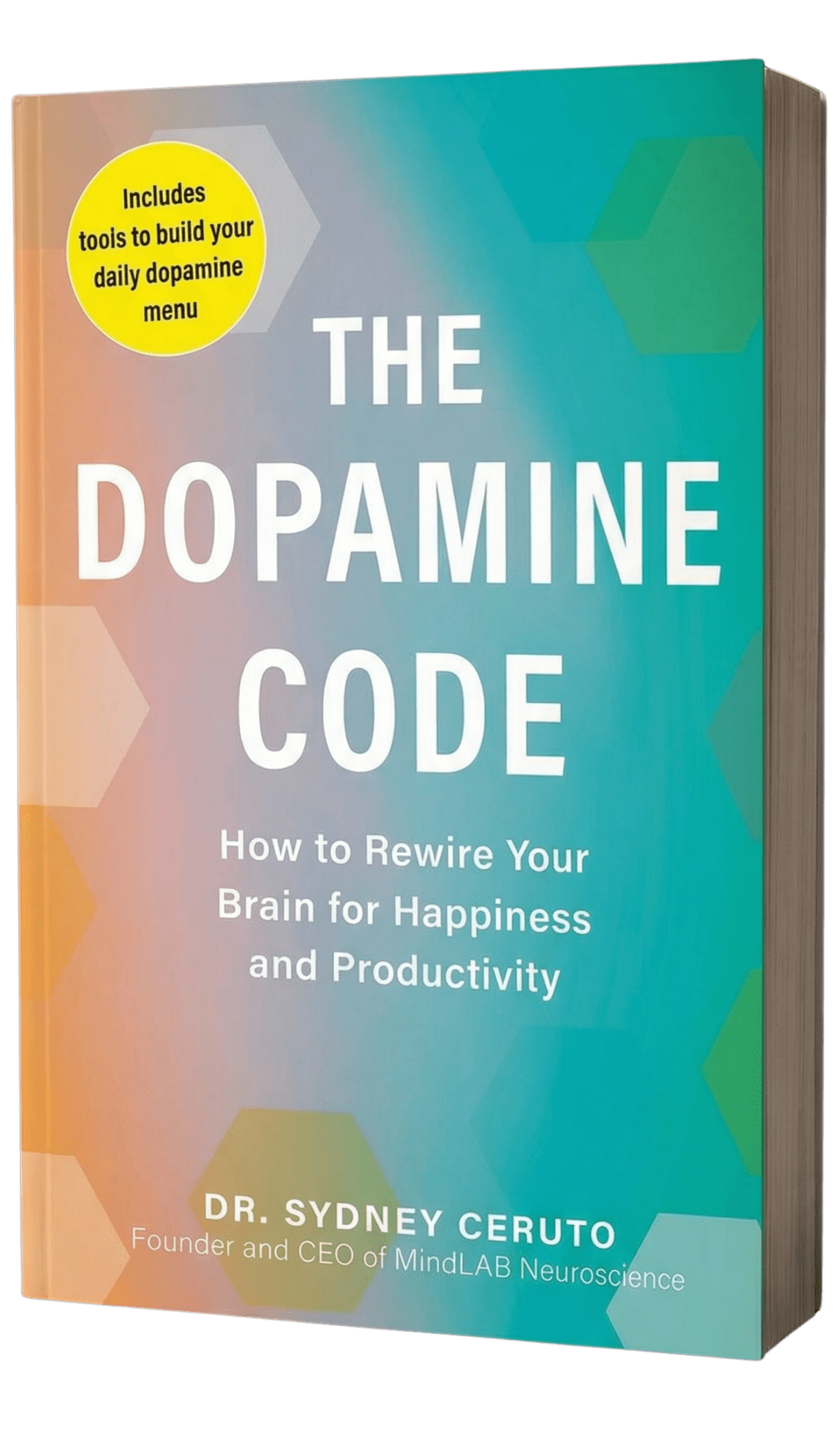
The Dopamine Code

Decode Your Drive

Why Your Brain Rewards the Wrong Things

Your brain's reward system runs every decision, every craving, every crash — and it was never designed for the life you're living. The Dopamine Code is Dr. Ceruto's framework for understanding the architecture behind what drives you, drains you, and keeps you locked in patterns that willpower alone will never fix.

Published by Simon & Schuster, The Dopamine Code is Dr. Ceruto's framework for building your own Dopamine Menu — a personalized system for motivation, focus, and enduring life satisfaction.

Order Now

Ships June 9, 2026

The Dopamine Code by Dr. Sydney Ceruto — Decode Your Drive
Locations

The Intelligence Brief

Neuroscience-backed analysis on how your brain drives what you feel, what you choose, and what you can’t seem to change — direct from Dr. Ceruto.