Business Development Service in Midtown Manhattan

You've built something remarkable. Now you're facing the gap between founder credentials and founder reality—the pressure to perform in a market where neural stamina is everything.

In my practice across Midtown's founder and emerging-executive community, I consistently observe the same inflection point: the moment when a founder or business leader transitions from individual contributor to founder-entrepreneur or from corporate executive to independent operator. At that threshold, the neurobiological demands shift radically. You're no longer optimizing within an existing system—you're building one. You're no longer executing someone else's vision—you're persuading capital allocators that your vision is worth funding. You're no longer managing known stakeholders—you're navigating investors, board members, customers, and market forces simultaneously. The difference between founders who scale rapidly and those who plateau isn't always intelligence, strategy, or work ethic. It's whether their nervous system has been rewired to navigate founder-level pressure without defaulting to the defensive patterns that constrain decision-making, investor communication, and business growth. Business development is where that neurological rewiring happens.
Schedule a Strategy Call

Founder Coaching

Founding a business activates every pressure system in your brain simultaneously. You’re managing identity risk—your reputation, your network, your financial security are all on the line. You’re navigating chronic ambiguity—no manual exists for the specific challenges your company is facing. You’re sustaining focus across competing demands—fundraising, hiring, product development, customer acquisition. Egana-delSol et al. (2023) measured this neurologically: entrepreneurs receiving structured education showed measurably decreased resting-state arousal and a 0.47σ reduction in responsiveness to negative stimuli—essentially, their nervous systems became more resilient to setback and failure feedback. What they documented is that these neural shifts preceded behavioral changes. The brain rewired first; sustainable founder behavior followed.

My founder coaching methodology treats this explicitly. I’m not teaching you how to be a founder—you’re already living it. I’m identifying where your nervous system is generating reactive, suboptimal patterns and rewiring it. Specifically: Do you panic when your latest customer acquisition drops? That’s amygdala over-activation signaling threat. Are you ruminating on rejection from a VC meeting instead of moving to the next prospect? That’s anterior cingulate cortex stuck in error-checking mode. Are you unable to make clear hiring or product decisions because you’re catastrophizing around downside? That’s prefrontal cortex being hijacked by threat detection. Nicolau et al. (2023) conducted a meta-analysis of executive coaching randomized controlled trials and found that coaching’s strongest effects were on cognitive activities (g=1.28) and behavioral outcomes (g=0.73)—meaning that when you rewire how a founder thinks, their actual behavior shifts durably. Over 12-16 weeks, using Real-Time Neuroplasticity™, we identify your specific pressure patterns and rebuild your nervous system’s capacity to remain resourceful under founder-level stress. The outcome is a founder who fundraises without emotional dysregulation, scales without burnout, and navigates ambiguity with strategic clarity rather than defensive reactivity.


Learn more about Founder Coaching in Midtown Manhattan →

Business Growth Consulting

You’ve built a business that’s profitable, operationally sound, and stuck. Revenue has plateaued. Customer acquisition has become harder per dollar spent. Your team is executing well but growth has stalled. The traditional diagnosis is “you need better marketing” or “you need to raise capital to scale” or “you need new product strategy.” Sometimes those are true. Often, they mask the real constraint: your nervous system can’t sustain the executive capacity required for business growth, and that neurological ceiling is acting as a business ceiling.

When I’m brought in for business growth consulting, my first assessment is always neurobiological. How is your nervous system currently organized at your company? Are you and your leadership team operating from a state of resourcefulness and strategic clarity, or are you in chronic stress-response mode? Iodice et al. (2022) trained senior managers in neurobiofeedback—teaching them to self-regulate their stress response in real time—and found that trained managers demonstrated steeper probability discounting (better risk assessment), longer deliberation times on high-stakes choices, and lower impulsivity. In other words: better, less reactionary business decisions. McEwen & Davidson (2012) documented that chronic stress produces measurable brain changes—amygdala enlargement and hippocampus/prefrontal cortex volume reduction—that directly impair the executive functions required for strategy, pattern recognition, and adaptive decision-making. The interventions that reversed these stress-driven changes? Intentional neural interventions—exactly what my growth consulting methodology employs.

What distinguishes my approach is this: I don’t add another strategic framework or marketing playbook to your team’s workload. I assess and rebuild the neural foundation that makes strategic execution possible. Are your key decision-makers able to sustain focus on long-term growth initiatives while managing daily operational crises? Can your leadership team hold complexity without collapsing into oversimplification? Can you evaluate new opportunities against your core strategy without being derailed by every new threat or market signal? Valesi et al. (2023) provided the first neurophysiological evidence that the quality of coach-coachee relational dynamics is measurable in real time using EEG—meaning that growth consulting rooted in neuroscience isn’t just metaphorically “brain-based,” it’s literally changing brain states. Over 16-24 weeks, using Real-Time Neuroplasticity™, we rebuild your organization’s neural fitness: restoring prefrontal function for sustained strategic focus, rebuilding emotional regulation so decision-making stays clear under pressure, rewiring how your team manages ambiguity and failure feedback. The outcome is measurable acceleration in business growth—higher revenue per customer, faster market response, more confident capital decisions, and sustained execution velocity.

Learn more about Business Growth Consulting in Midtown Manhattan →

Investor Relations Coaching

You have 45 minutes to persuade experienced investors to risk millions on your company. That window isn’t decided by your deck or your unit economics. It’s decided in the neural moment when investors are evaluating your credibility, your resilience, and whether they believe you can execute your vision under pressure. Genevsky et al. (2017) scanned investors’ brains while they reviewed funding pitches and found that nucleus accumbens activity (the reward anticipation circuit) predicted funding decisions at 59.1% accuracy—substantially higher than investors’ own behavioral self-reports. What activated that circuit wasn’t always the strongest product or the best business model. It was the founder’s ability to communicate with cognitive clarity and earned confidence while under high-stakes pressure.

Investor relations coaching treats this explicitly. Most pitch coaching teaches you how to talk about your business. Neuroscience-based investor coaching teaches you how to activate the neural systems in investors’ brains that make them willing to fund you. Zheng et al. (2021) found that investor confidence mediates how much social influence affects investment decisions—high-confidence investors are more independent in their thinking; low-confidence investors are more swayed by herd dynamics. A founder who projects neurologically authentic confidence (not performative bravado, which investors detect instantly) changes how investors’ brains process the entire pitch. Davydova et al. (2024) used fMRI to compare persuaded and unpersuaded investors and found that theory-of-mind regions (the brain’s mentalizing circuits) are active in resistance to persuasion. In other words: when you pitch, the investor’s brain is running a parallel model of whether you actually understand your market, your customers, and the challenges ahead. If your nervous system is generating anxiety signals (elevated cortisol, shallow breathing, micro-expressions of doubt), the investor’s mentalizing circuit detects it and concludes you don’t fully believe in what you’re saying.

My investor relations coaching addresses this at the neurological level. We identify where your nervous system activates threat signals during investor meetings—is it the dollar amount being discussed? Is it the moment a sharp question arrives? Is it the silence when an investor takes time to consider your response? We then systematically rewire your response to those triggers so you remain in a state of resourcefulness and strategic clarity throughout the pitch. We work on how you communicate under pressure—not to be slick or performative, but to be neurologically coherent, which investors perceive as authentic conviction. Over 8-12 weeks, typically intensifying as your fundraise timeline compresses, using Real-Time Neuroplasticity™, we rebuild your nervous system’s capacity to present with clarity, answer tough questions without defensive reactivity, and communicate your vision with the kind of earned confidence that activates investor reward circuitry. The outcome is pitch meetings where investors experience you as a credible, capable, genuinely confident founder—which means substantially higher close rates on fundraising and better terms.

Learn more about Investor Relations Coaching in Midtown Manhattan →

Midtown Manhattan is where founders and business leaders live, work, and raise capital. The concentration is specific to the city’s particular economic structure: media and publishing conglomerates producing spin-off founders; advertising holding companies (WPP, Interpublic, Omnicom) generating agency entrepreneurs; medical practices and medtech ventures emerging from the Upper East Side corridor; fintech and healthcare startups headquartered around Madison and Park Avenue.

This ecosystem has fundamentally changed in the last three years. The return-to-office mandate arrived in 2025. JPMorgan mandated five days in-office. Morgan Stanley followed. NBCUniversal shifted to four days beginning January 2026, followed by Paramount Global’s five-day requirement. The result? Midtown Manhattan office leasing surged to 23.2 million square feet in the first nine months of 2025—37.6% year-over-year increase, the strongest leasing environment in 20 years. Availability fell to 13.4% in Q4 2025, its lowest point since Q2 2020. Asking rents averaged $84.24/SF, with premium Class A buildings at $119/SF—a 14% increase since 2021. What this signals is that organizations are betting heavily on Midtown as a command center, a collaboration hub, a place where decisions happen in person.

New York City hosts 41 Fortune 500 headquarters (2024), concentrated in Midtown. These are the command centers for JPMorgan Chase, Morgan Stanley, MetLife, Verizon, Paramount Global, and dozens of other capital allocators and strategic decision-makers. In this ecosystem, business development—raising capital, scaling revenue, building investor relationships, navigating business growth—happens constantly.

The city’s creative industries employ 274,000 people, earning an average of $146,000 annually—28% above the citywide average. Advertising holds 19% of all U.S. advertising employment (location quotient 6.6, meaning six times the national concentration). Creative media employment surged 20% from 2017-2022. Publishing alone represents 95,000 jobs, $11 billion in wages, and $34 billion in economic output. What these numbers represent is not just employment—they represent a continuous stream of entrepreneurs launching ventures. Senior editors and publishers spin off boutique imprints. Advertising account directors launch independent creative studios. Media executives found digital media companies and newsletter platforms. Midtown’s founder ecosystem is densely populated and highly capitalized.

The startup ecosystem strengthens this further. New York City hosts over 10,000 tech companies and startups, with $10+ billion in annual early-stage funding and 119 unicorns as of 2024. Q4 2024 saw major funding rounds: Cyera ($300M Series D), Melio ($150M Series E), Maven Clinic ($110M). Unlike Silicon Valley, NYC’s startup funding is weighted heavily toward media, fintech, healthcare, and fashion—sectors where Midtown founders are embedded. The Upper East Side operates as a distinct healthcare and medical services corridor, with physicians founding and scaling practices, medtech ventures, and concierge medicine models. This is a founder population with capital, credentials, and pressure.

What distinguishes Midtown’s business development need is this: corporate spinoffs and founder-exiting-to-entrepreneur transitions are constant. Executives at Fortune 500 companies, media conglomerates, and advertising holding companies regularly launch independent ventures. Unlike Silicon Valley founders, where entrepreneurship is the cultural baseline, corporate-to-founder transitions in Midtown create a specific pressure pattern: you’re accustomed to operating within established systems, with institutional support, defined roles, risk mitigation. Suddenly, you’re the sole decision-maker. Suddenly, every decision carries financial and reputational consequence. Suddenly, you’re navigating investors, board dynamics, and market uncertainty without the buffer of a corporate organization behind you. This neurobiological transition—from corporate executive to independent founder—is where most Midtown entrepreneurs hit their first performance ceiling. Founder coaching, business growth consulting, and investor relations coaching directly address that transition. The market need is dense, continuous, and high-value.

Dr. Sydney Ceruto, PhD — Founder, MindLAB Neuroscience

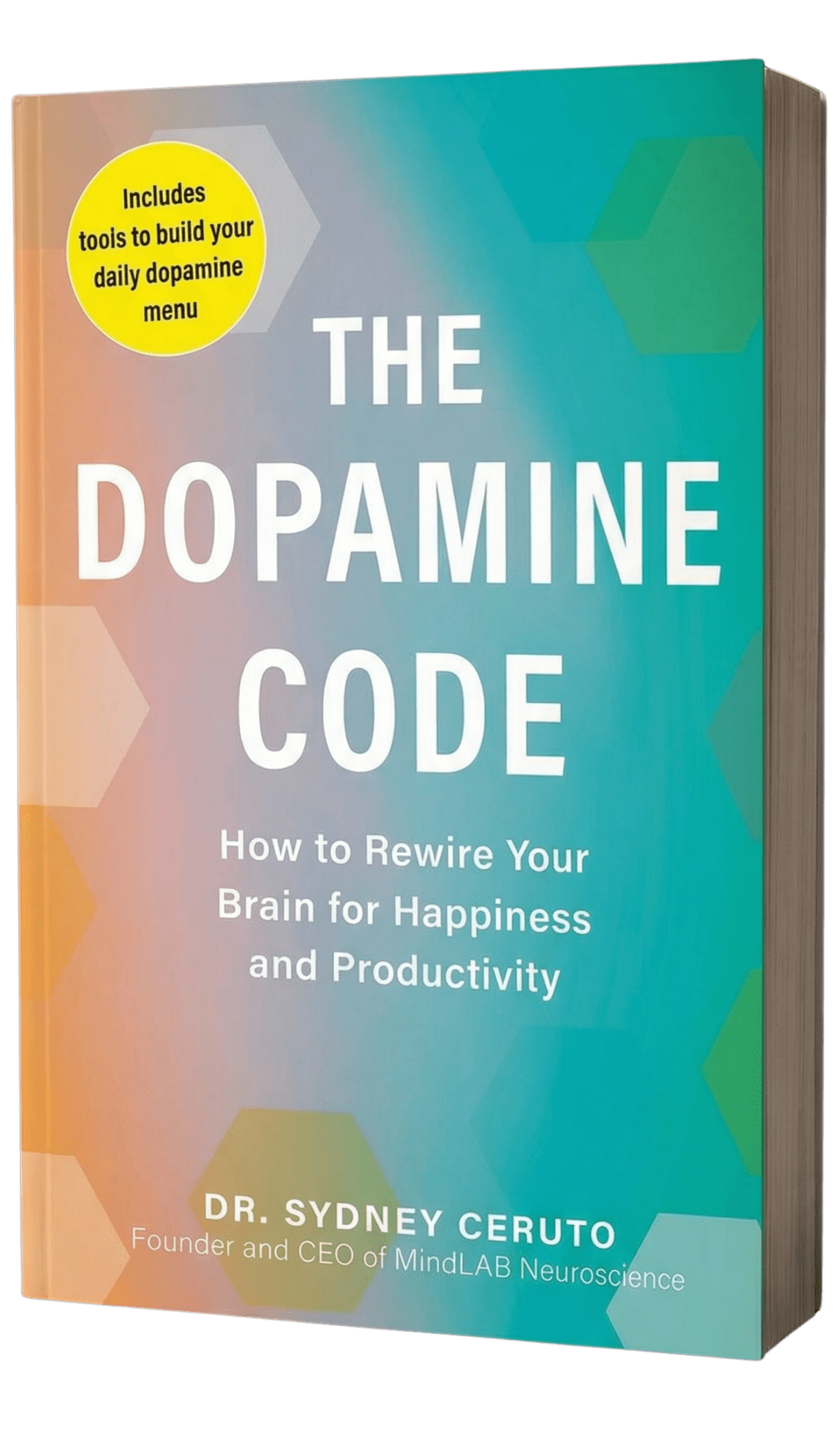
Dr. Sydney Ceruto holds a PhD in Behavioral & Cognitive Neuroscience from NYU and Master’s degrees in Clinical Psychology and Business Psychology from Yale University. She is a Lecturer in the Wharton Executive Development Program at the University of Pennsylvania, an Executive Contributor to Forbes Coaching Council, and an inductee in Marquis Who’s Who in America. Dr. Ceruto founded MindLAB Neuroscience in 2000 and has spent more than 26 years developing and refining her proprietary methodology, Real-Time Neuroplasticity™. She is the author of The Dopamine Code (Simon & Schuster, June 2026).

References

Berridge, K. C., & Kringelbach, M. L. (2015). Pleasure systems in the brain. Neuron, 86(3), 646–664. https://doi.org/10.1016/j.neuron.2015.02.018

Schultz, W. (2015). Neuronal reward and decision signals: from theories to data. Physiological Reviews, 95(3), 853–951. https://doi.org/10.1152/physrev.00023.2014

Arnsten, A. F. T. (2009). Stress signalling pathways that impair prefrontal cortex structure and function. Nature Reviews Neuroscience, 10(6), 410–422. https://doi.org/10.1038/nrn2648

Success Stories

“Every system, every supplement, every productivity method I tried collapsed within weeks — and nothing held because nothing addressed why my attention kept fragmenting. Dr. Ceruto identified the dopamine regulation pattern that was hijacking my prefrontal cortex every time I needed sustained focus. She didn't give me another workaround. She restructured the architecture underneath. My brain holds now. That's not something I ever thought I'd be able to say.”

Derek S. — Film Producer Beverly Hills, CA

“I struggled with debilitating anxiety for years, trying countless therapies and medications with little success. Finding Dr. Ceruto and her neuroscience-based approach was truly life-changing. From our very first session, her deep knowledge of brain science and how it applies to anxiety gave me real hope. What sets her apart is that perfect blend of expertise and compassion — she genuinely cared about my progress and responded quickly even outside of our scheduled sessions. I can now enjoy social situations and excel at work.”

Brian T. — Architect Chicago, IL

“The way I was processing decisions under pressure had a cost I couldn't see — until Dr. Ceruto mapped it. She identified the neural pattern driving my reactivity in high-stakes situations and restructured it at the root. I don't just perform better under pressure now. I think differently under pressure. That's not something any executive coach or performance program ever came close to delivering.”

Rob W. — Portfolio Manager Manhattan, NY

“My communication was damaging every relationship in my professional life and I couldn't see it. Dr. Ceruto's neuroscience-based approach didn't just improve how I communicate — it rewired the stress response that was driving the pattern in the first place. The people around me noticed the change before I fully understood what had happened. That tells you everything.”

Bob H. — Managing Partner London, UK

“Everyone around me had decided I was just 'wired differently' — creative but unreliable, brilliant but scattered. Years of trying to build systems around the chaos never worked because nobody identified what was actually driving it. Dr. Ceruto mapped the default mode network pattern that was hijacking my focus and recalibrated it at the source. The ideas still come fast — but now my prefrontal cortex decides what to do with them, not the noise.”

Jonah T. — Serial Entrepreneur New York, NY

“When my youngest left for college, I didn't just feel sad — I felt erased. My entire sense of self had been wired to caregiving for two decades, and I didn't know who I was without it. Years of talk-based approaches hadn't touched it. Dr. Ceruto mapped the identity circuitry that had fused with the role and restructured it. I didn't find a new purpose — I found the one that had been underneath the whole time.”

Diane L. — Nonprofit Director Chicago, IL

Frequently Asked Questions About Neuroscience-Based Business Growth Advisory

How does neural architecture affect business growth decisions?

Growth decisions are processed through the same prefrontal circuits that handle every other cognitive demand — meaning operational load directly reduces growth decision quality. Loss aversion causes leaders to systematically underinvest in expansion. Cognitive load from managing current operations depletes the strategic resources needed for growth planning. These are biological constraints that better strategy frameworks cannot compensate for.

How does this approach differ from traditional business growth consulting?

Growth consulting provides strategic frameworks, market analysis, and implementation plans. Dr. Ceruto expands the neural capacity of the leaders applying those frameworks. When strategic decisions are processed through depleted prefrontal circuits, even excellent frameworks are applied with degraded cognitive quality. Expanding the biological infrastructure supporting strategic processing improves the quality of every growth decision.

What specific growth challenges does this neuroscience-based approach address?

The highest-impact applications include: growth-stage decision-making under resource constraints, founder neural architecture that was built for startup survival but constrains at scale, risk calibration that systematically produces overly conservative growth decisions, and the cognitive demands of managing current operations while planning expansion simultaneously.

Can this approach help founders who are scaling beyond their current cognitive capacity?

Yes — this is one of the most common applications. The decision patterns encoded during startup founding are often precisely the patterns that constrain growth. The founder's neural architecture was built for conditions that no longer apply, and those patterns activate automatically under pressure. Dr. Ceruto restructures founder neural architecture to support scaled leadership while preserving the pattern recognition and risk tolerance that created value during founding.

How does this work support investor relations and fundraising?

Investor communications require the neural architecture to maintain composure, strategic clarity, and authentic confidence under social evaluation pressure. When the brain's social threat-detection system activates during investor interactions, it directly degrades communication quality. Dr. Ceruto builds the neural infrastructure that supports composed, strategic investor engagement across all communication contexts.

At what stage of business growth is this intervention most valuable?

The highest-return window is when business complexity has begun to exceed the leader's current neural capacity but before the resulting decision degradation has produced compounding strategic errors. Indicators include increasing decision fatigue, growing reliance on pattern-matching from earlier stages, and difficulty maintaining strategic perspective alongside operational demands. Earlier intervention prevents degradation; later intervention reverses it.

Does this approach add another advisory relationship to manage?

No. Unlike advisory services that add input the leader must process — consuming already-strained cognitive resources — this approach expands the neural capacity available for processing all input. The leader does not acquire another voice offering opinions. The biological infrastructure supporting their own decision-making is strengthened.

What does the Strategy Call assess for growth-stage leaders?

The Strategy Call maps the leader's neural architecture against the specific cognitive demands of their growth stage — evaluating strategic processing capacity, risk calibration accuracy, cognitive endurance under compound demand, and the decision patterns encoded during earlier phases that may now constrain growth-stage leadership quality.

Ready to Perform at Your Highest Level?

Midtown Manhattan concentrates more business development pressure per square mile than anywhere on earth — founder launches, capital raises, and growth-stage scaling all converging under relentless complexity. The difference between good outcomes and transformational outcomes is neurobiological, and that is the variable no one else in Manhattan's corporate corridor is equipped to address.

Schedule a Strategy Call
MindLAB Neuroscience consultation room

The Dopamine Code

Decode Your Drive

Why Your Brain Rewards the Wrong Things

Your brain's reward system runs every decision, every craving, every crash — and it was never designed for the life you're living. The Dopamine Code is Dr. Ceruto's framework for understanding the architecture behind what drives you, drains you, and keeps you locked in patterns that willpower alone will never fix.

Published by Simon & Schuster, The Dopamine Code is Dr. Ceruto's framework for building your own Dopamine Menu — a personalized system for motivation, focus, and enduring life satisfaction.

Order Now

Ships June 9, 2026

The Dopamine Code by Dr. Sydney Ceruto — Decode Your Drive
Locations

The Intelligence Brief

Neuroscience-backed analysis on how your brain drives what you feel, what you choose, and what you can’t seem to change — direct from Dr. Ceruto.