Cognitive Overload in Midtown Manhattan

Cognitive overload is not a productivity problem. It is a biological capacity limit — and the brain's load-management system can be strengthened and protected.

Cognitive overload is not a productivity problem. It is a biological capacity limit — and the brain’s load-management system can be strengthened and protected.

Book a Strategy Call

Key Points

  1. The brain's central working memory store holds approximately four meaningful chunks of information — this is a biological ceiling, not a skill deficit.
  2. Sustained cognitive work produces measurable glutamate accumulation in the prefrontal cortex that directly impairs cognitive control and shifts decisions toward low-effort options.
  3. Cognitive overload follows a three-stage cascade: compensatory effort, decompensation with error increase and emotional volatility, then cognitive shutdown with fog and motivational collapse.
  4. Task-switching costs reduce productive output by up to 40% compared to sequential single-task focus — no studies show cognitive advantages from multitasking.
  5. Even the mere presence of a smartphone on a desk measurably reduces available working memory capacity, even when the device is not in use.
  6. One week of targeted attentional filter training produces larger transfer effects than equivalent memory storage training — strengthening the gate is more effective than expanding the tank.
  7. The brain's working memory ceiling cannot be raised, but the efficiency with which that capacity is used and protection from overload are trainable through targeted intervention.

How the Brain Handles Information Overload

“The brain's working memory holds approximately four meaningful chunks of information simultaneously. This is not a training limitation — it is a structural constraint of neural architecture. When load exceeds this ceiling, the cascade that follows is predictable and measurable.”

The human brain’s working memory — the mental workspace for active thinking — holds approximately four meaningful units of information at any given moment. This is not a rough estimate. It is among the most robust findings in cognitive neuroscience, replicated across modalities, experimental designs, and populations. When the volume of incoming information consistently exceeds this capacity, the brain enters a state of cognitive overload that follows a predictable and well-characterized neural cascade.

The dorsolateral prefrontal cortex is the primary neural substrate for working memory operations. It actively maintains information across short delays, manipulates items held in working memory, monitors incoming information streams, and controls which information enters conscious processing. Neuroimaging consistently shows that dorsolateral prefrontal cortex activation scales with cognitive load — total demand on processing capacity. The critical transition occurs when load approaches or exceeds capacity. Sustained maintenance activity gives way to more effortful, error-prone processing, and the metabolic cost of cognitive work escalates.

The Physical Cost of Mental Work

This cost is not metaphorical. After a cognitively demanding workday, lateral prefrontal cortex glutamate — primary excitatory neurotransmitter — concentrations are approximately eight percent higher in high-demand workers compared to controls. This glutamate accumulation directly predicts more impulsive decision-making in the fatigued group. The brain’s fuel for cognitive work is measurably depleted by sustained high-demand processing.

Dense luminous neural threads condensing into single focused copper beam of clarity in deep navy void

When the Brain’s Control System Breaks Down

When cognitive demands persistently exceed capacity, the brain undergoes a two-stage decompensation. First, chronically elevated stress hormones impair prefrontal cortex function by degrading neurotransmitter signaling and weakening inhibitory control over subcortical structures. Second, the amygdala — normally held in check — becomes hyperactivated. Research using electrophysiological recordings has demonstrated that increased amygdala activity is accompanied by decreased prefrontal activation, and that reducing amygdala hyperactivity reverses the cortical deactivation and restores decision-making capacity. This is a self-reinforcing loop: prefrontal deactivation removes the brake on the amygdala, and amygdala hyperactivity further suppresses the prefrontal cortex.

The behavioral consequences of this cascade are recognizable to anyone who has experienced sustained professional overload. These include emotional reactivity disproportionate to actual events, impulsive short-horizon decision-making, reduced capacity for multi-step planning, and social misjudgment. There is also the progressive narrowing of attention to only the most immediate stimuli — losing strategic thinking capacity.

How Modern Technology Makes Things Worse

The modern information environment compounds the biological vulnerability. Task-switching reduces productive output by up to forty percent. The mere presence of a smartphone on a desk measurably reduces working memory performance, because a portion of the brain’s inhibitory control resources is continuously devoted to suppressing the impulse to check it. Heavy media multitaskers significantly underperform on working memory and sustained attention tasks, with no published study demonstrating a cognitive advantage from chronic multitasking.

The Hidden Stage Before Burnout

The overload cascade can be triggered within a single workday under conditions of sustained high-density interruption and multi-platform communication demands. But the most insidious phase is the compensatory stage where performance metrics may not yet visibly degrade. The brain maintains output quality by burning through significantly greater neural resources, creating cognitive reserve depletion that accumulates over weeks and months.

A Different Approach to Mental Capacity

Dr. Ceruto’s approach targets cognitive overload at its neural roots. Attentional filtering training has been shown to produce larger transfer effects on cognitive tasks than memory storage training, and to significantly improve decision-making quality. The methodology addresses the prefrontal-amygdala balance that determines whether the brain operates in executive mode or reactive mode under pressure. Autonomic regulation protocols restore the catecholamine levels that the prefrontal cortex requires for optimal function. The objective is not to reduce the complexity of a client’s professional environment — expanding biological processing capacity — but to expand the brain’s biological capacity to process that complexity without decompensation.

Walnut credenza with crystal brain sculpture and MindLAB journal in diffused dusk light suggesting high-floor Midtown Manhattan private office

For deeper context, explore cognitive restructuring for mental overload.

Marker What You Experience What's Happening Neurologically What We Restructure
Working harder for the same output Sustained effort that produces diminishing returns, a feeling of grinding rather than flowing Prefrontal glutamate — the brain's excitatory chemical — is accumulating during sustained cognitive work, reducing the efficiency of further operations The neurochemical conditions that allow the prefrontal cortex to resume efficient operation, starting with sleep architecture and autonomic recovery
Emotional volatility under pressure Snapping at colleagues or overreacting to minor provocations during high-demand periods The amygdala has escaped prefrontal regulatory control — heightened amygdala activity increases inhibitory signaling to the very circuits that should be regulating it The prefrontal-amygdala inhibitory pathway so emotional reactivity stays within bounds even during sustained cognitive demand
Erratic performance Errors increasing on tasks requiring multi-step reasoning while simple tasks still feel manageable Working memory capacity has effectively shrunk as prefrontal efficiency falls — the ability to hold and manipulate multiple information pieces simultaneously is sharply impaired The attentional filtering system that controls which information enters working memory, strengthening the gating mechanism rather than trying to expand raw capacity
Fog and motivational collapse Reaching a point where starting any new task feels impossible and thinking feels like wading through mud The prefrontal cortex has entered conservation mode — neurochemical depletion has produced a measurable shutdown state that is not burnout as metaphor but as biological event The recovery conditions the brain requires to exit conservation mode and restore executive function
Digital device distraction Inability to maintain focus even when actively trying, with attention pulled to notifications, email, or phone Even the mere presence of a smartphone measurably reduces available working memory — the brain continuously devotes inhibitory resources to suppressing the impulse to check the device The basal ganglia-prefrontal gatekeeper network that controls information entering working memory, reducing vulnerability to bottom-up attentional capture

Why Cognitive Overload Matters in Midtown Manhattan

Midtown Manhattan is the world’s largest central business district — the world’s highest office concentration. The environment is, by structural design, an engine of cognitive overload.

The information density is quantifiable. A senior professional in any of Midtown’s dominant industries simultaneously manages email, messaging platforms, client portals, internal systems, and the analytical work that constitutes the actual deliverable. All while navigating a physical environment that imposes its own continuous attentional tax. The commute from Grand Central Terminal or Penn Station passes through Times Square, where 220,000 pedestrians daily move through an environment of LED billboards, competing sound sources, and the subway system’s busiest station. At 243,000 daily riders. The brain’s attentional filtering system is already working before the workday begins.

The meeting culture systematically eliminates recovery. Seventy-eight percent of knowledge workers report attending so many meetings that it is difficult to do actual work, with fifty-one percent regularly working overtime to compensate for meeting overload. The neuroscience is specific: each meeting generates fifteen to twenty minutes of cognitive processing work. Decisions, open action items, relational dynamics must be completed before the next meeting’s content can be meaningfully absorbed. Without this interval, open cognitive loops generate background anxiety and attentional drag. By the third back-to-back meeting, working memory — the brain’s short-term mental workspace — operates at approximately sixty percent capacity.

The industry-specific demands compound the environmental load. Financial professionals at Bloomberg, Morgan Stanley, and BlackRock at 50 Hudson Yards process data volumes that systematically exceed the brain’s twelve-option value-computation threshold. Attorneys at the AmLaw firms carry the cognitive weight of multi-party transactions and complex litigation where sustained high-vigilance output extends over months. Media professionals at NBC, the New York Times, and Warner Bros. Discovery at 30 Hudson Yards monitor continuous information streams with no natural stopping point.

The return-to-office trend has re-concentrated this cognitive demand. Manhattan now has more employees working in its offices than before the pandemic, with law and financial services maintaining the highest in-office attendance at sixty-five percent. For the professional population working in the towers along Park Avenue, at Rockefeller Center, and throughout the Hudson Yards complex, the full cognitive load is active five or more days per week. The neural consequences of sustained overload without structured recovery are cumulative and measurable.

Dr. Sydney Ceruto, PhD — Founder, MindLAB Neuroscience

Dr. Sydney Ceruto, PhD — Founder & CEO, MindLAB Neuroscience

Dr. Ceruto holds a PhD in Behavioral & Cognitive Neuroscience from NYU and two Master’s degrees from Yale University. She lectures at the Wharton Executive Development Program at the University of Pennsylvania and has been an Executive Contributor to the Forbes Coaching Council since 2019. Dr. Ceruto is the author of The Dopamine Code (Simon & Schuster, June 2026). She founded MindLAB Neuroscience in 2000 and has spent over 26 years pioneering Real-Time Neuroplasticity™ — a methodology that permanently rewires the neural pathways driving behavior, decisions, and emotional responses.

References

Cowan, N. (2001). The magical number 4 in short-term memory: A reconsideration of mental storage capacity. Behavioral and Brain Sciences, 24(1), 87–114. https://doi.org/10.1017/S0140525X01003922

Ophir, E., Nass, C., & Wagner, A. D. (2009). Cognitive control in media multitaskers. Proceedings of the National Academy of Sciences, 106(37), 15583–15587. https://doi.org/10.1073/pnas.0903620106

Ji, G., & Neugebauer, V. (2010). Cognitive impairment in pain through amygdala-driven prefrontal cortical deactivation. Journal of Neuroscience, 30(15), 5451–5464. https://doi.org/10.1523/JNEUROSCI.0499-10.2010

Schmicker, M., Schwefel, M., Vellage, A. K., & Muller, N. G. (2016). Training of attentional filtering, but not of memory storage, enhances working memory efficiency by strengthening the neuronal gatekeeper network. Journal of Cognitive Neuroscience, 28(4), 636–642. https://doi.org/10.1162/jocn_a_00922

Success Stories

“The way I was processing decisions under pressure had a cost I couldn't see — until Dr. Ceruto mapped it. She identified the neural pattern driving my reactivity in high-stakes situations and restructured it at the root. I don't just perform better under pressure now. I think differently under pressure. That's not something any executive coach or performance program ever came close to delivering.”

Rob W. — Portfolio Manager Manhattan, NY

“When the inheritance came, it didn't feel like a gift — it felt like a grenade in every family relationship I had. I couldn't make a single financial decision without a flood of guilt and second-guessing. Years of talking through it hadn't changed anything. Dr. Ceruto identified the neural loop connecting money to fear of family rejection and dismantled it. The paralysis didn't fade — it stopped.”

Vivienne R. — Philanthropist Palm Beach, FL

“My phone was the first thing I touched in the morning and the last thing I put down at night — and every app blocker, digital detox protocol, and willpower-based system I tried lasted less than a week. Dr. Ceruto identified the variable-ratio reinforcement loop that had hijacked my attention circuits and dismantled it at the neurological level. My phone is still in my pocket. The compulsion to reach for it isn't. That's a fundamentally different kind of fix.”

Tomas R. — Architect Lisbon, PT

“Color-coded calendars, alarms, accountability partners — I'd built an entire scaffolding system just to stay functional, and none of it addressed why my brain couldn't sequence and prioritize on its own. Dr. Ceruto identified the specific prefrontal pattern that was misfiring and restructured it. I don't need the scaffolding anymore. My brain actually does what I need it to do.”

Jordan K. — Venture Capitalist San Francisco, CA

“I'd optimized everything — diet, fitness, sleep — but my cognitive sharpness was quietly declining and no one could explain why. Dr. Ceruto identified the synaptic density patterns that were thinning and built a protocol to reverse the trajectory. This wasn't prevention in theory. My neuroplasticity reserve is measurably stronger now than it was three years ago. Nothing I'd tried before even addressed the right problem.”

Henrique L. — University Dean Lisbon, PT

“After the concussion, my processing speed collapsed — I couldn't hold complex information the way I used to, and no one could explain why the fog wasn't lifting. Dr. Ceruto mapped the damaged pathways and built compensatory networks around them. My brain doesn't work the way it did before the injury. It works differently — and in some ways, more efficiently than it ever did.”

Owen P. — Orthopedic Surgeon Scottsdale, AZ

Frequently Asked Questions About Cognitive Overload in Midtown Manhattan

What is cognitive overload from a neuroscience perspective?

Cognitive overload occurs when the volume of information and decision demands consistently exceeds working memory — the brain's short-term mental workspace —’s biological capacity of approximately four items. The dorsolateral prefrontal cortex — the brain’s primary load manager — enters compensatory mode, consuming increasing metabolic resources to maintain performance. When compensation fails, the prefrontal cortex deactivates and the amygdala — the brain's threat-detection center — takes over, producing emotional reactivity, impulsive decisions, and the cognitive shutdown professionals describe as being unable to think clearly.

Why does performance sometimes hold up even when someone feels overloaded?

The compensatory phase of cognitive overload is specifically characterized by maintained performance metrics at escalating internal cost. The brain sustains output quality by recruiting additional neural resources, but this creates invisible cognitive reserve depletion. Research on overworked professionals demonstrates measurable changes in brain regions associated with executive function and emotional regulation — managing emotional responses — even when behavioral performance appears stable. The compensatory phase is where most professional overload actually operates.

Who is most vulnerable to this pattern?

Professionals in roles characterized by sustained high-density information processing, frequent task-switching, multi-platform communication monitoring, and meeting-heavy schedules with minimal recovery intervals. The pattern is particularly prevalent in knowledge work environments where cognitive output is the primary deliverable and the environment provides no natural stopping points for cognitive rest.

What happens during the initial engagement?

The engagement begins with a Strategy Call — a phone-based conversation with Dr. Ceruto that assesses the cognitive overload pattern, identifies the neural systems most affected, and determines the appropriate methodology. The $250 Strategy Call fee applies. Program structure and investment details are discussed during the Strategy Call.

What kind of results can someone expect?

The goal is to expand the brain's operational capacity under complexity. This involves strengthening the attentional filtering system that controls what enters working memory, restoring the prefrontal-amygdala balance that determines whether the brain operates in executive or reactive mode, and rebuilding the catecholamine reserves that the prefrontal cortex — the brain's executive control center — requires for sustained high-quality processing. Many individuals notice improved cognitive endurance, sharper attentional focus, and reduced emotional reactivity within the first several weeks, with deeper neurological restructuring developing over the course of the engagement.

Also available in: Miami · Wall Street · Beverly Hills · Lisbon

Take the First Step Beyond Cognitive Overload

The Strategy Call is a focused conversation with Dr. Ceruto that maps the specific neural mechanisms driving your concerns and determines the right path forward.

Book a Strategy Call
MindLAB Neuroscience consultation room

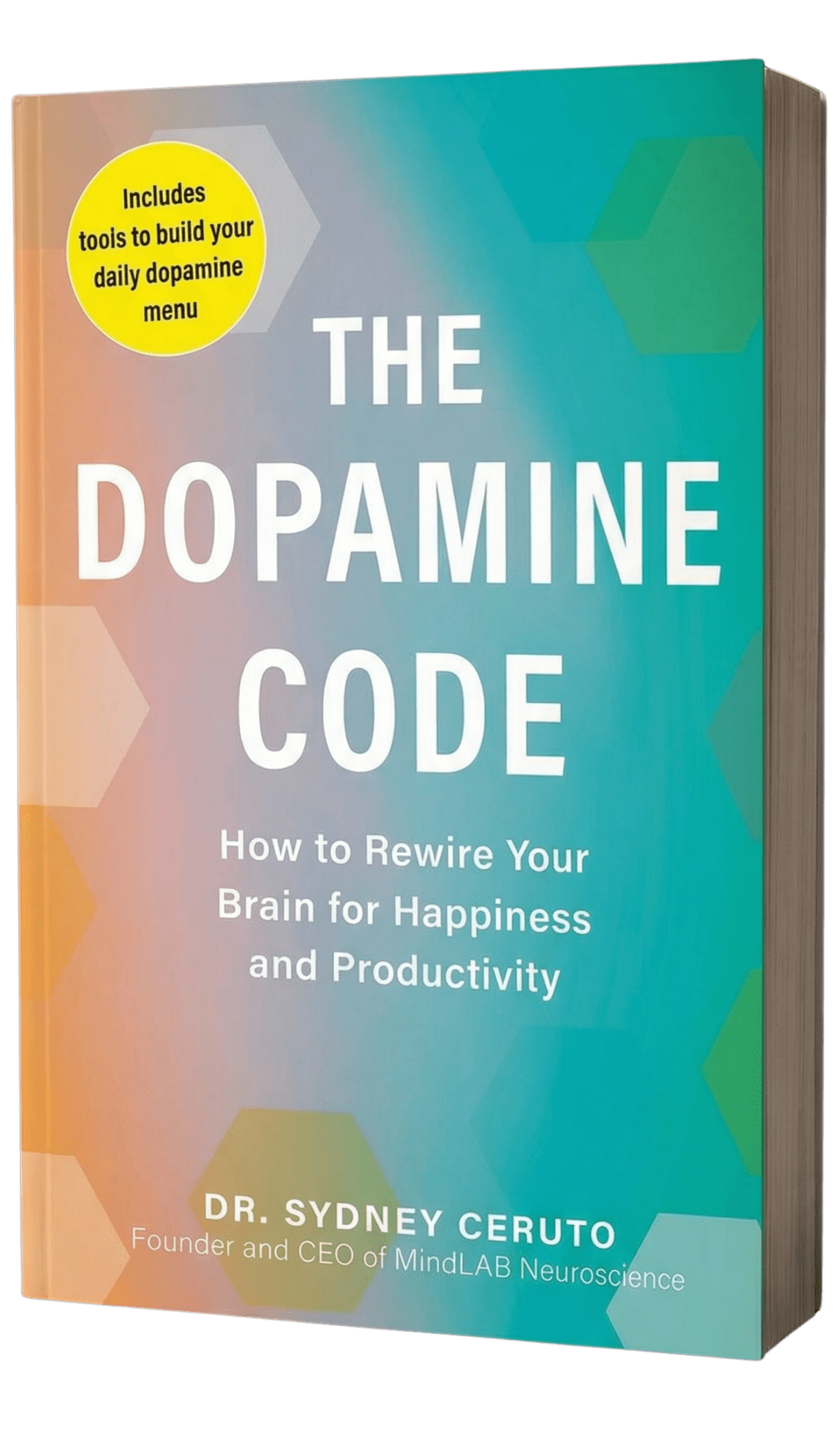
The Dopamine Code

Decode Your Drive

Why Your Brain Rewards the Wrong Things

Your brain's reward system runs every decision, every craving, every crash — and it was never designed for the life you're living. The Dopamine Code is Dr. Ceruto's framework for understanding the architecture behind what drives you, drains you, and keeps you locked in patterns that willpower alone will never fix.

Published by Simon & Schuster, The Dopamine Code is Dr. Ceruto's framework for building your own Dopamine Menu — a personalized system for motivation, focus, and enduring life satisfaction.

Order Now

Ships June 9, 2026

The Dopamine Code by Dr. Sydney Ceruto — Decode Your Drive
Locations

The Intelligence Brief

Neuroscience-backed analysis on how your brain drives what you feel, what you choose, and what you can’t seem to change — direct from Dr. Ceruto.