







Self-Esteem & Identity in Midtown Manhattan
Midtown Manhattan houses 43 Fortune 500 companies with collective annual revenues of $1.93 trillion. The professionals who work in these towers (JPMorgan Chase, Morgan Stanley, Paramount Global, Hearst, the major advertising holding companies) carry a specific identity formation pattern shaped by institutional prestige. In Midtown, who you work for is a significant component of who you are. The institutional affiliation becomes an identity anchor, which produces a particular vulnerability: when the institution changes, through layoff, restructuring, or voluntary departure, the anchor lifts and the identity it was supporting becomes unstable.
Midtown's media and advertising ecosystem is in structural disruption. WPP, Omnicom, Publicis, IPG, and Dentsu are navigating the collision between traditional advertising models and AI-driven marketing automation. The creative professionals who built their identity around specific craft skills (the copywriter, the art director, the strategist) are watching those skills being automated or commoditized in real time. Identity disruption in this context is not a personal failure. It is a structural consequence of working in an industry undergoing technological discontinuity. The brain's identity architecture, built during a period of professional stability, has not been updated to account for the new landscape.
The Upper East Side and Upper West Side residential communities that anchor Midtown's professional population carry their own identity pressures. Median household incomes of $165,280 on the Upper East Side create a social context where private school placement, apartment address, and summer plans are active status signals. The professional whose income dropped during a career transition, whose children are at public school, or whose apartment is smaller than their colleagues' can experience significant identity disruption even when their objective circumstances are comfortable by most metrics. The comparison class is the relevant variable, and in these neighborhoods, the comparison class is demanding.
The concentration of medical and research institutions in Midtown's orbit (Weill Cornell, Memorial Sloan Kettering, Rockefeller University, Columbia Irving Medical Center) creates a professional culture that is evidence-conscious and credential-aware. Physicians, researchers, and hospital administrators in this ecosystem carry identity structures organized around academic and clinical achievement markers. Career transitions within this context (the physician who moves into health technology, the researcher who moves into consulting) produce identity gaps between who they were in their previous role and who they are still becoming in the new one. The credential structure that defined them no longer applies cleanly.
In Midtown, I consistently observe that self-esteem difficulties are not about underperformance. The people seeking this work are accomplished by every external measure. The difficulty is that the identity structure supporting that accomplishment is organized around conditions (institutional affiliation, career trajectory, peer comparison) that are inherently unstable. When those conditions shift, and eventually they always do, the internal architecture is insufficient to hold the person's sense of self without external scaffolding. The work is to build that internal architecture before the scaffolding comes down.

Dr. Sydney Ceruto, PhD, Neuroscientist & Author, MindLAB Neuroscience
Dr. Ceruto holds a PhD in Behavioral & Cognitive Neuroscience from NYU and Master’s degrees in Clinical Psychology and Business Psychology from Yale University. She lectures at the Wharton Executive Development Program at the University of Pennsylvania and has been an Executive Contributor to the Forbes Coaching Council since 2019. Dr. Ceruto is the author of The Dopamine Code (Simon & Schuster, June 2026). She founded MindLAB Neuroscience in 2000 and has spent over 26 years leading it, pioneering Real-Time Neuroplasticity™, a methodology that durably rewires the neural pathways driving behavior, decisions, and emotional responses.
References
Northoff, G., Heinzel, A., de Greck, M., Bermpohl, F., Dobrowolny, H., & Panksepp, J. (2006). Self-referential processing in our brain: A meta-analysis of imaging studies on the self. NeuroImage, 31(1), 440–457. https://doi.org/10.1016/j.neuroimage.2005.12.002
Sharot, T., Korn, C. W., & Dolan, R. J. (2011). How unrealistic optimism is maintained in the face of reality. Nature Neuroscience, 14(11), 1475–1479. https://doi.org/10.1038/nn.2949
Kross, E., Berman, M. G., Mischel, W., Smith, E. E., & Wager, T. D. (2011). Social rejection shares somatosensory representations with physical pain. Proceedings of the National Academy of Sciences, 108(15), 6270–6275. https://doi.org/10.1073/pnas.1102693108
Frequently Asked Questions About Neuroscience-Based Self-Assessment Recalibration
Why does my self-assessment not match my objective achievements?
Self-assessment is a neural computation generated by the medial prefrontal cortex, not a rational evaluation of evidence. This computation is subject to the negativity bias, which assigns disproportionate weight to negative self-relevant information. The result is a self-assessment that systematically underweights achievements and overweights perceived failures. The discrepancy between your accomplishments and your self-perception reflects a miscalibrated neural computation, not accurate self-knowledge.
Can self-esteem genuinely change in adulthood, or is it set by childhood experiences?
Childhood experiences establish the initial calibration of self-assessment circuits, but these circuits remain plastic throughout adulthood. The default mode network's self-model, the negativity bias in self-relevant processing, and the social comparison circuits that generate self-worth evaluations can all be recalibrated through targeted intervention. Self-esteem is an architectural property that can be modified, not a permanent condition established in childhood.
How is this approach different from positive affirmations or confidence-building exercises?
Affirmations and confidence exercises add positive input to the conscious mind, but the self-assessment circuits generating low self-esteem operate in deeper structures that process information before conscious awareness. Layering positive content over unchanged assessment architecture produces temporary override that collapses under stress or social evaluation. Dr. Ceruto restructures the assessment circuits themselves so they generate accurate rather than negatively biased self-evaluation.
Why does social media particularly affect my self-esteem?
The brain's social comparison circuits were designed for small-group evaluation, comparing yourself to the 50-150 people in your immediate social environment. Social media exposes these circuits to curated presentations from thousands or millions of individuals, overwhelming the comparison system with data it was not architecturally designed to process. The result is systematically distorted self-assessment based on comparisons the brain cannot process accurately.
Can this approach help with imposter syndrome?
Imposter syndrome is one of the most precisely defined neural architecture patterns: the self-assessment circuits generate systematically deflated competence evaluations despite contradicting evidence. This miscalibration has a specific neural signature: the medial prefrontal cortex discounts positive performance data while amplifying evidence of inadequacy. Dr. Ceruto targets this specific miscalibration, producing accurate self-assessment that reflects genuine capability rather than distorted self-doubt.
How does identity work relate to self-esteem?
The default mode network maintains both self-esteem (the valuation of self) and identity (the model of who you are). These systems are architecturally connected: when the identity model is rigid, outdated, or constructed around negative self-concepts, the self-esteem computation draws from a biased source. Dr. Ceruto addresses both systems: updating the identity architecture so it accurately reflects who you are, and recalibrating the evaluation system so it produces accurate worth assessments from the updated model.
Will improving self-esteem make me overconfident or unrealistic?
No. The goal is accuracy, not inflation. Miscalibrated self-assessment produces distorted perception in the negative direction: you perceive yourself as less capable, less worthy, and less competent than you actually are. Recalibration corrects this distortion to produce accurate self-perception. Accurate self-assessment includes genuine awareness of limitations alongside genuine recognition of capability: it is more realistic than either deflated or inflated self-evaluation.
What does the Strategy Call assess for self-esteem and identity challenges?
The Strategy Call maps the neural systems generating your self-assessment: the negativity bias in self-relevant processing, the default mode network's current self-model, the social comparison circuits influencing self-worth computation, and the specific experiences or patterns that established the current miscalibration. You leave understanding the neurological architecture producing your self-assessment pattern and where recalibration can produce the most significant correction.
Self-esteem and identity patterns that persist despite effort have a neural source.
One hour with Dr. Sydney Ceruto. You leave knowing which neural pattern is actually driving this, and what to do about it.
Book a Strategy Call
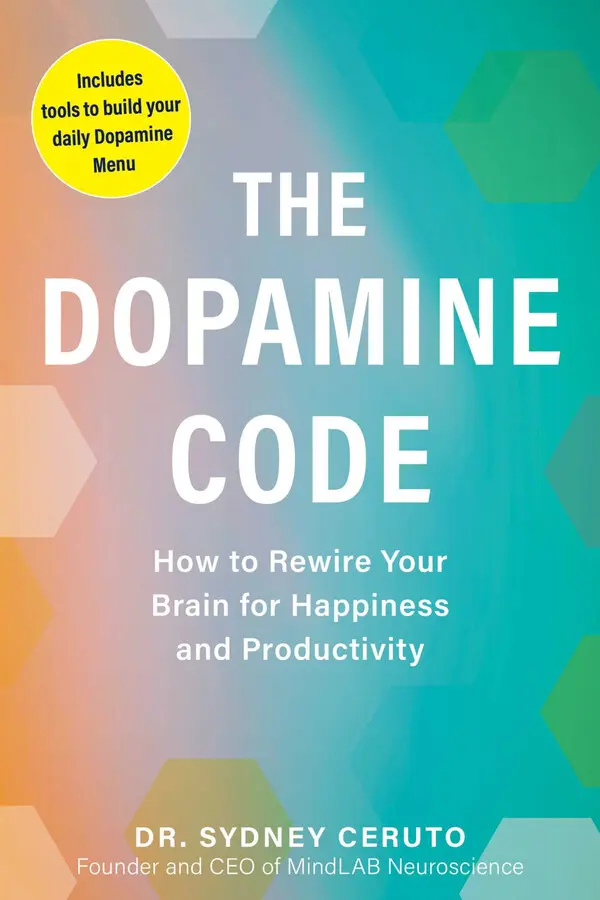
The Dopamine Code
Decode Your Drive
Why Your Brain Rewards the Wrong Things
Your brain's reward system runs every decision, every craving, every crash, and it was never designed for the life you're living. The Dopamine Code is Dr. Ceruto's framework for understanding the architecture behind what drives you, drains you, and keeps you locked in patterns that willpower alone will never fix.
Published by Simon & Schuster, The Dopamine Code is Dr. Ceruto's framework for building your own Dopamine Menu, a personalized system for motivation, focus, and enduring life satisfaction.
Order Now!Available now