Strategic Planning in Midtown Manhattan

Your strategy is only as good as the prefrontal cortex that produces it. Decision fatigue, cognitive rigidity, and stress-driven executive function loss degrade strategic quality long before you notice.

Strategic planning under Midtown Manhattan's cognitive demands is a prefrontal cortex — the brain's executive control center — challenge. This affects the ability to shift thinking between concepts, decision quality, and executive attention in the moments when strategic reasoning matters most.

Book a Strategy Call

Key Points

  1. Strategic thinking requires sustained activation of the brain's default mode network for creative synthesis — a state that organizational urgency systematically suppresses.
  2. The prefrontal cortex processes strategic and tactical demands through competing neural pathways, meaning operational pressure directly reduces strategic capacity.
  3. Cognitive biases in strategic planning are not errors of logic — they are features of neural architecture designed for short-term survival, not long-term organizational positioning.
  4. Under uncertainty, the brain's risk-assessment system overweights potential losses by a factor of approximately two to one — systematically distorting strategic risk evaluation.
  5. Effective strategic capacity requires neural architecture that maintains access to integrative, long-horizon thinking even under the operational pressures that typically suppress it.

When Strategic Thinking Stops Working the Way It Used To

“By four o'clock on a demanding day, your prefrontal cortex is not the same organ it was at nine in the morning. The degradation is neurochemical, measurable, and predictable — and it explains why executives make their worst decisions at the moments that matter most.”

The pattern is familiar. You sit down for a strategic planning session and the clarity you once brought to complex decisions is not there. Not dramatically absent — just diminished. The variables feel heavier. The options proliferate without resolution. You default to the safer choice, the incremental move, the decision that avoids the most risk rather than captures the most opportunity.

You notice this happening. You are not unaware. But awareness alone does not restore the strategic precision that defined your earlier career. The conventional response is to invest in better inputs — hire a consulting firm, bring in more data, schedule a strategy offsite. These investments address the quality of the information entering the system. They do not address the quality of the cognitive system processing it.

The executives who eventually recognize this distinction share a specific profile. They are not strategic novices. They have built careers on the strength of their ability to think clearly under pressure, to hold multiple variables simultaneously, and to arrive at decisions that balance risk and opportunity with precision. The degradation they are experiencing is not a skills problem. It is a neural architecture problem, and it has a biological explanation that changes what becomes possible when addressed at the right level.

The difficulty is compounded by the environment. Midtown Manhattan’s professional ecosystem generates a volume and intensity of cognitive demand that systematically degrades the prefrontal cortex resources available for high-quality strategic reasoning. By the time the quarterly review begins, the executive brain has already been depleted by hundreds of smaller decisions, emotional regulation events, and context-switching demands that consumed the same neural resources strategic planning requires.

The Neuroscience of Strategic Reasoning

Strategic planning depends on the prefrontal cortex, the most metabolically expensive, most recently evolved, and most vulnerable region of the human brain. Understanding how it functions under pressure reveals why strategic quality degrades and what can be done about it.

The prefrontal cortex governs what neuroscientists call executive functions: the capacity to hold information in working memory, the brain’s short-term mental workspace, shift between mental frameworks, inhibit automatic responses, and coordinate complex goal-directed behavior. Research established that these capacities, while related, are dissociable, meaning they can degrade independently. An executive may retain strong working memory while losing cognitive flexibility, or maintain inhibitory control while experiencing degraded set-shifting capacity. This matters because strategic planning requires all of these functions operating simultaneously.

Cognitive flexibility is particularly vulnerable. a double dissociation within the prefrontal cortex: reversal learning and attentional set-shifting require distinct circuits. The dorsolateral PFC and orbitofrontal cortex manage these operations through complementary but separable mechanisms. When both are demanded simultaneously under stress, as they invariably are during complex strategic planning, norepinephrine upregulation specifically degrades cognitive flexibility, producing the rigidity and premature strategic closure that professionals experience as “getting stuck.”

Decision fatigue adds a second layer of degradation. Pignatiello, Martin, and Hickman published a systematic concept analysis in the establishing that decision fatigue manifests through behavioral, cognitive, and physiological attribute clusters: passivity, impulsivity, default-option selection, impaired executive function, and reasoning degradation. The theoretical foundation traces to Baumeister, Bratslavsky, Muraven, and Tice’s landmark work in the, which demonstrated that the capacity for self-regulation, including the self-regulation required for strategic reasoning, is finite and depletable. An executive who has regulated their reactions to difficult conversations, approved budget variances, and managed a stakeholder crisis by midmorning has measurably less prefrontal capacity available for the strategic planning session scheduled that afternoon.

The executive attention network provides the third critical mechanism. This network governs the ability to focus strategic attention, suppress environmental noise, and sustain concentration across multi-hour planning sessions. Research has established that this network is dopamine-dependent and follows an inverted-U activation curve. Moderate arousal optimizes attention. The chronic overstimulation that characterizes Midtown’s professional environment pushes the system past optimal, suppressing the very attentional infrastructure that strategic planning requires.

The Pressure-Performance Paradox

The highest-stakes strategic moments — board presentations, annual reviews, investor contexts — are paradoxically the moments when strategic cognition is most at risk. Anticipatory stress activates cortisol-driven suppression of prefrontal activity precisely when prefrontal function is most needed. This explains why professionals who are brilliant in informal strategic conversations sometimes underperform in formal strategic reviews. The preparation was adequate. The neural state was not.

How Dr. Ceruto Approaches Strategic Planning

Dr. Ceruto’s methodology, Real-Time Neuroplasticity™, operates at the level of the neural systems that produce strategic cognition. The approach does not add another framework to an already-overloaded cognitive system. It optimizes the architecture that processes frameworks, data, and strategic variables.

Executive coaching and leadership development — precision copper neural switching junction directing strategic decision pathways

The intervention begins by identifying the specific executive function profile driving the current strategic pattern. What the pattern that presents most often reveals is not a global cognitive decline but a targeted degradation. The professional whose cognitive flexibility has narrowed while working memory remains strong, or whose executive attention has degraded while analytical processing remains sharp. These specific configurations determine the intervention protocol.

Real-Time Neuroplasticity™ targets the prefrontal circuits during the conditions that matter, not in a retrospective debrief, but in the cognitive states where strategic reasoning actually occurs. The methodology addresses cognitive flexibility by strengthening the — dlPFC-OFC set-shifting circuits — that enable evaluation of contradictory strategic frames. It addresses decision fatigue by optimizing the self-regulatory resource system that determines how much prefrontal capacity remains available for strategic decisions. It addresses the executive attention network by recalibrating the dopaminergic — related to dopamine — activation curve toward its optimal operating point.

The relevant program depends on the scope of the strategic demand. NeuroSync™ is designed for focused work on a specific constraint — restoring cognitive flexibility during a period of intense industry disruption, for example. NeuroConcierge™ provides comprehensive, embedded partnership for professionals whose strategic responsibilities span multiple domains and require ongoing neural optimization across shifting organizational demands.

The result is not a better strategy document. It is a brain that produces better strategy — reliably, under pressure, when the stakes are highest.

What to Expect

The engagement begins with a Strategy Call, a focused assessment of your current executive function profile as it relates to your strategic planning demands. Dr. Ceruto evaluates where prefrontal resources are being allocated, where degradation is occurring, and which specific neural systems will produce the greatest return when optimized.

From there, a structured protocol is designed around your cognitive profile. Sessions target the specific executive functions identified in your assessment: cognitive flexibility, decision fatigue management, executive attention, or the interaction between multiple systems. The work is intensive and occurs in the conditions that approximate your actual strategic demands.

Progress is measured against the neural systems being targeted. The metric is not whether you complete a better strategic plan. The metric is whether the prefrontal architecture producing your strategic reasoning is operating at a higher level of efficiency, flexibility, and durability under the pressure conditions you actually face.

References

Naomi P. Friedman, Trevor W. Robbins (2022). Prefrontal Cortex Architecture and Decision Quality. Neuropsychopharmacology. https://doi.org/10.1038/s41386-021-01132-0

Hua Tang, Mitchell R. Riley, Balbir Singh, Xue-Lian Qi, David T. Blake, Christos Constantinidis (2022). Prefrontal Cortical Plasticity During Learning of Cognitive Tasks: The Neural Architecture of Trainable Leadership. Nature Communications. https://doi.org/10.1038/s41467-021-27695-6

Katharina Zühlsdorff, Jeffrey W. Dalley, Trevor W. Robbins, Sharon Morein-Zamir (2022). Cognitive Flexibility and Changing One’s Mind: Neural Correlates. Cerebral Cortex. https://doi.org/10.1093/cercor/bhac431

Grace Steward, Vikram S. Chib (2024). The Neurobiology of Cognitive Fatigue and Its Influence on Effort-Based Decisions. Journal of Neuroscience. https://doi.org/10.1101/2024.07.15.603598

The Neural Architecture of Strategic Thinking

Strategic thinking is a distinct cognitive mode — not an enhanced version of analytical thinking, and not a personality trait distributed randomly among executives. It is a specific configuration of neural activity, centered on the default mode network and its interaction with the prefrontal executive system, that can be deliberately cultivated and that degrades under specific and identifiable conditions.

The default mode network — historically misnamed as the brain’s resting state — is now understood to be the substrate of prospective cognition: the capacity to mentally simulate future scenarios, to construct hypothetical worlds and test decisions within them, and to identify patterns that extend across long time horizons. It is the network that is active when you are not processing immediate sensory input, and it is the network that generates the insights that surface during the apparently unproductive spaces in a busy executive’s schedule — the shower, the walk, the unscheduled hour. These are not accidents. They are the default mode network doing its actual work, which requires withdrawal from the continuous sensory processing and reactive task management that dominate most professional days.

The prefrontal executive system, by contrast, is the substrate of analytical and deliberate reasoning — the capacity to hold a problem in working memory, apply structured frameworks, and generate explicit conclusions through traceable logical steps. This system is essential for evaluating strategic options once they have been generated. It is not the system that generates them. Strategic thinking at its highest level involves a productive collaboration between these two networks: the default mode generating hypotheses, simulations, and pattern recognitions, and the prefrontal system evaluating, testing, and refining them.

The conditions of modern executive work are almost perfectly designed to suppress this collaboration. The continuous reactive demands of senior leadership — the meeting cadence, the decision queue, the communication volume — keep the prefrontal system in constant engagement, which by design suppresses default mode activity. The result is executives who are analytically sophisticated but strategically constrained: highly capable of evaluating options presented to them, less capable of generating the genuinely novel framings that separate transformative strategic decisions from merely competent ones.

Why Conventional Strategic Planning Falls Short

Most organizational strategic planning processes are, in neurological terms, analytical exercises disguised as strategic ones. They involve gathering data, applying frameworks, generating option sets within the constraints of current assumptions, and selecting among those options according to pre-specified criteria. These are valuable activities. They are also, largely, prefrontal activities — precisely the cognitive mode that executives are already overusing and that is actively suppressing the default mode function that generates genuine strategic insight.

Walnut credenza with crystal brain sculpture and MindLAB journal in diffused dusk light suggesting high-floor Midtown Manhattan private office

The frameworks themselves — SWOT analyses, competitive positioning matrices, scenario planning templates — are useful as organizing structures for analysis that has already been generated through strategic thinking. When they are used as the primary generative tool, they constrain the output to the solution space that the framework was designed to illuminate, which by definition excludes the framings and possibilities that the framework’s designers did not anticipate. Innovation in strategic thought rarely emerges from applying the current best practice framework with greater rigor. It emerges from a cognitive mode that is not currently being cultivated in most strategic planning processes.

How Neural-Level Strategic Development Works

My approach to strategic planning works at two levels simultaneously. At the individual level, we develop the specific cognitive conditions that allow genuine strategic thinking to emerge — which includes restructuring the executive’s relationship to unstructured thinking time, building the capacity to sustain the mental space that default mode function requires, and developing the metacognitive awareness to recognize when analytical mode is substituting for strategic mode rather than complementing it.

At the organizational and decision-content level, we apply a structured process for developing strategic options that begins with assumption excavation — identifying the premises that current strategy takes for granted, stress-testing them against available evidence, and deliberately generating alternative framings of the competitive situation that violate those premises. This is not devil’s advocacy for its own sake. It is a systematic method for accessing solution spaces that conventional strategic analysis excludes by design.

The Dopamine Code framework informs this work directly: the same neural mechanisms that govern individual motivation and decision-making also govern organizational behavior and culture. Strategic plans that do not account for the motivational architecture of the people who must execute them are not strategic plans. They are intentions.

What This Looks Like in Practice

The most consistent observation from clients is a qualitative shift in the character of their strategic thinking — not just in what they decide, but in how the thinking feels. The sense of operating within a constrained solution space, of being driven by reactive demands rather than leading from a clear directional conviction, gives way to something more spacious: a felt sense of operating with genuine strategic agency, of choosing direction rather than managing circumstances.

Practically, this manifests as improved signal-to-noise ratio in strategic decision-making: faster identification of which decisions are genuinely strategic and which are tactical matters that have been elevated by urgency rather than importance, cleaner separation of short-term operational pressures from long-horizon directional commitments, and more durable confidence in strategic choices because those choices are grounded in a clearer map of the actual competitive landscape rather than inherited assumptions about it.

We begin with a strategy call — one hour of focused strategy conversation that maps the specific constraints on your current strategic thinking, identifies where conventional planning processes are limiting rather than enabling your strategic capacity, and establishes the development pathway that will produce the most significant and durable improvement in your strategic output.

For deeper context, explore cognitive distortions that block strategic thinking.

Marker Traditional Approach Neuroscience-Based Approach Why It Matters
Focus Strategic frameworks, competitive analysis, and scenario planning methodologies Strengthening the neural circuits that support integrative strategic thinking under operational pressure and uncertainty
Method Strategy consulting engagements, facilitated offsites, and analytic tool deployment Targeted intervention in the prefrontal circuits governing long-horizon thinking, risk assessment, and creative synthesis
Duration of Change Framework-dependent; strategic clarity requires repeated consulting input as conditions change Permanent strengthening of the neural capacity for strategic thinking that leaders apply independently across all future decisions

Why Strategic Planning Matters in Midtown Manhattan

Midtown Manhattan concentrates one of the most cognitively demanding strategic environments in the world. Within a ten-block radius of the Herald Square corridor, senior leaders at major fashion conglomerates, media companies headquartered along the Times Square axis, and advertising holding companies make high-stakes strategic decisions. These environments are defined by cross-industry disruption, compressed timelines, and continuous competitive pressure.

The cognitive demands are specific to Midtown’s industry mix. Fashion and retail executives at companies headquartered along Madison Avenue and in Hudson Yards navigate brand positioning, market entry, product lifecycle, and licensing decisions simultaneously — each requiring a different cognitive framework. Media executives at major conglomerates in the Times Square corridor manage the strategic paradox of defending legacy business models while investing in disruption alternatives. Advertising leaders at holding companies throughout Midtown perform strategic planning across media, technology, talent, and M&A domains simultaneously.

The cross-industry context-switching that defines Midtown professional life creates a specific type of cognitive overload. Research on high cognitive load demonstrates that frontoparietal networks — brain circuits managing complex thinking — show reduced efficiency under these conditions. Strategic attention narrows. Integration of complex information degrades. The executive does not experience this as failure. They experience it as a persistent sense that their strategic thinking is not as sharp, as creative, or as decisive as it once was.

Midtown’s professional culture also creates a distinctive innovation pressure. The pace of technological change across media, advertising, and fashion creates intense pressure for premature strategic closure — committing to a direction before adequate information is available. The frontopolar cortex that manages strategic optionality is suppressed under time pressure and cognitive depletion, reducing the capacity to maintain multiple strategic hypotheses. The brain defaults to the first plausible answer rather than the optimal one.

Array

Midtown Manhattan’s concentration of corporate strategy functions — from in-house planning teams at Fortune 500 headquarters to the strategy consulting firms along Park Avenue — creates an environment where strategic thinking quality is both the primary competitive variable and the resource under greatest biological strain. The leaders producing strategic plans in this ecosystem face the paradox of needing maximum cognitive capacity precisely when organizational demands are consuming it most aggressively.

The media industry strategic planning demands centered in Midtown require a specific form of neural processing: evaluating the strategic implications of technological change that is occurring faster than historical precedent provides reliable analogies. The leaders planning the strategic direction of media companies, advertising networks, and publishing enterprises must generate novel strategic frameworks rather than adapting existing ones — a creative cognitive function that requires default mode network engagement under precisely the time pressure that suppresses it.

Dr. Sydney Ceruto, PhD — Founder, MindLAB Neuroscience

Dr. Sydney Ceruto, PhD — Founder & CEO, MindLAB Neuroscience

Dr. Ceruto holds a PhD in Behavioral & Cognitive Neuroscience from NYU and two Master’s degrees from Yale University. She lectures at the Wharton Executive Development Program at the University of Pennsylvania and has been an Executive Contributor to the Forbes Coaching Council since 2019. Dr. Ceruto is the author of The Dopamine Code (Simon & Schuster, June 2026). She founded MindLAB Neuroscience in 2000 and has spent over 26 years pioneering Real-Time Neuroplasticity™ — a methodology that permanently rewires the neural pathways driving behavior, decisions, and emotional responses.

References

Miller, E. K., & Cohen, J. D. (2001). An integrative theory of prefrontal cortex function. Annual Review of Neuroscience, 24, 167–202. https://doi.org/10.1146/annurev.neuro.24.1.167

Rangel, A., Camerer, C., & Montague, P. R. (2008). A framework for studying the neurobiology of value-based decision making. Nature Reviews Neuroscience, 9(7), 545–556. https://doi.org/10.1038/nrn2357

Kahneman, D., & Klein, G. (2009). Conditions for intuitive expertise: A failure to disagree. American Psychologist, 64(6), 515–526. https://doi.org/10.1037/a0016755

Buckner, R. L., Andrews-Hanna, J. R., & Schacter, D. L. (2008). The brain’s default network: Anatomy, function, and relevance to disease. Annals of the New York Academy of Sciences, 1124(1), 1–38. https://doi.org/10.1196/annals.1440.011

Success Stories

“Color-coded calendars, alarms, accountability partners — I'd built an entire scaffolding system just to stay functional, and none of it addressed why my brain couldn't sequence and prioritize on its own. Dr. Ceruto identified the specific prefrontal pattern that was misfiring and restructured it. I don't need the scaffolding anymore. My brain actually does what I need it to do.”

Jordan K. — Venture Capitalist San Francisco, CA

“Every few months I'd blow up my life in a different way — new venture, new relationship, new fixation — and call it ambition. Dr. Ceruto identified the reward prediction error that was running the cycle. My brain had learned to chase escalation because it was the only thing that overrode what I was actually avoiding. Once she restructured the dopamine loop at the root, the compulsion to escalate just stopped. I didn't lose my drive — I lost the desperation underneath it.”

Kofi A. — Brand Strategist London, UK

“When the inheritance came, it didn't feel like a gift — it felt like a grenade in every family relationship I had. I couldn't make a single financial decision without a flood of guilt and second-guessing. Years of talking through it hadn't changed anything. Dr. Ceruto identified the neural loop connecting money to fear of family rejection and dismantled it. The paralysis didn't fade — it stopped.”

Vivienne R. — Philanthropist Palm Beach, FL

“The conviction was always there at the start — and then the momentum would vanish, every single time. Discipline and accountability systems changed nothing. Dr. Ceruto identified a dopamine signaling deficit in my mesolimbic pathway that was collapsing my ability to sustain effort toward a goal. Once that pattern was restructured, finishing stopped requiring force. The motivation wasn't missing — it was being interrupted.”

Landon J. — Restaurateur New York, NY

“When the demands of my career began negatively impacting my quality of life, I knew I needed help beyond my usual coping mechanisms. I landed on Dr. Ceruto’s name and couldn’t be happier. Her credentials are impeccable, but upon meeting her, all uneasiness dissipated immediately. She has an innate ability to navigate the particulars of your profession no matter how arcane it may be. By the middle of the first session, you’re talking to a highly intelligent and intuitive friend. She is simply that good.”

Norine D. — Attorney Newport Beach, CA

“I struggled with debilitating anxiety for years, trying countless therapies and medications with little success. Finding Dr. Ceruto and her neuroscience-based approach was truly life-changing. From our very first session, her deep knowledge of brain science and how it applies to anxiety gave me real hope. What sets her apart is that perfect blend of expertise and compassion — she genuinely cared about my progress and responded quickly even outside of our scheduled sessions. I can now enjoy social situations and excel at work.”

Brian T. — Architect Chicago, IL

Frequently Asked Questions About Strategic Planning in Midtown Manhattan

How does neuroscience-based strategic planning differ from management consulting?

Management consulting firms optimize the strategy itself — the document, framework, market analysis. MindLAB Neuroscience optimizes the brain that creates and executes the strategy. Dr. Ceruto uses Real-Time Neuroplasticity™ to strengthen the prefrontal circuits that govern cognitive flexibility, decision quality, and executive attention. The two approaches are complementary — and research demonstrates that even optimal strategic frameworks fail when the executive cognitive system processing them is degraded by decision fatigue or stress.

Why does my strategic thinking feel less sharp than it used to?

The prefrontal cortex — the brain's executive control center — that governs strategic reasoning is the most metabolically expensive and most vulnerable brain region. Under chronic cognitive load, which includes the volume of decisions, emotional regulation demands, and context-switching that define senior professional life, prefrontal resources deplete. Cognitive flexibility — the ability to shift thinking — narrows, risk assessment becomes conservative, and the brain defaults to incremental decisions rather than bold strategic moves. This degradation is biological, predictable, and addressable at the neural level.

Can decision fatigue actually be addressed neurologically?

Yes. Research published in the Journal of Health Psychology establishes that decision fatigue degrades executive function, the brain's ability to plan, focus, and manage tasks, through measurable behavioral, cognitive, and physiological mechanisms. The self-regulatory resource system that governs decision quality is finite but also restorable. Real-Time Neuroplasticity — the brain's ability to rewire itself —™ targets the prefrontal resource management system, optimizing how the brain allocates and recovers self-regulatory capacity so that strategic decisions made at four PM carry the same cognitive quality as those made at nine AM.

Is strategic planning support at MindLAB available virtually?

Yes. Dr. Ceruto works with senior professionals globally through virtual sessions that maintain full precision and intensity. Many Midtown Manhattan professionals combine in-person and virtual engagements structured around their strategic planning calendar and organizational demands.

What happens during the Strategy Call?

The Strategy Call is a precision assessment of your current executive function profile, evaluating how your prefrontal cortex allocates resources across the cognitive demands you face. Dr. Ceruto identifies the specific mechanisms driving any degradation in strategic quality and maps the neural intervention that will produce the most immediate impact on your strategic reasoning capacity.

Who benefits most from neuroscience-based strategic planning support?

Professionals operating in environments where the volume and complexity of decisions consistently outpace the brain's capacity to process them strategically. This includes leaders navigating industry disruption who must hold contradictory strategic realities simultaneously, professionals managing multi-domain strategic responsibilities, and anyone whose strategic output matters enough that optimizing the cognitive system that produces it represents a meaningful competitive advantage.

Why does my strategic thinking become more conservative and narrow as organizational pressure increases?

This is a direct consequence of how the brain allocates resources under threat. Strategic thinking requires the default mode network and prefrontal cortex to engage in integrative, long-horizon processing. Organizational pressure activates the amygdala's threat system, which redirects neural resources from strategic processing to immediate threat management.

The result is predictable: as pressure increases, strategic vision narrows, risk tolerance decreases, and decisions become increasingly reactive and short-term. This is not a failure of strategic skill — it is the brain's survival architecture overriding its strategic architecture. Resolving this requires raising the threshold at which pressure triggers the strategic-to-reactive switch.

How does improving strategic neural capacity differ from applying better strategic frameworks?

Strategic frameworks are tools that require adequate prefrontal function to apply effectively. Under sustained organizational pressure, the cognitive resources needed to engage with frameworks — holding multiple variables, evaluating long-term consequences, challenging assumptions — are precisely the resources that stress degrades first.

Improving strategic neural capacity ensures that the biological infrastructure required for effective strategic processing remains available under the conditions where strategy matters most. The leader retains access to integrative, long-horizon thinking even when operational pressure would normally force the brain into reactive, short-term processing. Better frameworks applied with full cognitive capacity produce fundamentally different strategic outcomes.

Can this work improve strategic thinking in group settings, not just individual decision-making?

Group strategic thinking is heavily influenced by the neural states of the most senior participants. Social conformity circuits suppress dissenting analysis when the group leader signals certainty — even if that certainty is the product of stress-narrowed processing rather than genuine strategic confidence. Mirror neuron systems calibrate the group's cognitive risk tolerance to match the leader's.

When key leaders maintain accurate strategic processing under pressure — specifically, when their neural architecture sustains genuine openness to disconfirming evidence and alternative analyses — the group's strategic output improves dramatically. Dr. Ceruto frequently works with the 2-3 individuals whose neural states most powerfully influence group strategic dynamics.

Also available in: Miami · Wall Street · Beverly Hills · Lisbon

The Prefrontal Architecture Behind Every Strategic Decision You Make in Midtown Manhattan

From the fashion houses of Herald Square to the media headquarters of Times Square, strategic quality is a neural architecture question. Your brain is making decisions under conditions it was never designed to sustain. Dr. Ceruto maps the gap in one conversation.

Book a Strategy Call
MindLAB Neuroscience consultation room

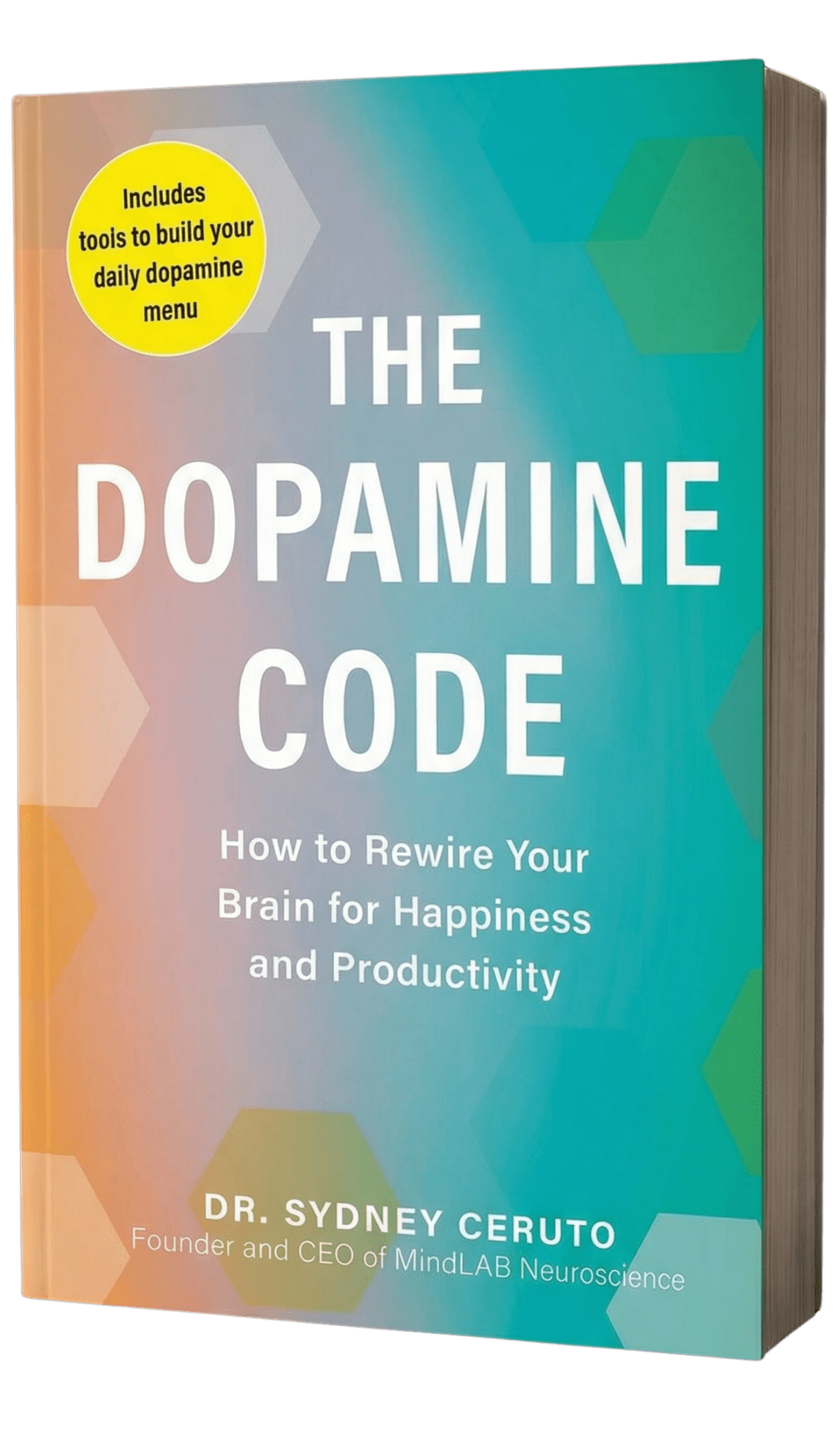
The Dopamine Code

Decode Your Drive

Why Your Brain Rewards the Wrong Things

Your brain's reward system runs every decision, every craving, every crash — and it was never designed for the life you're living. The Dopamine Code is Dr. Ceruto's framework for understanding the architecture behind what drives you, drains you, and keeps you locked in patterns that willpower alone will never fix.

Published by Simon & Schuster, The Dopamine Code is Dr. Ceruto's framework for building your own Dopamine Menu — a personalized system for motivation, focus, and enduring life satisfaction.

Order Now

Ships June 9, 2026

The Dopamine Code by Dr. Sydney Ceruto — Decode Your Drive
Locations

The Intelligence Brief

Neuroscience-backed analysis on how your brain drives what you feel, what you choose, and what you can’t seem to change — direct from Dr. Ceruto.