Trauma & Emotional Regulation in Midtown Manhattan

When the past keeps hijacking the present, the problem isn’t memory — it’s circuitry. Dr. Ceruto restructures the pattern at the neural level.

Trauma is not a memory — it is a reorganization of the brain's threat-detection, emotional regulation, and relational systems. When these circuits are recalibrated by overwhelming experience, they do not reset on their own. The downstream patterns — hypervigilance, emotional flooding, trust collapse, flashbacks without memory — persist because the architecture that produces them was never addressed. Dr. Ceruto's methodology identifies and intervenes at the level of the neural circuits themselves, creating structural change that insight, time, and narrative processing cannot reach.

Book a Strategy Call
ForbesUSA TodayHuffPostNewsweekAssociated PressCosmopolitanBusiness InsiderForbesUSA TodayHuffPostNewsweekAssociated PressCosmopolitanBusiness Insider

Trauma Recovery

Trauma rewires the brain’s threat-detection and emotional processing systems. Dr. Ceruto identifies the specific circuits that were reorganized by overwhelming experience and intervenes at the structural level — not through narrative retelling, but through targeted neural recalibration.

Learn more about Trauma Recovery in Midtown Manhattan →

Emotional Dysregulation

When emotional responses are consistently disproportionate to the situation — overwhelming anger, sudden shutdown, rapid cycling between extremes — the brain’s regulatory architecture has been miscalibrated. Dr. Ceruto maps the specific circuits and restores proportional emotional processing.

Learn more about Emotional Dysregulation in Midtown Manhattan →

Hypervigilance & Safety

The brain’s threat-detection system locked in permanent scan mode — every environment assessed for danger, every interaction filtered for threat. Dr. Ceruto downregulates the system at the circuit level so safety becomes neurologically accessible.

Learn more about Hypervigilance & Safety in Midtown Manhattan →

Emotional Flashbacks

The full emotional state of a past experience floods the present without the accompanying memory — the feeling arrives but the narrative does not. Dr. Ceruto intervenes at the circuit where the emotional encoding is stored, not the memory.

Learn more about Emotional Flashbacks in Midtown Manhattan →

Trust & Vulnerability

When the brain’s trust-assessment circuits have been recalibrated by betrayal or violation, vulnerability registers as threat rather than connection. Dr. Ceruto restructures the relational architecture so trust becomes neurologically possible.

Learn more about Trust & Vulnerability in Midtown Manhattan →

Trauma & Emotional Regulation in Midtown Manhattan

Midtown Manhattan's professional ecosystem creates trauma exposures that are specific to high-stakes institutional environments and rarely categorized as trauma in conventional terms. The senior executive who witnesses a colleague's public humiliation in a board meeting, the attorney who loses a career-defining case with institutional consequences, the physician who experiences a patient death under difficult circumstances — these events activate the same neural trauma response as more conventionally recognized traumatic events. The amygdala does not distinguish between the threat of physical violence and the threat of catastrophic professional failure. Both activate the same threat-detection architecture, both encode in the same memory systems, and both produce the same downstream effects on emotional regulation.

Midtown's media sector disruption is producing a category of anticipatory trauma that is clinically significant and largely unaddressed. The senior creative professional who watches their colleagues' roles eliminated by AI-driven automation, who sees the industry they built a career within fundamentally restructuring, is managing a sustained threat state. This is not an existential worry that can be resolved by changing one's perspective. It is a genuine threat to livelihood and professional identity that the nervous system correctly identifies as threatening. The sustained anticipatory threat state depletes the prefrontal regulatory capacity that emotional regulation requires — making the person less able to regulate their responses precisely when their circumstances most require regulation.

The healthcare sector concentrated in Midtown's orbit — Weill Cornell, Memorial Sloan Kettering, Mount Sinai, Hospital for Special Surgery — creates a specific trauma exposure context. Healthcare professionals, particularly in oncology, emergency medicine, and critical care, accumulate secondary traumatic stress from sustained exposure to patient suffering and mortality. This accumulation is well-documented in the clinical literature and poorly addressed by institutional support structures. The physician or nurse who manages acute patient crises daily has developed a professional emotional regulation architecture that maintains composure in clinical settings through dissociation from emotional impact. That same dissociative pattern, exported from the clinical setting into personal life, produces the emotional disconnection that partners and families of medical professionals consistently describe.

New York City's post-pandemic landscape added a collective trauma layer to Midtown's professional environment that has not been fully processed. The 59% moderate-to-high burnout rate among NYC employees documented in the 2024 Aflac WorkForces Report reflects not just current workload but the accumulated impact of the 2020-2022 period — the trauma exposures, the isolation, the loss, and then the aggressive return to high-intensity in-person professional environments. The transition back to Midtown's dense, face-to-face professional culture required that people bring fully activated nervous systems into an environment that demands sustained regulatory capacity. That combination is a formula for emotional regulation failure that presents, in my practice, as reactivity, relational difficulty, and the sense that one's internal resources are insufficient for current demands.

The emotional regulation work I do with Midtown professionals is not about emotional intelligence in the conventional training sense. It is about recalibrating the neural systems that were shaped by specific professional experiences — the accumulated losses, the witnessed events, the sustained pressure — so that the regulatory capacity available to the person in the present actually matches what they are now being asked to manage.

Dr. Sydney Ceruto, PhD — Founder, MindLAB Neuroscience

Dr. Sydney Ceruto, PhD — Founder & CEO, MindLAB Neuroscience

Dr. Ceruto holds a PhD in Behavioral & Cognitive Neuroscience from NYU and two Master’s degrees from Yale University. She lectures at the Wharton Executive Development Program at the University of Pennsylvania and has been an Executive Contributor to the Forbes Coaching Council since 2019. Dr. Ceruto is the author of The Dopamine Code (Simon & Schuster, June 2026). She founded MindLAB Neuroscience in 2000 and has spent over 26 years pioneering Real-Time Neuroplasticity™ — a methodology that permanently rewires the neural pathways driving behavior, decisions, and emotional responses.

References

Pitman, R. K., Rasmusson, A. M., Koenen, K. C., Shin, L. M., Orr, S. P., Gilbertson, M. W., & Liberzon, I. (2012). Biological studies of post-traumatic stress disorder. Nature Reviews Neuroscience, 13(11), 769–787. https://doi.org/10.1038/nrn3339

Bremner, J. D. (2006). Traumatic stress: Effects on the brain. Dialogues in Clinical Neuroscience, 8(4), 445–461. https://doi.org/10.31887/DCNS.2006.8.4/jbremner

LeDoux, J. E. (2000). Emotion circuits in the brain. Annual Review of Neuroscience, 23, 155–184. https://doi.org/10.1146/annurev.neuro.23.1.155

Success Stories

“Every close relationship I had eventually hit the same wall — I'd flood emotionally and shut down or explode, and nothing I'd tried gave me real control over it. Dr. Ceruto identified that my autonomic nervous system was defaulting to fight-or-flight the moment real intimacy was on the line. She didn't give me coping tools. She restructured the default. The flooding stopped because the trigger architecture changed.”

Simone V. — Publicist New York, NY

“The numbness crept in so gradually I didn't notice until I couldn't feel anything — not stress, not connection, not even relief when things went well. Dr. Ceruto identified it as a dorsal vagal shutdown — my nervous system had flatlined as a survival strategy. Nothing I'd tried before had even named the problem. Within ninety days, the signal came back. I feel things again, clearly and without overwhelm.”

Marcus H. — Fund Manager Dallas, TX

“The same relational patterns my mother and grandmother lived through kept repeating in my own life — the hypervigilance, the emotional shutdown, the inability to feel safe even when nothing was wrong. Talking through it changed nothing. Dr. Ceruto identified the epigenetic stress signatures driving the pattern and restructured them at the neurological level. The cycle that ran through three generations stopped with me.”

Gabriela W. — Real Estate Developer Miami, FL

“I could perform at the highest level professionally and still feel hijacked emotionally in my closest relationships — and no conventional approach had ever explained why those two realities coexisted. Dr. Ceruto identified the limbic imprint — an amygdala encoding from childhood that was running every intimate interaction I had. She didn't help me understand it better. She dismantled it. The reactivity isn't something I regulate anymore. The pattern that generated it is gone.”

Natasha K. — Art Advisor Beverly Hills, CA

“What I appreciate about Dr. Ceruto is her candid, direct approach — truly from a place of warmth and support. Every week delivered concrete value, and I never felt like I was wasting time the way I had with traditional methods. She draws from her clinical and academic expertise to dig deeper into the roots of issues. She helped me make enormous progress after a year of personal loss, including getting my faltering career back on track. She follows up after every session with additional materials.”

Eric F. — Surgeon Coral Gables, FL

“The divorce wasn't destroying me emotionally — it was destroying me neurologically. My amygdala was treating every interaction with my ex, every legal update, every quiet evening as a survival-level threat. Years of talk-based approaches hadn't touched it. Dr. Ceruto identified the attachment disruption driving the response and restructured it at the root. The threat response stopped. Not because I learned to tolerate it — because the pattern was no longer running.”

Daniela M. — Attorney North Miami Beach, FL

Frequently Asked Questions About Neuroscience-Based Trauma and Emotional Regulation

How does trauma actually change the brain?

Trauma produces three measurable structural changes: the amygdala becomes hyperreactive, lowering the threshold for threat detection and producing survival responses to stimuli that should register as safe. The hippocampus — responsible for contextualizing memories as past events — loses volume and function, leaving traumatic memories encoded as present-tense experiences. The prefrontal cortex loses regulatory capacity over the limbic system, reducing the ability to modulate disproportionate emotional responses. These are physical changes, not psychological reactions.

How does this approach differ from traditional trauma processing?

Traditional approaches typically involve revisiting and processing the traumatic experience through verbal or cognitive frameworks — talk-based exploration of what happened and how it affected you. Dr. Ceruto's approach targets the neural architecture that was altered by the trauma — restoring hippocampal integration capacity, recalibrating amygdala thresholds, and rebuilding prefrontal regulatory connectivity. The architectural changes are addressed directly rather than through repeated cognitive engagement with the traumatic content.

Can trauma that occurred decades ago still be addressed at the neural level?

Yes. The neural changes produced by trauma persist until they are specifically addressed — they do not naturally resolve with time. However, the brain's neuroplasticity ensures that the altered circuits remain modifiable regardless of how long they have been in their current state. The amygdala's hyperreactivity, the hippocampal integration deficit, and the prefrontal regulatory loss can all be addressed through targeted intervention at any point after the traumatic experience.

Why do trauma responses sometimes appear years after the traumatic event?

Delayed trauma responses reflect a neural system that was managing the altered architecture through compensatory mechanisms — until those mechanisms were overwhelmed by additional stress, life changes, or the cumulative burden of sustained compensatory effort. The architectural changes were present all along; the compensatory capacity simply reached its limit. New stressors do not create the trauma response — they reveal the architectural changes that were being managed until the management system failed.

How does this approach address emotional regulation difficulties that may or may not be trauma-related?

Emotional regulation depends on prefrontal-limbic connectivity — the neural pathway that allows the prefrontal cortex to modulate the intensity and duration of emotional responses generated by the amygdala and limbic system. Whether the regulation difficulty stems from trauma, chronic stress, developmental differences, or other sources, the neural mechanisms are the same. Dr. Ceruto targets the regulation architecture directly, producing improved emotional modulation regardless of the original cause of the dysregulation.

Can this work help with the hypervigilance and startle responses associated with trauma?

Hypervigilance and exaggerated startle reflect an amygdala operating with dramatically lowered threat-detection thresholds — classifying ordinary sensory input as potentially dangerous. These are among the most directly addressable trauma-related changes because they map precisely to amygdala calibration parameters. Recalibrating the threat-detection thresholds produces measurable reduction in hypervigilance and startle intensity as the brain returns to proportionate environmental processing.

Is this approach safe for individuals with complex or multiple trauma experiences?

Dr. Ceruto's approach does not require revisiting traumatic content in the way that exposure-based approaches do. The focus is on the neural architecture that was altered — the amygdala, hippocampus, and prefrontal regulatory systems — rather than on the traumatic narrative itself. This architectural focus is particularly relevant for individuals with complex or multiple traumas where repeated narrative processing could be destabilizing rather than therapeutic.

What does the Strategy Call assess for trauma and emotional regulation challenges?

The Strategy Call maps the current state of the neural systems most affected by trauma — amygdala reactivity levels, hippocampal integration capacity, prefrontal regulatory function, and the interaction between these systems. It assesses which architectural changes are most directly producing the symptoms you experience and where targeted intervention will produce the most effective restoration of regulated, proportionate emotional processing.

Take the First Step

The Strategy Call is a focused conversation with Dr. Ceruto that maps the specific neural mechanisms driving your concerns and determines the right path forward.

Book a Strategy Call
MindLAB Neuroscience consultation room

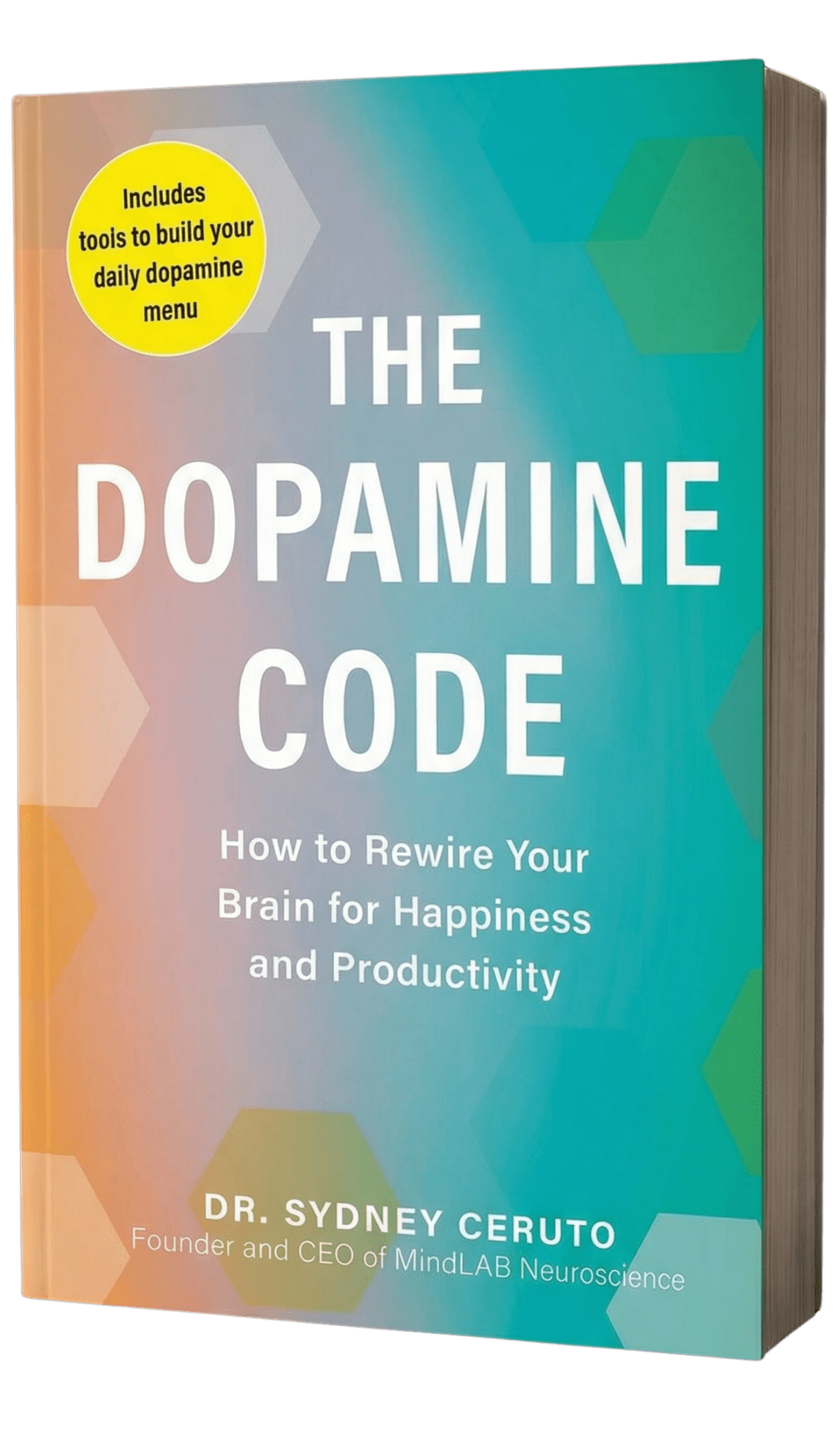
The Dopamine Code

Decode Your Drive

Why Your Brain Rewards the Wrong Things

Your brain's reward system runs every decision, every craving, every crash — and it was never designed for the life you're living. The Dopamine Code is Dr. Ceruto's framework for understanding the architecture behind what drives you, drains you, and keeps you locked in patterns that willpower alone will never fix.

Published by Simon & Schuster, The Dopamine Code is Dr. Ceruto's framework for building your own Dopamine Menu — a personalized system for motivation, focus, and enduring life satisfaction.

Order Now

Ships June 9, 2026

The Dopamine Code by Dr. Sydney Ceruto — Decode Your Drive
Locations

The Intelligence Brief

Neuroscience-backed analysis on how your brain drives what you feel, what you choose, and what you can’t seem to change — direct from Dr. Ceruto.