Business Management Consultant on Wall Street

Neuroscience-based management consulting for Wall Street organizations — where leadership, culture, and performance are neural engineering problems, not strategy problems.

Wall Street's management consulting needs are served by the most formidable firms in the world — McKinsey, BCG, Bain, and a dense ecosystem of financial-services specialists all maintain flagship offices within blocks of the Financial District. What none of them address is the neurological dimension of organizational performance: the measurable prefrontal cortex degradation under chronic stress, the cortisol-driven leadership deficits, and the brain-level dynamics that determine whether strategy translates into execution. Dr. Sydney Ceruto's management consulting practice operates at this level — using Real-Time Neuroplasticity — the brain's ability to rewire itself —™ to restructure the neural architecture of leadership, culture, and organizational performance in the most cognitively demanding market on Earth.
Schedule a Strategy Call

Executive Coaching

The evidence base for neuroscience-informed executive-level guidance is robust and growing. Valesi et al. (2023) in Behavioral Sciences demonstrated through EEG monitoring that the practitioner-client relationship produces distinct, measurable neural signatures — positive engagement activates the left lateral prefrontal cortex associated with approach motivation and visioning, while non-directive approaches boost alpha and theta wave activity linked to creative problem-solving and metacognition. Frisina (2024) in Frontiers in Health Services Management established that interactive, experiential engagement specifically activates prefrontal cortex circuits responsible for problem-solving, decision-making, and emotional regulation — producing stronger cognitive integration than passive or lecture-based formats. In my practice, I work with managing directors, hedge fund partners, and PE professionals whose compensation exceeds $1 million annually and whose cognitive performance directly determines the returns they generate. For these individuals, the distinction between conventional and neuroscience-based approaches is not philosophical — it is economic. The investment in restructuring neural circuitry is orders of magnitude smaller than the cost of operating with a chronically compromised prefrontal cortex.


Learn more about Executive Coaching in Wall Street →

Leadership Development

Leadership development on Wall Street fails at rates that should alarm every CHRO in the Financial District — and the failure is neurologically predictable. Frisina (2024) established that neuroscience-informed leadership programs significantly outperform conventional programs because they are designed around how the brain actually learns, adapts, and builds durable behavioral patterns. Friedman and Robbins (2021) in Neuropsychopharmacology documented that the dorsolateral prefrontal cortex governs cognitive flexibility and strategic shifting — the exact faculty required for adaptive leadership in rapidly changing market conditions — and that PFC network connectivity patterns are trainable through deliberate practice and guided learning protocols. Keen and Geldenhuys (2025) demonstrated that awareness-triggered neural changes in the salience network redirect attention from threat responses toward constructive, goal-focused behaviors. Wall Street leadership programs typically send participants to two-day workshops and expect behavioral transfer back to 100-hour workweeks. The neuroscience predicts this failure: cortisol load dissolves behavioral intentions within days. My methodology integrates leadership development into the neural architecture through sustained, real-time engagement — producing leaders whose capabilities are structurally embedded rather than cognitively maintained against the pressure gradient of the Financial District.

Learn more about Leadership Development in Wall Street →

Strategic Planning

Strategic planning in the Financial District occurs under conditions that systematically undermine the brain’s capacity for strategic thought. James et al. (2023) in Frontiers in Endocrinology documented that chronic stress via HPA axis dysregulation downregulates glucocorticoid expression in the prefrontal cortex, producing executive dysfunction equivalent to medial PFC lesions — rendering complex strategic planning neurologically impaired in precisely the population whose compensation depends on strategic judgment. Berkman (2018) in the Consulting Psychology Journal identified the dorsal anterior cingulate cortex as the allocator of cognitive resources toward strategic priorities based on task demand and anticipated payoff, and the vmPFC as the integrator of identity relevance into goal commitment. Spellman et al. (2021), published in Cell, demonstrated that PFC deep projection neurons enable cognitive flexibility not through real-time top-down control but by encoding and maintaining persistent representations of outcome feedback — establishing that effective strategic planning requires structured feedback review cycles to activate the neural machinery of strategic flexibility. For Wall Street organizations, where 42% of C-suite time and 43% of board time is consumed by regulatory compliance rather than strategic thinking, the prefrontal resources available for strategy are already depleted before the planning session begins. My methodology restores the neural capacity for genuine strategic cognition and designs the feedback architectures that sustain it.

Learn more about Strategic Planning in Wall Street →

Performance Management

Performance management in Wall Street firms operates on metrics, incentive structures, and review cycles — all of which assume that underperformance is a behavioral or motivational issue. The neuroscience contradicts this assumption. Khammissa et al. (2022) in the Journal of International Medical Research documented that burnout produces measurable structural brain changes: reduced gray matter volume in the prefrontal cortex and anterior cingulate cortex, increased amygdala volume and hypersensitivity, and HPA axis dysregulation that impairs working memory, attention, cognitive flexibility, and decision-making. Zientz, Spence, and Chapman (2023) in Frontiers in Psychology demonstrated that 75% of corporate participants in structured brain health programs showed significant BrainHealth Index gains, with improvements directly linked to burnout reduction — reduced exhaustion and reduced depersonalization at statistically significant levels. A pattern I encounter: the Wall Street professional on a performance improvement plan is typically not underperforming due to effort or skill deficits. They are operating with a prefrontal cortex structurally compromised by chronic stress in an environment where cardiac arrests among professionals under 30 have increased 10% over the past decade. My approach maps the neurobiological state of the individual, identifies the specific circuits that have degraded, and designs interventions that restore cognitive capacity — addressing the actual cause of performance decline rather than its visible symptoms.

Learn more about Performance Management in Wall Street →

Change Management Consulting

Change management in financial services fails at well-documented rates — and the neuroscience explains why with precision. Ford et al. (2022) in the European Journal of Neuroscience demonstrated that acute psychosocial stress produces measurable decreases in amygdala-prefrontal cortex functional connectivity, impairing the brain’s capacity for rational, value-based evaluation of new information. During periods of organizational stress — mergers, regulatory restructuring, technology transformation — the very neural capacity needed to evaluate and embrace change is degraded by the stress the change produces. Boukarras et al. (2022) in Frontiers in Psychology established through hyperscanning research that leader-follower neural dynamics are bidirectional: a leader’s neural state during change communication directly influences follower neural states. Emotionally regulated, prefrontal-engaged leaders produce more synchronized and aligned follower responses. Change management consulting that does not account for the neurological state of both leaders and the workforce is operating against the brain’s architecture rather than with it. My approach begins with the leadership team, restructuring the neural patterns that govern their stress response and communication, and then designs change implementation protocols that align with the brain’s learning and adaptation systems.

Learn more about Change Management Consulting in Wall Street →

Succession Planning

Succession planning in hedge funds and PE firms involves concentrated leadership risk that corporate-standard succession frameworks were not designed to address. When a firm’s returns depend on the cognitive performance of three to five individuals, the succession question is not “who has the right skills?” but “who has the neural architecture to sustain elite cognition under the specific pressure profile this firm generates?” Fuentes (2020) in the American Journal of Pharmaceutical Education argued for intentional, organization-wide succession approaches that incorporate cognitive neuroscience-rooted performance management — continuous evaluations, mindset shifts, equitable assignments, and intrinsic motivation cultivation, each mappable to specific neural circuits. Berkman (2018) identified that self-relevance of leadership goals activates the vmPFC and drives stronger neural commitment, while the shift from conscious effortful leadership to instinctive leadership behavior involves a striatal encoding transition that takes sustained guided development. In my practice, succession planning is not an event or an annual review. It is a neurologically-scaffolded developmental process: assessing the cognitive fitness of succession candidates, identifying which neural systems require development, and designing sustained programs that build the prefrontal and executive function capacity that distinguishes adequate successors from exceptional ones.

Learn more about Succession Planning in Wall Street →

Culture Transformation

Culture in the Financial District is not a set of values on a wall — it is the aggregate neural state of the people in the organization, propagated through thousands of interpersonal interactions daily. Boukarras et al. (2022) in Frontiers in Psychology demonstrated through hyperscanning research that interpersonal brain synchrony in the prefrontal cortex predicts cooperative success, team cohesion, and positive interaction outcomes. Leader-follower neural dynamics show directed coupling — leaders who model psychologically safe, cooperative neural states propagate those states to followers through measurable synchrony. Zientz et al. (2023) documented that brain health programs at the organizational level produce statistically significant reductions in depersonalization — the burnout component most associated with toxic workplace culture — with connectedness showing the largest effect size of any dimension measured. For Wall Street firms where turnover at the senior level costs 1.5 to 2 times annual compensation and toxic culture is the primary driver of attrition, culture transformation is not an HR initiative. It is a neural engineering problem. My methodology begins with the leadership layer, restructures the neural patterns that propagate through interpersonal dynamics, and designs organizational systems that reinforce the shift at scale.

Learn more about Culture Transformation in Wall Street →

Business Transformation Consulting

Business transformation in the Financial District — whether driven by fintech disruption, regulatory restructuring, or market evolution — depends on cognitive flexibility at the leadership level. Spellman et al. (2021), published in Cell, demonstrated that PFC deep projection neurons enable cognitive flexibility through feedback monitoring, not through top-down directive control. Organizations that build systematic outcome-review processes activate the same neural machinery that enables strategic adaptation. Frisina (2024) established that neuroscience-based programs specifically enhance cognitive flexibility and critical thinking — the two executive capacities most essential to leading organizations through transformation — and that programs integrating stress management produce superior transformation outcomes by addressing the PFC suppression caused by change-related stress. I regularly see that financial firms undergoing transformation invest heavily in strategy, technology, and communication — but neglect the cognitive capacity of the people expected to execute the transformation. When leaders are operating under chronic cortisol loads that impair the very prefrontal circuits responsible for adaptive thinking, the transformation plan becomes irrelevant. My approach ensures the neural architecture exists to execute the transformation — then designs the feedback-driven implementation protocols that align with how the brain actually adapts.

Learn more about Business Transformation Consulting in Wall Street →

The Financial District concentrates the most demanding management challenges in the American economy within a few square blocks. New York City’s financial activities sector employs over 508,000 workers at an average wage of approximately $289,830 — more than 2.5 times the citywide average. The securities industry alone generates 20% of all private sector wages in the city from just 4.9% of employment. The 2024 Wall Street bonus pool reached $47.5 billion, with 62% of securities employees in the office daily, leading the national return-to-office trend and intensifying the in-person management demands on leadership.

The management consulting landscape serving this market is the most competitive in the world. McKinsey’s New York office at 3 World Trade Center houses over 2,000 consultants. BCG, Bain, EY-Parthenon, Oliver Wyman, Capco, and Synechron all maintain major Financial District presences. Finance-specialist firms like Hatwell Group serve banks, hedge funds, and PE firms with leadership development and executive assessment using conventional psychometric tools. Wall Street Training and Advisory provides technical skills development for banking analysts.

What none of these competitors address is the neurological dimension of management performance. The Financial District’s working conditions — 100-hour weeks for junior professionals, cardiac arrest rates among bankers under 30 increasing by 10% over the past decade, 22% decline in mental health reported by banking professionals — create a population of managers and leaders whose prefrontal cortex function is structurally compromised by the very environment they are expected to lead. Employee hours devoted to financial regulation compliance increased 61% between 2016 and 2023, consuming 42% of C-suite time. Fintech disruption, with NYC firms raising $6.71 billion in 2024, creates transformation demands that require cognitive flexibility from leaders whose stress-loaded brains are operating in the opposite direction.

The gap between what traditional management consulting delivers — strategy, frameworks, process optimization — and what these organizations actually need — restored cognitive function, neurologically-grounded leadership development, brain-compatible change management — defines my practice. In a market where McKinsey and BCG optimize the system and Hatwell Group coaches the behavior, no one addresses the brain generating both.

Dr. Sydney Ceruto, PhD — Founder, MindLAB Neuroscience

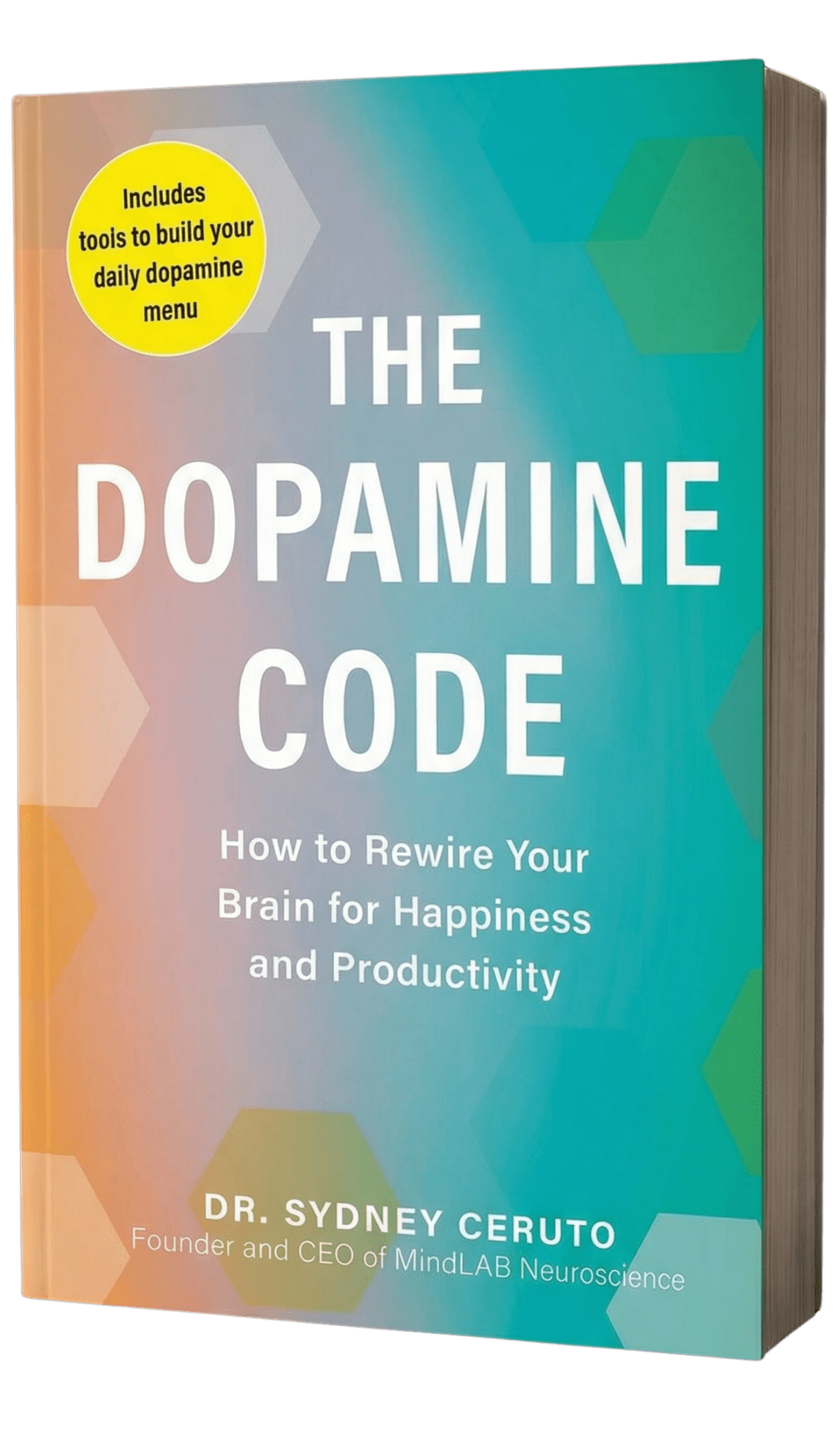
Dr. Sydney Ceruto holds a PhD in Behavioral & Cognitive Neuroscience from NYU and Master’s degrees in Clinical Psychology and Business Psychology from Yale University. She is a Lecturer in the Wharton Executive Development Program at the University of Pennsylvania, an Executive Contributor to Forbes Coaching Council, and an inductee in Marquis Who’s Who in America. Dr. Ceruto founded MindLAB Neuroscience in 2000 and has spent more than 26 years developing and refining her proprietary methodology, Real-Time Neuroplasticity™. She is the author of The Dopamine Code (Simon & Schuster, June 2026).

Frequently Asked Questions

I have tried executive-level programs before and they did not produce lasting change. What makes a neuroscience-based approach different from standard approaches?
My methodology works at the neural level where behavioral patterns originate. Valesi et al. (2023) demonstrated through EEG monitoring that the practitioner-client relationship itself produces measurable neural changes — this is not metaphorical. Frisina (2024) established that neuroscience-informed approaches produce superior outcomes because they target the brain systems where behavioral change must occur. The reason your previous experience did not produce lasting change is that it addressed behavior without restructuring the circuits generating the behavior. Real-Time Neuroplasticity — the brain's ability to rewire itself —™ operates at that deeper level.
My firm is under pressure to retain managing directors and VPs. How does neuroscience-based guidance reduce turnover in financial services?
Retention at the senior level is fundamentally a burnout and cognitive health problem. Khammissa et al. (2022) documented that burnout produces structural brain changes — reduced prefrontal gray matter, increased amygdala reactivity — that drive disengagement and departure decisions. Zientz et al. (2023) demonstrated that brain health programs reduce exhaustion and depersonalization at statistically significant levels. When you intervene early — before the prefrontal damage becomes severe — you restore the neural capacity that makes the role sustainable. The alternative is losing a managing director whose replacement cost exceeds $2 million.
What does burnout actually look like in the brain, and can the damage be reversed?
Burnout produces measurable structural and functional brain changes. Khammissa et al. (2022) documented reduced gray matter volume — the amount of brain processing tissue — in the prefrontal cortex and anterior cingulate cortex, increased amygdala volume and hypersensitivity, and HPA axis dysregulation — the breakdown of normal control systems — with chronically elevated cortisol. Arnsten and Shanafelt (2021) in Mayo Clinic Proceedings confirmed that these changes impair working memory, attention, cognitive flexibility, and decision-making. The critical finding is that early-stage changes are reversible with targeted intervention — but severe burnout may produce permanent structural damage. This is why early intervention is neurologically superior to post-collapse recovery.
How does a 100-hour workweek physically affect decision-making quality?
James et al. (2023) in Frontiers in Endocrinology documented that chronic stress via HPA axis dysregulation — the breakdown of normal control systems — produces executive dysfunction equivalent to medial PFC lesions. The chronic cortisol load from extreme hours directly impairs working memory, cognitive flexibility — the ability to shift thinking between concepts —, and strategic judgment — the precise cognitive capacities that investment banking professionals are paid to deploy. A managing director working 100-hour weeks for sustained periods is neurologically compromised in the exact brain regions responsible for the decisions that generate the firm's returns. The degradation is progressive, cumulative, and measurable — but also reversible when addressed with the right methodology.
We are implementing a major organizational change at our firm. Why does change management fail at most banks, and how does your approach prevent that?
Change management fails because it ignores the neurology of the people expected to change. Ford et al. (2022) demonstrated that stress produces measurable decreases in amygdala-prefrontal cortex (emotion-regulation) connectivity — impairing the brain's capacity for rational evaluation of new information. Organizational change generates stress, and that stress degrades the very neural systems needed to embrace the change. My approach addresses this circular problem by first restructuring the stress response at the leadership level and then designing implementation protocols that work with the brain's adaptation architecture rather than against it.
Can neuroscience-based consulting actually change the culture at a financial firm, or is culture too embedded to shift?
Culture is not embedded in policies or values statements — it is embedded in the aggregate neural states of the people in the organization. Boukarras et al. (2022) demonstrated that interpersonal brain synchrony in the prefrontal cortex predicts cooperative success and team cohesion. Leader-follower neural dynamics are bidirectional: leaders propagate their neural states to followers. When leadership operates from restored prefrontal function and emotional regulation, the interpersonal dynamics shift measurably. Zientz et al. (2023) confirmed this at the organizational level — brain health programs produced significant reductions in depersonalization, the burnout component most associated with toxic culture. Culture is changeable because it is neurological, and neurology is modifiable.
Dr. Ceruto's credentials are strong, but Wall Street is full of elite credentials. Why should I trust a neuroscience-based approach over the McKinsey or BCG consultants my firm already uses?
McKinsey and BCG are strategy and operations consultants. They optimize systems. I optimize the human brain running those systems. The two are complementary, not competitive. No strategy firm identified in the Wall Street competitive landscape deploys peer-reviewed neuroscience methodology as a core service differentiator. When McKinsey redesigns your operating model, the success of that redesign depends on whether the people executing it can sustain cognitive flexibility — the ability to shift thinking between concepts —, manage stress, and make sound decisions under pressure. Those are neurological variables — and they are the variables my practice addresses.

Ready to Perform at Your Highest Level?

Wall Street's organizations invest in strategy, technology, and compliance at world-class levels. The human brain executing those investments — the most consequential variable in every outcome — remains systematically underserved.

Schedule a Strategy Call
MindLAB Neuroscience consultation room
Locations

The Intelligence Brief

Neuroscience-backed analysis on how your brain drives what you feel, what you choose, and what you can’t seem to change — direct from Dr. Ceruto.