When Change Becomes the Operating Environment
“The brain that made you successful in the phase you are leaving physically reorganized itself around those demands. Asking it to operate differently without restructuring the circuits is like asking a sprinter's legs to run a marathon — the architecture does not support the demand.”
Organizational change is not an event in your professional life. It is the environment itself. Restructurings announced and then paused. Strategic pivots communicated in language designed to obscure more than it reveals. Reporting lines redrawn, then redrawn again before the first version is tested. Teams assembled for a mandate that shifts before the first deliverable is complete.
The experience is particular. It is not the change itself that destabilizes. It is the sustained uncertainty about what the change will mean, when it will resolve, and whether your role, your team, or your trajectory survives it. You have likely managed through multiple reorganizations. Each time, you adapted. Each time, something about the recovery took longer. The third restructuring does not feel like the first. The fifth feels qualitatively different from the third.
What prior approaches have offered is strategic advice. Positioning guidance. Narrative reframing. Resilience language. The assumption is that the challenge is tactical. But the real experience involves constant threat-scanning that will not turn off after hours. The emotional reactivity surfaces in moments that should not trigger it. The decision-making feels slower and less confident despite having more experience than ever. These responses are not tactical at all.
These are not personality deficits. They are neurological responses to temporally uncertain threat and they have precise, measurable mechanisms in the brain.
The compounding nature of this experience is what distinguishes it from acute stress. Each reorganization does not arrive as an isolated event. It arrives in the context of every previous reorganization the brain has processed. The neural system does not reset between cycles. It accumulates a pattern of response that increasingly determines the quality of your leadership, your decisions, and your capacity to operate effectively under pressure that shows no sign of resolving.
The Neuroscience of Organizational Uncertainty
The brain processes organizational change through the same circuitry it uses to process physical threat. The distinction between a restructuring memo and a predator in the environment is meaningful to the conscious mind. It is not particularly meaningful to the amygdala.
Research using high-resolution brain imaging with nearly one hundred adults mapped the circuits that respond to temporally uncertain threats. The findings showed that the brain deploys additional cognitive scaffolding to manage unpredictable danger. This creates a sustained processing load across the prefrontal cortex that persists as long as the uncertainty remains unresolved.
This is the precise neurological description of what organizational change feels like from the inside. The threat is real but undefined. The timing is unknown. Resolution depends on decisions made by others. The brain responds by maintaining a continuous activation state. This activation is metabolically expensive, cognitively draining, and invisible to everyone around you. It produces no visible symptoms beyond the subtle erosion of decision quality and emotional regulation.
A second mechanism determines whether the brain adapts constructively or deteriorates under repeated change exposure. Research has identified a core distinction in stress-related neuroplasticity — the brain’s ability to rewire itself. Successful interactions with novel stressors foster adaptive rewiring. But repeated exposure to uncontrollable stressors embeds inflexible, rigid coping as the brain’s default response. The key variable is not the magnitude of stress but the person’s perceived control over the stressor. Active coping engages brain regions governing reward, decision-making, and memory. Passive coping engages more constrictive pathways that limit behavioral flexibility.
What I observe consistently in professionals managing through repeated organizational transitions is this shift from adaptive to rigid rewiring. The first restructuring activates problem-solving circuits. The second engages strategic recalibration. By the third or fourth, the brain has encoded a pattern: this stressor is recurring, unpredictable, and outside my control. The neural response shifts from strategic coping to threat vigilance and emotional withdrawal. The result is visible as resistance to change, paralysis during transitions, and emotional volatility in leadership contexts. It is not a character flaw. It is a predictable neurological outcome of repeated uncontrollable stress exposure.
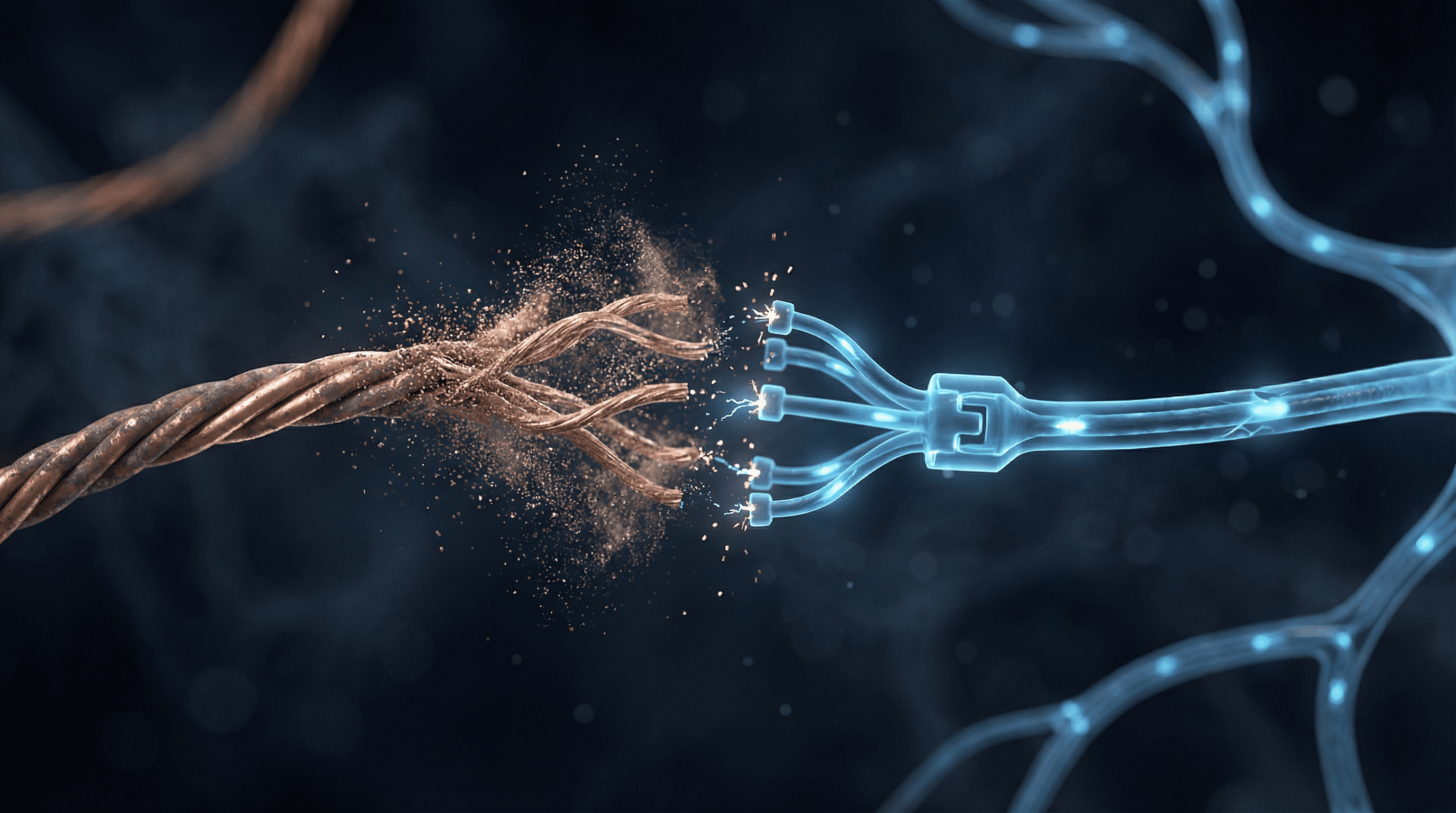
Structural Resilience and the VmPFC
The brain’s capacity to cope adaptively with sustained organizational stress is not a fixed personality trait. It is a dynamic, trainable property of ventromedial prefrontal cortex function.
Research at Yale demonstrated that this region shows acute flexibility under sustained stress. It strengthens its connections with surrounding regulatory regions during stress episodes. The regulatory network gets more coordinated with use under the right conditions.
This finding has direct implications. The professional who appears emotionally dysregulated during a reorganization is often experiencing blunted flexibility in this region. This is an acquired state produced by accumulated stress exposure, not a reflection of their actual capability. The flexibility that enables resilient coping under sustained stress can be rebuilt through targeted intervention. The neuroscience is clear: this is a trainable capacity, not a fixed character trait.
How Dr. Ceruto Approaches Organizational Change
Dr. Ceruto’s methodology addresses the specific neural mechanisms that organizational change activates. It targets the amygdala’s threat response under temporal uncertainty. It addresses the shift from adaptive to rigid rewiring under repeated uncontrollable stress. It restores the prefrontal flexibility that determines whether the brain copes or collapses.
The approach begins with identifying which mechanisms are active in the client’s current state. A professional navigating their first major restructuring presents differently from one who has managed through five reorganizations across a decade. The first may show elevated amygdala activation with intact prefrontal regulation. The second may show the accumulated pattern of rigid coping. This manifests as default threat vigilance, emotional withdrawal, and decision-making paralysis that no amount of strategic advice can override because the problem is not strategic. It is neural.
The protocol targets the controllability variable that research identifies as the key determinant of adaptive versus rigid coping. By building agentic frameworks and new response repertoires, the work reactivates the adaptive plasticity pathway. This shifts the brain from the protective, avoidant default back toward strategic engagement with the change environment. For prefrontal restoration, the methodology targets the dynamic flexibility that determines whether the brain can regulate emotional responses under sustained organizational uncertainty.
The NeuroSync program addresses focused change management. The NeuroConcierge program provides comprehensive embedded partnership for professionals whose organizational change pressures are compounded with career identity questions, family system demands, and the accumulated burden of years operating in a structurally unstable professional environment.
Landmark research provides the anatomical evidence that this work is not merely psychological. Participants in structured engagement showed significantly reduced perceived stress alongside decreases in amygdala gray matter density. Structured engagement demonstrably reduces the physical volume of the brain region that hyperactivates during organizational uncertainty. This is the scientific foundation for the claim that change management work produces neurological, not just behavioral, results.
The pattern that emerges across my work with professionals navigating organizational transitions is consistent: once the threat-detection system is addressed at the neural level, the strategic thinking capacity that was always present becomes accessible again. The problem was never a lack of strategy. It was a brain in sustained threat mode that could not access its own strategic resources.
What to Expect
Every engagement begins with a Strategy Call — a focused strategy conversation in which Dr. Ceruto assesses which neural mechanisms are active in your current response to organizational change. This is not a stress management consultation. It is a precision mapping of how your brain is processing the specific uncertainty you face.
From there, the protocol is structured around your identified patterns. Sessions target the specific systems involved in a sequence designed to produce measurable change in how you experience and respond to organizational uncertainty.
The work is virtual-first and designed to operate alongside active professional demands. Organizational change does not pause for personal development. The protocol is calibrated to produce neural change within the context of ongoing uncertainty, not after it resolves.
The Neural Architecture of Change Resistance
Every organization that has attempted significant change has encountered the same phenomenon: intelligent, capable, well-intentioned professionals who understand the rationale for the change, agree with the strategic logic, and still fail to sustain the new behaviors required. This is described, usually with frustration, as change resistance. It is more precisely described as neural architecture doing exactly what it is designed to do.
The brain’s pattern-recognition and habit systems are among the most powerful optimization mechanisms in nature. They encode repeated behaviors into low-energy, automatic routines precisely because this is metabolically efficient and operationally reliable. The prefrontal cortex is the expensive part of the brain — conscious, deliberate, energy-intensive. The habit system is cheap, fast, and deeply reinforced. When organizational change asks professionals to replace automated, deeply encoded working patterns with new behaviors that require sustained prefrontal engagement, it is asking the expensive system to consistently override the cheap system. Under normal conditions, this fails. Under elevated stress — and major organizational change reliably produces elevated stress — it fails with near certainty.
The social neural dimension amplifies this. The brain’s threat-detection systems monitor social belonging and status continuously. Organizational change that restructures roles, reporting relationships, or professional identities activates threat responses that are neurologically equivalent to physical danger. A professional who consciously supports the transformation can simultaneously have a limbic system that is generating sustained threat signals about what the change means for their belonging, status, and professional identity. These signals do not yield to rational argument. They yield to neural recalibration — a fundamentally different kind of intervention than the change communication and training that conventional change management delivers.
Why Traditional Approaches Fall Short
Conventional change management is built on models developed before modern neuroscience had mapped the specific mechanisms of habit, threat response, and social neural regulation that determine whether change succeeds or fails. Kotter’s eight steps, Prosci’s ADKAR model, and their equivalents are sophisticated behavioral frameworks that address the stages individuals move through in change adoption. They do not address the neural architecture that determines the pace and success of that movement.

The practical result is that change management programs deliver their communication campaigns, their training interventions, their sponsor activation strategies, and their reinforcement plans — and still produce adoption curves that plateau well short of the target. The people in the middle of the adoption curve are not resisting consciously. Their limbic systems are responding to threat signals that have not been addressed, their habit circuits are reasserting deeply encoded patterns, and their prefrontal capacity for sustained behavioral change is being depleted by the cognitive load of operating in an environment of elevated uncertainty.
Coaching as an adjunct to change management is often more effective than training, because the coaching relationship can address the individual’s specific neural response to the change rather than delivering generic change frameworks. But conventional coaching in this context still operates primarily at the cognitive and behavioral level — examining beliefs, identifying behavioral patterns, setting commitments — without reaching the limbic and dopaminergic circuits that are actually governing the response to change.
How Neural Change Management Coaching Works
My approach to change management coaching begins with a neural audit of the individual’s or team’s specific response pattern to the organizational change. What are the specific threat signals the change is generating? Which neural circuits are most activated — role-identity threat, status threat, belonging threat, or uncertainty overload in the predictive coding system? What is the habit architecture that is most powerfully reasserting itself, and what is the specific neural competition between the new and old behavioral patterns?
From this assessment, I design a coaching protocol that operates at the neural level. For leaders responsible for driving change, this means recalibrating the prefrontal-limbic regulatory balance to sustain strategic clarity and change commitment under the elevated stress of transformation. For individuals navigating role changes, it means targeted work on identity circuit recoding — building new neural associations with the emerging role before the old ones are asked to simply disappear. For teams experiencing social threat responses to structural reorganization, it means designing experiences that rebuild the neural signals of belonging and psychological safety within the new organizational configuration.
The neuroscience of successful change is clear on one point: the speed of change is constrained by the speed of neural recoding, not by the speed of rational adoption. Organizations that design change timelines around logical comprehension consistently outpace their organizations’ actual neural change capacity and produce reversion. Those that design around neural consolidation timelines produce changes that hold. My engagement calendar is calibrated to neural change pace, not project management pace.
What This Looks Like in Practice
Change management coaching engagements begin with a Strategy Call that maps the specific change context — its scope, timeline, and the specific professional population navigating it — against the neural mechanisms most likely to determine success. From that conversation, I design an engagement that directly addresses those mechanisms.
For individual executives navigating personal leadership transformation within an organizational change context, the NeuroSync model provides focused, intensive work on the specific neural patterns most limiting their change leadership effectiveness. For leadership teams navigating the sustained complexity of multi-year transformation, the NeuroConcierge model provides embedded coaching partnership across the transformation timeline — recalibrating and adjusting as the organizational system evolves and new neural challenges emerge. The engagement is not a supplement to the change management plan. It is the neural infrastructure that determines whether the change management plan succeeds.
For deeper context, explore common time management mistakes in change.