Hypervigilance & Safety on Wall Street

Wall Street rewards threat-detection as a professional skill. The brain does not know how to be hypervigilant on the trading floor and settled everywhere else.

There is a specific exhaustion that belongs to people whose brain never fully stands down — who scan a room before relaxing into it, who read subtext in silence, who cannot sit with their back to a door. That is not paranoia and it is not weakness. It is a nervous system that learned to stay on guard because, at some point, staying on guard was the right call. The problem is that the system never got the signal that the threat had passed.

At MindLAB Neuroscience, I work with people whose threat-detection circuitry is running on a setting calibrated for a past environment — one that required permanent vigilance — and has never been updated to match the present one. The work is not about relaxing more or thinking more positively. It is about recalibrating the brain system responsible for evaluating danger, so that rest is neurologically possible rather than just theoretically available.

Book a Strategy Call

The Brain That Never Gets to Stand Down

The brain has a system built for threat detection. When something in the environment is potentially dangerous, this system activates — sharpening perception, narrowing attention, preparing the body to respond. Under normal conditions, the system activates, evaluates the threat, and then returns to a baseline state of relative calm. The key word is returns.

In people living with hypervigilance, that return does not happen. The threat-detection system — anchored in the amygdala — stays in an activated state even when the environment is genuinely safe. The alarm does not turn off. Every room is scanned. Every expression is read for danger. Every moment of quiet registers as a warning rather than a respite, because quiet is where threats tend to emerge before they become visible.

This is not irrational. It is learned. In an environment where threats were real and unpredictable — a household that was unsafe, a relationship where moods changed without warning, a community where danger arrived without announcement — staying perpetually alert was the right neural response. The amygdala learned that lowering its guard carried costs. It encoded that learning structurally. The architecture changed. And then the environment changed, but the architecture did not follow.

What Permanent Activation Actually Costs

Chronic threat-detection activation is not just uncomfortable. It is metabolically expensive. The body’s stress-response hormones — cortisol and its related cascade — are designed for short, intense bursts of use. When they run continuously, they wear on every system in the body: sleep quality deteriorates, concentration fragments, emotional regulation narrows, physical tension becomes baseline rather than response.

The cognitive cost is significant on its own. A brain scanning constantly for threat has limited bandwidth for anything else. Creativity requires lowered vigilance — the ability to let the mind wander into unfamiliar associations. Deep focus requires sustained attention that is not interrupted by threat checks. Intimacy requires a nervous system settled enough to register another person’s presence without simultaneously running a risk assessment. All of these are compromised when the threat-detection system is occupying the lion’s share of neural resources.

There is also a relational cost that is easy to misread. People close to someone in a hypervigilant state often experience that person as guarded, quick to react, or impossible to fully reach. What looks like emotional distance from the outside is usually the nervous system doing its job — prioritizing safety over connection, because at the level of the brain, safety has to come first. This is not a choice. It is the sequence the threat-detection system imposes.

How the Threat-Detection System Gets Stuck

The amygdala learns from experience in a very specific way: it encodes threat associations quickly, stores them durably, and generalizes them broadly. This is adaptive in dangerous environments — you learn fast, you remember well, and you apply the lesson to similar situations. The problem is that the brain’s threat-detection system is not precise about similarity. A raised voice in a meeting activates the same association as a raised voice from childhood. A text that does not arrive activates the same circuitry as waiting for a door to open in fear. The context is different. The neural response is the same.

This generalization is what makes hypervigilance so persistent. It does not require the original threat to be present. It requires only a stimulus that the amygdala has associated — often loosely — with danger. In a world that is full of stimuli, the threat-detection system finds ample material to stay activated. The result is a nervous system that cannot find its off switch because the inputs that would signal safety are being processed through an architecture calibrated to read everything as a potential hazard.

There is a second mechanism worth understanding. The body’s capacity to shift between states of mobilization and rest depends on a circuit that runs between the brain and the body — regulating heart rate, breathing, gut activity, and facial muscle tone based on the brain’s assessment of environmental safety. When the threat-detection system is chronically activated, this circuit is locked in a mobilized state. The body cannot physiologically achieve the markers of safety — slowed heart rate, deep breathing, relaxed muscle tension — because the brain keeps signaling that safety has not been established. Rest becomes structurally unavailable, not merely emotionally difficult.

The Difference Between Caution and Hypervigilance

A reasonable question: isn’t some vigilance good? Yes. The capacity to notice threat accurately, respond to it effectively, and return to baseline afterward is exactly what healthy threat-detection looks like. The distinction is in the return. Caution responds to actual signals and then resolves. Hypervigilance does not require actual signals — it generates them. Every ambiguous input gets processed as a potential threat. The absence of obvious danger is not evidence of safety. It is merely evidence that the threat has not revealed itself yet.

This distinction matters because it defines what the work actually targets. The goal is not to eliminate threat sensitivity — that sensitivity is genuinely valuable and, in many cases, the reason someone navigated a difficult environment as well as they did. The goal is to restore the return. To give the brain a pathway back to baseline that it currently does not have access to. To update the threat-detection architecture so that present-tense safety actually registers, rather than getting overridden by the learned assumption that safety is temporary.

What Changes When the System Recalibrates

When the amygdala’s threat threshold adjusts — when the brain builds a more accurate, present-tense model of what the environment actually requires — the experience is not exactly relaxation. It is more like relief. The constant background processing that was consuming resources becomes available for other things. Sleep deepens because the brain is no longer running threat-checks through the night. Relationships change quality because the nervous system can now register another person’s presence without simultaneously assessing them for risk.

The changes are often described in terms of what becomes possible rather than what disappears. The capacity to sit still. The ability to stay in a conversation without tracking the exits. The experience of a quiet moment as neutral rather than ominous. These are not small things. They represent a fundamental shift in the quality of daily experience — not a removal of sensitivity, but a restoration of range. A nervous system that can move between states instead of being locked in one of them.

If the description of a brain that never fully stands down is recognizable — if rest feels like something you have to earn rather than something you can access — a Strategy Call is the right first step. One hour, by phone, to examine what the pattern actually looks like and what the work would involve.

Mahogany desk with crystal brain sculpture and MindLAB journal in warm lamp light surrounded by leather-bound volumes in institutional Wall Street study

Why Hypervigilance & Safety Matters in Wall Street

Wall Street has turned hypervigilance into a professional credential. The ability to scan a market for danger — to notice the anomaly in a position, read the shift in a counterparty’s tone, detect the signal inside the noise — is exactly what the environment selects for and rewards. The threat-detection system is not a liability here. It is the job description. The problem is that the brain cannot be hypervigilant professionally and regulated personally. The system generalizes, and the off switch stops working.

Trading floors require sustained threat-detection in a literal sense. Every screen is a threat vector. Volatility events arrive without warning. The 2008 financial crisis encoded something durable in the professionals who lived through it: a threat association between financial markets and catastrophic personal consequence that still runs in the background for many of them. A sharp market move in 2025 activates the same circuitry as the acute terror of 2008, even when the current event is structurally different. The amygdala does not run nuanced comparative analysis. It pattern-matches, and those patterns run deep.

JPMorgan’s five-day return-to-office mandate has compressed the recovery window for finance professionals whose threat-detection system needs downtime between exposures. The work-from-home buffer — the commute gone, the home environment offering minor sensory breaks — has been removed. Every day now begins with the subway, the lobby, the floor. For someone who cannot access a settled nervous system state, there is no reset between threat cycles. The week is one continuous activation event.

The FiDi at night is quiet in a way that does not reach the nervous system. This is worth naming directly. For people living with hypervigilance, quiet is not evidence of safety — it is evidence that the threat has not revealed itself yet. The empty street is not restful. It is a scanning problem. What is in the shadow that I haven’t identified. The amygdala that spent the day processing market signals does not shift modes when the Bloomberg closes. It keeps running its scan on whatever inputs are available.

The bonus structure adds a specific kind of threat cycle. Year-end becomes an annual survival event: the number either validates continued belonging in the environment or it doesn’t. For a nervous system that has encoded belonging as survival, this is not merely an employment evaluation. It is a repeated activation of the threat circuitry around social exclusion. The anxiety of bonus season is not proportionate to the financial stakes alone — it is the full threat-detection system treating a compensation conversation as a safety event.

Working with hypervigilance on Wall Street requires acknowledging what the environment asks for and what it costs. The scanning that makes someone good at the job is the same scanning that prevents sleep, strains relationships, and makes the body feel permanently braced. The work is not about making someone less alert. It is about restoring the return pathway — the ability to downshift from scanning mode to a state of genuine, neurologically accessible rest. Right now that pathway does not exist. It can be rebuilt.

If the description of a nervous system that cannot stand down after the market closes is familiar — if the vigilance that serves you at work is costing you everywhere else — a Strategy Call is a one-hour phone conversation. $250. No commitment after that.

Dr. Sydney Ceruto, PhD — Founder, MindLAB Neuroscience

Dr. Sydney Ceruto, PhD — Founder & CEO, MindLAB Neuroscience

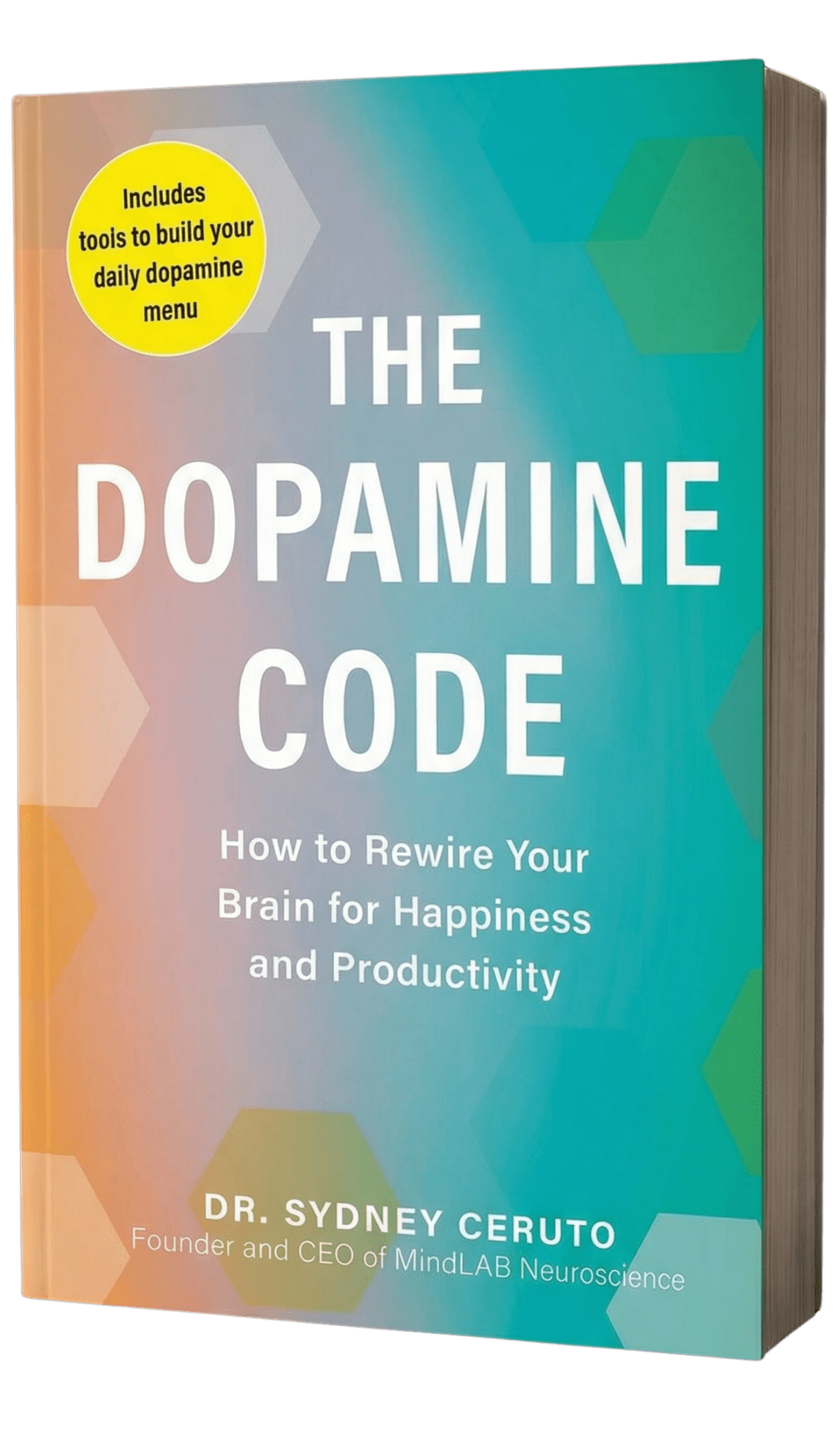
Dr. Ceruto holds a PhD in Behavioral & Cognitive Neuroscience from NYU and two Master’s degrees from Yale University. She lectures at the Wharton Executive Development Program at the University of Pennsylvania and has been an Executive Contributor to the Forbes Coaching Council since 2019. Dr. Ceruto is the author of The Dopamine Code (Simon & Schuster, June 2026). She founded MindLAB Neuroscience in 2000 and has spent over 26 years pioneering Real-Time Neuroplasticity™ — a methodology that permanently rewires the neural pathways driving behavior, decisions, and emotional responses.

References

Rauch, S. L., Shin, L. M., & Phelps, E. A. (2006). Neurocircuitry models of posttraumatic stress disorder and extinction: Human neuroimaging research — past, present, and future. *Biological Psychiatry*, 60(4), 376–382. https://doi.org/10.1016/j.biopsych.2006.06.004

Shin, L. M., & Liberzon, I. (2010). The neurocircuitry of fear, stress, and anxiety disorders. *Neuropsychopharmacology*, 35(1), 169–191. https://doi.org/10.1038/npp.2009.83

McEwen, B. S. (2007). Physiology and neurobiology of stress and adaptation: Central role of the brain. *Physiological Reviews*, 87(3), 873–904. https://doi.org/10.1152/physrev.00041.2006

Porges, S. W. (2007). The polyvagal perspective. *Biological Psychology*, 74(2), 116–143. https://doi.org/10.1016/j.biopsycho.2006.06.009

Success Stories

“The numbness crept in so gradually I didn't notice until I couldn't feel anything — not stress, not connection, not even relief when things went well. Dr. Ceruto identified it as a dorsal vagal shutdown — my nervous system had flatlined as a survival strategy. Within ninety days, the signal came back. I feel things again, clearly and without overwhelm.”

Marcus H. — Fund Manager Dallas, TX

“The same relational patterns my mother and grandmother lived through kept repeating in my own life — the hypervigilance, the emotional shutdown, the inability to feel safe even when nothing was wrong. Dr. Ceruto identified the epigenetic stress signatures driving the pattern and restructured them at the neurological level. The cycle that ran through three generations stopped with me.”

Gabriela W. — Real Estate Developer Miami, FL

“Unfortunate consequences finally forced me to deal with my anger issues. Nothing was clicking until I found Sydney's approach. Her insightfulness and warm manner helped me through a very low point in my life. Together we worked through all my pent-up anger and rage, and she gave me real tools to manage it going forward. I now work to help others learn how to control their own anger.”

Gina P. — Trial Attorney Naples, FL

“Every close relationship I had eventually hit the same wall — I'd flood emotionally and shut down or explode, and nothing I'd tried gave me real control over it. Dr. Ceruto identified that my autonomic nervous system was defaulting to fight-or-flight the moment real intimacy was on the line. She restructured the default. The flooding stopped because the trigger architecture changed.”

Simone V. — Publicist New York, NY

“I could perform at the highest level professionally and still feel hijacked emotionally in my closest relationships. Dr. Ceruto identified the limbic imprint — an amygdala encoding from childhood that was running every intimate interaction I had. She dismantled it. The reactivity isn't something I regulate anymore. The pattern that generated it is gone.”

Natasha K. — Art Advisor Beverly Hills, CA

“I struggled with anxiety since I was 13. I simply could not control my thoughts, and no medication or therapy was helping. Since working with Sydney, I've gained a whole new perspective on what anxiety actually is and — most importantly — how to control it. At 28, I'm finally in a happy place with solid emotional management and real coping skills.”

Lydia G. — Gallerist Paris, FR

Frequently Asked Questions About Hypervigilance & Safety

What is hypervigilance — is it the same as anxiety?

They overlap but are not identical. Anxiety involves a generalized apprehension about future events — a forward-facing worry about what might happen. Hypervigilance is specifically about environmental scanning: the brain's threat-detection system running in continuous monitoring mode, evaluating the present-tense environment for danger signals rather than anticipating future ones. Many people experience both simultaneously, but they have different neural signatures and respond to different approaches. The distinguishing feature of hypervigilance is the scanning itself — the inability to be in a space without monitoring it, the difficulty sitting with your back to a door, the reading of ambient signals as potential threats.

Why do I feel like I'm always waiting for something bad to happen?

That is a precise description of how the amygdala operates when it is stuck in a threat-detection state. The brain's threat system does not require evidence of danger to stay activated — once it has learned that threats can arrive unexpectedly, it treats the absence of visible threat as insufficient reason to stand down. Quiet becomes suspicious rather than safe. Calm becomes the condition under which threats appear. The "waiting" feeling is the lived experience of an amygdala that has not received a reliable all-clear signal and has stopped expecting one. That is a pattern the brain learned — and a pattern the brain can unlearn.

Can hypervigilance develop in adults, or does it only come from childhood experiences?

It can develop at any point in life where the environment genuinely required sustained vigilance. Certain professions that demand continuous threat assessment — high-stakes finance, high-accountability roles, environments with unpredictable authority figures — can calibrate the threat-detection system upward over time. Relationships with significant unpredictability, situations involving actual danger, or extended periods of instability can all produce the same pattern regardless of when they occur. Early experiences do encode particularly durably, but the mechanism is the same whenever it develops: the brain learned that staying alert was the correct response, and it has not received sufficient new evidence to update that learning.

I function well professionally — is what I'm experiencing really a problem worth addressing?

Hypervigilance and high functioning are not mutually exclusive. Some environments actively reward the threat-detection sensitivity that defines hypervigilance — finance, competitive professional fields, certain creative industries. The professional performance may be excellent. The cost is paid in the parts of life that require the nervous system to settle: sleep, relationships, physical rest, moments of genuine ease. If the question is whether your threat-detection system is running at a cost to your quality of life outside performance contexts, that is worth examining regardless of how well you function where hypervigilance is the asset.

How is hypervigilance different from just being a careful or observant person?

The distinction is in the cost and the control. A naturally observant person notices things accurately and proportionately, and that noticing is available to them rather than running them. Hypervigilance runs involuntarily and at a tax: it consumes cognitive bandwidth that would otherwise be available, operates even when there is no relevant input, and generates a physiological stress response that an observant person's noticing does not. The key markers are involuntary scanning you cannot switch off, a body that stays braced even in genuinely safe environments, and a persistent sense of waiting for a threat that has not yet appeared.

Why can't I relax even when I know I'm safe?

Because knowing and the nervous system's assessment operate through different systems. The reasoning brain can conclude that the environment is safe. The amygdala evaluates safety independently, using its own learned threat associations rather than the reasoning brain's current analysis. When the amygdala's threat-detection history is calibrated toward permanent vigilance, the knowing does not reach the system responsible for producing rest. The body stays braced because that is what the deeper system is instructing. This is why "just relax" is not useful guidance — it addresses the wrong system. The work targets the system that is actually running the response.

Is hypervigilance something I can address on my own?

Some people develop significant skill with practices that help regulate the nervous system — movement, breathwork, sleep discipline, reducing stimulation load. These can reduce the subjective experience of hypervigilance without addressing the underlying threat-detection calibration. They manage the output. The pattern persists. For lasting change at the architectural level — updating what the amygdala files as threat, recalibrating the threshold at which the alarm fires, rebuilding the pathway back to a settled state — the work needs to engage the brain systems responsible for those changes directly. That requires more than self-management practices, however skillfully applied.

What does a Strategy Call involve for someone dealing with hypervigilance?

A Strategy Call is a one-hour phone conversation — $250, no commitment beyond that. We examine your specific pattern: what the scanning looks like, when it is most activated, what environments or inputs reliably escalate it, and what baseline you have access to when the vigilance is relatively lower. From that picture, I can give you a clear read on what the neural pattern actually involves and what the work would target. You leave with more precision about what is happening and what would be required to change it — whether or not there turns out to be a fit for deeper work.

Does addressing hypervigilance mean becoming less alert or less perceptive?

No. The goal is not reduced perception — it is restored range. A nervous system locked in hypervigilance has lost access to the lower end of the activation range: the genuinely settled states that make deep sleep, full presence in relationships, and creative thinking possible. Recalibrating the threat-detection system restores access to that range without removing the higher end. Most people who do this work find that their perception becomes more accurate, not less — because accurate threat assessment requires being able to distinguish genuine threat signals from ambient noise, which a constantly activated system cannot do reliably.

What is the neural mechanism behind the body feeling permanently braced?

The body's state — muscle tension, heart rate, breathing depth, gut activity — is regulated by a circuit connecting the brain to the body that responds to the brain's ongoing assessment of environmental safety. When that assessment is chronically tilted toward threat, the circuit maintains the body in a mobilized state as a default. Muscles stay contracted because the brain is signaling that rapid response may be required. Sleep stays shallow because the brain is maintaining enough arousal to respond to threat. The gut is disrupted because the digestive system is deprioritized when resources are allocated to threat response. These are not separate symptoms — they are expressions of a single neural state that the threat-detection system is maintaining. When that system recalibrates, the body state follows.

Also available in: Miami · Midtown Manhattan · Beverly Hills · Lisbon

Take the First Step

The Strategy Call is a focused conversation with Dr. Ceruto that maps the specific neural mechanisms driving your concerns and determines the right path forward.

Book a Strategy Call
MindLAB Neuroscience consultation room
Locations

The Intelligence Brief

Neuroscience-backed analysis on how your brain drives what you feel, what you choose, and what you can’t seem to change — direct from Dr. Ceruto.