Cognitive Economics
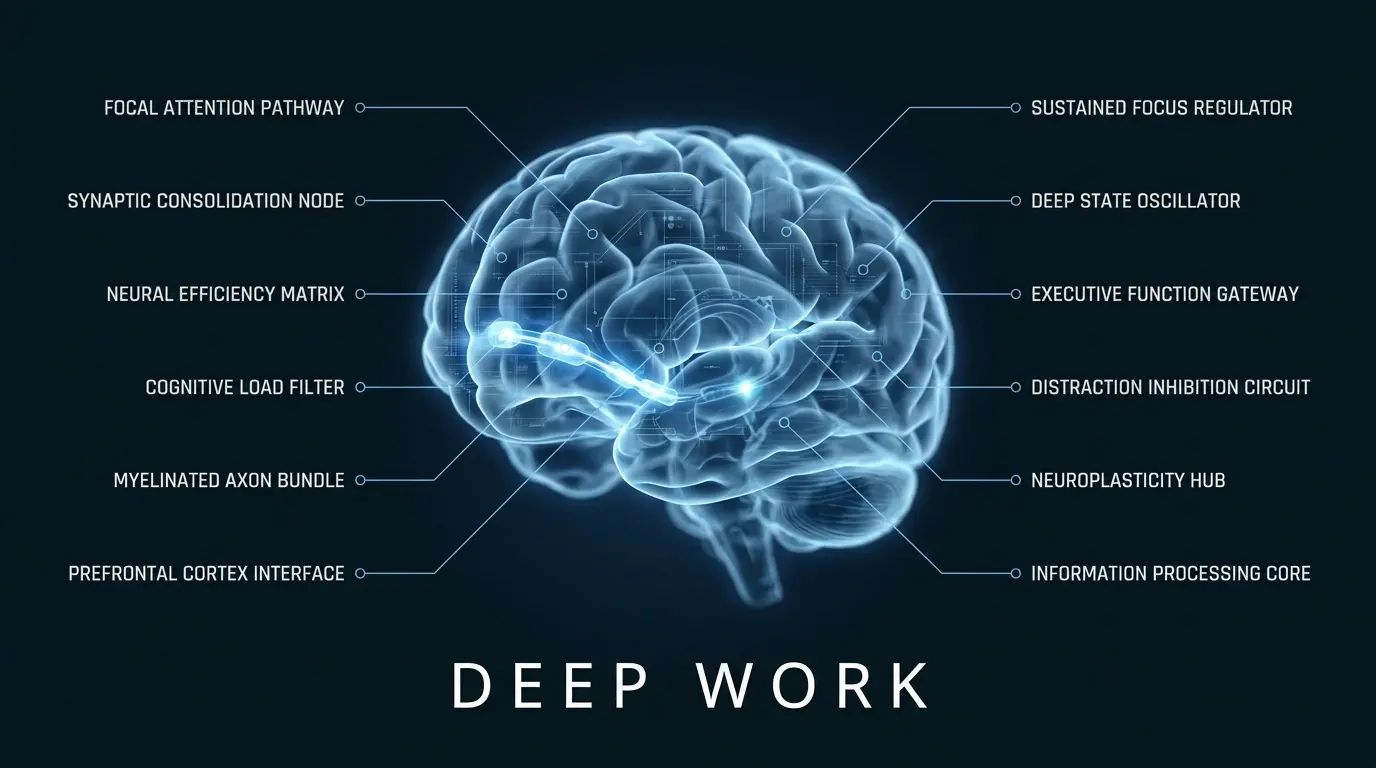
Deep Work is not merely “working hard”; it is a specific neurophysiological state of distraction-free concentration that pushes your cognitive capabilities to their limit. In this state, the Prefrontal Cortex (PFC) synchronizes neural firing to a specific task, maximizing “myelination”: the insulation of nerve fibers that increases the speed and efficiency of neural transmission. It is the only state in which you can master hard things quickly.
The Cost of Switching
The enemy of deep work is “Attention Residue.” Neuroscience reveals that when you switch from Task A to Task B (e.g., checking Slack while coding), your attention does not follow immediately. A significant portion of your cognitive resources remains “stuck” processing the previous task.
-
Metabolic Drain: Rapid context switching burns through glucose and depletes neurotransmitters (like norepinephrine) faster than sustained focus, leading to premature cognitive fatigue.
-
The Shallow Trap: Chronic multitasking trains the brain to seek novelty, effectively atrophying the neural circuits responsible for sustained attention.
Protocols for Depth
Deep work is a skill that must be trained, not a habit you simply decide to have.
-
Bimodal Segmentation: The most effective protocol involves strict compartmentalization. Separate your day into “Deep Blocks” (zero connectivity, high complexity) and “Shallow Blocks” (admin, communication). Do not mix them.
-
Progressive Overload: Just like a muscle, the PFC fatigues. Start with 60-minute intervals of intense focus and progressively extend them. Most human brains max out at 4 hours of true deep work per day.