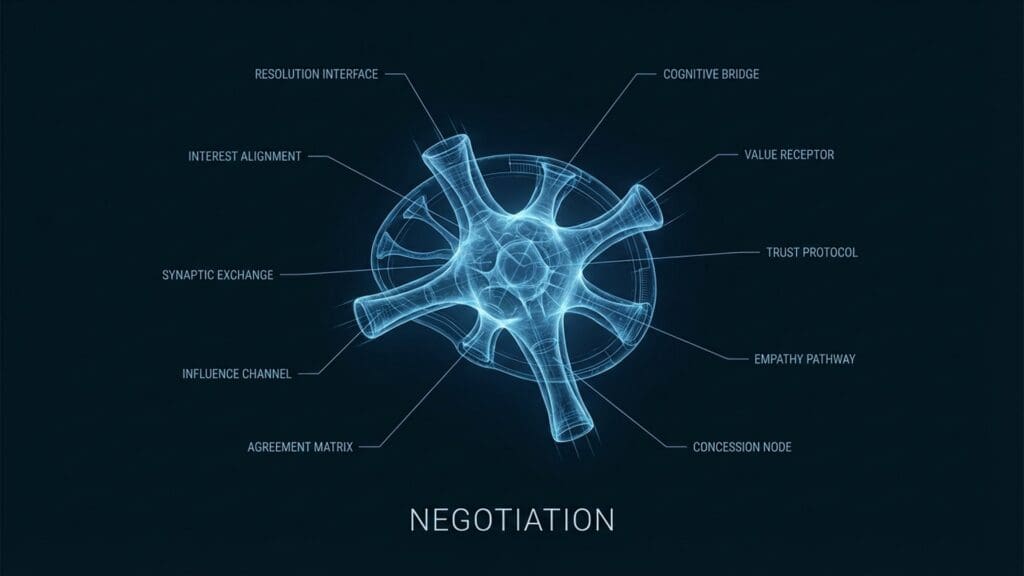
The art of cognitive influence. Learn to read the room, manage leverage, and drive consensus using behavioral psychology and strategic empathy.
Executive Neuro-Brief
The Evolutionary Design
Nature built you to survive. But fighting is dangerous. Physical conflict burns energy and risks injury. So, your brain developed a safer way to get resources. It created social exchange. This allows you to settle disputes and share food without violence. It keeps the tribe together. Your brain uses this tool to balance your needs with the needs of the group. It is the biological root of fairness.
The Modern Analogy
Negotiation is like trading cards at recess, trying to make a trade where both kids walk away feeling like they got something valuable. Your brain is the playground. You hold a rare card in your hand. The other person holds the one you want. If you refuse to trade, you sit alone. If you give up your card for nothing, you feel cheated. Stress chemicals flood your system if the trade feels unfair. But if you find the right swap, your brain releases dopamine. You both feel like winners.
The Upgrade Protocol
To win, you must stop looking only at your own hand. Look at the other kid’s binder. Find out what card is missing from their collection. Do not try to trick them. Instead, help them complete their set. Use your higher brain functions to stay calm. Offer a trade that fills their empty slot while getting what you need. When you make the other kid feel smart for trading with you, the game becomes easy. You build a better deck by helping them build theirs.
Discover the five moves to achieve astonishing personal and professional success. With strategies like self-reflection, trust-building, and effective negotiation, you’ll unlock your potential and master...
Conflict can be an asset in team negotiation and decision-making if managed constructively. Leaders must avoid groupthink by encouraging diverse perspectives and constructive dissent. By preparing for...
Why does it always seem easier to ask for something for someone else? We will ask our child’s teacher for something we think will improve their learning, we will ask a co-worker for a charitable donation...
Negotiation is not a battle of logic; it is a battle of Emotional Regulation. The person who is most calm (regulated) usually wins because they retain access to their Prefrontal Cortex, while the agitated person acts from their Amygdala.
Mirror Neurons & Empathy
Strategic empathy is the tool of the master negotiator.
Tactical Empathy: By labeling the other person’s emotions (“It seems like you’re worried about the timeline”), you down-regulate their amygdala. When they feel “heard,” their defenses drop, and they become open to influence.
The “No” Advantage: Pushing for a “Yes” too early triggers defensiveness. Getting the other person to say “No” (e.g., “Are you against this idea?”) makes them feel in control and safe, which paradoxically opens the door to agreement.
Framing Effects
The brain is loss-averse.
Loss Aversion: Framing a deal as “preventing a loss” is neurologically more motivating than “gaining a benefit.” The fear of losing $100 motivates the brain more than the joy of gaining $100.
The Intelligence Brief
Neuroscience-backed analysis on how your brain drives what you feel, what you choose, and what you can’t seem to change — direct from Dr. Ceruto.