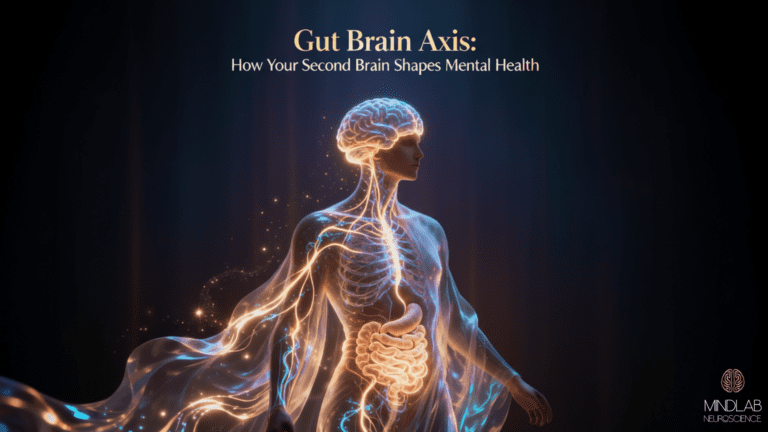
Nervous system regulation refers to the autonomic nervous system’s ability to calibrate its response to environmental demands — shifting between sympathetic activation when genuine threat requires mobilization and parasympathetic recovery when safety permits restoration. This is not a binary switch. It is a graded, continuous process governed by the vagus nerve complex, brainstem nuclei, and their bidirectional communication with cortical and subcortical structures. When this system is well-regulated, a person can escalate arousal appropriately under pressure and de-escalate efficiently when the demand passes. When it is dysregulated, the system gets stuck — locked in sympathetic overdrive, collapsed into dorsal vagal shutdown, or oscillating unpredictably between the two.
Porges’s polyvagal theory provided the neuroanatomical framework for understanding this process, identifying three hierarchical circuits: the ventral vagal complex (social engagement and calm alertness), the sympathetic nervous system (mobilization), and the dorsal vagal complex (immobilization and conservation). The system’s default priority is the most recently evolved circuit — ventral vagal — but when the neuroception system detects threat, it drops to sympathetic activation, and under perceived inescapable danger, to dorsal vagal collapse. Crucially, Porges demonstrated that this threat detection operates below conscious awareness through a process he termed neuroception: the nervous system evaluates safety and danger before the conscious mind has any input.
Thayer and Lane’s neurovisceral integration model extended this work, demonstrating that heart rate variability — a direct measure of vagal tone — correlates with prefrontal cortical function, emotional regulation capacity, and cognitive flexibility. Low vagal tone predicts not just physiological dysregulation but impaired executive function, difficulty with social engagement, and reduced capacity to recover from stress. The nervous system is not separate from cognition and emotion. It is the substrate on which they operate.
Dr. Sydney Ceruto’s work at MindLAB Neuroscience addresses nervous system regulation as a foundational capacity that underlies every other domain of neural function — decision-making, emotional processing, relational dynamics, and sustained performance under pressure. Rather than teaching generic regulation techniques in isolation, her approach identifies the specific dysregulation patterns in an individual’s autonomic profile and intervenes at the circuit level during the live conditions that trigger dysregulated states. A strategy call is where this assessment process begins.
The articles below examine the science of autonomic function, vagal tone, stress physiology, and the neural mechanisms that determine whether your nervous system supports or undermines your capacity to perform.