Key Takeaways
- A leader’s cognitive distortions shape team decisions, communication, and morale before anyone names the error.
- Distorted thinking warps a leader’s read of reality, driving poor personal and professional decisions.
- The distortion travels three routes: behavioral transmission, emotional contagion, and bias encoded into team norms.
- Because the spread is unconscious, leaders rarely trace team dysfunction to the original thinking error.
- Naming and correcting the distortion at its source is core leadership, not a soft skill.
How a Leader’s Distortions Become the Team’s Problem
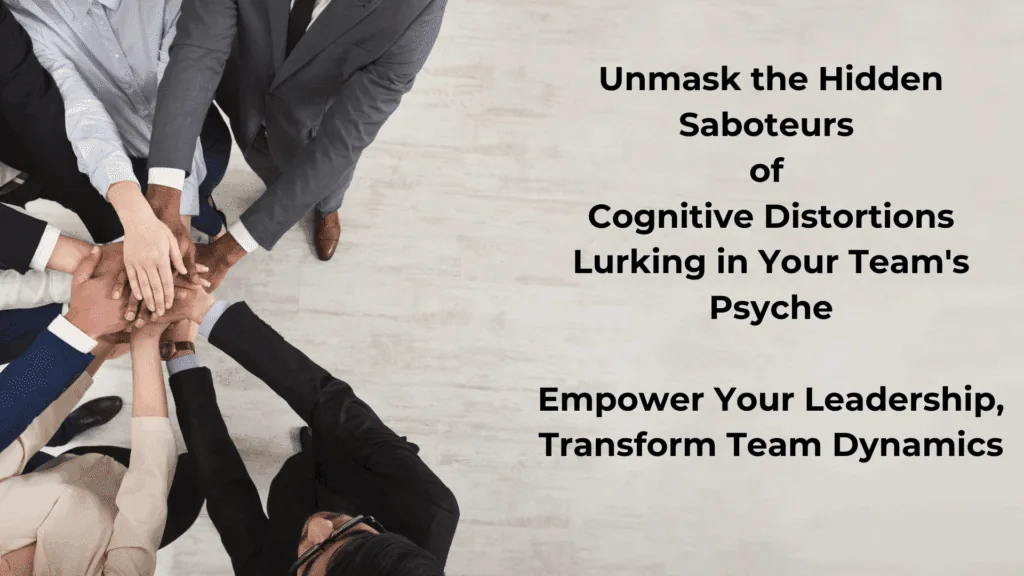
A leader’s cognitive distortions do not stay in the leader’s head. These irrational thought patterns quietly reshape how a leader reads each situation, and that distorted read then spreads through every decision, message, and judgment the team receives. What I see in practice is a team full of miscommunication, clouded decisions, and eroded trust, all traceable to a thinking error the leader never registered as one. Cognitive distortions in leadership run on specific neural circuits, and those circuits can be identified and restructured with sustained, targeted work.
A leader’s distorted thinking does not stay contained. Its effects reach well past the original moment, and the leader is usually the last to see the source.
This is why I treat distortion work as central, not optional, and a real part of any high-performance leadership system. Left unchecked, a leader’s distorted thinking steadily degrades a team’s productivity and trust, which makes recognizing and correcting these patterns one of the most practical leadership skills there is.
The Ripple Effect: How Distortions Damage a Team
Distortions move outward through every team interaction. Four patterns show up most:
- Communication breakdowns. Misreadings multiply, and unspoken assumptions harden into barriers that shut down open dialogue. The team ends up in conflict, and genuine collaboration drops off.
- Clouded decisions. Distorted thinking acts like fog over the team’s judgment. Reasoning gets flawed, solutions get weak, and people start second-guessing decisions they cannot see clearly.
- Stalled innovation. Cognitive biases anchor a team to the familiar. The comfort of the known pulls people away from the risk that real creativity requires, and you get motion without progress.
- Blocked diversity and inclusion. Affinity bias in particular builds invisible barriers to a genuinely diverse team, and the result is a homogeneous group that echoes itself and loses perspective.
What This Looks Like in Real Teams
Abstractions do not move people, so consider three patterns I see repeatedly.
- All-or-nothing thinking. A team member, call her Sarah, reads every project in binary. A project that hits 90 percent of its goals lands in her mind as a total failure. That thinking is contagious. It spreads demotivation through the team and quietly discourages anyone from trying a new approach.
- Overgeneralization. A team delivers one weak presentation, and instead of treating it as a single event, the group concludes that every future presentation is doomed. The distortion becomes a self-fulfilling prophecy that drains morale and effort.
- Personalization. A leader, call him John, reads a team member’s disengagement as a personal affront. That interpretation, which shows up under every leadership style, creates tension that gradually erodes cohesion and trust.

Spotting the Distortions Before They Spread
A leader has more power over this than they usually realize. Three practices make the difference.
- Build the awareness first. Learn the common distortions well enough that recognizing one becomes second nature, in yourself before your team. You cannot correct a pattern you cannot see.
- Make dissent safe. Create a culture where people can voice a concern and challenge distorted thinking without paying a social price. Safety is what lets the correction happen out loud.
- Use structured feedback. Regular, structured feedback works as a detection mechanism, surfacing patterns of distorted thinking early enough to address them before they harden into norms.
Team Practices That Counter Distortion
Teams are not passive here either. The executive functions that resist distortion, working memory, cognitive flexibility, and inhibitory control, are supported by overlapping prefrontal circuits that strengthen with targeted practice.
- Diverse perspectives. A team rich in genuinely different viewpoints acts as a natural counterweight to any one person’s bias, which measurably improves the group’s decisions.
- Structured decision frameworks. A framework like WRAP (Widen your options, Reality-test your assumptions, Attain distance before deciding, Prepare to be wrong) works as a cognitive guardrail, limiting how much bias can steer a decision.
- Deliberate reflection. Building in a habit of pausing to observe your own thinking, before reacting, sharpens metacognitive awareness. When a team learns to watch its thought patterns rather than act on them automatically, its decisions get noticeably more balanced.
How Distortions Skew Team Decisions
Distortions reach deep into how teams actually decide.
- Confirmation bias. Teams gravitate to information that fits what they already believe, building an echo chamber that skews the decision.
- Anchoring. The first number or framing on the table, however irrelevant, exerts an outsized pull on everything that follows.
- Hindsight bias. After the fact, teams convince themselves they saw the outcome coming, which quietly corrupts how they plan and assess risk next time.
The Long Game: Building Lasting Cognitive Clarity
Correcting distortion is a marathon, not a sprint. A few longer-term practices hold up. Leaders who activate the social and emotional network in their people, rather than only the analytical one, produce higher engagement and more sustainable performance. Leaders bringing in outside help at this stage usually start by working out how to tell a coach, a therapist and an advisor apart.
- Regular reflection as a team habit. Build in structured moments for the team to step back and observe its own thinking. Used consistently, this recalibrates the group toward clearer, more balanced decisions.
- Structured peer feedback. A steady system of peer feedback acts as a mirror, showing the team how distortions are shaping its dynamics and individual behavior.
- Bring in neuroscience-based guidance. When distortions are deeply embedded and keep resurfacing, targeted, neuroscience-based work on the underlying circuits is what actually shifts them, rather than another round of surface-level advice.
The Path Forward
Recognizing and correcting these patterns is how a team reaches clearer communication, sharper decisions, and stronger productivity. It is ongoing work, not a destination. It asks for vigilance, commitment, and a real willingness to question your own perceptions, which is exactly why it separates capable leaders from the rest.
Cognitive distortions are both a challenge and an opportunity. Naming and correcting them is how a leader builds a stronger, more resilient culture of collaboration and success. The question is not whether to address distortions in your team, but how quickly you can start, because a leader’s own thinking is the lever for lasting change. This piece is part of our broader work on leadership and executive performance.
References
- Boyatzis, R. E., Smith, M. L., and Beveridge, A. J. (2013). Coaching with compassion: Inspiring health, well-being, and development in organizations. Journal of Applied Behavioral Science, 49(2), 153-178. https://doi.org/10.1177/0021886312462236
- Rock, D. (2008). SCARF: A brain-based model for collaborating with and influencing others. NeuroLeadership Journal, 1, 1-9.
- Passarelli, A. M. (2015). Vision-based coaching: Optimizing resources for leader development. Frontiers in Psychology, 6, 412. https://doi.org/10.3389/fpsyg.2015.00412
- Decety, J., and Jackson, P. L. (2004). The functional architecture of human empathy. Behavioral and Cognitive Neuroscience Reviews, 3(2), 71-100. https://doi.org/10.1177/1534582304267187
- Kahneman, D., and Tversky, A. (1979). Prospect theory: An analysis of decision under risk. Econometrica, 47(2), 263-292. https://doi.org/10.2307/1914185
- Beck, A. T. (1976). Cognitive therapy and the emotional disorders. International Universities Press.
- Diamond, A. (2013). Executive functions. Annual Review of Psychology, 64, 135-168.
- Beck, A. T. and Haigh, E. A. P. (2014). Advances in cognitive theory and therapy: The generic cognitive model. Annual Review of Clinical Psychology, 10, 1-24.
Understanding how cognitive distortions spread through a team on a page is one thing. Seeing the specific pattern running in your own leadership, named precisely and traced to the circuit driving it, is another, and it is where real change begins. A strategy call with Dr. Sydney Ceruto is a working conversation built to do exactly that: to map the thinking pattern shaping your decisions and show you what rewiring it would involve. You leave understanding what your brain is doing, why, and what it would take to change it.
Book a Strategy CallHow do cognitive distortions in leaders affect their entire teams?
A leader’s cognitive distortions have an outsized organizational impact because leadership decisions shape the environment, communication patterns, and performance expectations of everyone below them. When a leader catastrophizes, their team inherits a climate of anxiety. When a leader engages in all-or-nothing thinking, it narrows the team’s solution space. These patterns create ripple effects that extend far beyond the leader’s individual performance; they become embedded in team culture and decision-making norms.
What are the most common cognitive distortions that damage team dynamics?
The most organizationally destructive patterns include: mind-reading (assuming team members’ motivations without evidence), catastrophizing that generates chronic organizational anxiety, personalization that causes leaders to interpret neutral events as personal challenges, and confirmation bias that filters out information contradicting the leader’s existing narrative. Each creates specific team dysfunctions, inhibited communication, risk aversion, yes-man culture, or strategic blind spots, that compound over time.
How does groupthink relate to cognitive distortions in team settings?
Groupthink is a collective cognitive distortion, the shared preference for consensus over accurate analysis. It typically develops when leaders implicitly or explicitly signal that dissent is unwelcome, activating the team’s social threat-avoidance systems. Individual members suppress valid concerns to preserve relational safety, and the group arrives at decisions no individual would endorse alone. Historical examples, from corporate collapses to geopolitical failures, demonstrate that groupthink’s consequences can be catastrophic.
What strategies help leaders identify their own cognitive distortions?
Strategies for self-identifying cognitive distortions include: establishing trusted advisors who have genuine permission to challenge the leader’s thinking, conducting structured pre-mortems that force consideration of how a decision might fail, reviewing past decisions specifically for recurring distortion patterns, and engaging in neuroscience-based development work that builds metacognitive awareness, the ability to observe one’s own thought process rather than simply being inside it.
How can teams be equipped to manage cognitive distortions collectively?
Team-level cognitive resilience is built through structures that create psychological safety for dissent, protocols like devil’s advocate assignment that institutionalize challenging dominant narratives, diverse perspective integration that prevents monocultural blind spots, and leadership modeling of intellectual humility. When the leader openly acknowledges a cognitive error and visibly corrects it, they normalize the same behavior throughout the team, creating a culture of accurate thinking rather than defensive correctness.