Master your concentration. This hub unlocks the neurological architecture of sustained attention, offering practical, neuroscience-backed protocols to optimize your prefrontal cortex and attention networks. Learn to mitigate evolutionary distractions, enhance executive function, and apply biological insights for peak performance in any demanding environment, guided by the expertise of Dr. Sydney Ceruto.
The Evolutionary Design
Your brain is built for survival. It is not designed to sit at a desk. In the wild, you need to see a predator immediately. You need to ignore the wind in the grass. This system filters out the noise. It locks onto threats and rewards. This saves precious energy. It ensures you only process what matters for staying alive right now.
The Modern Analogy
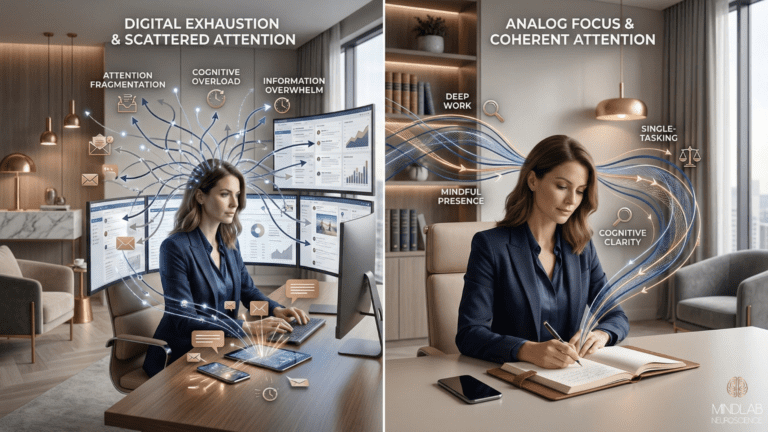
Focus is like shining a spotlight in a dark room, where whatever is in the light is clear and everything else fades into the background. But today, your hand is shaking. The light swings wildly from your work to your phone. It jumps to an email. You try to light up five things at once. This makes the beam weak and diffuse. The bulb flickers because your mental energy is low. Nothing is truly clear, and you are lost in the shadows.
The Upgrade Protocol
You must stabilize the beam. First, charge the battery with deep sleep and good fuel. A strong battery creates a bright light. Next, clear the room of clutter. Remove the things that pull the light away. Finally, narrow the aperture. Do not try to illuminate the whole room. Point the light at one single task. Hold it there. The longer you hold it, the sharper the image becomes.
You may be searching for How to Focus therapy, but traditional talk therapy often fails high-performers. You need Neuro-Optimization.
Here is the hard truth: Venting about your inability to concentrate does not fix the neural circuitry responsible for attention. If you are a high-net-worth individual or a knowledge worker operating at the bleeding edge of your industry, your attention is not just a soft skill—it is your most expensive asset. When that asset depreciates, so does your market value. You do not need a therapist to ask you how that makes you feel; you need a neuro-engineer to help you recalibrate the machine.
To master focus, you must first understand the mechanics of why you lose it. In my practice, I see brilliant minds that are effectively “cognitively leaking.”
Focus is dictated by the Prefrontal Cortex (PFC). Think of your brain as a bustling, chaotic stock exchange floor. The PFC is the gavel-wielding regulator on the balcony. When the PFC is online and firing correctly, it inhibits the noise, shuts down irrelevant data streams, and directs all resources to a single trade. This is what we call Top-Down Processing.
However, for the ADHD-adjacent or the chronically distracted, the PFC is asleep at the wheel. Instead of the regulator running the show, the Default Mode Network (DMN) takes over. The DMN is the brain’s “autopilot.” It is responsible for mind-wandering, ruminating on the past, and worrying about the future.
The Einstein Translation: Imagine your brain is a high-performance sports car (your raw intelligence). Currently, you are pressing the accelerator to the floor, but your steering wheel (the PFC) is disconnected, and the car is drifting wherever the road tilts. You don’t need a faster engine; you need to reconnect the steering column.
We are not going to “try harder.” Willpower is a finite resource that depletes glucose in the brain. Relying on willpower to focus is biologically expensive and unsustainable. Instead, we are going to use Neuroplasticity—the brain’s ability to rewire itself—to strengthen the neural pathways between your intention and your attention.
This is not about productivity hacks or buying a new planner. This is about biological leverage. We are going to tighten the aperture of your attention span so that distractions don’t just get ignored—they effectively cease to exist.
To command your attention, you must understand the biological hardware running the software of your mind. Focus is not a singular action; it is a complex suppression mechanism. It is not just about what you look at; it is about what your brain actively deletes from your awareness.
In high-stakes environments, your brain is constantly negotiating a trade-off between two neural networks. Understanding this negotiation is the difference between a flow state and cognitive fatigue.
Your ability to concentrate resides primarily in the Prefrontal Cortex (PFC). This is the CEO of the brain—responsible for executive function, long-term planning, and impulse control. However, the PFC is evolutionarily young and metabolically expensive. It is easily exhausted.
Opposing the PFC is the Amygdala, the brain’s threat-detection center. The Amygdala is ancient, fast, and loud. In a survival context, it overrides the CEO to keep you alive.
The Einstein Translation: Imagine your brain is a boardroom. The PFC is the thoughtful Chairman trying to review a contract. The Amygdala is a security guard screaming that the building is on fire. When the security guard screams (stress, anxiety, or high-urgency notifications), the Chairman stops reading. You cannot focus when your brain perceives a threat, and to the modern brain, an overflowing inbox mimics the biological signature of a predator.
Focus requires a precise neurochemical cocktail. You are likely familiar with Dopamine, but it is often misunderstood as merely the “pleasure molecule.” In the context of focus, Dopamine is the molecule of pursuit. It narrows your visual and cognitive field onto a target.
However, Dopamine alone is not enough. You also need Norepinephrine (noradrenaline). This neurotransmitter provides the agitation and alertness required to start the engine.
Your brain operates on two attention systems. Bottom-Up processing is reflexive; it happens when a loud noise startles you or a notification pops up. It is involuntary and requires zero effort. Top-Down processing is voluntary; it is you deciding to write a report. It requires immense effort.
We are fighting an evolutionary mismatch. For 200,000 years, Bottom-Up processing saved our lives (noticing the rustle in the grass meant avoiding a lion). Today, that same mechanism destroys your productivity. Every time your phone buzzes, your ancient brain addresses it as a potential survival threat or opportunity, hijacking your Top-Down focus. You are not “weak” for looking at your phone; you are fighting millions of years of survival coding.
Focus is an energy-intensive act. While the brain represents only about 2% of your body weight, it consumes roughly 20% of your caloric energy. Deep concentration spikes this energy demand.
When you find yourself “zoning out,” it is often a metabolic safety switch. Your brain is attempting to conserve glucose. To maintain focus, we must optimize the fuel delivery system, ensuring the PFC has the resources to inhibit the DMN (Default Mode Network) without burning out.
If you are reading this, you have likely already tried the standard menu of interventions: the Pomodoro timers, the mindfulness apps, the weekly talk therapy sessions, and perhaps a prescription pad. Yet, the fog remains. This is not a failure of your character; it is a failure of the model.
The standard model of mental health is designed to bring dysfunctional individuals back to a baseline of “average.” But you are not looking for average. You are looking for elite cognitive performance. The tools designed for survival are insufficient for optimization.
Traditional talk therapy, particularly Cognitive Behavioral Therapy (CBT), relies heavily on Top-Down processing. It asks you to use your Prefrontal Cortex to analyze your behaviors, rationalize your distractions, and “think” your way into better habits.
Here is the neurological flaw: Stress takes the Prefrontal Cortex offline.
When you are under the pressure of a deadline or managing a crisis, your Amygdala (the threat center) hijacks the brain’s resources. This is a “Limbic Hijack.” At that moment, your rational brain—the part you use in therapy—is effectively disconnected. Relying on talk therapy to fix focus is like trying to install a software update on a computer that is currently on fire. You cannot rationalize with a nervous system that is in a sympathetic survival state.
For many in the high-net-worth and executive space, stimulants are the quick fix. While they do increase the availability of Dopamine and Norepinephrine, they are a sledgehammer where you need a scalpel.
Medication forces the brain into a state of arousal, but it often comes at a steep cost: Cognitive Blunting. While you may be able to stare at a spreadsheet for six hours, you lose the lateral thinking, emotional intelligence, and creative synthesis that made you successful in the first place.
The Einstein Translation: Medication is like putting a brick on the accelerator of your car. Yes, you are moving fast and you are not stopping, but you have lost the ability to steer, drift, or navigate complex turns. You become a robot, not a visionary.
The protocols given to the general population fail you because your neural load is different. A knowledge worker or CEO processes more data in a day than the average human did in a lifetime a century ago.
Standard interventions assume a low-stakes environment. They tell you to “reduce stress” or “take a break.” In your world, stress is the environment, and taking a break often means losing market share. You do not need to simply “calm down”; you need to build a neural architecture that is robust enough to process high-velocity data without overheating. You need neuro-conditioning, not coping mechanisms.
We are done with theory. Now we move to execution. Because we cannot rely on the “top-down” approach (telling yourself to focus), we must use “bottom-up” Cognitive Restructuring. We will manipulate your physiology and sensory inputs to force your brain into a state of high-beta concentration.
These protocols do not require electrodes, wires, or a clinic. They use the biological hardware you already possess—your ocular motor system, your respiratory system, and your autonomic nervous system—to manually override the Default Mode Network. This is how we bypass the psychological “mind” to engineer the biological “brain.”
The Mechanism: Your eyes are not just cameras; they are the only visible part of your brain. There is a direct deeply ingrained connection between your visual focus and your mental focus. When you narrow your visual field, you trigger the release of Acetylcholine (which acts as a spotlight for the brain) and Norepinephrine (which provides the energy to act).
The Drill:
The Mechanism: When you feel “scattered” or overwhelmed, your brain is in a sympathetic (fight-or-flight) state. Your carbon dioxide (CO2) levels are likely off-balance, causing the Amygdala to sound the alarm. You cannot focus when the alarm is ringing. We need a manual override switch to downregulate the nervous system instantly.
The Drill:
The Mechanism: Focus is not just about doing; it is about suppressing. High-performers often have strong accelerators but weak brakes. We need to train the Go/No-Go circuitry in the brain. This strengthens the inhibitory networks that stop you from clicking a notification or tab-switching.
The Drill:
I don’t have time for “drills.” Can’t I just force myself to work harder?
Let’s be clear: You are already wasting hours every day recovering from micro-distractions. “Working harder” with a cognitively leaking brain is like revving a Ferrari in neutral—you are burning expensive fuel but going nowhere. These protocols take less than five minutes combined. The Return on Investment is not just time saved; it is the quality of the cognitive output produced. You do not have time not to do this.
Is this simply a replacement for ADHD medication?
No. Medication is a chemical intervention; this is a structural one. Stimulants artificially spike neurotransmitters to mask a deficit, often resulting in dependency and the “crash” cycle. Neuro-optimization is about rebuilding the neural pathways so your brain can self-regulate without external chemical support. We are not interested in renting focus; we are interested in owning it.
Why does trying to focus feel physically painful for me?
Because you are fighting metabolic friction. When your Amygdala is active (stress/anxiety) and you try to force Top-Down focus, you are burning glucose at an accelerated rate to override your survival instincts. It is biologically expensive. The protocols above are designed to lower that friction first, making focus the path of least resistance rather than an uphill battle.
How long until I see permanent results?
You must distinguish between State and Trait. You will feel a change in your State (alertness and clarity) immediately after performing the Ocular Aperture Lock. However, to alter your Trait (your baseline personality and cognitive function), neuroplasticity requires consistency. Expect to see permanent structural changes in your attention span after roughly 40 days of consistent practice. Biology respects frequency, not intensity.
In the modern economy, focus is no longer just a soft skill—it is the new IQ. We live in an age of weaponized distraction, where algorithms are engineered by the smartest minds on earth to hijack your dopamine systems. Most people have already lost this war. They live in a permanent state of reactive “blur,” constantly toggling between tasks and achieving deep work only by accident.
By mastering your concentration through neuro-optimization, you are not just becoming “more productive.” You are acquiring an unfair market advantage. While your competition is drowning in the noise, you will be the signal. You now have the schematics to rebuild the machine. Stop venting about the distraction, and start engineering the focus.
Dr. Sydney Ceruto is a Neuroscientist and Brain Performance Strategist specializing in neurological re-engineering for elite individuals navigating high-stakes environments. As the founder of MindLAB Neuroscience and the pioneer of Real-Time Neuroplasticity™, she translates clinical neurobiology into decisive competitive advantages for tech innovators, professional athletes, entertainers, and private families worldwide. Dr. Ceruto holds dual PhDs in Behavioral & Cognitive Neuroscience from New York University and dual Master’s degrees in Clinical Psychology and Business Psychology from Yale University. She is the author of The Dopamine Code, published by Simon & Schuster.
Join my inner circle for exclusive insights and breakthroughs to elevate your life.
Limited Availability
Your Journey to Unparalleled Personal and Professional Growth Starts Here
Limited Availability
A Truly Bespoke, One-on-One Journey with Dr. Sydney Ceruto
Download The Influence Within and discover how small shifts lead to big transformations.