


Key Takeaways
- Emotional intelligence operates through measurable neural circuits connecting the amygdala, prefrontal cortex, and insula, not through personality traits or abstract concepts
- Interoceptive awareness, the brain’s capacity to read its own physiological signals, is the neurological foundation of emotional self-awareness and can be systematically strengthened
- The amygdala-prefrontal cortex regulatory loop determines how effectively an individual processes emotional information under pressure, and this loop is modifiable through targeted neural restructuring
- Emotional intelligence training produces measurable changes in brain connectivity patterns within weeks, with the most durable changes occurring through real-time intervention during emotionally activated states
- Resting-state brain network connectivity predicts emotional intelligence capacity more accurately than self-report measures, explaining why many individuals who believe they are emotionally aware still struggle with regulation
Emotional intelligence is not a personality trait you either possess or lack: it is a set of neural competencies that operate through specific, identifiable brain circuits and can be systematically restructured at any age. At MindLAB Neuroscience, I have spent more than 26 years working with individuals who arrived convinced their emotional responses were fixed: that the way they reacted under pressure, misread social signals, or shut down during conflict was simply who they were. The neuroscience tells a fundamentally different story.
The brain regions that govern emotional perception, regulation, and expression (the amygdala, insula, anterior cingulate cortex, and prefrontal cortex) are among the most plastic structures in the human brain. They respond to targeted intervention with measurable structural and functional changes. What most approaches to emotional development miss is that these circuits cannot be rewired through insight alone. They require activation-state practice: restructuring that occurs during the live emotional moment, when the relevant neural pathways are biologically primed for modification.
What Part of the Brain Controls Emotional Intelligence?
Emotional intelligence is controlled by a distributed network of brain regions (primarily the amygdala, prefrontal cortex, anterior cingulate cortex, and insula) that work in coordinated loops to detect, interpret, regulate, and respond to emotional information in real time. No single brain region houses emotional intelligence; it emerges from the quality of communication between these structures.
The amygdala functions as the brain’s rapid emotional evaluator, processing incoming stimuli for emotional significance before conscious awareness catches up. The prefrontal cortex, particularly the ventromedial and dorsolateral regions, provides the regulatory counterweight, evaluating whether the amygdala’s signal warrants action and modulating the intensity of the emotional response. The insula bridges body and mind, translating physiological states into conscious emotional experience.
Emotion and cognition are not processed in separate brain systems but are deeply integrated through amygdala-prefrontal cortex interactions that continuously shape both perception and decision-making. In my practice, this integration is precisely what I observe: individuals who struggle with emotional intelligence are not lacking emotional circuitry: they have disrupted communication between these regions, often as a result of chronic stress, early relational patterns, or unprocessed emotional experiences that have altered the signal quality between amygdala and prefrontal cortex.
The distinction that matters clinically is between emotional detection and emotional regulation. Many individuals detect emotional signals with extraordinary sensitivity, their amygdala is highly responsive, but lack the prefrontal regulatory capacity to process those signals constructively. This is not low emotional intelligence. It is an imbalanced circuit, and it responds to targeted restructuring.
Emotional intelligence is not about feeling less: it is about the brain’s capacity to process what it feels with precision rather than reactivity.
How Does the Amygdala Affect Emotional Regulation?
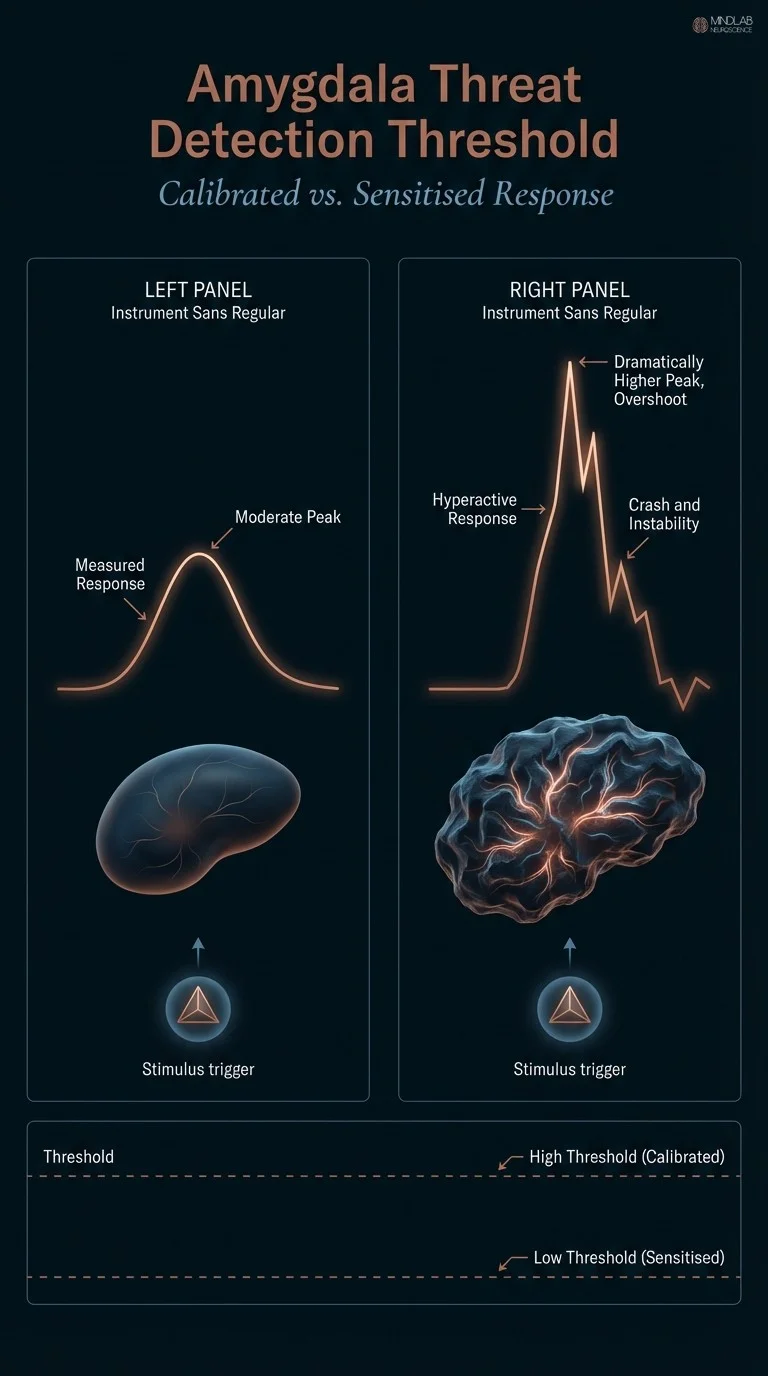
The amygdala affects emotional regulation by setting the threshold for threat detection and emotional reactivity: when it is hyperactivated by chronic stress or unresolved emotional patterns, it overrides prefrontal cortex regulation and produces responses that are disproportionate to the actual situation, a process that becomes self-reinforcing without deliberate intervention.
The amygdala does not simply generate fear. It assigns emotional salience to every incoming stimulus, determining how much attentional and physiological resource the brain allocates in response. When this system is well-calibrated, emotional reactions are proportionate and useful. When it has been sensitized by repeated stress, the amygdala fires at lower thresholds and with greater intensity, producing the experience many describe as overreacting, though from the amygdala’s perspective, it is functioning exactly as its learning history has trained it to function.
The strength of the connection between the amygdala and prefrontal cortex shapes how effectively an individual can regulate their response to uncertain or mixed emotional signals, precisely the situations that matter most in relationships and high-stakes decisions. In my practice, this explains a pattern I see consistently: individuals who function well in clear, structured situations but become dysregulated when the emotional terrain is ambiguous are experiencing a connectivity deficit, not a character flaw.
The amygdala’s sensitivity is not fixed. It is the product of accumulated experience, and it responds to the same neuroplasticity mechanisms that govern every other brain system. What it requires is not suppression, which is neurologically counterproductive, but recalibration through repeated exposure to emotionally activated states under conditions that support new learning.
Can Emotional Intelligence Be Developed or Trained?
Emotional intelligence can be developed at any age because the neural circuits underlying it (amygdala-prefrontal connectivity, interoceptive accuracy, and social cognition networks) retain significant plasticity throughout the lifespan and respond to structured training with measurable changes in both brain function and behavior within weeks.
This is not an aspirational claim. Neuroimaging research has demonstrated that targeted interventions produce visible changes in the brain regions that support emotional competencies. The key distinction is between passive understanding and active neural restructuring. Reading about emotional intelligence does not restructure the circuits that govern it. Practicing new emotional responses, under conditions of genuine emotional activation, does.
Lim and Lau reviewed the features and approaches used in emotional intelligence training studies and found that programs incorporating experiential practice produced more durable gains than those relying on cognitive instruction alone, consistent with the neuroscience of skill acquisition. In my practice, the distinction between knowing what emotional intelligence looks like and having the neural architecture to produce it under pressure is the gap that most approaches fail to bridge. You can understand the concept perfectly and still lack the wiring to execute it when your amygdala is activated.
What makes Real-Time Neuroplasticity™ different from conventional approaches is precisely this: the restructuring happens during the moment of emotional activation, not in retrospective analysis. The brain is most receptive to lasting change when the relevant circuits are firing, not when you are calm and reflective, discussing what happened after the fact.
What Is the Connection Between the Prefrontal Cortex and Self-Regulation?
The prefrontal cortex is the brain’s primary self-regulation engine: it inhibits impulsive responses generated by the amygdala, maintains working memory during emotional distress, and enables the conscious selection of adaptive behavioral responses over automatic reactive ones. When prefrontal function is compromised by stress, fatigue, or chronic emotional dysregulation, self-regulation capacity collapses.
Self-regulation is not willpower. It is a neurological function that depends on the prefrontal cortex having adequate resources (glucose, oxygen, and neurotransmitter availability) and sufficient connectivity strength to override subcortical signals. This is why self-regulation fails predictably under conditions of sleep deprivation, acute stress, decision fatigue, and emotional overload: these conditions directly impair the prefrontal cortex.
Killgore and colleagues demonstrated that emotional intelligence correlates with the connectivity within and between resting-state brain networks, establishing that the brain’s capacity for emotional self-regulation is visible in its baseline architecture, not just its activated state. In my practice, this finding reshapes how I approach the work: the goal is not to teach someone to regulate in the moment: it is to restructure the baseline connectivity that determines how much regulatory capacity they have available before the moment arrives.
Individuals navigating complex family systems, managing multiple demanding domains simultaneously, or carrying the invisible weight of relational obligations and interpersonal dynamics are drawing on prefrontal resources constantly. The self-regulation failures they experience are not character weaknesses: they are the predictable outcome of a system that has been running at maximum capacity without adequate neural recovery.

How Does Interoception Relate to Emotional Awareness?
Interoception (the brain’s capacity to perceive and interpret signals from within the body, including heart rate, breathing patterns, gut sensations, and muscular tension) is the neurological foundation of emotional awareness, because emotions are not purely cognitive events but are constructed from the brain’s interpretation of physiological states.
The insula, the brain region most associated with interoceptive processing, acts as a translator between bodily sensation and conscious emotional experience. When interoceptive accuracy is high, an individual can detect the early physiological signatures of an emotional response (the subtle acceleration of heart rate, the shift in breathing pattern, the muscular tension in the jaw or shoulders) before that response reaches the intensity that overwhelms prefrontal regulation.
Pollatos, Kirsch, and Schandry established a direct relationship between interoceptive accuracy and emotional experience, finding that individuals with greater ability to detect their own heartbeat demonstrated more nuanced emotional processing and better emotional regulation. In my practice, interoceptive accuracy is often the first target of intervention, before any work on cognitive reframing or behavioral strategy, because without the ability to detect what is happening physiologically, an individual cannot intervene early enough in the emotional cascade to redirect it.
The individuals who describe being blindsided by their own emotional reactions (exploding in anger they did not see building, freezing in situations they expected to handle, or making decisions under emotional states they were not aware of carrying) frequently have compromised interoceptive pathways. The emotional information was there; their brain was not reading it.
The brain does not distinguish between a threat in the environment and a threat from its own internal narrative: the amygdala fires on both, and the prefrontal cortex must regulate both.
What Brain Changes Occur with Emotional Intelligence Training?
Emotional intelligence training produces measurable changes in brain structure and function, including increased gray matter density in the prefrontal cortex, enhanced amygdala-prefrontal connectivity, improved default mode network regulation, and more efficient interoceptive processing: changes that are detectable on neuroimaging within weeks of structured practice.
The brain is not static. Every meaningful experience modifies it, and structured, targeted practice modifies it with specificity. When an individual repeatedly practices new emotional regulation strategies under conditions of genuine activation, the synaptic connections supporting those strategies undergo long-term potentiation: the same cellular mechanism that consolidates any learned skill. The old, reactive patterns do not disappear immediately, but they are progressively weakened through disuse as the new pathways are strengthened through repetition.
Functional imaging shows that individuals with higher emotional intelligence engage cognitive regulatory resources more effectively during negative emotional states, suggesting that emotional intelligence training restructures the brain’s default approach to emotional challenges. In my practice, the most compelling evidence of neural change is not the imaging data: it is the shift in real-world performance. Individuals who previously lost regulatory capacity under pressure begin to maintain it. The reaction that was automatic becomes a response that is chosen.
The caveat is that these changes require the methodology to match the neuroscience. Passive instruction does not restructure active circuits. The training must engage the brain under the conditions in which the emotional challenge actually occurs (during real-time, high-stakes, emotionally activated moments) for the rewiring to transfer from practice to life.

How Does Emotional Intelligence Affect Decision-Making Under Pressure?
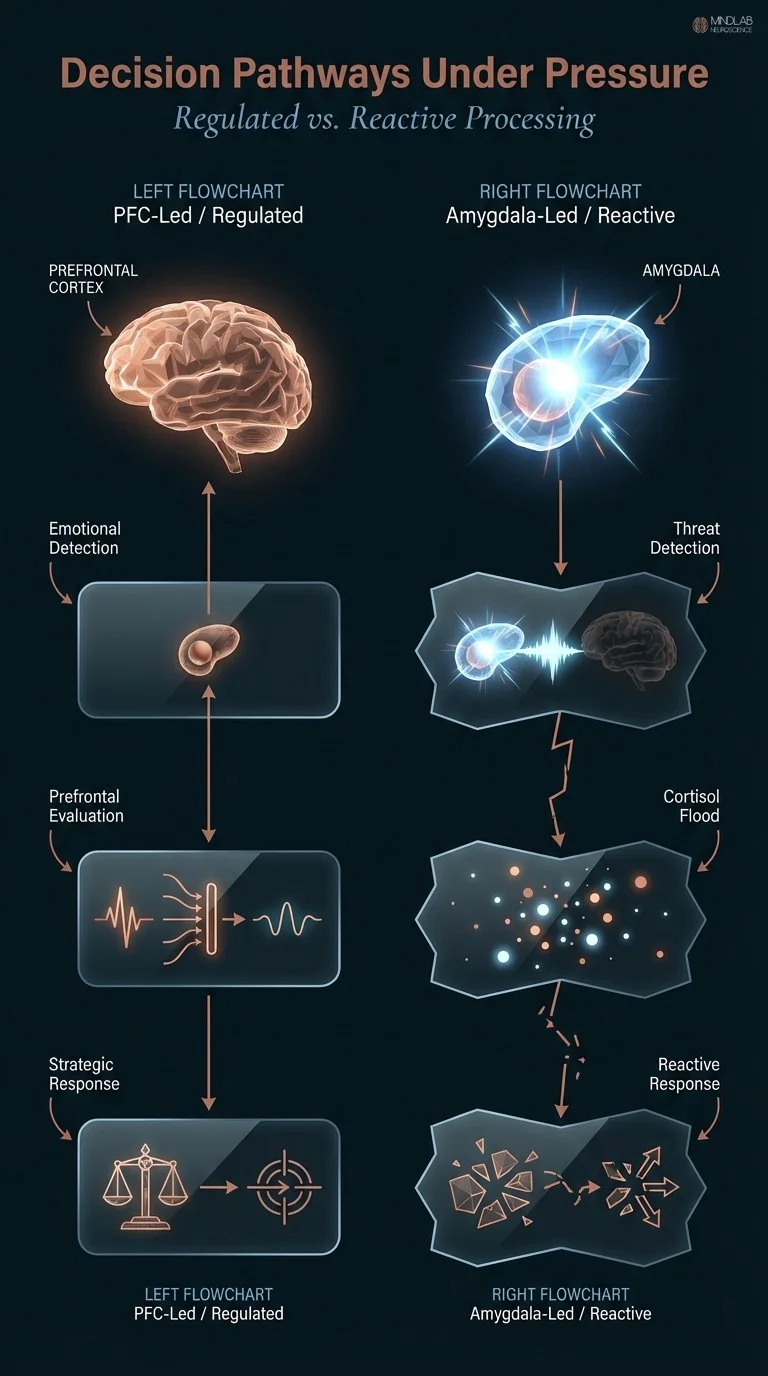
Emotional intelligence directly determines decision quality under pressure because the amygdala’s threat response, which is activated by any high-stakes situation, degrades prefrontal cortex function unless the regulatory loop between these regions has been strengthened through deliberate practice, allowing the individual to maintain executive function when it matters most.
High-stakes decisions are not purely rational events. Every significant decision activates the brain’s emotional circuitry, whether or not the individual is consciously aware of it. The amygdala evaluates the stakes, the anterior cingulate cortex monitors for conflict between competing options, and the prefrontal cortex attempts to integrate all available information into a coherent choice. When the emotional load overwhelms the prefrontal cortex’s regulatory capacity, decisions default to the amygdala’s faster, less nuanced processing, producing choices that are reactive rather than strategic.
Price and Hooven documented that interoceptive awareness skills provide the foundation for improved emotional regulation during decision-making, because the ability to detect the body’s stress signals early allows for intervention before the prefrontal cortex is fully compromised. In my practice, this is the mechanism that produces the most dramatic shifts: individuals who learn to read the early physiological markers of emotional activation gain a decision-making window that was previously unavailable to them.
The individuals navigating decisions that affect their families, their livelihoods, and their closest relationships simultaneously are operating under cumulative emotional load. Emotional intelligence is not a luxury for these individuals: it is the neural infrastructure that determines whether decisions reflect values or stress responses.
- Salzman, C.D. and Fusi, S. (2010). Emotion, Cognition, and Mental State Representation in Amygdala and Prefrontal Cortex. Annual Review of Neuroscience, 33, 173–202. https://pmc.ncbi.nlm.nih.gov/articles/PMC3108339/
- Killgore, W.D.S., Smith, R., Olson, E.A., Weber, M., Rauch, S.L. and Nickerson, L.D. (2017). Emotional intelligence is associated with connectivity within and between resting state networks. Social Cognitive and Affective Neuroscience, 12(10), 1624–1636. https://pubmed.ncbi.nlm.nih.gov/28981827/
- Price, C.J. and Hooven, C. (2018). Interoceptive Awareness Skills for Emotion Regulation: Theory and Approach of Mindful Awareness in Body-Oriented Therapy (MABT). Frontiers in Psychology, 9, Article 798. https://pmc.ncbi.nlm.nih.gov/articles/PMC5985305/
- Pollatos, O., Kirsch, W. and Schandry, R. (2005). On the relationship between interoceptive awareness, emotional experience, and brain processes. Brain Research and Cognitive Brain Research, 25(3), 948–962. https://pubmed.ncbi.nlm.nih.gov/16298111/
- Lim, M.D. and Lau, M.C. (2021). Can We “Brain-Train” Emotional Intelligence? A Narrative Review on the Features and Approaches Used in Ability EI Training Studies. Frontiers in Psychology, 12, Article 569749. https://pmc.ncbi.nlm.nih.gov/articles/PMC8415904/
What the First Conversation Looks Like
When someone reaches out to MindLAB, the first conversation is not an intake form or a clinical evaluation. It is a direct, substantive exploration of what is actually happening: the specific situations where emotional responses are not serving you, the patterns that keep recurring despite your best efforts, and the gap between who you are capable of being and how you are currently functioning under pressure.
Dr. Ceruto will identify the neural patterns driving your current emotional architecture, often revealing that the real issue is not the one you expected to discuss. From that clarity, a path forward becomes visible: specific, structured, and grounded in the neuroscience of how the brain actually changes.
Frequently Asked Questions
Can emotional intelligence be improved at any age?
The neural circuits governing emotional intelligence retain significant plasticity throughout the entire adult lifespan, meaning emotional competencies can be developed and strengthened at any age through targeted practice. Neuroimaging studies demonstrate measurable changes in amygdala-prefrontal connectivity within weeks of structured emotional regulation training. The key variable is not age but methodology: passive learning produces limited neural change, while practice during emotionally activated states produces durable restructuring of the circuits that govern emotional perception and response.
What is the difference between emotional intelligence and emotional awareness?
Emotional awareness is the capacity to detect and identify what you are feeling, governed primarily by interoceptive processing in the insula and anterior cingulate cortex. Emotional intelligence encompasses awareness but extends further, including the ability to regulate emotional responses, interpret emotional signals from others, and deploy emotional information strategically in real-time decision-making. An individual may have high awareness yet low intelligence when the detection system works well but the regulatory loop between amygdala and prefrontal cortex does not.
How does stress affect emotional intelligence?
Chronic stress degrades emotional intelligence by impairing the prefrontal cortex, the brain region responsible for emotional regulation, impulse control, and nuanced social processing. Chronic stress reduces prefrontal gray matter density and weakens the regulatory connections between the prefrontal cortex and amygdala. Under acute stress, the amygdala dominates processing and executive function narrows, producing emotional responses that are faster but less accurate. This is why individuals who demonstrate strong emotional intelligence in calm conditions may lose access to those capabilities under pressure.
What role does the amygdala play in emotional intelligence?
The amygdala serves as the brain’s rapid emotional evaluator, assigning significance to incoming stimuli and triggering physiological responses before conscious processing occurs. In emotional intelligence, the amygdala’s role is detection, not regulation: it identifies emotional signals with remarkable speed and sensitivity. Emotional intelligence depends on the quality of the amygdala’s upstream connection to the prefrontal cortex, which evaluates whether the amygdala’s threat signal warrants the response being generated. Individuals with high emotional intelligence do not have quieter amygdalae; they have stronger regulatory circuits.
How long does it take to develop emotional intelligence?
Measurable neural changes in emotional intelligence circuitry appear within four to eight weeks of consistent, structured practice, based on neuroimaging studies of emotional regulation training. Behavioral changes, such as improved regulation under pressure, more accurate reading of social signals, and better decision-making during emotional activation, typically follow within the same timeframe. Durable architectural changes that persist without ongoing practice require longer consolidation, typically three to six months of sustained restructuring. The timeline depends on the baseline connectivity strength and the methodology’s alignment with how the brain actually learns.