
Key Takeaways
- Career stagnation is neurological, not motivational: prefrontal fatigue, disrupted reward circuitry, chronic decision overload.
- The dopamine system separates wanting from liking: achievements can feel hollow despite outward success.
- Executive function is finite, degrading under sustained stress; recovery and cognitive load management are essential.
- Neuroscience-informed career design aligns professional demands with neurological strengths, producing measurably higher satisfaction and output.
- A structured thinking partnership provides accountability, strategic perspective, and neural pattern interruption that self-direction cannot.
You are accomplished. The results are there, the reputation is solid, and your track record speaks for itself. Yet something has shifted. The career that once energized you now drains you. The challenges that once sparked engagement now trigger a low-grade exhaustion that no holiday fully resolves. You have built something impressive, and you know it should feel better than this.
This is not a failure of ambition or discipline. What you are experiencing has a precise neurological signature: the progressive misalignment between your brain’s reward architecture and the demands of your professional environment. When the prefrontal cortex, the brain region governing strategic thought, future planning, and impulse regulation, operates under chronic strain without adequate recovery, even exceptional professionals begin to coast. Performance remains competent on the surface while the internal experience deteriorates into frustration, dissatisfaction, and a persistent sense of unrealized potential. For related insights, see Optimize Your Productivity: Address 10.
The neuroscience is unambiguous: your brain is not broken. It is responding predictably to conditions that no longer serve it. And the solution is not to push harder through the same patterns: it is to redesign the architecture of your career in alignment with how your brain actually performs at its best. The sections that follow explain how that redesign works at the neurological level, and what changes once you act on it, the redesign at the heart of the architecture of peak performance.
Coasting at the top is not lost ambition. It is your reward architecture drifting out of alignment with a role that stopped matching how your brain performs at its best.
This is exactly the terrain Dr. Ceruto maps when she explains how high-achiever anxiety is wired in the driven brain.
High achievers in Georgia can apply this to leadership performance through executive coaching in Atlanta, GA.
The Neuroscience of Career Dissatisfaction: Why High Achievers Stall
Career dissatisfaction among high performers is one of the most misunderstood phenomena in professional development. Conventional wisdom frames it as a motivational deficit or a values misalignment, problems to be solved through reflection, journaling, or a change of scenery. The neuroscience tells a fundamentally different story.
At the core of career satisfaction sits the mesolimbic dopamine pathway, the neural circuit responsible for motivation, reward anticipation, and goal-directed behavior. This system operates through two neurologically separable mechanisms: wanting (incentive salience driven by mesolimbic dopamine) and liking (hedonic pleasure mediated by opioid circuits). This distinction is critical. A professional can remain intensely driven, working long hours, pursuing targets, delivering results, while experiencing progressively less pleasure from those achievements. The wanting system fires relentlessly while the liking system goes quiet. For related insights, see Optimizing Brain Function to Escape.
This is precisely the neurological profile I observe in high-performing clients who describe feeling trapped in careers that look successful but feel empty. The dopamine system has habituated to the existing reward landscape. Promotions, bonuses, and recognition that once generated genuine satisfaction now produce only a brief spike followed by rapid return to baseline. The brain has adapted, and adaptation without recalibration leads inevitably to the flatline experience so many accomplished professionals describe.
Compounding this is the phenomenon Vergauwe and colleagues documented in their research: impostor feelings intensify with career advancement. As responsibility expands, the gap between self-perception and external validation widens. The prefrontal cortex, already managing increasing cognitive demands, must now also suppress a persistent undercurrent of self-doubt. This additional load degrades the very executive functions required for strategic career management, creating a vicious cycle in which advancement itself becomes a source of diminishing returns.
Executive Function and the Performance Ceiling
The prefrontal cortex is the neurological seat of everything that distinguishes competent professionals from exceptional ones: strategic planning, cognitive flexibility, working memory, impulse regulation, and the capacity to hold competing priorities in dynamic tension. When this system operates optimally, career decisions are sharp, priorities are clear, and execution flows with apparent ease.
But prefrontal capacity is finite, and it is the first cognitive system to degrade under sustained stress. Research in cognitive neuroscience consistently demonstrates that chronic cortisol elevation, the hallmark of prolonged professional pressure, magnifies the excessive catecholamine signaling that selectively impairs prefrontal function, while simultaneously heightening amygdala reactivity. The practical consequence is devastating: the executive system you need most for strategic career management is the system most vulnerable to the conditions of high-stakes professional life.
This explains why so many talented professionals describe hitting a ceiling they cannot think their way past. The ceiling is not intellectual: it is neurological. The prefrontal resources required to envision and execute a career transformation are the same resources being consumed by daily operational demands. Without deliberate intervention to restore executive capacity, the cycle perpetuates itself indefinitely. Rebuilding that executive capacity is central to Strategic Career Architecture.
Decision Fatigue and Strategic Paralysis
Decision fatigue is not a metaphor. Each decision a professional makes throughout the day, from strategic priorities to email responses, draws from a shared pool of prefrontal resources. This pool depletes with use and requires specific recovery conditions to restore. For senior professionals making hundreds of consequential decisions daily, depletion is not occasional but structural.
The career implications are profound. The most important career decisions, whether to pursue a new direction, how to position for advancement, when to make a strategic move, require the highest quality of prefrontal function. Yet these are precisely the decisions most professionals attempt after a full day of cognitive expenditure, when prefrontal reserves are at their lowest. The result is not poor decision-making per se, but decision avoidance: the chronic deferral of strategic career choices in favour of tactical operational work that feels productive but changes nothing.
This pattern is what I call strategic paralysis, and it is one of the most common presentations among the high-performing professionals I work with. The individual is not lacking intelligence, ambition, or even awareness of what needs to change. They are lacking the prefrontal bandwidth to convert awareness into action. Every evening they resolve to address the bigger career questions; every morning the operational demands consume the cognitive resources those questions require.
The solution is not willpower. It is architectural: restructuring the cognitive environment so that strategic thinking receives the neural resources it demands. This means ring-fencing dedicated cognitive space for career-level decisions, protecting that space from operational encroachment, and establishing external structures, a thinking partnership, a decision framework, an accountability rhythm, that reduce the prefrontal cost of strategic engagement.
Reward Circuitry Recalibration: From Autopilot to Intentional Design
Breaking out of career autopilot begins with understanding what the brain’s reward system is actually responding to. The nagging sense that things “should be so much better than this” is not a character flaw or a discipline problem. It has a precise neurological explanation, and that explanation is what makes it addressable.
The neuroscience of reward circuitry recalibration offers a clear framework for understanding what must change. The brain’s reward system does not respond to absolute value, it responds to prediction error, the difference between what was expected and what was received. When a career becomes predictable, even a well-compensated and prestigious one, the reward prediction error approaches zero. The dopamine system effectively stops signaling because there is nothing new to encode.
Recalibration requires introducing structured novelty and challenge that reactivates the prediction error mechanism. This is not about reckless career pivots or impulsive resignations. It is about precise, neuroscience-informed adjustments to the challenge-skill balance, the autonomy-accountability ratio, and the meaning-reward alignment within your professional life. When these adjustments are made deliberately, the reward system reengages, and the subjective experience of career satisfaction returns.
Feldman further demonstrated that the synchrony of oxytocin and dopamine signaling during social interaction predicts relationship satisfaction more reliably than either neurochemical measured alone. This finding extends directly to professional contexts: the quality of your working relationships, with mentors, colleagues, and thinking partners, is not a soft variable. It is a neurochemical driver of sustained career satisfaction. For related insights, see Neuroscience Coaching vs Traditional Approaches.
The Neurological Advantage of a Thinking Partnership
One of the most consistent findings in social neuroscience is that the brain processes information fundamentally differently in the presence of a trusted thinking partner than it does in isolation. Collaborative cognition activates regions of the prefrontal cortex, particularly the dorsolateral and ventromedial areas, that remain relatively dormant during solitary deliberation. This is not a convenience. It is a neurological advantage.
For high-performing professionals accustomed to solving problems independently, this finding carries a counterintuitive implication: the very self-reliance that built your career may now be the constraint limiting it. The patterns, assumptions, and cognitive shortcuts that served you at one level of complexity become invisible barriers at the next. An external thinking partner does not just provide advice, they provide a fundamentally different neural processing environment in which those invisible barriers become visible and addressable. Those partners are not interchangeable, and it helps to know what separates an executive coach, a therapist, and a performance advisor.
In my practice, this is where the most significant breakthroughs occur. Not in the acquisition of new knowledge, but in the recognition and rewiring of cognitive patterns that have been operating below conscious awareness for years, patterns governing risk tolerance, self-advocacy, boundary-setting, and the internalized definition of success itself. The brain requires specific conditions to update these deeply held models of self and career: psychological safety, structured challenge, and consistent reinforcement over time. These are precisely the conditions that a neuroscience-informed thinking partnership is explicitly designed to create.
Sustainable Performance: Beyond the Push-Crash Cycle
The push-crash cycle is endemic among high achievers: periods of intense output followed by periods of depletion, recovery, and rebuilding. Most professionals treat this as inevitable, the cost of ambition. Neuroscience reveals it as entirely preventable.
Sustained high performance depends on three neurological systems operating in coordination: the executive attention network (prefrontal cortex), the salience network (anterior insula and anterior cingulate), and the default mode network (medial prefrontal and posterior cingulate regions). Peak performance emerges not from maximizing any single network but from the dynamic flexibility of transitions between them. The executive network drives focused output. The default mode network enables creative insight and future planning. The salience network arbitrates between them, determining moment to moment which mode of processing the current situation demands.
Chronic overwork degrades the salience network’s switching capacity. The result is cognitive rigidity, an inability to disengage from operational mode even when strategic thinking is required. This manifests as the professional who works continuously but never seems to gain traction on the larger career questions. They can execute brilliantly within the existing framework but cannot step back far enough to evaluate whether the framework itself still serves them.
The program I have developed specifically targets this switching capacity, restoring the neural flexibility that makes both sustained output and strategic vision possible within the same career. Through structured practices that deliberately exercise the transitions between focused execution and open-ended strategic thinking, clients progressively rebuild the cognitive agility that chronic overwork has eroded. The result is not just better performance: it is a qualitatively different experience of professional life, one in which both productivity and perspective coexist rather than competing for scarce neural resources.
The Architecture of a High-Performance Career Program
So it is time for a bold decision and focused action. What you need now is focus, strategy, decision, and action, supported by a trusted thinking partner through the process.
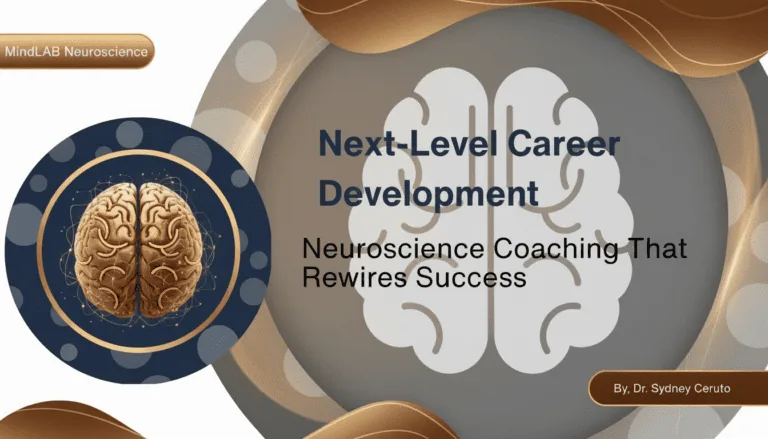
CAREER DESIGN. In this development program, we will work together to help you design and create the fulfilling career you long to have. This is not a templated coaching process. It begins with a comprehensive assessment of your neurological strengths, your natural attentional style, your stress response profile, your reward sensitivity patterns, and builds a career architecture that leverages these strengths rather than fighting against them.
CAREER GOALS. We will get crystal-clear on your career goals so that every decision you take from here on is powerfully aligned with who you are and what you want. Goal clarity is not a motivational exercise: it is a prefrontal function. When goals are vague, the executive system cannot prioritize effectively, and cognitive resources scatter across competing possibilities. Precision in goal definition produces immediate gains in decision quality and execution momentum.
CAREER PLAN. We will work together to create a challenging but workable plan to make the changes necessary for a career that excites and fulfills you, every single day. The plan is designed around ultradian performance rhythms, the approximately 90-minute cycles of peak focus that neuroscience identifies as the fundamental unit of high-quality cognitive output. Working with your biology rather than against it transforms what is achievable within existing time constraints.
CAREER LEARNING. I will be sharing with you the best learning and self-development from my development tool kit to make sure you have everything you need and that you are performing at your very best. This includes evidence-based practices for prefrontal restoration, attentional training, and stress inoculation, the neuroscience foundations of sustainable high performance.
CAREER PROGRESS. Our work together will instill a deep sense of confidence, commitment, and motivation for you to make the bold career decisions and embrace this opportunity. And I will be providing the accountability to make sure you stay on track. Accountability is not merely a behavioral mechanism, it engages the social bonding circuits (oxytocin and vasopressin systems) that sustain motivation long after initial enthusiasm fades.
CAREER SUCCESS. Ultimately, I will help you get to a career that you love and that leaves you feeling fulfilled in your work, confident in yourself, and balanced in your life. Success in this framework is not defined by external metrics alone: it is defined by the sustained activation of your brain’s satisfaction circuitry in response to your daily professional experience. For related insights, see Optimizing Your Path to Success: A 5-Step Framework for G….
High-Performance Career Development Is for You If:
- You are an ambitious, high-achieving professional who knows you want more from your career, but you are not yet sure exactly what needs adding or exactly how you will achieve it. The prefrontal clarity required to answer these questions demands a structured process, not more rumination.
- You find yourself coasting in a career you only tolerate, feeling fatigued, frustrated, undervalued, and overlooked. And at just the point when you know your work should be leaving you feeling satisfied, successful, and deeply fulfilled. This pattern reflects reward circuitry habituation, your brain has stopped encoding your current achievements as meaningful, and recalibration requires deliberate intervention.
- You know just how important it is to your career to embrace this moment, but are struggling to find the time, energy, and focus to make meaningful inroads into your longer-term career goals. This is the hallmark of executive function depletion: the strategic capacity exists but is being consumed by operational demands before it can be directed toward transformation.
- You are ready to welcome a thinking partner into your circle to provide the direction, support, and accountability you know you need to maintain perfect focus, and the balance between near-term strategies and the long-term vision. The neuroscience of social cognition demonstrates that external perspective activates neural circuits inaccessible to solitary reflection.
- You agree with me when I say: your career should be your agenda; your career should excite and fulfill you; and your career should harmonize with your life, not compromise it.
- You are ready to get to work on this, truly excited about the prospect of once again feeling completely energized by a career that inspires, motivates, and challenges you, and that leaves you feeling satisfied and fulfilled.
If you recognize yourself in these patterns, the persistent dissatisfaction despite achievement, the strategic paralysis despite ambition, the sense that your career should feel profoundly different from how it currently does, then your neuroscience is telling you something important. The architecture of your career needs to change. And that change begins with a single, decisive conversation about what is possible when your brain and your career are finally working in the same direction.
What separates high-performing professionals from those who stagnate despite equal talent?
High performers operate from a neurologically optimized state characterized by focused attention, adaptive stress responses, and clarity of strategic priority. The differentiating factor is rarely raw intelligence but rather the neural regulation of effort, decision-making, and recovery. Stagnation typically reflects an unaddressed mismatch between individual neurological strengths and the demands of the current role or environment, a mismatch that targeted career redesign can resolve.
How does the brain’s executive function system relate to career performance?
The prefrontal cortex governs the executive functions most critical to career performance: strategic planning, impulse regulation, working memory, and behavioral flexibility. When this system is chronically taxed by stress, poor sleep, or cognitive overload, performance plateaus even in technically skilled professionals. Optimizing prefrontal function through structured recovery, prioritization disciplines, and stress regulation creates measurable gains in both output quality and career satisfaction.
Why do career achievements sometimes feel hollow despite outward success?
The brain’s reward system operates on prediction error rather than absolute value. When a career becomes predictable, the dopamine system reduces its response regardless of the objective quality of outcomes. Additionally, the wanting and liking systems are neurologically separable, it is possible to remain highly driven while experiencing progressively less pleasure from achievements. Recalibration of the reward circuitry through structured novelty and challenge restores the subjective experience of satisfaction.
How can a thinking partnership accelerate career transformation?
Collaborative cognition activates prefrontal regions that remain relatively dormant during solitary deliberation. A trusted thinking partner provides not just external perspective but a fundamentally different neural processing environment in which invisible cognitive barriers become visible and addressable. This is particularly valuable for high achievers whose self-reliance, while instrumental to past success, may now be the constraint limiting further growth.
When is professional support most valuable for career optimization?
Professional support delivers the highest return at transition points, stepping into senior leadership, navigating organizational complexity, recovering from a significant setback, or breaking through a persistent performance ceiling. These moments require recalibration of identity, belief systems, and decision-making frameworks alongside tactical guidance. A neuroscience-informed program provides both the strategic clarity and the neural pattern interruption to navigate these transitions successfully.
References
- Arnsten, A. F. T. (2009). Stress signalling pathways that impair prefrontal cortex structure and function. Nature Reviews Neuroscience, 10(6), 410–422.
- Berridge, K. C. and Robinson, T. E. (2016). Liking, wanting, and the incentive-sensitization theory of addiction. American Psychologist, 71(8), 670–679.
- Baumeister, R. F., Vohs, K. D. and Tice, D. M. (2007). The strength model of self-control. Current Directions in Psychological Science, 16(6), 351–355. https://doi.org/10.1111/j.1467-8721.2007.00534.x
- Feldman, R. (2017). The neurobiology of human attachments. Trends in Cognitive Sciences, 21(2), 80–99.
- Vergauwe, J., Wille, B., Feys, M., De Fruyt, F. and Anseel, F. (2015). Fear of being exposed: The trait-relatedness of the impostor phenomenon and its relevance in the work context. Journal of Business and Psychology, 30(3), 565–581.