Key Points
- Unwanted behaviors persist because they are wired into your brain’s automatic circuitry — not because you lack willpower or discipline.
- Real-Time Neuroplasticity™ targets the neural architecture sustaining the pattern, producing structural change rather than surface-level coping.
- Once a behavioral circuit is rewired, the old pattern no longer fires automatically — eliminating the need for constant self-monitoring.
- Dr. Ceruto maps your specific neural pattern during the Strategy Call to determine the precise approach for your situation.
- MindLAB's methodology does not require electronic devices, ongoing maintenance programs, or clinical referrals to begin.
| Marker | Traditional Approach | Neuroscience-Based Approach | Why It Matters |
|---|---|---|---|
| Target of Intervention | Surface behaviors and symptoms | Neural circuits driving the behavior | Root-cause change vs. symptom management |
| Primary Method | Talk-based awareness and coping tools | Real-Time Neuroplasticity™ rewiring | Structural brain change, not just insight |
| Duration of Results | Requires ongoing maintenance | Permanent neural pathway restructuring | Change that holds without constant effort |
| Approach to Relapse | Expected; managed with new strategies | Addressed by rewiring the trigger circuit | Eliminates the pattern, not just the episode |
| Role of Willpower | Central — client must resist urges | Minimal — the automatic circuit is recalibrated | Stops requiring you to fight yourself daily |
| Personalization | Standardized protocols and worksheets | Mapped to your specific neural architecture | Precision targeting for your exact pattern |
Why Neuroscience-Based Behavioral Change Matters in Bergen County
Neuroscience-Based Behavioral Change in Bergen County
Bergen County is a place where people work hard, raise families deliberately, and hold themselves to standards that leave little margin for the patterns they cannot control. In Tenafly, Ridgewood, Alpine, and Englewood Cliffs, life is structured around responsibility — to careers, to children, to community standing, to the carefully maintained appearance that everything is under control. That structure can mask a behavioral pattern for years. It can also make the pattern feel more shameful and more isolating when it finally becomes undeniable, because the person experiencing it knows how it would look to everyone who believes they have it all together.
The father in Tenafly who loses his temper with his children despite every resolution to stop. The professional in Paramus whose procrastination has become a secret liability that no colleague suspects. The parent in Ridgewood whose emotional eating has quietly escalated beyond any diet or wellness plan. The spouse in Glen Rock who shuts down emotionally during every argument, leaving the other person feeling invisible. These are not failures of character. They are neural circuits that were built under specific conditions and now run on autopilot — firing before the conscious mind can choose a different response. The basal ganglia — the brain region that automates habitual behavior — does not consult your intentions before executing the pattern. It runs the circuit because that is what it was built to do.
MindLAB Neuroscience works with clients throughout Bergen County who have exhausted conventional approaches and recognize that the pattern requires something fundamentally different. Dr. Ceruto’s Real-Time Neuroplasticity™ methodology targets the neural circuits sustaining the behavior and recalibrates them at their source. This is not talk-based work where you discuss the origins of the pattern week after week. It is not motivational coaching that gives you new strategies to layer on top of the old circuit. It is precision intervention at the level of neural architecture — changing the wiring that produces the behavior rather than building defenses around it.
Bergen County’s family-centered culture means that behavioral patterns often carry consequences that extend far beyond the individual. A reactive anger pattern affects a spouse, children, and the entire household climate in ways that compound silently over years. A compulsive behavior erodes trust in increments so small that the damage is not visible until it is severe. An avoidance pattern turns every important conversation into a withdrawal, teaching children that difficult emotions are something to run from. Addressing the behavior at its neural source — rather than attempting to manage it through willpower — is both the most effective path and the most responsible one for everyone the pattern touches.
The Strategy Call with Dr. Ceruto is by phone, private, and structured to determine whether this approach matches your specific situation. For people in Bergen County who have been managing a pattern in isolation — succeeding at everything visible while one thing runs unchecked in private — that phone call often represents the first time someone has mapped the actual neural mechanism behind the behavior rather than offering another set of tools to fight it. The difference between fighting a pattern and eliminating it is the difference between ongoing struggle and permanent change. Real-Time Neuroplasticity™ is designed for the latter.


Dr. Sydney Ceruto, PhD — Founder & CEO, MindLAB Neuroscience
Dr. Ceruto holds a PhD in Behavioral & Cognitive Neuroscience from NYU and two Master’s degrees from Yale University. She lectures at the Wharton Executive Development Program at the University of Pennsylvania and has been an Executive Contributor to the Forbes Coaching Council since 2019. Dr. Ceruto is the author of The Dopamine Code (Simon & Schuster, June 2026). She founded MindLAB Neuroscience in 2000 and has spent over 26 years pioneering Real-Time Neuroplasticity™ — a methodology that permanently rewires the neural pathways driving behavior, decisions, and emotional responses.
Success Stories
“Dr. Ceruto's methodology sharpened my negotiation instincts and built a level of mental resilience I didn't know I was missing. The difference showed up in how my team responds to me — trust, respect, and a willingness to follow that I'd been trying to manufacture for years. I stopped trying to project authority and started operating from it. That's the difference.”

“The way I was processing decisions under pressure had a cost I couldn't see — until Dr. Ceruto mapped it. She identified the neural pattern driving my reactivity in high-stakes situations and restructured it at the root. I don't just perform better under pressure now. I think differently under pressure. That's not something any executive coach or performance program ever came close to delivering.”

Identifying details withheld to protect client confidentiality.
All outcomes represent genuine engagements with Dr. Ceruto.
Frequently Asked Questions About Neuroscience-Based Behavioral Change
Why does my behavioral pattern seem to get worse during stressful periods?
Stress depletes the prefrontal cortex — the brain region responsible for conscious control. When that resource is taxed, deeper automatic circuits run with less opposition. The pattern does not actually get worse; it simply meets less resistance. This is why stress-management strategies alone rarely solve the underlying behavior.
How does neuroscience-based behavioral change differ from willpower-based approaches?
Willpower relies on the prefrontal cortex to override automatic circuits — a battle the prefrontal cortex consistently loses under stress, fatigue, or emotional activation. Real-Time Neuroplasticity™ recalibrates the automatic circuit itself, so the unwanted behavior stops firing rather than requiring constant suppression.
Do you serve clients in Bergen County?
Yes. MindLAB works with clients in Tenafly, Ridgewood, Alpine, Englewood Cliffs, Paramus, Glen Rock, and throughout Bergen County. The Strategy Call is conducted by phone for convenient, private access.
What types of behavioral patterns does MindLAB address?
Any persistent pattern that resists your conscious effort to change — reactive anger, procrastination, emotional eating, compulsive habits, self-sabotage, avoidance, impulsive decisions. The key indicator is a behavior that keeps repeating despite genuine effort and intention to stop.
How does the process start?
It begins with a Strategy Call — a phone conversation with Dr. Ceruto where she maps the neural mechanisms driving your specific pattern. The fee is $250. From there, she determines whether MindLAB's approach is the right fit and outlines a path forward.
Can this approach help with patterns that affect my family life?
Yes. Reactive anger, emotional withdrawal, overcontrolling behavior, and other patterns that impact family dynamics are among the most common concerns MindLAB addresses. These are neural circuits, often inherited from your own upbringing, that fire automatically in the family environment. Rewiring the circuit changes the dynamic at its source.
How long before I notice a difference?
Many clients notice shifts within weeks as the targeted circuits begin to recalibrate. The timeline depends on how deeply entrenched the pattern is and how long it has been active. Dr. Ceruto provides a realistic assessment during the Strategy Call.
Is the process completely confidential?
Yes. The Strategy Call and all subsequent engagement is phone-based and strictly confidential. There are no offices to visit, no groups, and no records shared with outside parties.
Do I need a referral to work with MindLAB?
No. MindLAB does not require referrals or clinical prerequisites. If you have a behavioral pattern that persists despite your efforts to change it, that is sufficient to begin the conversation.
Will the changes be permanent or will I need ongoing maintenance?
Real-Time Neuroplasticity™ produces structural changes in neural pathways. The goal is permanent rewiring, not a maintenance relationship. Once the circuit is recalibrated, the old automatic behavior no longer fires the same way — which is why the changes hold without ongoing effort.
Also available in: Miami · Wall Street · Midtown Manhattan · Beverly Hills · Lisbon
Take the First Step
The Strategy Call is a focused conversation with Dr. Ceruto that maps the specific neural mechanisms driving your concerns and determines the right path forward.
Book a Strategy Call
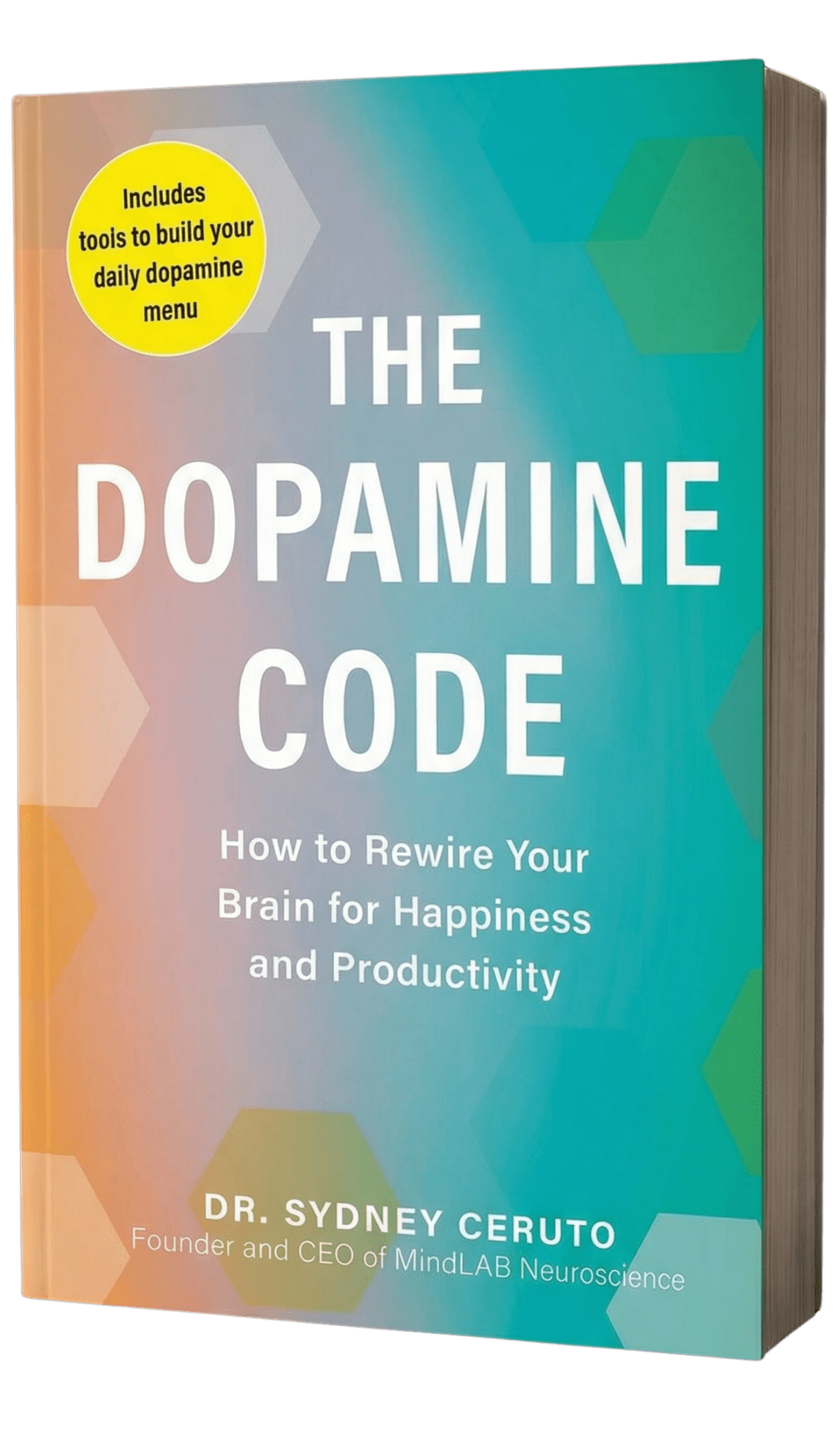
The Dopamine Code
Decode Your Drive
Why Your Brain Rewards the Wrong Things
Your brain's reward system runs every decision, every craving, every crash — and it was never designed for the life you're living. The Dopamine Code is Dr. Ceruto's framework for understanding the architecture behind what drives you, drains you, and keeps you locked in patterns that willpower alone will never fix.
Published by Simon & Schuster, The Dopamine Code is Dr. Ceruto's framework for building your own Dopamine Menu — a personalized system for motivation, focus, and enduring life satisfaction.
Order NowShips June 9, 2026