Mental Fog in Lisbon

Mental fog is not vague fatigue. It is a measurable disruption of brain network connectivity and neurotransmitter dynamics that targeted intervention can resolve.

Mental fog is not a vague condition. It corresponds to specific, identifiable disruptions in how the brain processes and routes information. MindLAB Neuroscience identifies which disruptions are active in your case and addresses them at the source.

Book a Strategy Call

The experience of mental fog corresponds to specific, identifiable disruptions in how the brain processes and routes information. Three converging mechanisms account for the majority of what people describe as brain fog, and understanding each one is essential to resolving the condition rather than merely enduring it.

The first mechanism is neuroinflammation — the brain’s immune response becoming overactive and disrupting normal neural signaling —. When the brain’s resident immune cells become chronically activated, they release signaling molecules that directly impair the connections between neurons. These inflammatory signals suppress the brain’s ability to form and strengthen memories, particularly in the hippocampus. They disrupt the delicate balance between excitatory and inhibitory signals that healthy, clear thinking depends on. They also reduce the brain’s capacity to generate new neurons and create new synaptic connections.

Beyond these direct effects on individual neurons, excess inflammation also degrades activity in the regions governing attentional control and interoceptive awareness — the brain’s ability to read its own internal state —. Research using specialized neuroimaging has demonstrated that when the blood-brain barrier is compromised, peripheral immune cells and inflammatory molecules gain direct access to brain tissue, triggering a secondary wave of neuroinflammation. This compounds the original problem, particularly in the temporal lobes and frontal cortex — the anatomical foundations of memory and executive function.

The second mechanism involves disrupted neuromodulation — the brain’s chemical signaling systems that set the overall tone and quality of cognition —. Acetylcholine — the brain’s primary attention-sharpening chemical — is released from deep brain structures and activates the memory, sensory processing, and information-relay systems. Under conditions of chronic stress, sleep disruption, or elevated inflammation, this cholinergic tone declines. The consequences are direct: attentional filtering degrades because acetylcholine normally sharpens signal-to-noise ratios in cortical circuits. Working memory — the brain’s short-term mental workspace — contracts because the hippocampus depends on this input to bind moment-to-moment experience into accessible short-term memory. Mental energy declines as the brain’s sensory relay system loses its optimal chemical input.

Dense luminous neural threads condensing into single focused copper beam of clarity in deep navy void

Simultaneously, the brain’s norepinephrine system — which modulates alertness and cognitive precision — shifts from a sharp, precise firing pattern into a chronically elevated but diffuse state. Moderate norepinephrine levels strengthen the prefrontal networks that support working memory and top-down attentional control. Chronically elevated levels disrupt those same circuits, impairing cognitive flexibility and producing the subjective sense of mental static. This creates a bidirectional cycle: when norepinephrine declines or becomes dysregulated, neuroinflammation worsens — and worsening neuroinflammation further disrupts the norepinephrine system.

The third mechanism operates at the network level. Focused cognition depends on a precisely orchestrated relationship between the dorsal attention network — responsible for goal-directed focus — and the default mode network — the brain’s inward-looking, self-referential mode —. In a healthy brain, these two networks suppress each other: when one activates, the other quiets. In mental fog, this suppression breaks down. The inward-looking network intrudes into task-relevant processing, creating the subjective experience of distraction, mind-wandering, and effortful thinking. Research demonstrates that the strength of this opposition directly predicts working memory performance and attentional accuracy on a moment-by-moment basis.

Chronic stress compounds these patterns at the structural level. Sustained cortisol elevation causes the physical loss of synaptic connection points in prefrontal neurons — shorter dendritic branches, reduced branching, and loss of the tiny protrusions through which neurons communicate. The brain’s dedicated waste-clearance pathway, which operates primarily during deep sleep, is also compromised by sleep disruption, allowing metabolic byproducts to accumulate in the prefrontal cortex. Research has linked this accumulation directly to cognitive fatigue and lower-quality decision-making.

Dr. Ceruto’s approach addresses mental fog at each mechanistic layer: reducing the neuroinflammatory burden to restore clean neural signaling, recalibrating the brain’s chemical tone to return acetylcholine and norepinephrine to their optimal ranges, and restoring the network dynamics that enable sustained, clear cognitive processing.

Why Mental Fog Matters in Lisbon

Lisbon creates a distinctive cognitive fog profile through the convergence of factors that conventional wellness approaches overlook.

Antique rosewood desk with crystal brain sculpture and MindLAB journal in warm amber Lisbon afternoon light with historic European wood paneling

The second-language cognitive tax is the most pervasive and least recognized contributor. Research confirms that second-language processing is consistently slower and more effortful than native-language cognition, requiring greater working memory and attentional resources to support word retrieval and meaning-making. For Lisbon’s international professional community, this tax is continuous. Professionals compose emails in what may be their second or third language, attend meetings where European Portuguese, Brazilian Portuguese, and multiple varieties of English collide, and manage banking, health registration, and utility systems in Portuguese. The cumulative effect is end-of-day cognitive exhaustion disproportionate to the volume of work completed — the operational signature of working memory depletion from sustained language processing overhead.

The cultural code-switching demand layers additional processing load. A professional in a Lisbon startup with a British founder, American investors, and a Portuguese team navigates four distinct cultural operating systems before lunch. This creates a feedback loop of constant self-surveillance that drains precisely the executive resources needed for clear thinking — and contributes directly to the cognitive fog that accumulates over the workday.

The time zone architecture prevents cognitive recovery. Professionals managing obligations across European and American business hours experience a workday that structurally eliminates the sustained attentional rest periods the brain requires to clear accumulated metabolic waste and restore prefrontal reserves. The late Portuguese dining culture further compresses the recovery window, as metabolic disruption from eating close to sleep onset impairs the body temperature decline the brain uses to signal sleep readiness.

For the high-net-worth expat community in Cascais and Estoril, the fog presentation often involves the intersection of age-related neuromodulatory decline with the sustained cognitive demands of managing international financial complexity, multi-jurisdiction tax obligations under the NHR-to-IFICI transition, and the ongoing processing required to justify a significant relocation investment. The commute from Cascais to central Lisbon adds one to three hours of daily dead time that disrupts the professional rhythms of intensive knowledge work without providing genuine cognitive recovery.

Dr. Sydney Ceruto, PhD — Founder, MindLAB Neuroscience

Dr. Sydney Ceruto, PhD — Founder & CEO, MindLAB Neuroscience

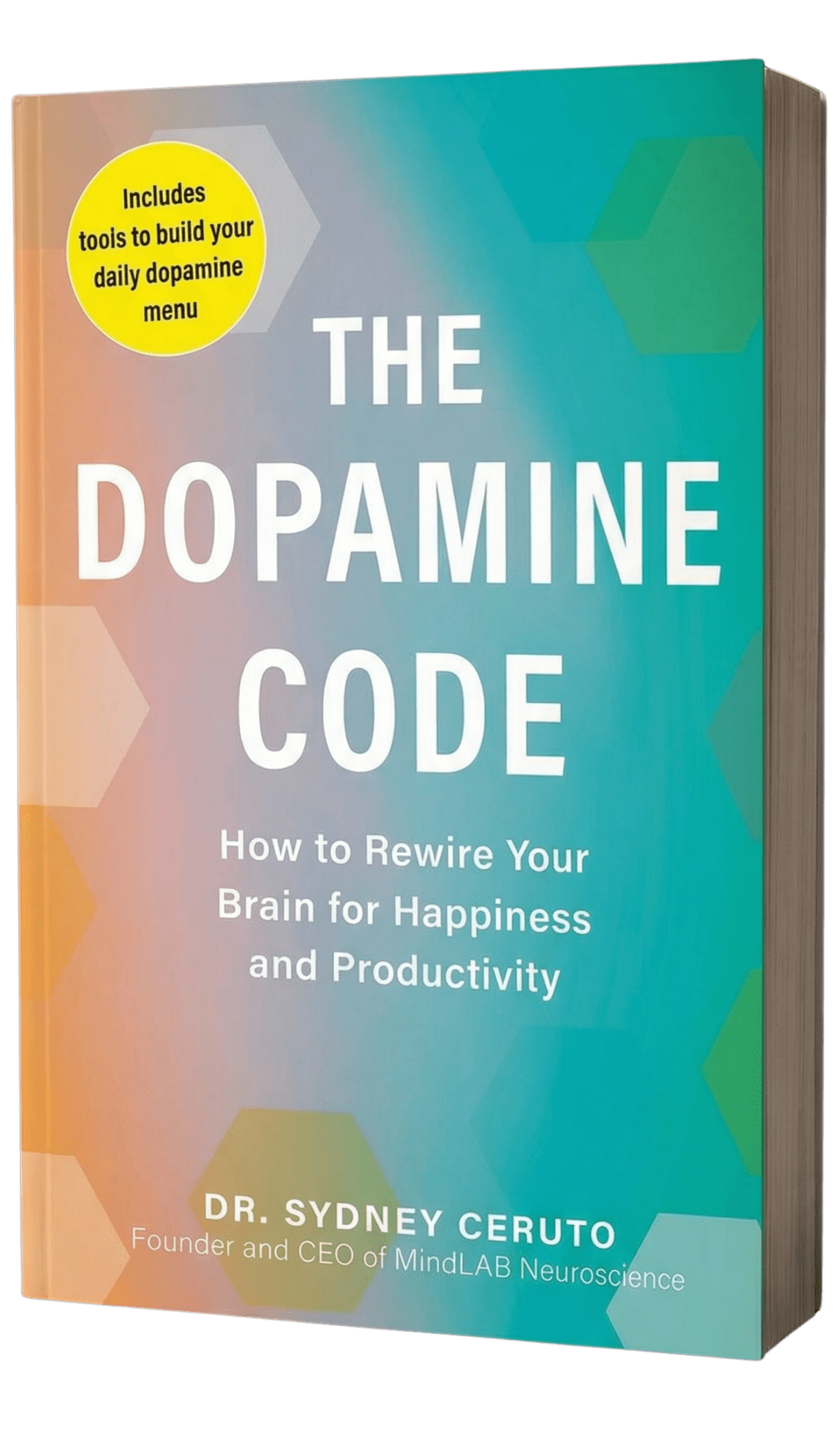
Dr. Ceruto holds a PhD in Behavioral & Cognitive Neuroscience from NYU and two Master’s degrees from Yale University. She lectures at the Wharton Executive Development Program at the University of Pennsylvania and has been an Executive Contributor to the Forbes Coaching Council since 2019. Dr. Ceruto is the author of The Dopamine Code (Simon & Schuster, June 2026). She founded MindLAB Neuroscience in 2000 and has spent over 26 years pioneering Real-Time Neuroplasticity™ — a methodology that permanently rewires the neural pathways driving behavior, decisions, and emotional responses.

References

Fox, M. D., Snyder, A. Z., Vincent, J. L., Corbetta, M., Van Essen, D. C., & Raichle, M. E. (2005). The human brain is intrinsically organized into dynamic, anticorrelated functional networks. Proceedings of the National Academy of Sciences, 102(27), 9673-9678. https://doi.org/10.1073/pnas.0504136102

Wiehler, A., Branzoli, F., Adanyeguh, I., Mochel, F., & Pessiglione, M. (2022). A neuro-metabolic account of why daylong cognitive work alters the control of economic decisions. Current Biology, 32(16), 3564-3575. https://doi.org/10.1016/j.cub.2022.07.010

Greene, C., Connolly, R., Brennan, D., Laffan, A., O’Keeffe, E., Zaporojan, L., … & Campbell, M. (2024). Blood-brain barrier disruption and sustained systemic inflammation in individuals with long COVID-associated cognitive impairment. Nature Neuroscience, 27, 421-432.

Yang, Y., Wang, Z., & Zhang, J. (2025). Microglial-mediated synaptic alterations in neuroinflammation. Frontiers in Cellular Neuroscience, 19, 1555308.

Success Stories

“My phone was the first thing I touched in the morning and the last thing I put down at night — and every app blocker, digital detox protocol, and willpower-based system I tried lasted less than a week. Dr. Ceruto…”

Tomás R., COO Logistics & Supply Chain Lisbon, PT

“After the concussion, my processing speed collapsed — I couldn't hold complex information the way I used to, and no one could explain why the fog wasn't lifting. Dr. Ceruto mapped the damaged pathways and built compensatory networks around them.…”

Owen P., Founder & CEO Sports Performance Scottsdale, AZ

“Color-coded calendars, alarms, accountability partners — I'd built an entire scaffolding system just to stay functional, and none of it addressed why my brain couldn't sequence and prioritize on its own. Dr. Ceruto identified the specific prefrontal pattern that was…”

Jordan K., VP of Product Enterprise SaaS San Francisco, CA

“The way I was processing decisions under pressure had a cost I couldn't see — until Dr. Ceruto mapped it. She identified the neural pattern driving my reactivity in high-stakes situations and restructured it at the root. I don't just…”

Rob Winston Goldman Sachs Manhattan, NY

“When the inheritance came, it didn't feel like a gift — it felt like a grenade in every family relationship I had. I couldn't make a single financial decision without a flood of guilt and second-guessing. Years of talking through…”

Vivienne R., CFO Family Office Palm Beach, FL

“I'd optimized everything — diet, fitness, sleep — but my cognitive sharpness was quietly declining and no one could explain why. Dr. Ceruto identified the synaptic density patterns that were thinning and built a protocol to reverse the trajectory. This…”

Henrique L., Head of Strategic Planning Galp Lisbon, PT

Frequently Asked Questions About Mental Fog in Lisbon

What is mental fog from a neuroscience perspective?

Mental fog is a measurable state involving three overlapping disruptions: neuroinflammation that impairs how neurons communicate with each other, disrupted chemical signaling systems that degrade attentional precision, and a breakdown in how the brain's focus and self-referential networks interact. It is not a personality issue or a motivation problem. It has identifiable neural mechanisms that can be assessed and addressed.

Why does mental fog persist even when someone is getting adequate rest?

Mental fog often involves mechanisms that sleep alone does not correct. Microglial priming creates a self-amplifying inflammatory loop with a lowered activation threshold. Chronic stress produces structural changes in prefrontal neurons — including dendritic atrophy and spine loss — that persist beyond the stressor. And if sleep quality is compromised — even when duration appears adequate — the overnight processes of synaptic renormalization and metabolic waste clearance may be incomplete, maintaining the fog state despite apparent rest.

Who benefits from this approach?

Anyone experiencing a sustained decline in cognitive sharpness that does not respond to rest, exercise, or lifestyle adjustment alone. This includes professionals whose processing speed and mental clarity have deteriorated under sustained career pressure, individuals experiencing post-relocation cognitive fatigue, people whose multi-language or multi-timezone working environment creates chronic attentional depletion, and anyone whose decision quality or creative output has noticeably declined.

What does the process look like?

The first step is a Strategy Call — a phone-based conversation where Dr. Ceruto identifies which neural mechanisms are most likely contributing to the fog state and determines whether the methodology is appropriate. This is a substantive analysis, not an introductory conversation, and carries a $250 fee. Program structure and investment details are discussed during the Strategy Call.

How long does it take to restore cognitive clarity?

The timeline varies depending on which mechanisms are dominant. Neuroinflammatory patterns that have been building over months or years may require a longer engagement than neuromodulatory imbalances that respond more rapidly to targeted intervention. The encouraging evidence from neuroimaging research is that network connectivity patterns, prefrontal function, and synaptic efficiency all retain the capacity for meaningful restoration even after prolonged periods of cognitive fog.

Take the First Step Toward Mental Fog

The Strategy Call is a focused conversation with Dr. Ceruto that maps the specific neural mechanisms driving your concerns and determines the right path forward. The Strategy Call carries a $250 fee.

Book a Strategy Call
MindLAB Neuroscience consultation room
Locations

The Intelligence Brief

Neuroscience-backed analysis on how your brain drives what you feel, what you choose, and what you can’t seem to change — direct from Dr. Ceruto.