Nervous System Regulation & Vagal Tone in Lisbon

Dr. Sydney Ceruto provides neuroscience education on autonomic nervous system function, vagal tone, and their direct relationship to cognitive performance and emotional regulation.

When the nervous system can't shift out of high alert, everything else pays the price — sleep, focus, relationships, decisions. The vagus nerve — the body's primary reset pathway from stress back to calm — is trainable. At MindLAB Neuroscience, we identify what's disrupting your nervous system's natural recovery cycle and build the conditions for durable regulation.
Book a Strategy Call

Key Points

  1. The neural circuits governing autonomic regulation and executive cognition share the same anatomical substrate — nervous system state directly determines the quality of thought.
  2. Heart rate variability consistently predicts superior performance across working memory, inhibitory control, cognitive flexibility, and wise reasoning.
  3. Burnout is vagal resource exhaustion — emotional exhaustion is independently associated with reduced vagal tone during both rest and emotional challenge.
  4. Midlife heart rate variability predicts the rate of cognitive decline over a decade, establishing vagal tone as a biomarker of long-term neural trajectory.
  5. The autonomic nervous system operates through a three-tiered hierarchy: social engagement, fight-or-flight, and freeze-shutdown — stress progressively moves the system down the tiers.
  6. The speed of autonomic recovery following challenge is itself a trainable variable that independently predicts cognitive performance stability.
  7. Recalibrating the autonomic setpoint involves baroreflex sensitization, prefrontal-subcortical circuit strengthening, and interoceptive resolution training — producing durable shifts over eight to twelve weeks.

There is a state that high-capacity professionals know intimately but rarely have language for. The body is tired, but the mind will not stop scanning. Sleep comes, but it does not restore. Small disruptions trigger disproportionate reactions. The ability to think clearly under pressure – once a defining strength – has been replaced by a persistent sense of operating from a reactive, narrowed state. This differs from the expansive clarity that complex work demands.

This experience has a precise neurophysiological explanation. It is rooted in the autonomic nervous system — the body’s automatic regulation system —. This vast neural network regulates heart rate, respiration, digestion, immune function, and the physiological state from which all cognition emerges.

The Three-Tiered Autonomic Hierarchy

“Every cognitive function that defines high-level performance — working memory, inhibitory control, cognitive flexibility, strategic decision-making — depends on the state of the autonomic nervous system. This is not a peripheral wellness consideration.”

The autonomic nervous system operates through a phylogenetically ordered hierarchy of three distinct states. Each is governed by different neural circuits and each produces a fundamentally different quality of cognitive and emotional function.

The ventral vagal state – the most recently evolved circuit, exclusive to mammals – is mediated by myelinated vagal fibers originating in the nucleus ambiguus of the brainstem. This state produces the conditions for social engagement, calm, curiosity, and flexible cognition. It is the neurophysiological foundation of optimal professional performance: the state from which complex reasoning, creative problem-solving, and nuanced interpersonal engagement become possible.

Macro cross-section of neural pathway with copper sheathing forming around blue signal core depicting active brain optimization

The sympathetic mobilization state – the fight-or-flight system – is activated when the nervous system perceives danger. It produces heightened arousal, increased heart rate, and the cognitive narrowing that prioritizes threat response over reflective thinking. This state is adaptive in genuine emergencies but corrosive when it becomes the default operating mode.

The dorsal vagal immobilization state – the oldest circuit, shared with reptiles – emerges under conditions of perceived inescapable overwhelm. It produces shutdown, emotional numbness, cognitive dissociation, and fatigue disproportionate to activity. This state is often misidentified as laziness or depression when the neurophysiological reality is an ancient protective circuit deployed in response to accumulated overwhelm.

Vagal Tone: The Measure of Neural Readiness

Heart rate variability – the millisecond-to-millisecond fluctuation between successive heartbeats – serves as the primary noninvasive measure of vagal tone. This metric reflects the functional output of the myelinated ventral vagal system. Through the neurovisceral integration model, it indexes the functional integrity of the prefrontal cortex — the brain’s executive control center —-based inhibitory control network.

The relationship between vagal tone and cognitive performance is among the most replicated findings in applied psychophysiology. Higher resting heart rate variability consistently predicts superior executive function, including working memory, inhibitory control, cognitive flexibility — the ability to shift thinking between concepts —, and the capacity for wise reasoning under pressure. A large longitudinal cohort study demonstrated that midlife heart rate variability predicts the rate of cognitive decline over a decade. This establishes vagal tone not merely as a performance-state variable but as a biomarker of long-term neural trajectory.

The neurovisceral integration model explains why: the central autonomic network governs both executive cognitive function and cardiac vagal outflow. This circuit encompasses the prefrontal cortex and insular cortex — the brain’s internal awareness center —, along with brainstem nuclei.

How Dysregulation — the breakdown of normal control systems — Develops

Autonomic dysregulation does not present as clinical pathology in its early stages. It manifests as a progressive shift in the nervous system’s baseline operating state toward sympathetic or dorsal vagal dominance, with corresponding reductions in cognitive, emotional, and social flexibility.

The underlying mechanism involves allostatic load – the cumulative physiological cost of repeated or sustained stress-response activation. As allostatic load accumulates, three converging processes occur. Tonic sympathetic drive elevates as the locus coeruleus — the brain’s alertness center —-norepinephrine system becomes sensitized. The myelinated ventral vagal brake retracts as nucleus ambiguus output diminishes. And the system begins recruiting older phylogenetic circuits, expressed as the exhaustion, numbness, and motivational collapse that characterize advanced burnout.

Research on the autonomic signature of burnout confirms that emotional exhaustion – the core dimension of burnout – is the only burnout component independently associated with reduced vagal tone. The autonomic correlate is specific to exhaustion-as-resource-depletion: the physiological state in which prolonged demand has outpaced recovery capacity.

Antique rosewood desk with crystal brain sculpture and MindLAB journal in warm amber Lisbon afternoon light with historic European wood paneling

Vagal Flexibility: The Dynamic Resource

Vagal tone is not merely a static trait. It functions as a dynamic resource – a vagal reserve that determines the range of adaptive responding available under stress. The ability to modulate vagal tone in context matters as much as the resting level. Individuals with high resting vagal tone but low vagal flexibility show attenuated cognitive stability under emotional perturbation. Those with both high resting tone and flexible vagal reactivity demonstrate the most robust cognitive performance across varying conditions.

The Recalibration Principle

Dr. Ceruto educates clients on the distinction between state-level and trait-level autonomic regulation. A single calming practice produces transient parasympathetic enhancement. Trait-level recalibration – the actual goal – shifts the baseline operating point from which the autonomic system functions, producing lasting improvements in vagal dominance and dynamic range. This recalibration occurs through neuroplasticity — the brain’s ability to rewire itself — mechanisms: baroreflex sensitization, synaptic remodeling in the central autonomic network, and enhanced myelination of nucleus ambiguus efferent pathways.

Evidence-based approaches to trait-level vagal recalibration include resonance frequency breathing protocols that produce structural adaptation in baroreflex circuits over eight to twelve weeks. These require consistent practice, combined with heart rate variability biofeedback that adds an interoceptive precision-training dimension (relating to sensing internal body signals), and cold exposure protocols that enhance parasympathetic tone through baroreceptor loading. Dr. Ceruto provides the neuroscience education that enables clients to understand which mechanisms are relevant to their specific autonomic profile and how to engage neuroplasticity pathways effectively.

For deeper context, explore nervous system regulation and vagal tone.

Marker What You Experience What's Happening Neurologically What We Restructure
Decision fatigue with paradoxical urgency Decisions feel increasingly costly to make, yet you are reluctant to defer any of them Chronic sympathetic dominance has shifted prefrontal blood flow toward subcortical defensive circuits, consuming the resources needed for deliberate decision-making The autonomic setpoint — shifting baseline nervous system state from sympathetic dominance toward higher vagal tone
Emotional blunting Reduced responsiveness to positive experiences while negative ones still hit with full force The ventral vagal system — the circuit supporting calm attention and nuanced social perception — has been down-regulated by sustained physiological burden Ventral vagal circuit capacity so the nervous system can access the state from which clear thinking and accurate perception naturally emerge
Persistent hypervigilance Low-grade scanning behavior that prevents sustained focused attention, always on alert for the next problem Neuroception — the brain's unconscious environmental threat monitoring — is stuck in threat-detection mode, recruiting sympathetic responses below conscious awareness The neuroceptive threshold so the nervous system accurately distinguishes genuine threats from safe environments
Burnout exhaustion Emotional exhaustion that persists despite rest, vacation, and reduced workload Vagal resource exhaustion — prolonged demand has outpaced recovery capacity, and the autonomic system no longer has the reserves to restore parasympathetic dominance Vagal recovery capacity through targeted baroreflex sensitization and active recovery training — distinct from passive rest
Slow stress recovery Taking hours or days to return to baseline after a stressful interaction that used to resolve in minutes The speed and completeness of autonomic recovery following challenge has degraded as the inhibitory circuit weakened The trainable variable of recovery speed — building neural circuits governing active autonomic restoration after challenge

Why Nervous System Regulation & Vagal Tone Matters in Lisbon

Lisbon is simultaneously one of Europe’s most beautiful and one of its acoustically most stressful cities. According to the city’s updated Strategic Noise Map, over 74,000 residents – 13.6 percent of Lisbon’s total population – are exposed to ambient noise exceeding 65 decibels, with road traffic identified as the primary source. The city’s famous hillside topography concentrates traffic noise in narrow historic streets, and neighborhoods like Alfama, Mouraria, and Intendente trap vehicle and tourist noise in ways that flat urban grids do not. This persistent low-grade acoustic overload creates sympathetic nervous system — the body’s accelerator for stress and alertness — activation that is invisible on any medical chart but physiologically corrosive over months and years.

The tech professional population working in Parque das Nacoes or Chiado experiences a specific form of sympathetic dominance: hypervigilance — a state of constant threat-scanning — shaped by always-on digital culture. Slack notifications, code review pressures, investor update cycles, and engineering performance metrics condition the nervous system into perpetual readiness that never fully discharges. Fully remote workers – a large share of Lisbon’s nomad and expat tech community – experience higher rates of daily stress, loneliness, and emotional dysregulation — the breakdown of normal control systems. They show these patterns more than on-site peers.

The wearable heart rate variability monitoring market in Portugal is growing, with devices like Oura Ring gaining visibility through high-profile endorsements and Web Summit coverage. Yet ownership of an HRV-tracking device and understanding how to clinically interpret its data represent entirely different competencies. The market for wearable devices is expanding; the market for professionals who can translate HRV data into nervous system optimization protocols is essentially empty in Lisbon.

Lisbon’s Atlantic-coast and outdoor recreation culture creates a natural opening for nervous system regulation. The surfing communities of Cascais, Ericeira, and Costa da Caparica – all within thirty to sixty minutes of central Lisbon – represent a population already oriented toward somatic experience, breath regulation, and nature-based recovery. Premium wellness programs operating near Lisbon already combine HRV training with nervous system regulation, signaling demonstrated demand for this service category. Dr. Ceruto’s neuroscience-led approach sits above these offerings in clinical authority and cognitive performance specificity.

Dr. Sydney Ceruto, PhD — Founder, MindLAB Neuroscience

Dr. Sydney Ceruto, PhD — Founder & CEO, MindLAB Neuroscience

Dr. Ceruto holds a PhD in Behavioral & Cognitive Neuroscience from NYU and two Master’s degrees from Yale University. She lectures at the Wharton Executive Development Program at the University of Pennsylvania and has been an Executive Contributor to the Forbes Coaching Council since 2019. Dr. Ceruto is the author of The Dopamine Code (Simon & Schuster, June 2026). She founded MindLAB Neuroscience in 2000 and has spent over 26 years pioneering Real-Time Neuroplasticity™ — a methodology that permanently rewires the neural pathways driving behavior, decisions, and emotional responses.

References

Porges, S. W. (2022). Polyvagal Theory: A science of safety. Frontiers in Integrative Neuroscience, 16, 871227. https://doi.org/10.3389/fnint.2022.871227

Forte, G., Favieri, F., & Casagrande, M. (2019). Heart rate variability and cognitive function: A systematic review. Frontiers in Neuroscience, 13, 710. https://doi.org/10.3389/fnins.2019.00710

Jandackova, V. K., Scholes, S., Britton, A., & Steptoe, A. (2024). Midlife heart rate variability and cognitive decline: A large longitudinal cohort study. International Journal of Clinical and Health Psychology, 24(4), 100518. https://doi.org/10.1016/j.ijchp.2024.100518

Kanthak, M. K., Stalder, T., Hill, L. K., Thayer, J. F., Penz, M., & Kirschbaum, C. (2017). Autonomic dysregulation in burnout and depression: Evidence for the central role of exhaustion. Scandinavian Journal of Work, Environment & Health, 43(5), 475-484. https://doi.org/10.5271/sjweh.3647

Success Stories

“Nothing was wrong — and that's exactly why no one could help me. I wasn't struggling. I wanted to know what my brain was actually capable of if its resting-state architecture was optimized. Dr. Ceruto mapped my default mode network and restructured how it allocates resources between focused and diffuse processing. The cognitive clarity I operate with now isn't something I'd ever experienced before — and I had no idea it was available.”

Nathan S. — Biotech Founder Singapore

“After the concussion, my processing speed collapsed — I couldn't hold complex information the way I used to, and no one could explain why the fog wasn't lifting. Dr. Ceruto mapped the damaged pathways and built compensatory networks around them. My brain doesn't work the way it did before the injury. It works differently — and in some ways, more efficiently than it ever did.”

Owen P. — Orthopedic Surgeon Scottsdale, AZ

“Slower processing, foggier recall, decisions that used to be instant taking longer than they should — I'd been accepting it all as inevitable decline for two years. Dr. Ceruto identified the prefrontal efficiency pattern that was degrading and restructured it at the neurological level. The sharpness didn't just come back. It came back faster and more precise than it was a decade ago. Nothing I'd tried before even addressed the right problem.”

Elliott W. — Wealth Advisor Atherton, CA

“I'd optimized everything — diet, fitness, sleep — but my cognitive sharpness was quietly declining and no one could explain why. Dr. Ceruto identified the synaptic density patterns that were thinning and built a protocol to reverse the trajectory. This wasn't prevention in theory. My neuroplasticity reserve is measurably stronger now than it was three years ago. Nothing I'd tried before even addressed the right problem.”

Henrique L. — University Dean Lisbon, PT

“Every system, every supplement, every productivity method I tried collapsed within weeks — and nothing held because nothing addressed why my attention kept fragmenting. Dr. Ceruto identified the dopamine regulation pattern that was hijacking my prefrontal cortex every time I needed sustained focus. She didn't give me another workaround. She restructured the architecture underneath. My brain holds now. That's not something I ever thought I'd be able to say.”

Derek S. — Film Producer Beverly Hills, CA

“From our first meeting, Sydney made me think about what I actually wanted and helped me change my perspective. She immediately put me at ease. I’ve only been working with her a short time, but I already have a more positive outlook — for the first time, I really see that I can find a career I’ll be happy in. What I like most is her honesty and ability to make you examine what’s holding you back in a way that doesn’t make you feel judged.”

Nyssa — Creative Director Berlin, DE

Frequently Asked Questions About Nervous System Regulation & Vagal Tone in Lisbon

What does nervous system regulation and vagal tone education involve at MindLAB?

Dr. Ceruto provides neuroscience-based education on how the autonomic nervous system — the body's automatic regulation system — shapes cognitive performance, emotional regulation, and stress resilience. This includes understanding the three-tiered autonomic hierarchy, how heart rate variability reflects the functional state of prefrontal-subcortical circuits. It also covers which neuroplasticity — the brain's ability to rewire itself — based approaches support lasting autonomic recalibration rather than temporary relief.

How does vagal tone affect cognitive performance?

Vagal tone — the body's ability to calm itself — is measured through heart rate variability. It reflects the functional integrity of the neural circuit shared by executive cognition and cardiac autonomic control. Higher vagal tone consistently predicts superior working memory, inhibitory control, cognitive flexibility — the ability to shift thinking between concepts —, and wise reasoning under pressure. Longitudinal research demonstrates that midlife vagal tone predicts the trajectory of cognitive decline over decades, making it not merely a wellness metric but a biomarker of long-term brain health.

Who is this service designed for?

Individuals experiencing the cognitive and emotional consequences of chronic sympathetic dominance – persistent hypervigilance — a state of constant threat-scanning —, difficulty recovering from stress, emotional reactivity disproportionate to circumstances, or the exhaustion-without-restoration pattern characteristic of advanced burnout. The service is particularly relevant for those who recognize that rest alone is not producing recovery. It helps those who want to understand the neurophysiology behind their experience.

How does the process begin?

The process starts with a Strategy Call – a phone-based conversation with Dr. Ceruto to discuss the specific autonomic patterns, relevant history, and goals. The Strategy Call carries a $250 fee and serves as the initial point of contact to determine whether the neuroscience-based approach is appropriate. Program structure and investment details are discussed during the call.

How long does autonomic recalibration take?

State-level improvements – transient shifts toward parasympathetic tone – can occur within a single practice session. Trait-level recalibration, which involves actual neuroplastic adaptation (related to the brain's ability to rewire itself) of brainstem circuits and baroreflex sensitivity, requires consistent engagement over eight to twelve weeks for measurable structural change. Dr. Ceruto provides education on these distinct timelines so clients understand the difference between temporary relief and lasting nervous system remodeling.

Also available in: Miami · Wall Street · Midtown Manhattan · Beverly Hills

Take the First Step Toward Nervous System Balance

The Strategy Call is a focused conversation with Dr. Ceruto that maps the specific neural mechanisms driving your concerns and determines the right path forward.

Book a Strategy Call
MindLAB Neuroscience consultation room

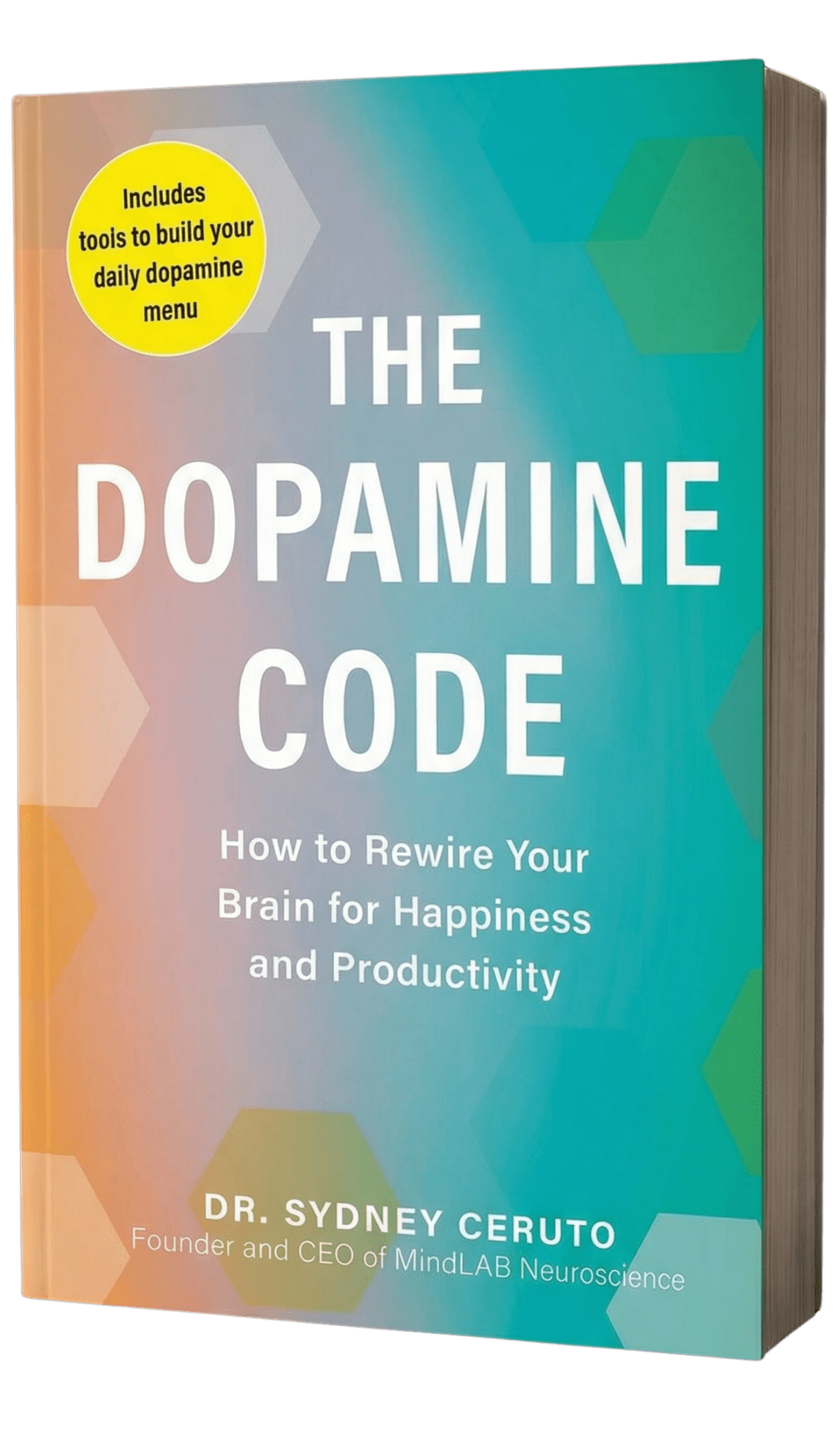
The Dopamine Code

Decode Your Drive

Why Your Brain Rewards the Wrong Things

Your brain's reward system runs every decision, every craving, every crash — and it was never designed for the life you're living. The Dopamine Code is Dr. Ceruto's framework for understanding the architecture behind what drives you, drains you, and keeps you locked in patterns that willpower alone will never fix.

Published by Simon & Schuster, The Dopamine Code is Dr. Ceruto's framework for building your own Dopamine Menu — a personalized system for motivation, focus, and enduring life satisfaction.

Order Now

Ships June 9, 2026

The Dopamine Code by Dr. Sydney Ceruto — Decode Your Drive
Locations

The Intelligence Brief

Neuroscience-backed analysis on how your brain drives what you feel, what you choose, and what you can’t seem to change — direct from Dr. Ceruto.