Organizational Development Consulting in Lisbon

Organizations do not resist change because of culture. They resist it because the amygdala activates before the prefrontal cortex engages. Every failed transformation has this in its architecture, undiagnosed.

Organizational change fails at a rate exceeding 70 percent not because the strategy was wrong, but because the human nervous system treats structural uncertainty as a survival threat. MindLAB Neuroscience addresses organizational development at the neural level where resistance originates.

Book a Strategy Call

Key Points

  1. Organizational dysfunction is collective neural dysfunction — the same threat responses, cognitive biases, and social processing errors that affect individuals scale predictably across groups.
  2. Group decision-making quality depends on the social cognition capacity of key individuals — the neural architecture of a few leaders determines organizational intelligence.
  3. The SCARF model identifies five domains of social threat — status, certainty, autonomy, relatedness, fairness — each processed through dedicated neural circuits.
  4. Organizational trust is mediated by oxytocin and social bonding circuits that are remarkably sensitive to leadership behavior — and remarkably slow to rebuild once damaged.
  5. Sustainable organizational development requires restructuring the neural patterns of the individuals whose behavior sets the norms others unconsciously mirror.

The Change That Never Holds

“Seventy percent of organizational change initiatives fail to achieve their stated objectives. This is not a management failure — it is a neuroscience failure. The brain's threat-detection architecture, evolved for physical survival, cannot distinguish between a territorial predator and an ambiguous organizational announcement.”

The restructuring was designed by capable strategists. The communication plan was comprehensive. The leadership team was aligned. And still, six months later, the organization has reverted to its prior operating patterns with only cosmetic evidence of the intended transformation.

This is not a failure of strategy. It is not a failure of communication. It is not a failure of will. It is a failure that repeats with such consistency across industries, geographies, and organizational sizes that the 70-percent change failure rate has become an accepted statistic rather than an urgent diagnostic signal.

Organizations invest in change management consultancies, transformation roadmaps, and culture redesign programs. Then they watch the same pattern unfold: initial compliance followed by progressive reversion, accelerating under the first serious operational pressure.

The people within these organizations are not resistant because they are obstinate or disengaged. They are resistant because their brains are doing exactly what brains are designed to do when the environment becomes unpredictable. The moment a restructuring is announced, a pivot is declared, or new performance frameworks are introduced, the ancient threat-detection system activates.

What leaders and consultants interpret as cultural resistance is, at the neural level, a survival circuit in overdrive. The conventional approach responds to this pattern by improving the change process: better vision statements, more stakeholder engagement, stronger change champion networks. Each of these refinements addresses the surface while leaving the biological driver untouched.

The Neuroscience of Organizational Resistance

Understanding why organizations resist change requires examining the neural mechanisms that govern how humans process uncertainty, threat, and structural shifts in their environment.

The amygdala — the brain’s threat-detection center — functions as the brain’s continuous environmental threat scanner. Research confirms the amygdala’s central role in both threat learning and threat extinction. Critically, it communicates threat salience directly to the prefrontal cortex, effectively hijacking executive function precisely when organizations need employees to think most clearly.

In organizational settings, uncertainty about role security, structural change, or power reconfigurations activates the same amygdala circuits that evolved to detect physical predators. This behavioral consequence was formalized in landmark research.

Their analysis demonstrated that threat perception produces a consistent outcome across individual, group, and organizational levels: restriction of information processing and constriction of control. Organizations facing the highest change demands default to the most rigid, hierarchical behaviors. This is the opposite of what transformation requires and it is not a cultural problem. It is a threat-detection cascade.

The tension between the brain’s threat response and its executive function defines the central neurological battleground of organizational change. Five social domains can trigger threat responses: Status, Certainty, Autonomy, Relatedness, and Fairness. Research establishes the strong negative correlation between threat activation and prefrontal resource availability.

Less oxygen and glucose reach working memory — the brain’s short-term mental workspace. This directly impairs the rational processing that change requires. Ambiguous restructuring communications do not merely confuse employees; they actively degrade the neural machinery needed to comply with the change directive.

A seminal study on psychological safety established the relationship between team psychological safety and learning behavior. Psychological safety predicts learning behavior, which in turn affects team performance. The neuroscience beneath this construct is direct: psychological safety operates by reducing amygdala activation.
Strategy consulting and organizational development — layered copper neural blueprint connecting operational tiers

When psychological safety is absent, the prefrontal cortex becomes subordinated to limbic defensive processing. Information sharing collapses, and organizational intelligence is systematically withheld.

Research has demonstrated that even short training periods produce measurable, selective structural changes in brain tissue. The brain physically rewires itself in response to sustained new demands. This means organizational change is asking employees to grow new neural architecture under conditions that actively suppress the neuroplasticity — the brain’s ability to rewire itself — required.

Any change process that fails to modulate the threat-detection system first generates the exact neurochemical conditions that prevent the neural rewiring it demands.

How Dr. Ceruto Approaches Organizational Development

Dr. Ceruto’s methodology addresses the sequencing error that conventional organizational development consistently makes: behavioral expectations before neural state management.

Real-Time Neuroplasticity inverts this sequence. Threat modulation precedes behavioral direction. Before any organizational change initiative is implemented, the protocol assesses the current threat-load profile across the organization’s leadership and team structures.

This includes evaluation of allostatic load — cumulative stress wear on the body — indicators, prefrontal-limbic balance, and the hormone patterns that predict whether the organizational nervous system can support the neural rewiring that change requires.

What I see repeatedly in organizational engagements is that the change strategy itself was sound. The failure occurred because the strategy was deployed into a neural environment actively hostile to new pattern formation. The amygdala was already in overdrive from prior change cycles. Prefrontal resources were depleted by sustained uncertainty.

Psychological safety had been degraded by ambiguous communications about roles and reporting structures. The change never had a chance because the biological prerequisites for change were absent.

Dr. Ceruto’s protocol addresses each of these neural dimensions systematically. For organizations where threat-rigidity effects have calcified into structural resistance, targeted interventions reduce amygdala activation across leadership tiers before change directives are introduced.

For teams where psychological safety has been compromised by rapid scaling, multicultural integration, or distributed work arrangements, the protocol rebuilds the neural conditions that allow interpersonal risk-taking and information sharing.

The NeuroSync program addresses a focused organizational challenge, such as a specific restructuring or cultural integration, with targeted neural recalibration across the leadership team. For organizations navigating comprehensive transformation across multiple dimensions simultaneously, the NeuroConcierge partnership embeds Dr. Ceruto’s methodology as an ongoing advisory architecture.

This ensures that the neural environment adapts in real time as the organizational landscape shifts. The result is organizational change that holds because the biological prerequisites for neural rewiring were established before the behavioral expectations were introduced. The organization’s nervous system was prepared to adapt rather than defend.

What to Expect

Every engagement begins with a Strategy Call where Dr. Ceruto assesses the organization’s change history, current transformation objectives, and the specific patterns of resistance or stagnation that previous approaches have failed to resolve.

From this assessment, a structured protocol addresses the organization’s specific neural landscape. The protocol sequences threat modulation before change implementation, builds psychological safety through measured amygdala deactivation rather than cultural workshops, and monitors prefrontal-limbic balance across leadership tiers throughout the transformation process.

The engagement does not follow arbitrary timelines. It is structured around neuroplasticity consolidation windows — periods when brain changes become stable — and measured against cognitive and organizational performance markers that indicate whether the neural environment is supporting or sabotaging the change initiative.

The protocol concludes when the organizational nervous system demonstrates stable adaptation rather than chronic threat response.

The Neural Architecture of Organizational Performance

Organizational development is, at its most precise, the study of how collective human neural architecture produces organizational behavior — and how to modify that architecture to produce different behavior at scale. The structures, systems, and culture that OD consulting addresses are not independent of the people who inhabit them. They are the aggregate output of the neural prediction systems, reward architectures, threat responses, and social neural circuits of every individual in the organization, operating in interaction with each other and with the organizational environment. Changing organizational performance requires changing these neural systems, not just the structures that express them.

The prefrontal capacity of the organizational leadership layer is the primary constraint on organizational development. The structures and systems that OD consultants design cannot be more sophisticated than the prefrontal capacity of the leadership population implementing them. A governance structure that requires sustained cognitive flexibility, nuanced contextual judgment, and complex multi-stakeholder integration to function effectively will be simplified by the brains operating it to a level they can manage — regardless of how well it was designed. This simplification is not a conscious decision. It is the brain’s predictive coding system finding the most efficient operating pattern given its current regulatory capacity.

The social neural architecture of the organization is the second critical variable. Every organizational structure exists within a social neural environment — a distributed network of threat responses, status hierarchies, belonging signals, and social reward patterns that determines which of the structure’s intended functions are actually reinforced by the social environment and which are quietly overridden by social neural imperatives. An accountability structure that creates social threat for the behaviors it is trying to reinforce will be systematically subverted by the social neural imperative to minimize threat, regardless of its logical coherence.

Why Traditional Approaches Fall Short

Organizational development consulting has built sophisticated frameworks for diagnosing organizational dysfunction and designing structural, systemic, and cultural interventions. The best OD practice combines rigorous diagnostic methodology, evidence-based intervention design, and skilled change management to produce genuine organizational improvement. The fundamental limitation is that these frameworks operate at the level of organizational systems and professional behavior without directly addressing the neural architecture generating the behavior the systems are designed to modify.

This produces a characteristic pattern: structural interventions that improve organizational performance in the short term, followed by a progressive reversion to previous performance patterns as the neural architectures of the people inhabiting the new structures reassert their established patterns. The new accountability structure is adopted and then gradually re-interpreted to be consistent with existing threat avoidance patterns. The new collaborative model is implemented and then progressively undermined by the status and belonging dynamics that the social neural architecture generates. The performance management redesign produces initial behavioral compliance and then the normative drift that always follows when the system conflicts with the neural environment it is embedded in.

Antique rosewood desk with crystal brain sculpture and MindLAB journal in warm amber Lisbon afternoon light with historic European wood paneling

The missing element is neural-level diagnosis and intervention. OD consulting that can identify the specific neural architectures most powerfully maintaining the organizational patterns that need to change, and design interventions that address those architectures directly, can produce organizational development that holds — because the neural substrate generating the organizational behavior has been modified, not just the systems expressing it.

How Neural OD Consulting Works

My approach to organizational development consulting begins with a neural diagnostic layer that operates beneath the conventional OD assessment. The standard diagnostic — organizational surveys, leadership interviews, process analysis, structural mapping — reveals the behavioral and systemic expression of organizational patterns. The neural diagnostic examines the circuits generating those patterns: the threat architectures most powerfully shaping decision behavior, the reward systems most powerfully sustaining the existing performance patterns, the social neural dynamics most powerfully overriding the intended functions of existing structures, and the prefrontal capacity available in the leadership layer to sustain and model the organizational development the change requires.

From this layered diagnostic, I design OD interventions that address both the structural and neural dimensions simultaneously. The structural interventions — the governance redesign, the process architecture, the accountability systems, the role clarity — are designed not just for their logical coherence but for their compatibility with the neural architectures that will implement them. This means designing structures that work with the brain’s reward and threat systems rather than against them — creating environments in which the neural imperatives of the professional population and the intended functions of the organizational systems are aligned rather than in conflict.

The neural development component focuses on the leadership layer, because leadership neural architecture is the primary determinant of whether organizational development holds or reverts. Leaders whose regulatory capacity is rebuilt, whose reward systems are recalibrated to the actual reward landscape of organizational leadership, and whose threat responses are recalibrated to the specific threat signals most undermining their organizational development effectiveness are the most powerful OD intervention available. They are the social neural models that the rest of the organization’s prediction systems are most powerfully calibrated to.

What This Looks Like in Practice

Organizational development consulting engagements begin with a Strategy Call in which I map the presenting organizational performance challenge against its most likely neural substrates. This conversation identifies whether the presenting challenge is primarily a structural problem, a neural architecture problem, or the more common combination of the two — and designs an engagement accordingly.

For organizations addressing a specific, well-defined organizational development challenge — a particular team’s dysfunction, a specific process failure, a leadership transition requiring organizational realignment — the NeuroSync model provides focused consulting designed around both the structural and neural dimensions of that specific challenge. For organizations undertaking broad organizational development initiatives spanning multiple years and affecting the full professional population, the NeuroConcierge model provides the embedded consulting partnership required to address organizational development at the neural depth that lasting change requires. The engagement is calibrated to organizational and neural development timelines simultaneously — because the rate of lasting organizational change is ultimately constrained by the rate of neural change in the people generating organizational behavior.

For deeper context, explore personal development in organizational growth.

Marker Traditional Approach Neuroscience-Based Approach Why It Matters
Focus Organizational design, process optimization, and structural alignment Restructuring the neural patterns of key leaders whose social cognition signals determine organizational behavior
Method OD consulting with assessments, design sprints, and implementation roadmaps Targeted intervention in the social brain circuits of leaders whose neural outputs set the norms others mirror
Duration of Change Structure-dependent; organizational behavior reverts when consulting engagement ends Permanent neural changes in key individuals that continuously generate the leadership signals driving organizational function

Why Organizational Development Consulting Matters in Lisbon

Lisbon’s organizational development landscape presents a convergence of forces that makes neuroscience-informed advisory especially critical. The city was named European Capital of Innovation in 2023 by the European Commission. Its startup ecosystem has entered what researchers identify as the Early-Globalization phase, with five active unicorns and a billion-dollar exit establishing late-stage credibility.

This structural transformation creates acute organizational demand. Eighty-nine percent of Portugal’s 5,091 active startups are micro-enterprises with fewer than nine employees. Nearly 70 percent were founded in the last five years. These organizations face first-time structural challenges with no management layer, no human resources function, and founders making organizational architecture decisions with no prior experience.

The scaling chaos of growing from five to 50 employees in a European regulatory environment creates specific neural challenges. Right to Disconnect legislation, mandatory training hours, and strong dismissal protections form a highly specific regulatory context that many founders have never navigated.

The international-Portuguese cultural interface adds a dimension that purely process-based consulting cannot address. Portuguese business culture is relationship-first, with trust established personally over time and hierarchical respect embedded in communication norms. International companies entering Lisbon, particularly those from American or Northern European contexts, systematically underestimate this.

They import organizational cultures that trigger social threat responses across the Status and Relatedness dimensions. The resulting retention and engagement problems are diagnosed as culture misalignment. The neurological reality is that the imported organizational culture was designed for a threat-detection profile calibrated to different cultural norms.

Web Summit’s annual return to Lisbon, with over 70,000 attendees concentrated in November, creates a predictable demand cycle. The weeks before and after Web Summit represent peak organizational anxiety for scaling startups. Founders make hiring commitments, announce pivots, and enter partnership agreements that restructure organizational reality without the infrastructure to manage the neural consequences.

From Chiado incubators to Parque das Nacoes corporate centers, the pattern repeats: organizational commitments made under cognitive load — the total demand on mental processing capacity. These are followed by implementation attempts that collide with the biological constraints of the teams tasked with executing them.

The estimated 16,000 digital nomads residing in Lisbon bring additional organizational complexity. These remote professionals work for organizations that may have no Portuguese legal entity, operate across multiple time zones, and report to managers they rarely meet. Psychological safety in this context is not an aspirational cultural goal. It is the primary enabler of any performance in an environment where every social dimension operates on degraded signal.

Array

Organizational development in Lisbon’s international business environment involves building cohesive organizations from culturally diverse workforces that bring different neural models of organizational authority, communication, and collaboration. Portuguese, British, American, German, and Brazilian professionals within the same Lisbon-based company each carry organizational expectations shaped by their origin cultures — creating an OD challenge that requires genuine cross-cultural neural architecture understanding rather than surface-level diversity awareness.

The transition of Lisbon-based organizations from cost-center operations to innovation hubs requires OD work at the identity level — restructuring how teams understand their purpose, value contribution, and relationship to the global organization. This is not a process redesign — it is a collective identity architecture challenge that must be addressed through the neural patterns of the leaders whose signals determine team self-concept. Dr. Ceruto’s approach to OD through leadership neural optimization is particularly effective in this transformation context.

Dr. Sydney Ceruto, PhD — Founder, MindLAB Neuroscience

Dr. Sydney Ceruto, PhD — Founder & CEO, MindLAB Neuroscience

Dr. Ceruto holds a PhD in Behavioral & Cognitive Neuroscience from NYU and two Master’s degrees from Yale University. She lectures at the Wharton Executive Development Program at the University of Pennsylvania and has been an Executive Contributor to the Forbes Coaching Council since 2019. Dr. Ceruto is the author of The Dopamine Code (Simon & Schuster, June 2026). She founded MindLAB Neuroscience in 2000 and has spent over 26 years pioneering Real-Time Neuroplasticity™ — a methodology that permanently rewires the neural pathways driving behavior, decisions, and emotional responses.

References

Rock, D. (2008). SCARF: A brain-based model for collaborating with and influencing others. NeuroLeadership Journal, 1(1), 44–52.

Lieberman, M. D. (2007). Social cognitive neuroscience: A review of core processes. Annual Review of Psychology, 58, 259–289. https://doi.org/10.1146/annurev.psych.58.110405.085654

Adolphs, R. (2009). The social brain: Neural basis of social knowledge. Annual Review of Psychology, 60, 693–716. https://doi.org/10.1146/annurev.psych.60.110707.163514

Hazy, J. K., & Uhl-Bien, M. (2015). Towards operationalizing complexity leadership: How generative, administrative and community-building leadership practices enact organizational outcomes. Leadership, 11(1), 79–104. https://doi.org/10.1177/1742715013511483

Success Stories

“Dr. Ceruto restructured how I show up in high-stakes conversations. The blind spots I couldn't see for years became visible in our first sessions. I went from an overwhelmed Managing Director to a leader people actually want to follow. The change wasn't cosmetic — it was architectural. The way I process high-pressure interactions is fundamentally different now.”

Matteo R. — Investment Banker London, UK

“My body had simply stopped knowing when to sleep. Crossing time zones weekly for over two years had broken something fundamental, and every protocol, supplement, and device I tried couldn't hold longer than a few days. Dr. Ceruto identified the disruption at the level of my suprachiasmatic nucleus and recalibrated the signaling pattern driving the dysfunction. Within weeks, my circadian rhythm locked back in. I sleep now. Consistently. Regardless of where I land.”

Jonathan K. — Diplomat Geneva, CH

“When my youngest left for college, I didn't just feel sad — I felt erased. My entire sense of self had been wired to caregiving for two decades, and I didn't know who I was without it. Years of talk-based approaches hadn't touched it. Dr. Ceruto mapped the identity circuitry that had fused with the role and restructured it. I didn't find a new purpose — I found the one that had been underneath the whole time.”

Diane L. — Nonprofit Director Chicago, IL

“It took years and many other professionals — not to mention tens of thousands of dollars — before I was recommended to Dr. Ceruto. I’d been suffering with chronic anxiety, OCD, and distorted thinking. After just two sessions, I started to see positive change. By the time my program ended, I had my sanity and my life back. Sydney creates a warm, supportive atmosphere where I found myself sharing things I’ve never told anyone. She is there for you anytime you need her.”

Nicholas M. — Private Equity Hong Kong

“Dr. Ceruto is a true professional with massive experience helping people get where they need to be. The important thing for me was understanding my strengths, developing ways to use them, and learning from the pitfalls that kept me from reaching my goals. She broke it all down and simplified the obstacles that had been painful blockers in my career, providing guidance and tools to conquer them. You will learn a lot about yourself and have a partner who works with you every step of the way.”

Michael S. — Real Estate Developer Boca Raton, FL

“Three months. That's how long it took to go from debilitating panic to leading with clarity. Years of conventional approaches hadn't moved the needle — Dr. Ceruto identified the root neural pattern and eliminated it. She didn't teach me to manage the panic. She made it unnecessary. I didn't know that was possible.”

Ella E. — Media Executive Manhattan, NY

Frequently Asked Questions About Organizational Development Consulting in Lisbon

Why do organizational change initiatives fail so consistently, and how does a neuroscience approach address this?

Change initiatives fail because they deploy behavioral expectations into a neural environment that is actively hostile to new pattern formation. The amygdala treats organizational uncertainty as a survival threat, hijacking prefrontal resources needed for rational compliance with change directives. Dr. Ceruto's methodology inverts the conventional sequence: threat modulation precedes behavioral direction, establishing the biological prerequisites for neural rewiring before change expectations are introduced.

We are a company establishing European operations in Lisbon. What organizational challenges should we anticipate?

International companies entering the Portuguese market consistently underestimate the neural implications of cultural interface. Portuguese business culture operates through relationship-first trust and indirect communication norms that differ significantly from Anglo-American or Northern European frameworks. Your imported organizational culture may trigger social threat responses across Status and Relatedness dimensions in Portuguese hires. Dr. Ceruto's approach identifies these cross-cultural neural mismatches and builds organizational architecture that accounts for the threat-detection profiles of your specific workforce composition.

Our startup has grown rapidly and the culture is breaking down. What is happening neurologically?

Rapid scaling creates compounded allostatic load — the cumulative wear of chronic stress on the body — across your team. Each new hire, role change, and structural adjustment activates the amygdala — the brain's threat-detection center —'s threat-detection circuits. When these activations accumulate without adequate recovery, the cortisol/DHEA ratio shifts in ways that impair cognitive flexibility — the ability to shift thinking between concepts —, reduce working memory capacity, and heighten defensive reactivity. What looks like culture breakdown is neurochemical depletion compounded by sustained uncertainty. Dr. Ceruto assesses the organization's actual stress-load profile and addresses the neural substrate before attempting cultural or structural interventions.

How does psychological safety work at a neurological level?

Psychological safety, as documented in Amy Edmondson's foundational research, operates by reducing amygdala — the brain's threat-detection center — activation. When the basolateral amygdala receives signals that social risk-taking is not threat-equivalent, threat responses diminish. As a result, the prefrontal cortex regains access to working memory and cognitive flexibility — the ability to shift thinking between concepts —. Information sharing increases, error reporting improves, and the trial-and-error learning required for effective organizational adaptation becomes possible. Dr. Ceruto's protocol builds psychological safety through measured neural state management, not through values workshops or team-building exercises.

Can Dr. Ceruto work with our organization remotely?

Yes. MindLAB's organizational advisory is fully available through virtual engagement. The assessment and intervention protocols maintain their precision regardless of delivery format. For organizations with distributed teams, remote delivery is often the natural fit, allowing the advisory to integrate with leadership schedules spanning multiple cities and time zones.

How long does a typical organizational neuroscience advisory engagement last?

Engagements are structured around neuroplasticity — the brain's ability to rewire itself — consolidation windows and organizational performance markers, not arbitrary timelines. A focused engagement addressing a specific restructuring or cultural integration may require a concentrated protocol of several months. Comprehensive organizational transformation advisory through the NeuroConcierge partnership adapts to the full complexity and duration of the change initiative. Dr. Ceruto does not prescribe standard durations because every organization's neural landscape is different.

What is the Strategy Call and what should we prepare?

The Strategy Call is a focused strategy conversation where Dr. Ceruto assesses your organization's change history, current transformation objectives, and the specific patterns of resistance or stagnation that previous approaches have not resolved. Come prepared to discuss what has been tried, what has failed, and where the organization is experiencing the most friction. This conversation reveals neural patterns that standard organizational assessments systematically miss.

How does organizational dysfunction trace to the neural patterns of specific individuals?

Organizations are neural networks — the collective behavior emerges from the individual neural states of key members, propagated through mirror neuron systems and social cognition circuits. When leaders carry elevated threat responses, rigid decision patterns, or impaired social cognition, these neural states transmit through the organization via the same mechanisms that transmit culture, trust, and psychological safety.

Organizational dysfunction that appears systemic — poor communication, low trust, resistance to change, siloed behavior — frequently traces to the neural patterns of a small number of individuals at influential nodes. The dysfunction is not organizational design. It is the predictable output of specific neural architectures operating under specific conditions.

Can this approach complement existing organizational development consulting engagements?

Yes — and it addresses the layer that organizational development consulting typically cannot reach. OD consulting excels at structural design, process optimization, and systemic analysis. It assumes the individuals operating within the system have the neural capacity to implement recommendations effectively. When they do not, even excellent organizational design fails to produce the intended outcomes.

Dr. Ceruto's work ensures the biological infrastructure of key individuals supports the organizational changes being implemented. This complementary approach produces outcomes that neither organizational design nor individual intervention alone can achieve — sound structure operated by individuals with optimized neural capacity.

How does Dr. Ceruto identify which individuals in an organization should be prioritized for neural optimization?

Organizational influence does not follow the org chart. The individuals whose neural states most powerfully shape organizational behavior are those at the intersection of high social influence and high decision impact — often, but not always, senior leaders. Some mid-level managers at critical information or cultural nodes exert disproportionate neural influence over their surrounding teams.

Dr. Ceruto identifies these individuals through analysis of organizational decision flows, cultural transmission patterns, and the social cognition networks that determine where neural signals propagate most powerfully. Optimizing the architecture of 3-7 individuals at these nodes typically produces organizational impact that far exceeds what individual development of the same number of randomly selected leaders would achieve.

Also available in: Miami · Wall Street · Midtown Manhattan · Beverly Hills

The Neural Environment Behind Every Organizational Change You Attempt in Lisbon

From Chiado startups scaling past their founding team to Parque das Nacoes multinationals integrating international hires, change resistance is biological. Dr. Ceruto diagnoses the organizational nervous system in one conversation.

Book a Strategy Call
MindLAB Neuroscience consultation room

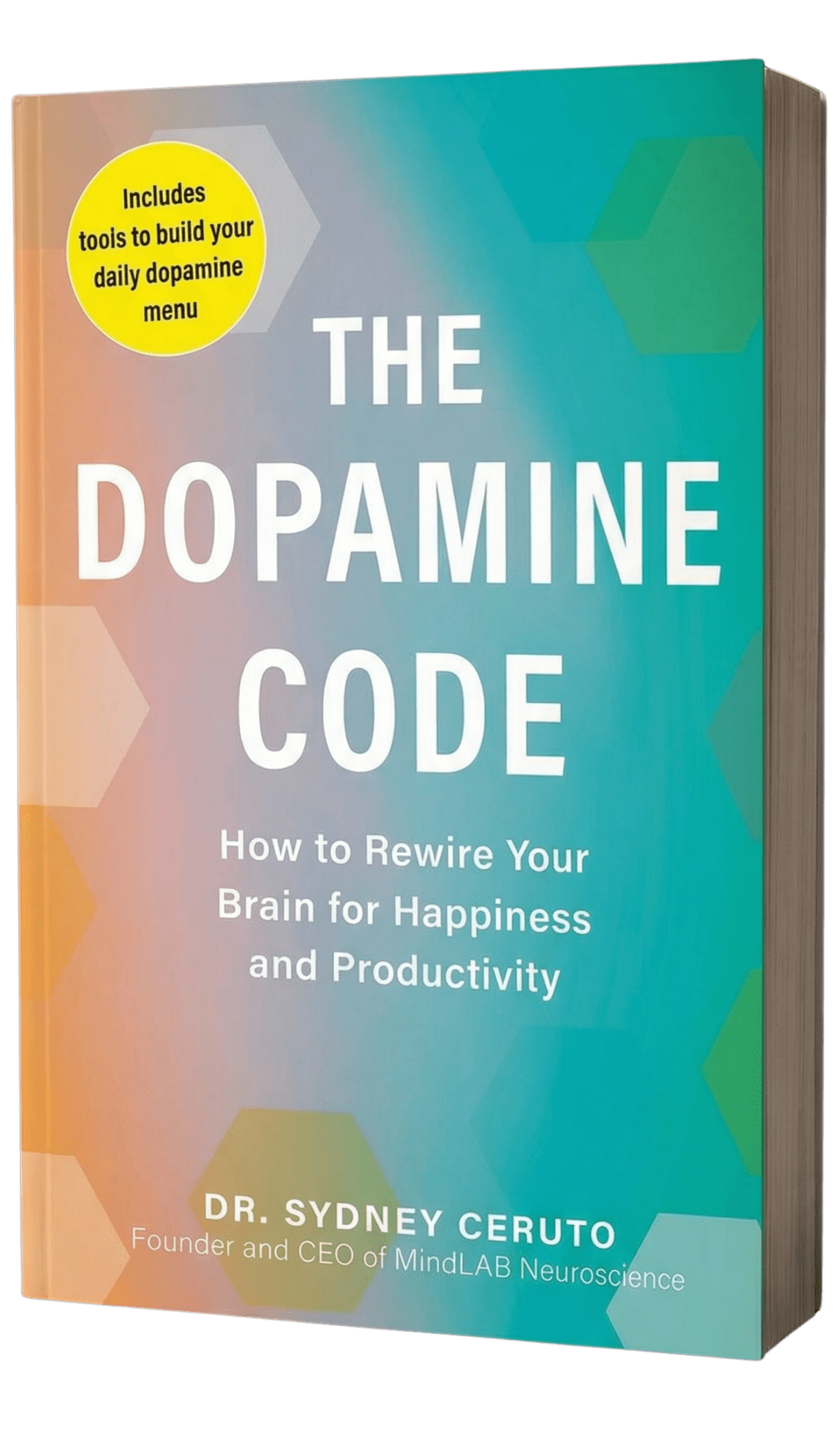
The Dopamine Code

Decode Your Drive

Why Your Brain Rewards the Wrong Things

Your brain's reward system runs every decision, every craving, every crash — and it was never designed for the life you're living. The Dopamine Code is Dr. Ceruto's framework for understanding the architecture behind what drives you, drains you, and keeps you locked in patterns that willpower alone will never fix.

Published by Simon & Schuster, The Dopamine Code is Dr. Ceruto's framework for building your own Dopamine Menu — a personalized system for motivation, focus, and enduring life satisfaction.

Order Now

Ships June 9, 2026

The Dopamine Code by Dr. Sydney Ceruto — Decode Your Drive
Locations

The Intelligence Brief

Neuroscience-backed analysis on how your brain drives what you feel, what you choose, and what you can’t seem to change — direct from Dr. Ceruto.