Key Points
- Major life transitions trigger a neural reorganization period where the brain is exceptionally receptive to permanent structural change.
- Without guided intervention, the brain defaults to threat-based wiring that prioritizes survival over growth.
- Real-Time Neuroplasticity™ works during the live consolidation window, not after patterns have already hardened.
- Identity, decision-making capacity, and emotional regulation all restructure simultaneously during major transitions.
- Dr. Ceruto’s methodology produces permanent architectural change, eliminating the need for ongoing maintenance or coping strategies.
| Marker | Traditional Approach | Neuroscience-Based Approach | Why It Matters |
|---|---|---|---|
| Approach | Conventional Support | Self-Directed Adaptation | Real-Time Neuroplasticity™ |
| Timing | After patterns solidify | Reactive, unstructured | During the neural consolidation window |
| Target | Emotional coping | Surface-level habit changes | Neural pathway architecture |
| Duration of results | Requires ongoing maintenance | Inconsistent, often temporary | Permanent structural rewiring |
| Identity integration | Narrative processing only | Trial and error | Guided neural identity reconstruction |
| Personalization | Protocol-based frameworks | Generic advice and books | Mapped to your specific neural patterns |
Why Life Transition Navigation Matters in Miami
Why Life Transitions Hit Differently in Miami
Miami’s population grew by over 100,000 residents between 2020 and 2024, making it one of the fastest-growing metros in the country. Many of those arrivals left established lives elsewhere — careers, social networks, family proximity — and landed in a city that rewards reinvention but offers little structure for the internal work that reinvention demands.
The Brickell financial district alone absorbed thousands of finance and tech professionals relocating from New York, San Francisco, and Chicago. These moves looked like upgrades on paper. But the brain does not process a cross-country relocation as a simple address change. The prefrontal cortex — responsible for planning and identity continuity — loses its environmental anchors. Routines that once ran on autopilot now require deliberate effort, draining cognitive resources that used to go toward performance and decision-making.
The Relocation Paradox in South Florida
South Florida’s international character creates a specific challenge for people in transition. Over 70% of Miami-Dade residents speak a language other than English at home. For transplants, the cultural richness that makes Miami compelling also means fewer familiar reference points during a period when the brain is already working overtime to recalibrate.
Coral Gables, Coconut Grove, and Wynwood each carry distinct social codes. Someone rebuilding a life after a major career shift, a divorce, or the loss of a defining relationship has to navigate these micro-cultures while their identity architecture is still under construction. The brain defaults to threat-scanning in unfamiliar environments, which makes every social interaction feel higher-stakes than it actually is.
The Design District and Edgewater have drawn a younger professional demographic since 2021, many arriving without established local networks. Doral’s corporate relocation zone houses families who uprooted from Latin America and the northeast simultaneously. Each neighborhood represents a different flavor of the same neurological challenge: building a new identity in an environment that has not yet become familiar to the brain.
How Dr. Ceruto Works With Transitions in Miami
Dr. Ceruto’s Real-Time Neuroplasticity™ methodology intervenes during the live moments when the brain is consolidating new identity patterns. Rather than processing a transition after it has already hardened into anxiety or avoidance, the work happens while the neural architecture is still malleable.
For Miami’s transplant population, this means the early months of a major change become an opportunity rather than a survival exercise. The amygdala — the brain’s threat-detection center — stops flagging every unfamiliar situation as danger. The default mode network — the system governing self-narrative — builds a coherent story that integrates past and present rather than splitting them.

The subtropical climate, year-round outdoor access, and proximity to water create natural conditions that support neuroplastic change. Dr. Ceruto leverages Miami’s environmental advantages as part of a structured methodology, not as a lifestyle suggestion. The brain responds to consistent environmental warmth and natural light by lowering baseline cortisol, which accelerates the neuroplastic process. From the high-rises along Biscayne Boulevard to the residential neighborhoods of South Miami and Pinecrest, the work addresses the full spectrum of transitions that this city’s rapid growth has produced.

Dr. Sydney Ceruto, PhD — Founder & CEO, MindLAB Neuroscience
Dr. Ceruto holds a PhD in Behavioral & Cognitive Neuroscience from NYU and two Master’s degrees from Yale University. She lectures at the Wharton Executive Development Program at the University of Pennsylvania and has been an Executive Contributor to the Forbes Coaching Council since 2019. Dr. Ceruto is the author of The Dopamine Code (Simon & Schuster, June 2026). She founded MindLAB Neuroscience in 2000 and has spent over 26 years pioneering Real-Time Neuroplasticity™ — a methodology that permanently rewires the neural pathways driving behavior, decisions, and emotional responses.
Success Stories
“The way I was processing decisions under pressure had a cost I couldn't see — until Dr. Ceruto mapped it. She identified the neural pattern driving my reactivity in high-stakes situations and restructured it at the root. I don't just perform better under pressure now. I think differently under pressure. That's not something any executive coach or performance program ever came close to delivering.”

Identifying details withheld to protect client confidentiality.
All outcomes represent genuine engagements with Dr. Ceruto.
Frequently Asked Questions About Life Transition Navigation
What qualifies as a major life transition?
Any event that fundamentally disrupts your daily patterns, identity, or sense of direction. Career changes, relocations, relationship endings, family restructuring, retirement, becoming a caregiver, or the loss of someone central to your life. The common thread is that the brain’s existing wiring no longer matches your current reality.
How is this different from just waiting for things to settle?
Time does not equal resolution. Without guided intervention, the brain consolidates whatever patterns emerge during the chaos — including avoidance, hypervigilance, and identity confusion. Dr. Ceruto’s methodology ensures the neural pathways that form during a transition serve your long-term functioning, not just your short-term survival.
I relocated to Miami recently and feel off despite everything going well. Is that normal?
Completely. The brain registers a loss of environmental familiarity as a low-grade threat, even when the new environment is objectively better. Your prefrontal cortex is burning extra energy on tasks that used to be automatic — navigation, social calibration, routine decisions. That cognitive drain shows up as a vague sense of something being wrong. It is one of the most common patterns Dr. Ceruto addresses in Miami.
How does Real-Time Neuroplasticity™ work during a transition?
Dr. Ceruto identifies the specific neural patterns that are consolidating during your transition and intervenes while they are still forming. This is not retrospective processing. The methodology works in the live window when the brain is most receptive to structural change, ensuring that new wiring supports clarity, agency, and forward movement.
What does the Strategy Call involve?
The Strategy Call is a focused phone conversation with Dr. Ceruto. She maps the specific neural patterns driving your current experience and determines whether her methodology is the right fit. The call costs $250 and is conducted by phone — an intentional format backed by research showing that eliminating visual stimuli activates deeper processing pathways.
How long does the process take?
Duration depends on the scope and depth of the transition. Some clients see measurable shifts within weeks. More complex situations — layered transitions involving career, identity, and relationships simultaneously — may require a longer engagement. Program structure and investment details are discussed during the Strategy Call.
Can this help if my transition happened months or years ago and I still feel stuck?
Yes. The brain does not have a statute of limitations on unresolved transitions. If the neural patterns that formed during the change were never properly restructured, they persist regardless of how much time passes. Dr. Ceruto’s methodology can intervene at any stage, though earlier engagement typically produces faster results.
Is this relevant for someone going through a career change in Miami’s finance or tech scene?
Miami’s rapid expansion in finance and technology has drawn professionals making significant career pivots. The neural challenge is specific: your brain built its competence identity around a previous role, industry, or organizational rank. Rebuilding that architecture while performing at a high level in a new context is exactly what this work addresses.
Do I need to be in Miami for this?
MindLAB Neuroscience serves clients globally. Dr. Ceruto conducts all sessions by phone, which means geography is not a constraint. The Miami-specific content on this page reflects the city’s unique pressures, but the methodology applies regardless of location.
What makes Dr. Ceruto’s approach different from conventional support during life changes?
Conventional approaches focus on coping strategies and emotional processing after patterns have already formed. Dr. Ceruto’s Real-Time Neuroplasticity™ methodology works at the level of the neural architecture itself — restructuring the pathways during the window when the brain is actively reorganizing. The result is permanent structural change, not temporary relief.
Also available in: Wall Street · Midtown Manhattan · Beverly Hills · Lisbon
Take the First Step
The Strategy Call is a focused conversation with Dr. Ceruto that maps the specific neural mechanisms driving your concerns and determines the right path forward.
Book a Strategy Call
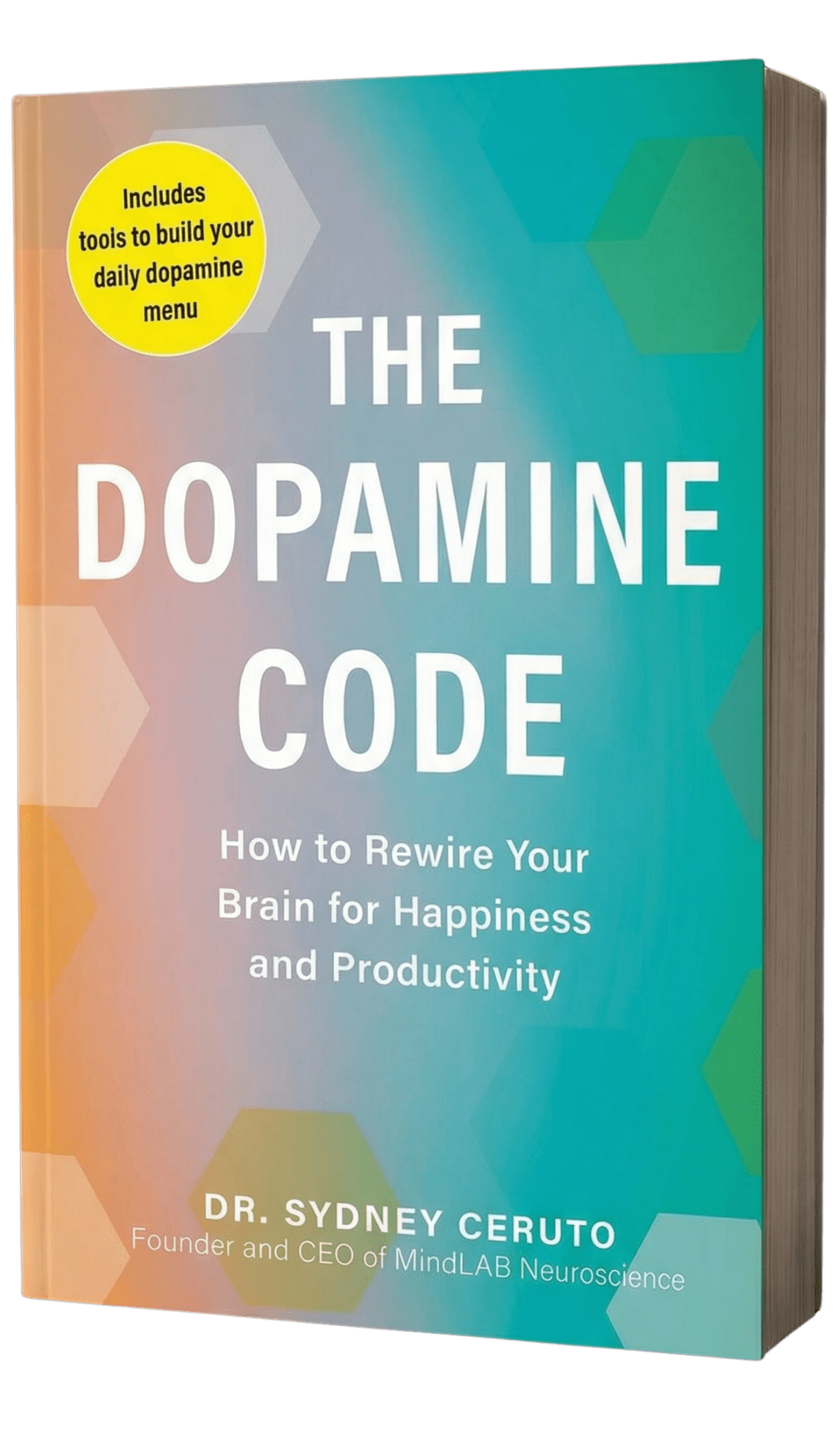
The Dopamine Code
Decode Your Drive
Why Your Brain Rewards the Wrong Things
Your brain's reward system runs every decision, every craving, every crash — and it was never designed for the life you're living. The Dopamine Code is Dr. Ceruto's framework for understanding the architecture behind what drives you, drains you, and keeps you locked in patterns that willpower alone will never fix.
Published by Simon & Schuster, The Dopamine Code is Dr. Ceruto's framework for building your own Dopamine Menu — a personalized system for motivation, focus, and enduring life satisfaction.
Order NowShips June 9, 2026