Sleep Anxiety in Midtown Manhattan

The fear of not sleeping is not irrational. It is a learned neural circuit — and learned circuits can be retrained.

Book a Strategy Call

When Sleep Becomes the Enemy

Sleep anxiety is one of the most clinically underestimated conditions in neuroscience. It is not simply worrying about sleep. It is a circuit-level dysregulation — the breakdown of normal control systems — in which the fear of not sleeping recruits the same neural machinery the brain uses for threat detection — machinery that is fundamentally incompatible with sleep initiation. The result is a self-reinforcing loop that grows stronger with every failed attempt to sleep.

How the Brain Traps Itself

The loop proceeds through five interlocking stages. First, anticipatory anxiety activates the amygdala and the bed nucleus of the stria terminalis before the person even enters the bedroom. Second, this threat activation triggers the HPA axis and sympathetic nervous system, elevating cortisol and norepinephrine and increasing heart rate. Third, the resulting cortical hyperarousal — elevated beta and gamma frequency brain activity — prevents the inhibitory shift that sleep onset requires. Fourth, the anterior insula registers the arousal as confirmation that sleep is not coming. Fifth, the basolateral amygdala strengthens the association between the sleep environment and threat. The circuit is now more entrenched than it was the night before.

When Your Bedroom Betrays You

The bedroom itself becomes a conditioned stimulus for wakefulness. Through classical conditioning the bedroom, the act of lying down, and the approach of bedtime acquire the power to trigger physiological arousal independent of any conscious thought about sleep. The clinical signature is distinctive: a person feels drowsy and relaxed in the living room, then experiences sudden, inexplicable alertness the moment they enter the bedroom. This contextual fear acquisition is hippocampus-dependent. The hippocampus encodes the bedroom’s specific configuration — its geometry, lighting, sounds, associations — as a threat context, and the conditioned arousal response fires before conscious deliberation begins.

Why Trying Harder Makes Sleep Worse

A structural paradox makes sleep anxiety particularly resistant in high-functioning individuals. Healthy sleep requires the opposite of effortful performance: a shift from sympathetic activation to parasympathetic dominance, from goal monitoring to release, from performance evaluation to surrender. Every cognitive pattern that makes a person effective during waking hours — focused attention, error detection, outcome tracking — must be suspended for sleep to occur. The harder someone tries to perform well at sleep, the more they activate the exact neural systems that prevent it. Research demonstrates this directly: instructing normal sleepers to fall asleep as quickly as possible under cognitive load actually increases sleep onset latency compared to subjects simply told to sleep whenever they feel ready.

Translucent copper and blue wave forms visualizing sleep cycle phases against deep navy background

The Body Scanning Problem

Interoceptive hypervigilance amplifies the loop further. The insular cortex is overactivated in sleep-anxious individuals, making arousal signals louder and more attention-capturing. Research confirms that both the objective ability to detect body signals and the subjective belief in that ability are associated with poorer sleep quality, with the relationship becoming substantially stronger at elevated anxiety levels. Scanning the body for signs of arousal is itself an arousing activity. The act of monitoring amplifies what is being monitored.

Eighty-one percent of Americans report losing sleep due to worries about sleep problems — a direct measurement of the sleep anxiety paradox operating at population scale.

Breaking Free from Sleep Anxiety

Dr. Ceruto’s methodology addresses sleep anxiety at each node of the circuit. The approach targets extinction of the conditioned arousal response not by suppressing body awareness, but by changing the evaluative stance toward internal signals. The therapeutic target is not maximal interoceptive awareness but the modulation of how that awareness is interpreted. When the nervous system learns that arousal signals at bedtime are not evidence of threat, the monitoring process that amplifies them loses its fuel.

Why Sleep Anxiety Matters in Midtown Manhattan

Midtown Manhattan’s environment activates every driver of sleep anxiety simultaneously. The district does not simply make sleep difficult. It creates the precise conditions under which the fear-of-not-sleeping circuit is most likely to establish and most resistant to extinction.

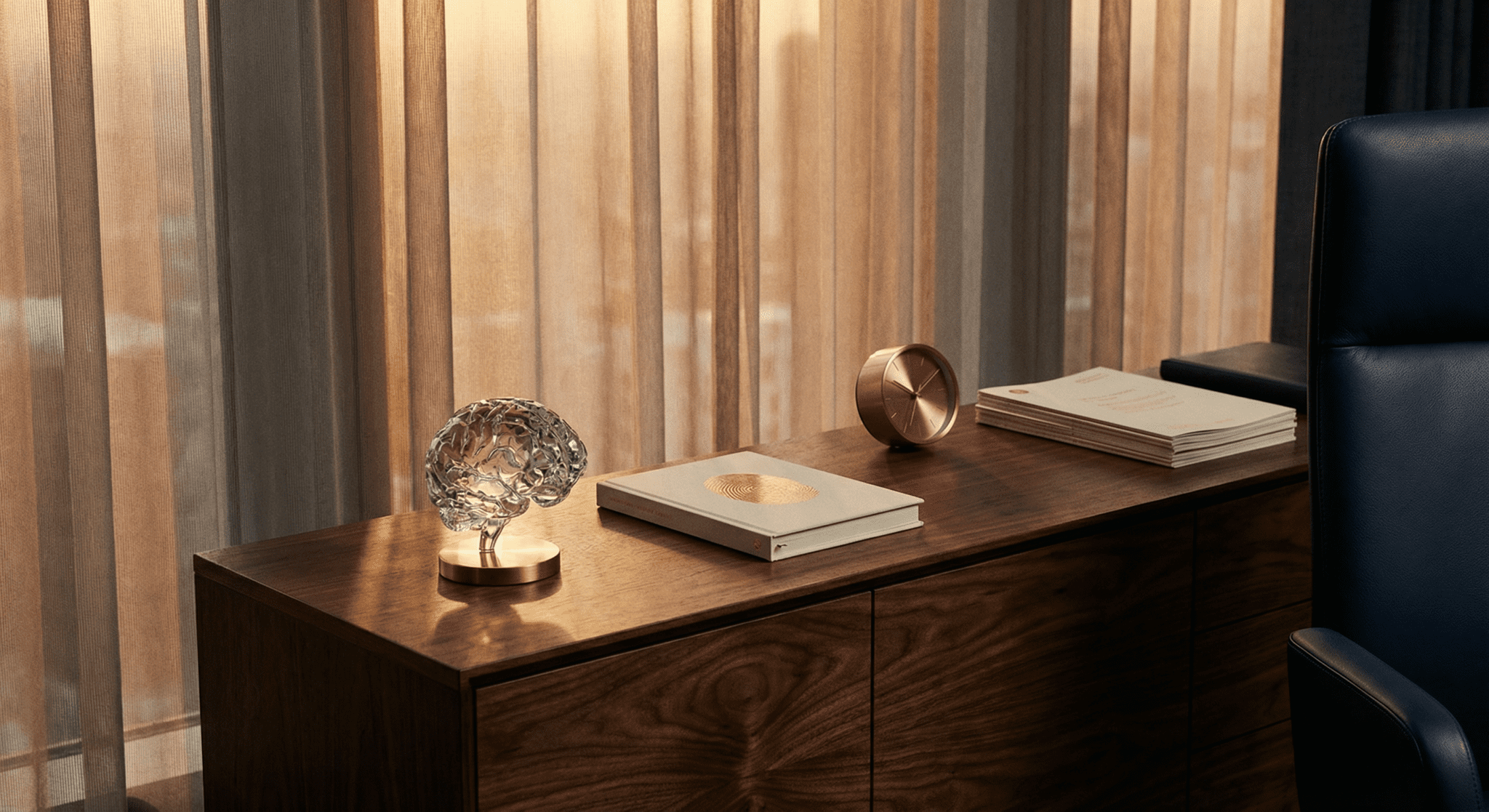
Walnut credenza with crystal brain sculpture and MindLAB journal in diffused dusk light suggesting high-floor Midtown Manhattan private office

The performance-oriented professional culture that defines Midtown produces brains trained in sympathetic-dominant, prefrontal-mediated executive function sustained attention, goal monitoring, performance evaluation — become the mechanisms that prevent sleep at night.

The environmental conditioning is relentless. Midtown residents living in apartments above or adjacent to Times Square, the Theater District, and the Sixth Avenue commercial corridor cannot escape the light and noise cues that keep the arousal system engaged. The Times Square LED environment suppresses melatonin after 10:00 PM. Construction noise provides unpredictable high-decibel disruptions that fragment sleep and activate the threat-detection circuits that sleep anxiety exploits. Thirty-nine percent of all New York City adults experience noise-related sleep disturbance on three or more nights per week, and Manhattan residents are more interventional than other borough residents precisely because they have more to defend against.

The conditioned arousal pattern deepens in Midtown because spatial separation between work and rest is minimal. When the bedroom is two blocks from the office, one block from the restaurant where the client dinner just ended, and directly above the avenue where sirens cycle through the night, the hippocampal context-encoding that should distinguish the sleep environment from the performance environment collapses. The bedroom cannot become a safety cue when it shares its sensory context with the spaces that demand vigilance.

For Midtown’s young professional population in Murray Hill sleep windows are compressed from both ends. Late-night socializing delays bedtime while early professional obligations truncate morning sleep. This bidirectional compression increases the stakes around every night’s sleep, feeding the anticipatory anxiety that drives the loop: each night that goes poorly raises the pressure on the next night, which raises the arousal, which makes the next night worse.

Dr. Sydney Ceruto, PhD — Founder, MindLAB Neuroscience

Dr. Sydney Ceruto, PhD — Founder & CEO, MindLAB Neuroscience

Dr. Ceruto holds a PhD in Behavioral & Cognitive Neuroscience from NYU and two Master’s degrees from Yale University. She lectures at the Wharton Executive Development Program at the University of Pennsylvania and has been an Executive Contributor to the Forbes Coaching Council since 2019. Dr. Ceruto is the author of The Dopamine Code (Simon & Schuster, June 2026). She founded MindLAB Neuroscience in 2000 and has spent over 26 years pioneering Real-Time Neuroplasticity™ — a methodology that permanently rewires the neural pathways driving behavior, decisions, and emotional responses.

References

Baglioni, C., Spiegelhalder, K., Regen, W., Feige, B., Nissen, C., Lombardo, C., Violani, C., Hennig, J., & Riemann, D. (2014). Insomnia disorder is associated with increased amygdala reactivity to insomnia-related stimuli. Sleep, 37(12), 1907–1917. https://doi.org/10.5665/sleep.4240

Seo, J., Moore, K. N., Gazecki, S., Bottary, R. M., Milad, M. R., Song, H., & Pace-Schott, E. F. (2018). Delayed fear extinction in individuals with insomnia disorder. Sleep, 41(8), zsy095. https://doi.org/10.1093/sleep/zsy095

Pace-Schott, E. F., Germain, A., & Milad, M. R. (2015). Effects of sleep on memory for conditioned fear and fear extinction. Psychological Bulletin, 141(4), 835–857. https://doi.org/10.1037/bul0000014

Espie, C. A., Broomfield, N. M., MacMahon, K. M. A., Macphee, L. M., & Taylor, L. M. (2006). The attention-intention-effort pathway in the development of psychophysiologic insomnia: A theoretical review. Sleep Medicine Reviews, 10(4), 215–245. https://doi.org/10.1016/j.smrv.2006.03.002

Success Stories

“My body had simply stopped knowing when to sleep. Crossing time zones weekly for over two years had broken something fundamental, and every protocol, supplement, and device I tried couldn't hold longer than a few days. Dr. Ceruto identified the disruption at the level of my suprachiasmatic nucleus and recalibrated the signaling pattern driving the dysfunction. Within weeks, my circadian rhythm locked back in. I sleep now. Consistently. Regardless of where I land.”

Jonathan K., VP of Global Operations Maersk

“My kids had been sleeping through the night for three years, but my brain hadn't caught up. I was still waking every ninety minutes like clockwork — no amount of sleep hygiene or supplements touched it. Dr. Ceruto identified the hypervigilance loop that had hardwired itself during those early years and dismantled it at the source. My brain finally learned the threat was over. I sleep through the night now without effort.”

Catherine L., General Counsel Private Equity Greenwich, CT

“Four hours a night for over two years — that was my ceiling. Supplements, sleep protocols, medication — nothing touched it because nothing addressed why my brain wouldn't shut down. Dr. Ceruto identified the cortisol loop that was keeping my nervous system locked in a hypervigilant state and dismantled it. I sleep now. Not because I learned tricks — because the pattern driving the insomnia no longer exists.”

Adrian M., Portfolio Manager Citadel New York, NY

“Endocrinologists, sleep clinics, functional medicine — every specialist cleared me, and no one could tell me why I was exhausted every single day. Dr. Ceruto identified that my HPA axis was locked in a low-grade stress activation I couldn't feel consciously. Once that pattern was disrupted at the neurological level, my energy came back in a way that felt completely foreign. I'd forgotten what it was like to not be tired.”

Danielle K., Chief Marketing Officer Luxury Retail Beverly Hills, CA

“I knew the scrolling was a problem, but I didn't understand why I couldn't stop — or why it left me feeling hollow every time. Dr. Ceruto identified the dopamine-comparison loop that had fused my sense of worth to a feed. Years of trying to set boundaries with my phone hadn't worked because the problem was never the phone. Once the loop broke, the compulsion just stopped. My relationships started recovering almost immediately.”

Anika L., Head of Brand Direct-to-Consumer Los Angeles, CA

“The way I was processing decisions under pressure had a cost I couldn't see — until Dr. Ceruto mapped it. She identified the neural pattern driving my reactivity in high-stakes situations and restructured it at the root. I don't just perform better under pressure now. I think differently under pressure. That's not something any executive coach or performance program ever came close to delivering.”

Rob Winston, Chief Operating Officer Goldman Sachs Manhattan, NY

Frequently Asked Questions About Sleep Anxiety in Midtown Manhattan

What is sleep anxiety from a neuroscience perspective?

Sleep anxiety is a circuit-level dysregulation — the breakdown of normal control systems — in which the fear of not sleeping activates the brain’s threat-detection system — specifically the amygdala and extended amygdala — creating a self-reinforcing loop where anticipatory anxiety produces the exact physiological arousal that prevents sleep. Dr. Ceruto’s approach identifies the specific nodes of this circuit and targets them for reconditioning.

Why does trying harder to sleep make it worse?

Sleep is a passive process that requires the withdrawal of effort, not its application. The brain cannot be forced into sleep through concentration or relaxation techniques performed as performance strategies. Any attempt to produce sleep activates prefrontal monitoring systems, maintains beta-wave cortical activity, and elevates stress hormones — all of which signal the nervous system that a task is incomplete and wakefulness should be maintained.

Who develops sleep anxiety?

Sleep anxiety can develop in anyone, but it is particularly common in individuals whose daily lives reward effortful performance, sustained monitoring, and outcome tracking. The neural strategies that produce success during waking hours — focused attention, error detection, goal evaluation — are the same strategies that, when applied to sleep, activate the arousal systems that prevent it. Sleep anxiety does not require a traumatic event. It can establish across weeks or months of ordinary insomnia, with each night of wakefulness adding associative weight to the bedroom-as-threat circuit.

What does the engagement process look like?

The process begins with a Strategy Call — a phone-based conversation with Dr. Ceruto to assess the sleep anxiety pattern, identify the dominant circuit nodes, and determine the appropriate methodology. The $250 Strategy Call fee applies to this initial conversation. Program structure and investment details are discussed during the Strategy Call.

Can sleep anxiety that has persisted for years be resolved?

The neural circuits underlying sleep anxiety are maintained by active learning processes — conditioned arousal, interoceptive hypervigilance — a state of constant threat-scanning —, and effort-based monitoring. Because these are learned patterns, they are accessible to neuroplastic change (related to the brain's ability to rewire itself). Extinction of conditioned fear associations, reconditioning of the sleep environment as a safety context, and autonomic retraining can progressively weaken the loop even after years of entrenchment. The timeline depends on the depth of conditioning, but the brain’s capacity to form competing safety memories does not diminish with the duration of the anxiety.

Take the First Step Toward Restful Nights

The Strategy Call is a focused conversation with Dr. Ceruto that maps the specific neural mechanisms driving your concerns and determines the right path forward.

Book a Strategy Call
MindLAB Neuroscience consultation room
Locations

The Intelligence Brief

Neuroscience-backed analysis on how your brain drives what you feel, what you choose, and what you can’t seem to change — direct from Dr. Ceruto.