Life Coach on Wall Street

A neuroscience-based approach to lasting behavioral change for professionals navigating Wall Street's relentless demands — grounded in peer-reviewed research, not motivational theory.

Wall Street attracts driven, high-capacity individuals who have optimized every external variable — compensation, credentials, network — yet find themselves stuck in patterns that no amount of discipline can override. The Financial District's unique pressure environment, where 80-to-100-hour weeks are structural norms and cognitive performance is the currency of advancement, creates behavioral loops that conventional approaches cannot reach. Dr. Sydney Ceruto's methodology operates at the neural level where these patterns originate, using Real-Time Neuroplasticity — the brain's ability to rewire itself —™ to intervene in the live moment — not retrospectively, and not through talk-based frameworks that Wall Street professionals have already exhausted.
Schedule a Strategy Call

Personal Development Coaching

The pattern is familiar: a finance professional who performs at an elite level externally while experiencing a widening gap between achievement and satisfaction. The brain’s reward circuitry adapts to chronic high-stimulation environments, requiring escalating inputs to produce the same dopaminergic response — a process neuroscientist Wolfram Schultz’s research on reward prediction errors has documented extensively. Clients who have reached senior positions in banking or asset management yet describe a flatness that neither promotion nor compensation resolves. This is not a motivation problem. It is a neural recalibration issue — the prefrontal cortex has been so chronically deployed for task execution that the circuits responsible for self-directed reflection and value integration have atrophied from disuse. My methodology maps the specific neural patterns sustaining this disconnect and restructures them in real time, restoring the internal architecture that makes external achievement meaningful again.

Learn more about Personal Development Coaching in Wall Street →

Career Coaching

Career stagnation in the Financial District rarely presents as a skills deficit. It presents as paralysis — the inability to make a career move despite clear intellectual understanding that one is needed. Research published in Neuron (Bielczyk et al., 2020) established that career development operates as a brain-driven process where structured interventions addressing goal-setting and professional identity produce measurable improvements in trajectory and psychological wellbeing. The Wall Street professional trapped in golden handcuffs is experiencing a specific neural conflict: the ventromedial prefrontal cortex, which integrates subjective value and identity relevance into goal commitment, is receiving competing signals from threat-detection circuits that have encoded the current role as “safe” regardless of its cost. I work within this conflict directly, restructuring the neural valuation system so that career decisions reflect authentic priorities rather than conditioned fear responses.

Learn more about Career Coaching in Wall Street →

Confidence Coaching

A managing director who commands a room during client pitches but freezes during internal promotion conversations. A portfolio manager whose conviction evaporates at precisely the moment position sizing matters most. Confidence deficits in finance professionals are rarely global — they are context-specific and neurologically precise. Research by Blanchette Sarrasin et al. (2025) in Trends in Neuroscience and Education demonstrated that neuroscience-based interventions activate the ventrolateral prefrontal cortex linked to inhibitory control and measurably improve perceived competence. In my practice, I identify the exact neural triggers — often rooted in early competitive conditioning during analyst training — that suppress prefrontal executive authority in specific high-stakes contexts. The intervention is not affirmation. It is targeted restructuring of the circuits governing self-efficacy in the precise situations where confidence collapses.

Learn more about Confidence Coaching in Wall Street →

Mindset Coaching

Wall Street professionals are among the most cognitively rigid populations I work with — not because they lack intelligence, but because the Financial District rewards pattern recognition and punishes deviation. Over years, neural networks consolidate around a narrow set of decision heuristics that served early career advancement but become liabilities at senior levels. Zheng et al. (2025), published in eLife, demonstrated that intensive cognitive interventions produce functional changes in brain network connectivity within one to two weeks, primarily in cognitive control networks, without requiring structural brain changes. This means the neural reorganization that underlies genuine mindset shift is achievable rapidly when the intervention targets the right circuits. My approach identifies which cognitive control networks have calcified and applies Real-Time Neuroplasticity™ to restore the flexibility that Wall Street’s evolving demands require.

Learn more about Mindset Coaching in Wall Street →

Stress Management Coaching

Chronic stress on Wall Street is not a lifestyle complaint — it is a neurological emergency operating in slow motion. Arnsten and Shanafelt (2021), writing in Mayo Clinic Proceedings, established that uncontrollable stress impairs prefrontal cortex function and causes measurable gray matter loss in the brain region responsible for goal-directed behavior, communication, and emotional regulation. These changes are reversible when stress is adequately addressed. The Wall Street bonus pool reached a record $47.5 billion in 2024 — average bonus of $244,700 per employee — yet the professionals generating those returns are operating with structurally degraded prefrontal cortices from years of chronic cortisol exposure. I do not teach stress management techniques. I intervene at the neurobiological level where the HPA axis dysregulation originates, restoring the prefrontal architecture that chronic financial-sector stress has eroded.

Learn more about Stress Management Coaching in Wall Street →

Leadership Coaching

The transition from individual contributor to leader is the single most common inflection point where Wall Street professionals seek my guidance. Research by Frisina (2024) in Frontiers in Health Services Management established that neuroscience-informed programs that incorporate stress regulation and social-collaborative learning produce measurably superior leadership outcomes compared to conventional approaches. The challenge is neurologically specific: the dorsolateral prefrontal cortex that governs cognitive flexibility and the ventromedial prefrontal cortex that governs value-aligned decision-making must both be engaged simultaneously — a dual activation that chronic stress systematically undermines. In the Financial District, where newly promoted managing directors inherit teams of fifteen while maintaining their own deal flow, this dual demand is acute. My methodology develops both neural systems in parallel, producing leaders whose authority is neurologically integrated rather than performative.

Learn more about Leadership Coaching in Wall Street →

Executive Life Coaching

Executive-level professionals in the Financial District face a paradox that conventional approaches cannot resolve: the cognitive capacities that drove their ascent — relentless focus, emotional compartmentalization, risk tolerance — become liabilities when applied to relationships, health, and personal fulfillment. Chapman et al. (2025) demonstrated through the SMART cognitive training program that executive function and self-efficacy improve with large effect sizes through structured neuroplasticity-based interventions. What emerges across engagements is that Wall Street executives who present with “work-life balance” concerns are actually experiencing a deeper neural pattern: the prefrontal circuits governing professional performance have been so heavily reinforced that the circuits governing personal life domains have weakened from disuse. My approach does not divide life into compartments. It rebuilds the neural infrastructure that allows executive-caliber cognition to operate across every domain.

Learn more about Executive Life Coaching in Wall Street →

Resilience Coaching

Resilience on Wall Street is often confused with endurance — the ability to absorb punishment without visible deterioration. Neuroscience draws a critical distinction. Kalisch, Russo, and Müller (2024), in a comprehensive review published in Physiological Reviews, established that resilience is not a fixed trait but a dynamic, modifiable capacity involving multiple interacting neural systems. The mPFC-amygdala functional connectivity that mediates emotional regulation also mediates sleep quality, which emerged as a significant predictor of resilience improvement in research published in Frontiers in Aging Neuroscience (2023). For finance professionals averaging 6.2 hours of sleep per night — with 24% averaging five hours or less, per the 2024 Wall Street Oasis survey — resilience is being structurally undermined at the neurobiological level. I address resilience as a neural engineering problem: identifying which systems are depleted, which compensatory patterns have formed, and restructuring the architecture that produces genuine adaptive capacity.

Learn more about Resilience Coaching in Wall Street →

Decision Making Support

Every consequential decision on Wall Street — from position sizing to career pivots to compensation negotiations — runs through the same neural circuitry, and that circuitry is systematically degraded by the very environment in which these decisions must be made. Warren et al. (2020), published in Biological Psychiatry, demonstrated that anxiety and stress causally disrupt the amygdala-dorsolateral prefrontal cortex circuitry governing decision-making and emotion regulation. The amygdala hijacks the dlPFC circuits responsible for rational analysis and risk assessment. Alizamini et al. (2022) extended this finding, showing that social stress — the hierarchical, competitive pressure endemic to investment banking — modulates decision-making through specific receptor activity in the infralimbic cortex. I work with finance professionals whose decision-making has degraded not because they lack analytical capacity but because chronic stress has shifted neural control from deliberative prefrontal systems to reactive limbic systems. The intervention restores prefrontal authority over the decision process.

Learn more about Decision Making Support in Wall Street →

Emotional Intelligence Coaching

Emotional intelligence in the Financial District is simultaneously undervalued and urgently needed. A 2026 systematic review by Martín-Aguiar, Fernández-Berrocal, and Megías-Robles confirmed the neurological architecture underlying emotional intelligence — establishing it as a brain-based capacity with identifiable neural correlates amenable to targeted intervention. Wall Street’s training culture explicitly suppresses emotional expression from the analyst level forward, creating professionals whose amygdala-PFC pathways have been conditioned for emotional compartmentalization rather than emotional integration. I regularly see that this conditioning produces a specific deficit: high performance in transactional interactions but progressive failure in relationship-dependent contexts — team leadership, partnership dynamics, client retention, and personal relationships. My methodology does not teach emotional skills. It restructures the neural pathways that Wall Street’s culture has systematically narrowed.

Learn more about Emotional Intelligence Coaching in Wall Street →

Work Performance Coaching

Performance degradation in high-functioning finance professionals is neurologically distinct from underperformance. A meta-analysis published in Neuropsychopharmacology (2021) confirmed that work performance is directly linked to prefrontal cortex volume, thickness, and connectivity — and that these neural substrates are trainable. The Wall Street professional experiencing performance decline is typically not working less hard. They are working with a prefrontal cortex that has been structurally compromised by chronic stress, insufficient sleep, and sustained cognitive overload. Fujii et al. (2023), published in GeroScience, demonstrated that targeted interventions significantly improve executive function by modulating neural efficiency in the prefrontal cortex. I identify the specific cognitive domains where performance has degraded — working memory, attentional control, cognitive flexibility — and apply interventions that restore neural efficiency rather than adding compensatory strategies on top of impaired circuitry.

Learn more about Work Performance Coaching in Wall Street →

Burnout Prevention Coaching

Burnout on Wall Street is not a risk factor — it is a statistical certainty given the working conditions. The 2024 Wall Street Oasis survey documented a 22% decline in mental health and a 26% decline in physical health among respondents since starting their current investment banking positions, with 62% reporting that work hours negatively affected relationships. Arnsten and Shanafelt (2021) in Mayo Clinic Proceedings established that chronic uncontrollable stress causes measurable gray matter loss in the prefrontal cortex — and critically, that these changes are reversible when addressed before they become permanent. I do not wait for burnout to arrive. I identify the neurobiological phase a client occupies — using cortisol patterns and cognitive performance markers — and intervene during the strained or cynical phases, before the prefrontal architecture sustains irreversible damage. For finance professionals, this is the highest-ROI intervention available: preserving the neural capital that generates their economic value.

Learn more about Burnout Prevention Coaching in Wall Street →

Communication Skills Coaching

Effective communication depends on executive functions mediated by the prefrontal cortex — working memory for holding conversational context, inhibitory control for regulating impulsive responses, and cognitive flexibility for adapting communication style in real time. Arnsten and Shanafelt (2021) specifically identified poor communication as a burnout symptom driven by PFC degradation. In the Financial District, where client relationships, deal negotiations, and internal politics all depend on precise communication under pressure, this degradation has direct economic consequences. Avramović et al. (2023), published in the Journal of Medical Internet Research, demonstrated that structured communication interventions using cognitive-behavioral frameworks produce statistically reliable positive changes in conversation skills and quality of life. My approach targets the neural substrate of communication rather than its surface mechanics — restoring the prefrontal capacity that makes clear, adaptive, influential communication possible under the pressure conditions that define Wall Street interactions.

Learn more about Communication Skills Coaching in Wall Street →

Change Management Coaching

The resistance to change that Wall Street professionals experience — whether career transitions, role shifts, or behavioral pivots — is not a character flaw. It is a neurological default. Zheng et al. (2025) in eLife demonstrated that cognitive interventions produce functional changes in brain network connectivity within weeks, primarily in cognitive control networks. Laird et al. (2024) in Current Opinion in Behavioral Sciences found that teaching neuroplasticity — the principle that the adult brain can reorganize in response to new demands — directly shifts the cognitive architecture that enables change, with effects persisting at six-week follow-up. For finance professionals whose neural networks have consolidated around years of repetitive high-stakes decision patterns, change requires more than motivation. It requires a targeted intervention that loosens the calcified circuits and creates new pathways. My methodology identifies which specific networks resist reorganization and applies the precise inputs needed to enable the shift.

Learn more about Change Management Coaching in Wall Street →

Public Speaking Confidence

Public speaking anxiety in Wall Street professionals is neurologically distinct from general social anxiety. Anderson et al. documented that individuals with speech anxiety show sustained, less dynamic amygdala activation during speech anticipation — the amygdala activates and fails to deactivate, overwhelming prefrontal regulatory capacity. For the managing director who presents flawlessly to clients but stumbles during internal committee presentations, or the portfolio manager who articulates investment theses one-on-one but freezes during quarterly reviews, the pattern is neurologically precise and addressable. Laird et al. (2024) confirmed that exposure-based approaches grounded in amygdala reconditioning shift beliefs about the controllability of anxiety and produce measurable resilience improvements, with a medium positive effect size on anxiety symptoms. I identify the exact contexts that trigger the dysregulated amygdala response and restructure the neural pathway in those specific situations — not through generic desensitization, but through Real-Time Neuroplasticity™ applied at the moment the pattern fires.

Learn more about Public Speaking Confidence in Wall Street →

Breakthrough Sessions

The neuroscience of insight — the “Aha!” moment — is not metaphorical. Tik et al., using ultra-high-field fMRI, documented that breakthrough moments produce hyperactivation in the nucleus accumbens (reflecting sudden relief and confidence), the ventral tegmental area (encoding certainty about a decision), and the posterior hippocampus (memory reorganization following insight). Bernhardt et al. (2023) in Scientific Reports confirmed that insight-enhanced nucleus accumbens activity promotes risk-appropriate decision-making after the breakthrough. For Wall Street professionals trapped in repetitive behavioral patterns — the same relationship conflicts, the same career paralysis, the same stress responses — breakthrough sessions are designed to create the precise neurological conditions under which the brain reorganizes its own circuitry. I do not manufacture breakthroughs through emotional intensity. I engineer the cognitive and neurochemical conditions that allow the prefrontal cortex and reward systems to converge on a new configuration, producing insight that is neurologically consolidated and durable.

Learn more about Breakthrough Sessions in Wall Street →

Wall Street is not merely a location — it is the most extreme professional pressure environment in the United States, and the behavioral patterns it produces are correspondingly extreme. The Financial District’s securities industry represents just 4.9% of New York City’s private sector employment but accounts for 20% of all private sector wages, creating a compensation-driven identity structure where self-worth and net worth become neurologically fused. The 2024 Wall Street bonus pool reached a record $47.5 billion, with average bonuses of $244,700 per employee. These figures attract and retain individuals whose dopaminergic reward circuits have been calibrated to financial stimulus — and whose brains have adapted to operating under chronic cortisol loads that would be clinically concerning in any other population.

The working conditions are documented and severe. Junior bankers regularly log 100-hour weeks, with 24% of investment banking professionals averaging five hours of sleep or less per night. A London cardiologist specializing in banking-sector patients documented a 10% rise in cardiac arrests among bankers under 30 over the past decade. The 2024 Wall Street Oasis survey — sampling 531 banking professionals — found a 22% decline in mental health and 26% decline in physical health since starting current positions, with 59% reporting frequent unrealistic deadlines and 24% feeling like victims of workplace abuse.

This environment creates demand that conventional approaches cannot meet. The Financial District’s professionals are analytically rigorous, evidence-oriented, and deeply skeptical of interventions they perceive as “soft.” They have often cycled through multiple practitioners — coaches, therapists, consultants — without producing lasting change, because those approaches addressed behavior without reaching the neural circuits that generate behavior. The concentration of investment banks (Goldman Sachs, JPMorgan, Morgan Stanley, Citigroup), hedge funds (Point72, Millennium, Two Sigma, D.E. Shaw), private equity firms (Blackstone, KKR, Apollo), elite legal practices (Sullivan & Cromwell, Davis Polk, Cleary Gottlieb), and a rapidly expanding fintech sector creates a professional ecosystem where cognitive performance is the primary competitive advantage — and where the neurological costs of sustaining that performance are rarely addressed until the damage becomes visible.

In my practice, I consistently observe that Wall Street clients arrive not because they are failing, but because they sense the gap between their external performance and their internal experience is widening — and they recognize, often intuitively, that the solution must operate at a deeper level than anything they have previously tried.

Dr. Sydney Ceruto, PhD — Founder, MindLAB Neuroscience

Dr. Sydney Ceruto holds a PhD in Behavioral & Cognitive Neuroscience from NYU and Master’s degrees in Clinical Psychology and Business Psychology from Yale University. She is a Lecturer in the Wharton Executive Development Program at the University of Pennsylvania, an Executive Contributor to Forbes Coaching Council, and an inductee in Marquis Who’s Who in America. Dr. Ceruto founded MindLAB Neuroscience in 2000 and has spent more than 26 years developing and refining her proprietary methodology, Real-Time Neuroplasticity™. She is the author of The Dopamine Code (Simon & Schuster, June 2026).

References

Diamond, A. (2013). Executive functions. Annual Review of Psychology, 64, 135–168. https://doi.org/10.1146/annurev-psych-113011-143750

Ochsner, K. N., & Gross, J. J. (2005). The cognitive control of emotion. Trends in Cognitive Sciences, 9(5), 242–249. https://doi.org/10.1016/j.tics.2005.03.010

Pascual-Leone, A., Amedi, A., Fregni, F., & Merabet, L. B. (2005). The plastic human brain cortex. Annual Review of Neuroscience, 28, 377–401. https://doi.org/10.1146/annurev.neuro.27.070203.144216

Success Stories

“Excellent experience working with Dr. Ceruto. Very effective method that gave me the results I was looking for to improve my professional relationships. I loved the neuroscience woven into the art of higher-level communication and relationship building. Dr. Ceruto is extremely astute and does not require you to go back in history over and over to understand what’s going on. Her attention to detail, dedication to follow-up, and breadth of knowledge in my industry is truly unparalleled. I can’t recommend her highly enough.”

Dan G. — Hedge Fund Manager Greenwich, CT

“Dr. Ceruto's methodology sharpened my negotiation instincts and built a level of mental resilience I didn't know I was missing. The difference showed up in how my team responds to me — trust, respect, and a willingness to follow that I'd been trying to manufacture for years. I stopped trying to project authority and started operating from it. That's the difference.”

Victoria W. — Trial Attorney New York, NY

“My communication was damaging every relationship in my professional life and I couldn't see it. Dr. Ceruto's neuroscience-based approach didn't just improve how I communicate — it rewired the stress response that was driving the pattern in the first place. The people around me noticed the change before I fully understood what had happened. That tells you everything.”

Bob H. — Managing Partner London, UK

“Unfortunate consequences finally forced me to deal with my anger issues. I’d read several books and even sought out a notable anger specialist, but nothing was clicking. Then I found Sydney’s approach and was intrigued. Her insightfulness and warm manner helped me through a very low point in my life. Together we worked through all my pent-up anger and rage, and she gave me real tools to manage it going forward. I now work to help others learn how to control their own anger.”

Gina P. — Trial Attorney Naples, FL

“I struggled with anxiety since I was 13. I simply could not control my thoughts, and no medication or therapy was helping. Since working with Sydney, I’ve gained a whole new perspective on what anxiety actually is and — most importantly — how to control it. Her approach is unlike anything I’ve ever experienced, a must for anyone who wants to understand what drives their actions and emotions. At 28, I’m finally in a happy place with solid emotional management and real coping skills.”

Lydia G. — Gallerist Paris, FR

“I'd relocated internationally before, but this time my nervous system wouldn't settle. Everything unfamiliar registered as danger — new people, new routines, even the sound of a different language outside my window. Pushing through it only deepened the pattern. Dr. Ceruto identified that my nervous system was coding unfamiliarity itself as threat and restructured the response at its source. The world stopped feeling hostile. I stopped bracing.”

Katarina L. — Gallerist Zurich, CH

Frequently Asked Questions About Neuroscience-Based Personal Transformation

How is MindLAB Neuroscience different from conventional personal development programs?

Conventional programs work at the behavioral level — setting goals, building habits, and creating accountability structures. These approaches produce temporary changes that revert under pressure because they do not alter the neural architecture generating the behaviors. Dr. Ceruto works at the circuit level — restructuring the prefrontal, limbic, and reward systems that produce the patterns you want to change. When the architecture changes, the behavioral change is self-sustaining because the brain's default processing has shifted.

What types of personal challenges does this neuroscience-based approach address?

The scope spans any persistent pattern that has resisted conventional approaches: emotional regulation, relationship dynamics, self-sabotage, motivation and drive, confidence and self-assessment, decision-making under pressure, stress response, communication patterns, and the gap between potential and performance. The common thread is not the content of the pattern but its persistence — if it has resisted insight-based and behavioral approaches, the resistance is architectural.

How long does the process typically take before I notice meaningful changes?

Most individuals notice measurable shifts in how they process situations within weeks of beginning targeted work. The timeline depends on how deeply encoded the patterns are and how many neural systems are involved. Changes in stress response and emotional regulation are typically noticed first, followed by shifts in decision-making, relationship patterns, and the more deeply embedded aspects of identity architecture.

Do I need a specific diagnosis or condition to benefit from this work?

No. This is not a medical practice and Dr. Ceruto does not provide diagnoses. The work addresses persistent patterns — regardless of whether they have been labeled with a formal diagnosis. Many individuals who seek this work have no diagnosable condition; they simply have neural architecture that produces patterns they want to change and that have not responded to conventional approaches.

How does Dr. Ceruto determine which neural systems are maintaining my patterns?

The initial assessment maps the relationship between your presenting patterns and the neural systems most likely maintaining them. This involves understanding not just what the pattern looks like but when it activates, what triggers it, how it has responded to prior intervention attempts, and what maintains it despite genuine effort to change. This mapping identifies the specific circuits — threat response, reward architecture, identity systems, executive function — that require targeted intervention.

Can this work be done remotely, or do I need to be in person?

Dr. Ceruto works with clients both in-person and via phone. The Strategy Call is a phone conversation — not a video call — because eliminating visual stimuli activates deeper processing pathways and creates conditions for greater clarity. Ongoing work can be conducted remotely, allowing clients worldwide to access Dr. Ceruto's methodology without geographic constraint.

What should I expect from the Strategy Call?

The Strategy Call is a one-hour phone conversation designed to map the neural landscape of the patterns you want to address. It is not a sales conversation — it is a precision assessment that identifies which neural systems are maintaining your patterns and whether Dr. Ceruto's methodology is the appropriate intervention. You will leave the call with a clear understanding of what is driving your patterns at the neurological level.

How does this approach ensure lasting change rather than temporary improvement?

Lasting change requires restructuring the neural circuits that generate the pattern — not layering strategies on top of unchanged architecture. When the brain's default mode network updates its self-model, when threat-detection thresholds recalibrate, when reward architecture realigns with genuine priorities, the changes persist because the biological system producing the old behavior has been genuinely altered. This is the fundamental difference between neural architecture work and behavioral modification.

Ready to Perform at Your Highest Level?

Wall Street demands cognitive performance that no amount of discipline can sustain indefinitely. If the gap between your external results and your internal experience is widening, the solution operates at the neural level where the pattern began.

Schedule a Strategy Call
MindLAB Neuroscience consultation room

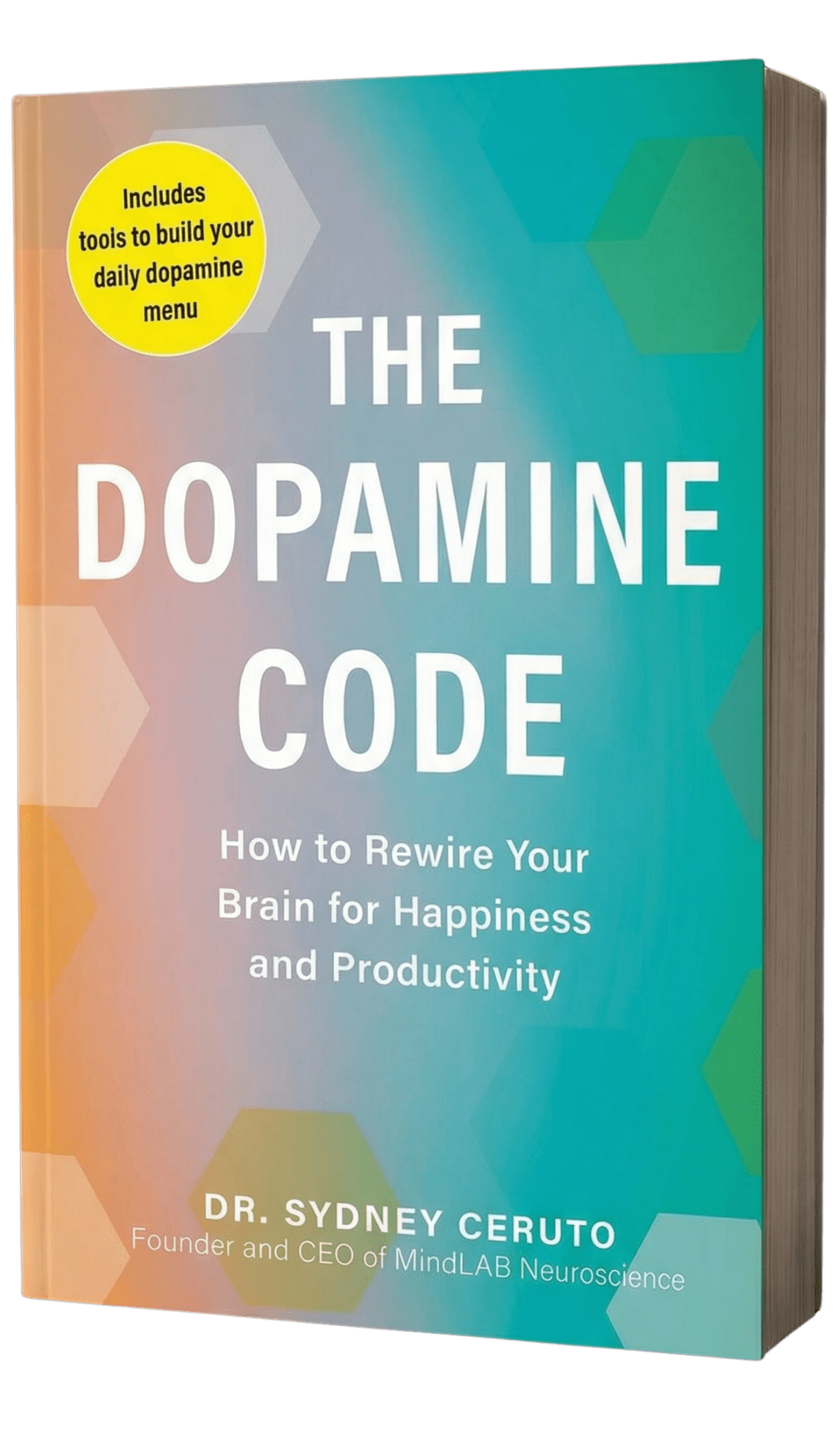
The Dopamine Code

Decode Your Drive

Why Your Brain Rewards the Wrong Things

Your brain's reward system runs every decision, every craving, every crash — and it was never designed for the life you're living. The Dopamine Code is Dr. Ceruto's framework for understanding the architecture behind what drives you, drains you, and keeps you locked in patterns that willpower alone will never fix.

Published by Simon & Schuster, The Dopamine Code is Dr. Ceruto's framework for building your own Dopamine Menu — a personalized system for motivation, focus, and enduring life satisfaction.

Order Now

Ships June 9, 2026

The Dopamine Code by Dr. Sydney Ceruto — Decode Your Drive
Locations

The Intelligence Brief

Neuroscience-backed analysis on how your brain drives what you feel, what you choose, and what you can’t seem to change — direct from Dr. Ceruto.