
Key Takeaways
- Rewiring requires an active target circuit, a new response during activation, repeated for synaptic consolidation.
- No neurological basis for “21 days”: synaptic consolidation runs weeks to years by circuit depth.
- Emotional activation enhances neuroplasticity: aroused circuits show faster, more durable synaptic change than neutral ones.
- Precision beats volume: 10 emotionally activated repetitions beat 1,000 in the wrong state or circuit.
- Intellectual understanding (prefrontal) and circuit-level change (subcortical) are separate processes requiring separate mechanisms.
If you have ever told yourself, “I know what to do, so why can’t I do it?” you are not broken. You are patterned. And the good news is that patterns can change, the foundation of cognitive flexibility and thought patterns. In my 26+ years of applied neuroscience work and neuroscience-based practice at MindLAB Neuroscience, I have watched people learn how to rewire their brains in ways that feel almost unbelievable at first. We don’t achieve such success through mere hype. This process does not rely on motivational speeches but on clear, repeatable brain training that fits real life.
When people ask me how to rewire their brain, they usually want one of three things: to stop a behavior that keeps pulling them backward, to start a behavior they cannot seem to sustain, or to change an emotional response that feels automatic. The science of neuroplasticity covers all three. But you need the correct map.
This is that map.
How to rewire your brain starts with one truth about neuroplasticity
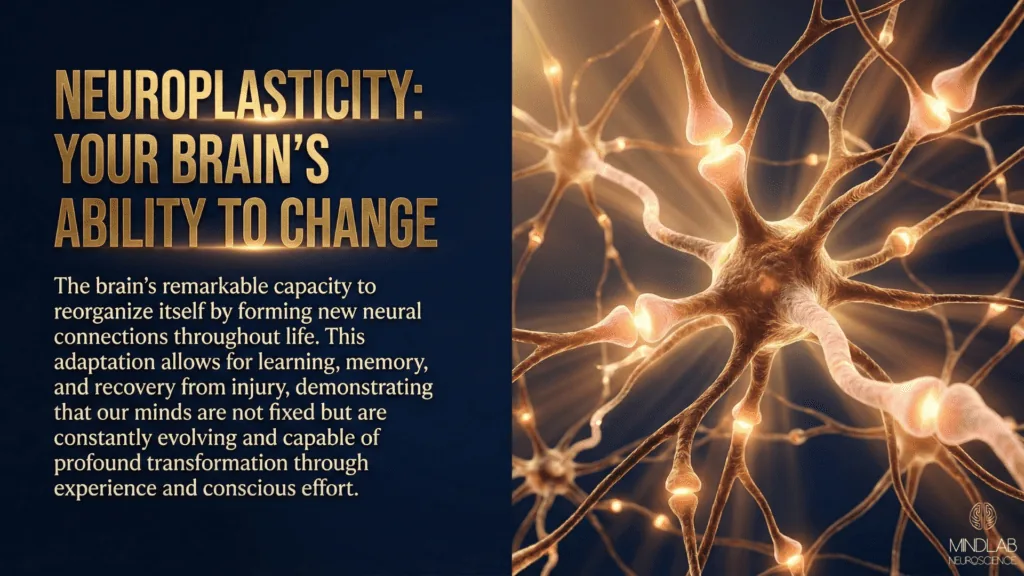
Neuroplasticity is your brain’s ability to change based on what you repeat. The more profound truth is this: your brain changes most when attention, emotion, and repetition occur together in a single moment. Structural change follows from consistent, targeted practice rather than passive exposure or intention alone.
Dr. Sydney Ceruto details how the brain rewires in the live moment it counts.
Attention
Emotion
Repetition
If you want to understand how to rewire your brain, stop thinking of your brain as a library where you “store” facts and start thinking of it as a living city. Roads get reinforced where traffic flows. Shortcuts form where you keep walking. If you drive the same route every day, that road becomes fast and automatic. That is efficient. It is also why your old patterns feel so stubborn.
Your brain is a prediction machine, not a truth machine
A lot of people think the brain’s job is to see reality clearly. It is not. Your brain’s job is to keep you alive by predicting what happens next. Prediction saves energy. Prediction prevents danger. Prediction also creates habits of thought.
If your brain predicts rejection, it will scan for rejection.
If your brain predicts failure, it will avoid the attempt.
If your brain predicts stress, it will mobilize your body before the stress even arrives.
So when you ask how to rewire your brain, you are really asking, “How do I train a new prediction?”

Why insight alone rarely changes behavior
Insight is valuable. It is also often powerless on its own.
I have worked with founders who can explain their childhood wounds in perfect detail, yet they still blow up in meetings. I have encountered high achievers who possess knowledge from numerous productivity books, yet they continue to delay tasks. Knowing is not the same as wiring.
Wiring is built through lived repetition. The goal is not to “understand yourself better.” The goal is to train your nervous system to run a different program under pressure. That is how to rewire your brain in the real world.
Why an old pattern can change at all
Consolidation explains how something new gets saved. It does not explain how something old gets rewritten. That is the harder problem, because the pattern you want to change is already built.
Animal research points to an answer, called reconsolidation. Nader, Schafe and LeDoux showed in rats in 2000 that a reactivated fear memory needs fresh protein synthesis to persist. The implication is that a retrieved memory can turn briefly unstable before it re-settles. Under the right conditions it might be edited in that window rather than buried under something newer.
In people it is an open question, and I would rather say that than borrow certainty. One much-studied procedure pairs retrieval with extinction. It has produced positive reports, including one with amygdala imaging to go with it (Agren and colleagues, 2012). A pre-registered replication of the same procedure found no lasting reduction in fear (Chalkia and colleagues, 2020). A 2018 review in Psychological Bulletin, from one of the labs doing this work, finds many human observations consistent with reconsolidation. It still calls the account viable but hotly contested.
Here is what that means for you. Insight arriving after the fact has nothing live to work on. Whether the biology turns out to be reconsolidation or something adjacent, the practical rule is the same: get to the pattern while it is running.
How to rewire your brain by changing what your attention rewards
Attention functions as the primary selector in neural learning: whatever you consistently direct it toward becomes reinforced at the synaptic level. Attention shapes predictive coding in ways that determine which neural pathways grow stronger over time.
Think of attention as the “select” button on your brain’s remote control. Whatever you select gets amplified.
If you want to master rewiring your brain, start here: you must stop feeding the pattern you are trying to eliminate.
That does not mean you never think the thought again. It means you stop rewarding it with time, rumination, and emotional rehearsal.
The attention trap that keeps people stuck
Repeated mental rehearsal of a fear scenario strengthens that neural circuit regardless of whether the threat is real or imagined. Many people try to resolve difficult feelings by thinking harder: replaying conversations, rehearsing comebacks, scanning for certainty. That feels productive, but neuroscience confirms it often deepens the groove rather than smoothing it.
Every time you rehearse a fear story, you are practicing it.
Every time you re-check, re-open, re-read, and re-ask, you are strengthening uncertainty.
If you want to learn how to rewire your brain, you need a new relationship with your mental content. Thoughts can be data without being directives.
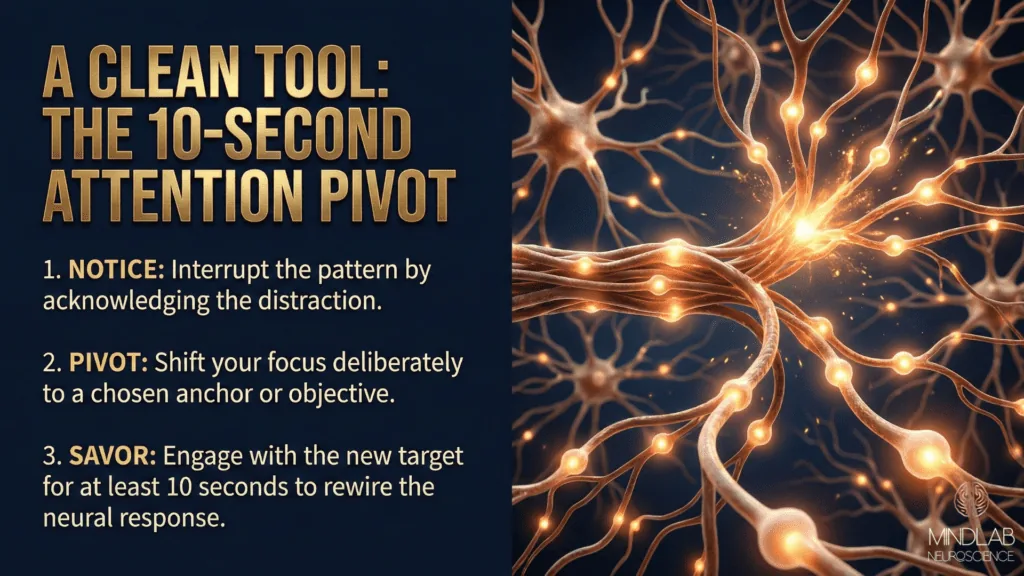
A clean tool: the 10-second attention pivot
This simple procedure is one of the easiest ways to rewire your brain, and it can be done when you’re stressed.
- Label what is happening in plain language.
“My brain is predicting danger.”
“My brain is searching for certainty.”
“My brain is looping.” - Shift your eyes and your body to something concrete.
Pick one: your feet on the floor, your breath, a sound in the room, or a single object. - Give it 10 seconds of full attention.
Not as a focused stillness performance. As a neurological interrupt.
This is not about “calming down.” It is about breaking the automatic attention reward that keeps the loop alive. This is how to rewire your brain in tiny, real moments.

How to rewire your brain when stress is running the show
A stressed brain is not a learning brain. Under threat, your brain narrows its focus, speeds its conclusions, and prioritizes safety over growth. That is normal biology. It is also why people keep repeating the same reaction even when they hate it.
If you want to understand how to rewire your brain, you must understand the state you’re in. Your state is the platform your brain is standing on. In a threatened state, your brain will reach for old wiring because old wiring is fast.
The “survival mode” sequence that hijacks your choices
Here is a pattern I see constantly in high-achieving clients. Understanding the neural mechanisms underlying this experience requires examining how different brain regions communicate through complex signaling pathways, creating patterns of activation that shape perception, motivation, emotional responses, and decision-making processes across various life contexts and developmental stages.
Trigger: an email, a tone, a missed deadline, a vague text, a sudden change
Body: tight chest, shallow breath, shoulder tension, restless energy
Mind: urgency, catastrophizing, self-attack, rigid rules
Behavior: snapping, avoiding, doomscrolling, overeating, overworking, shutting down
That is not a character flaw. It is a nervous system sequence.
Learning to rewire your brain means intervening earlier in the sequence, before the behavior becomes the release valve.
A practical nervous system reset you can do anywhere
Try this the next time you feel hijacked. It is simple, but it is not soft.
- Exhale longer than you inhale for five breaths.
You are sending your brain one message: “This is not an emergency.” - Relax your jaw and tongue.
Most people carry a threat in their mouths without realizing it. - Drop your shoulders on each exhale.
Give your body the signal that the “brace” is no longer needed.
Then take one small action that aligns with the life you want. One email. One sentence. One dish. One minute of the task.
This is how to rewire your brain: you are pairing regulation with behavior, not using regulation as an escape.
How to rewire your brain with the MindLAB Real-Time Neuroplasticity™ Method
At MindLAB Neuroscience, I teach a simple structure that clients can apply in high-pressure moments. It is not about becoming a different person overnight. It is about training a new response in real time, where the brain actually learns.
If you want to learn how to rewire your brain, you need a method that survives stress. Here is mine.
Step 1: Notice the pattern early
Most people notice their pattern after it has already cost them something. This is typically observed after an argument. After the binge. The training begins after the procrastination period. The training begins after the shutdown.
The training is noticeable earlier. Look for your early signals.
I can’t focus
I feel rushed
I need certainty right now
I want to escape this feeling
I’m about to people-please
I’m about to get sharp
Early noticing is how to rewire your brain because it creates a choice point.

Step 2: Name the brain job, not the drama
Instead of “I’m a mess,” use “My brain is doing a job.”
My brain is scanning for a threat
My brain is chasing relief
My brain is conserving energy
My brain is trying to avoid rejection
This disruption reduces shame, and shame is a learning killer. Shame makes people hide from their own experience. Clear naming makes people train.
Step 3: Nudge the nervous system by 5 percent
The nervous system should not be fully stimulated. The nervous system is not completely at ease. Five percent.
Softer jaw
Slower breath
Feet grounded
Unclench hands
Sit back instead of forward
If you can shift the body even slightly, you can change the brain’s prediction. That is how to rewire your brain without needing ideal conditions.
Step 4: Repeat the “micro-rep” on purpose
A micro-rep is a small repetition of the new behavior in the moment it counts.
Send the email you avoid
Tell the truth with one sentence
Pause before reacting
Finish the last 10 percent instead of abandoning
Micro-reps help rewire your brain by providing objective evidence that your system can perform differently.
How to rewire your brain to break habit loops without relying on willpower
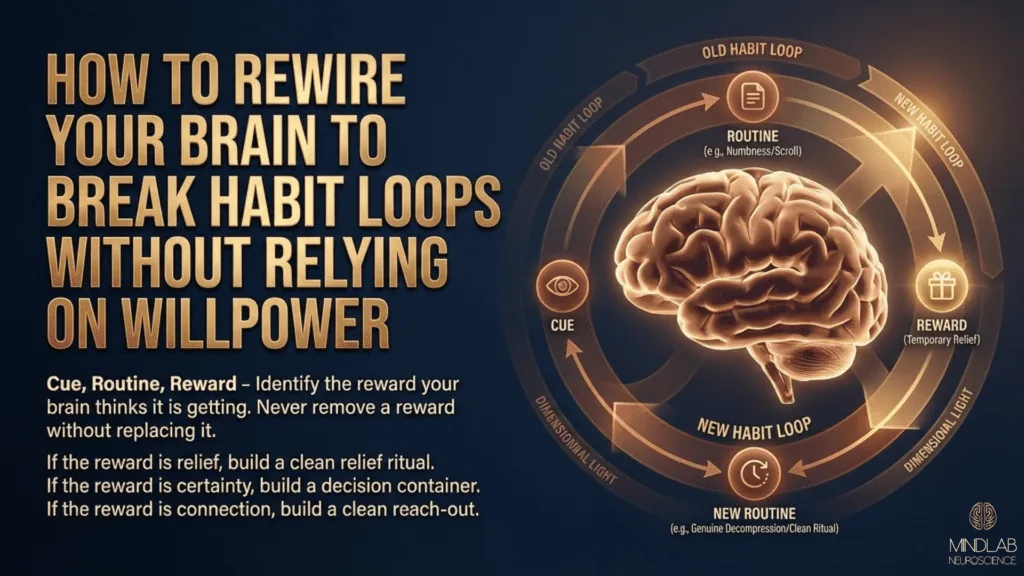
Habits are not random. Habits are efficient loops.
Cue
Routine
Reward
If you want to understand how to rewire your brain, do not start by attacking the routine. Start by identifying the reward your brain thinks it is getting.
Case example: the nightly scroll that “won’t stop”
A client of mine, a high-level executive, told me she had “no discipline” at night. Each night, she vowed to retire early, yet consistently remained awake, engrossed in scrolling.
When we tracked it, the reward was not entertainment. The reward was numbness. Her brain was using her phone to downshift a day of pressure.
Once we saw that, the work changed.
We did not start by deleting apps.
We started by building a new downshift reward.
A 7-minute decompression routine
A low-light environment
A warm shower or face wash ritual
A single page of a familiar book.
A two-sentence journal closeout
Then we made the phone harder to reach, not through punishment, but through design.
Phone charged outside the bedroom
Notifications off after 9 p.m.
One “closing playlist” that signaled bedtime
This is how to rewire your brain: you replace the reward with something that meets the same need but costs you less.
The Habit Swap Rule that makes change realistic
Most people try to remove a habit, leaving a hole. The brain hates holes. The brain will fill the hole.
If you want to learn how to rewire your brain, use this rule:
Never remove a reward without replacing it.
If your habit gives you relief, you must build a clean relief.
If your habit gives you certainty, you must build a clean certainty.
If your habit gives you a sense of connection, you must build a clean connection.
That is not a weakness. That is brain design.
A short protocol: rewiring one habit in 14 days
Day 1–2: Track the loop
Write down: cue, routine, reward, time, state.
Day 3–5: Keep the cue, change the routine
Same time, same trigger, new action
Day 6–10: Make the new routine easier than the old one
Reduce friction: prep, environment, reminders
Day 11–14: Strengthen the reward
Celebrate completion, even if it is small
Your brain needs to register “this worked.”
This is how to rewire your brain in a way that is measurable, not motivational.
How to rewire your brain to stop overthinking and decision paralysis
Overthinking often looks intellectual. Neurologically, it is usually a threat response.
The brain is trying to reduce uncertainty.
It keeps generating more options.
It keeps scanning for the “right” move.
If you want to learn how to rewire your brain, you have to stop viewing overthinking as a personality trait and start addressing it as a pattern that has a purpose.
What overthinking is actually protecting you from
In session, when we trace it back, overthinking usually protects against one of these fears:
Being judged
Being wrong
Feeling regret
Losing control
Feeling rejection
Feeling disappointment
Overthinking is the brain’s attempt to prevent pain by forecasting every outcome. The problem is that forecasting becomes its own pain.
Case example: the founder who could not choose
A founder I worked with was brilliant and stuck. He had two strong business options. He kept making spreadsheets, calling mentors, and re-checking data he already knew.
The turning point was not more analysis. It was a nervous system shift.
We created a decision container:
A 20-minute decision window
Two criteria that mattered most
One “good enough” standard
A commitment to act, not to be perfect
Then we trained a new response when the urge to re-check hit.
He would say, “This is my brain searching for certainty.”
Then he would do one action that moved the chosen path forward.
That is how to rewire your brain: you train action as the antidote to rumination.
The 3-question filter for faster decisions
When you feel stuck, ask:
- What is the next smallest decision, not the final one?
- What would I choose if I trusted I could adapt later?
- What choice aligns with my values, even if it is uncomfortable?
This is a clean way to learn to rewire your brain, as it builds flexibility. Flexibility is a sign of safety. Safety is where learning happens.
How to rewire your brain for focus in a distracted world
Focus is not a moral quality. Focus is a trained state. And for many people, the issue is not laziness. It is that their attention has been trained to expect constant novelty.
If you want to know how to rewire your brain for focus, you must train two things:
Sustained attention
Recovery from distraction
Ways to rewire your brain for happiness without forcing positivity
Rewiring your brain for happiness is not about pretending you are fine. It is about training your nervous system to register safety, meaning, and reward again, especially if you have been living in a state of stress and survival mode.
Science-backed ways to rewire that make happiness feel real
Here are science-backed ways to rewire your emotional baseline without turning your life into a full-time self-improvement project.
First, shrink the reward window. Your brain learns faster when a reward is close to the behavior. If you only reward yourself after a significant milestone, your brain will not feel reinforced often enough to stay engaged. Build “micro-rewards” that are clean and immediate: a short walk, a warm drink, sunlight, music, or a two-minute reset.
Second, retrain “meaning,” not just pleasure. Pleasure spikes are not the same as sustained well-being. Meaning is the signal that your effort matters. A simple way to train meaning is to end your day with one sentence: “Today mattered because ____.” You are not journaling for aesthetics. You are teaching your brain what to tag as valuable.
Third, use planned novelty. Novelty is a powerful brain signal that increases learning and lifts mood. The mistake is leaving novelty to algorithms. Choose it on purpose: a new walking route, a new skill, a new recipe, a new conversation, a new class. Your brain reads chosen novelty as agency, and agency is a happiness amplifier.
Maintain cognitive fitness as you age by training your reward system
To maintain cognitive fitness as you age, you want your brain to keep doing two things well: updating predictions and recovering from stress. That is cognitive fitness as you age in plain language. It is not about being “sharp” only in your mind. It is also about staying flexible in your emotions and behavior.
Here is a simple weekly template I give clients who want to keep their mood and cognition strong:
Two sessions per week of focused learning (30–45 minutes)
Three sessions per week of deliberate movement (20–40 minutes)
Five minutes per day of nervous system downshifting (breath, walk, or stretch)
One social connection rep per day (text, call, or real interaction)
This is not a “perfect routine.” It is a set of inputs that protect cognitive fitness as you age while also stabilizing mood.
A quick case example from MindLAB
One client came in saying, “I have a great life, but I don’t feel happy.” She was high-functioning, productive, and emotionally flat. Her brain was not failing. It was conserving. We built a small plan around chosen novelty, micro-rewards, and recovery.
The focus myth that hurts high performers
Many high performers believe focus should feel effortless. When it does not, they assume something is wrong with them. That belief creates friction, which in turn increases avoidance.
Focus often feels like effort at first. That is normal. Learning how to rewire your brain means you stop waiting to feel ready and you train readiness.
A practical deep work ramp that does not require motivation
Use this “ramp” when your brain feels scattered:
Minute 1: Clear the deck
Write down the three tasks pulling at you, then choose one
Minutes 2–6: Low-pressure entry
Do the easiest part of the task first
Open the doc, title the file, and outline three bullets
Minutes 7–22: Single-task sprint
One tab
One objective
If distracted, return without drama
Minutes 23–25: Close the loop
Write the next step before you stop
This protects your future self from restart friction
This is how to rewire your brain for focus: you are training for consistent re-entry, not perfect concentration.
Case example: attention fragmentation that looked like “ADHD”
I have worked with many clients who believe they have an attention challenge when the real issue is attention fragmentation. They switch tasks every two minutes, not because they cannot focus, but because their brain is trained to chase micro-rewards.
When we stabilize the reward system, the person often feels like they “got their brain back.”
We build:
Time blocks with a visible finish
Short breaks with movement
A clear start ritual
A clear stop ritual
If you want to learn how to rewire your brain, you need rituals that tell the brain, “This is the lane now.”

How to rewire your brain in relationships and emotional triggers
Your relationship patterns are not just “communication skills.” They are often nervous system patterns formed through years of emotional learning.
If you grew up walking on eggshells, your brain may scan for mood shifts.
If you learned love is inconsistent, your brain may chase closeness when it feels uncertain.
If you learned vulnerability is punished, your brain may shut down when things get real.
Learning how to rewire your brain in relationships is learning how to feel safe while being seen.
The trigger-response gap is where intimacy is built
Most relational damage happens at speed.
A tone triggers a story.
A story triggers a defense.
A defense triggers conflict.
Rewiring means creating a small gap where you can choose.
Try this simple script the next time you feel activated:
“I’m noticing my nervous system is getting loud.”
“I want to respond well, so I’m taking a moment.”
“What I heard you say was __. Is that what you meant?”
This is how to rewire your brain because you are training repair instead of reflex.
Case example: the “shutdown” partner
A client told me, “When my partner is upset, I go blank.” He hated it. He felt guilty. He also could not stop.
His nervous system learned that conflict equals danger. Going blank was a protective freeze response.
We rewired it by training with graded exposure:
Start with small conversations
Practice staying present for 60 seconds
Use a physical anchor: feet down, hands open
Name the impulse to escape
Return to one sentence of connection
Over the weeks, his capacity grew. Not because he became “better.” This improvement occurred because his brain learned to recognize safety in the presence of emotion. Siegel describes this as developing interpersonal neurobiology: the capacity to remain regulated in the presence of another person’s emotional activation.
That is how to rewire your brain for intimacy.

How to rewire your brain with a 30-day plan that builds lasting change
People ask for hacks. What works is training. If you want a realistic approach to how to rewire your brain, use a 30-day structure that focuses on one core pattern at a time. The goal is not intensity; it is consistency, because your brain needs repetition to implement long-term benefits without burnout.
If you are asking long-term benefits and how to implement them, commit to one tool for 30 days so your brain gets enough clean reps to lock it in.
Pick one target:
Procrastination
Overthinking
Emotional reactivity
Phone compulsion
People-pleasing
Perfectionism
Stress eating
Avoidance
Then follow this.
Week 1: Build awareness without shame
Daily task (5 minutes):
Track the pattern once per day.
Write:
What was the trigger?
What did I feel in my body?
What story did my brain run?
What did I do next?
What reward did my brain get?
This week teaches you how to rewire your brain by making the pattern visible. You cannot change what you cannot see.
Week 2: Create one interrupt
Choose one interrupt that you will use every time the pattern starts:
Long exhale x 5
10-second attention pivot
Stand up and move for 60 seconds
Cold water on wrists
One sentence of naming: “My brain is predicting danger.”
Do not add five tools. Add one tool and repeat it. Repetition is how to rewire your brain.
A simple rule for benefits and long-term implementation is to reduce friction in your environment so the new habit becomes the easiest option.
Week 3: Replace the reward
Now create a replacement behavior that delivers the same reward with less cost.
If the reward is relief, build a clean relief ritual
If the reward is certainty, build a decision container
If the reward is connection, build a clean reach-out
Then practice it at least three times per week on purpose, not only when you are desperate.
This is how to rewire your brain: you stop relying on the old relief.
Week 4: Train completion, not perfection
Most people can start. Fewer people finish. Completion is a skill.
Pick one small project and finish it:
Send the pitch
Book a Strategy Call
Clean the drawer
Publish the post
Have the conversation
Then, cleanly celebrate completion. No sarcasm. No, “it’s nothing.” Your brain must register the win.
This is how to rewire your brain because your nervous system learns, “I complete.”
Why the same methods rewire one brain and not another
After years of guiding clients through structured neuroplasticity work, I have watched two people run nearly identical practices and get opposite results. One reorganizes a lifelong pattern in a few months. The other repeats the same drills and stays stuck. The difference is almost never motivation, because the people who reach me are already highly motivated. It comes down to a handful of conditions that decide whether a new pathway consolidates or quietly dissolves.
The consolidation window: sleep is where rewiring gets saved
A rep you practice during the day is not locked in until your brain consolidates it overnight. Deep sleep strengthens the procedural traces behind a new behavior, and dreaming sleep integrates the emotional learning attached to it. Clients who sleep poorly during the first weeks of a new pattern show what I call a consolidation deficit: they do the work, but the work does not stick, because the biological step that saves it never gets to run. Protect the early weeks of any change the way you would protect the practice itself.
Emotional valence: the brain rewires fastest when it cares
Plasticity is not neutral. The brain prioritizes changes that carry emotional weight, which is why a calm, detached rehearsal of a new response rewires slowly while a charged, real moment rewires fast. This is the lever most people skip. If you practice a new pattern only when you already feel fine, you train the version of yourself that was never the problem. The durable reps happen when you can stay present with the actual trigger and choose the new response while the old feeling is still live.
The identity threshold: a habit is one thing, who you think you are is another
Adjusting a single habit is one kind of work. Changing a pattern bound up with who you believe you are is another order entirely. When a behavior is wired into identity, the brain defends it as if it were defending you, and progress stalls right at the edge of a real shift. Naming that threshold out loud is often what lets a client cross it: this is not a willpower failure, it is your nervous system protecting a self-image that no longer fits. Expect that resistance, and read it as a sign you are close rather than proof you are failing.
The biological foundations most plans ignore
Rewiring is a physical process, and it runs on physical conditions. Cardiovascular exercise raises the growth factors that help new connections form, steady sleep gives consolidation its window, and basic nutrition and hydration keep the machinery supplied. None of this replaces the practice itself, but when these foundations are missing, the brain is trying to build new structure on a budget it does not have. Get the body right first, and every rep you make afterward counts for more.
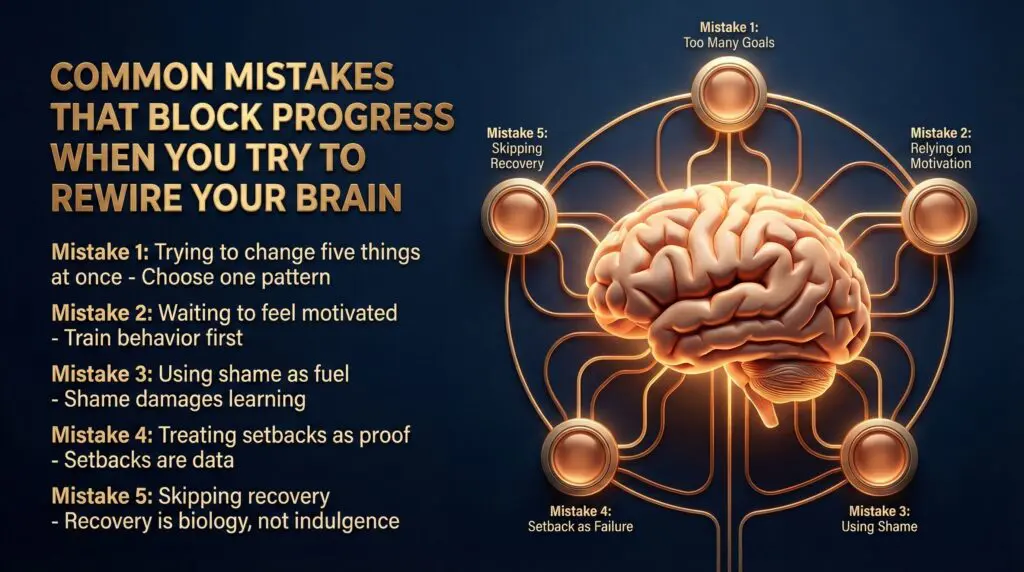
Common mistakes that block progress when you try to rewire your brain
Mistake 1: Trying to change five things at once
Your brain does not learn faster in the face of chaos. It learns faster with targeted reps. Choose one pattern.
Mistake 2: Waiting to feel motivated
Motivation is unreliable. Structure is reliable. If you want to know how to rewire your brain, train behavior first and let motivation catch up.
Mistake 3: Using shame as fuel
Shame feels urgent, but it harms learning. Shame narrows attention and increases threat. That is the opposite of rewiring.
Mistake 4: Treating setbacks as proof
Setbacks are data. Every setback shows you a trigger you missed or a reward you still need. Use it to refine the plan.
Mistake 5: Skipping recovery
Your brain rewires during rest, sleep, and downshifts. If you are exhausted, your brain will default to old patterns. Recovery is not indulgence. It is biology.
How to rewire your brain starting today
If you take nothing else from this guide, take this: learning how to rewire your brain is not about becoming flawless. It is about becoming trainable. Your brain is not fixed. Your patterns are not permanent. You can build new wiring that supports the life you actually want to live.
Start with one target pattern. Track it. Interrupt it. Replace the reward with train completion. Repeat.
And if you are tired of trying to do the task alone, that is not a weakness. That is wisdom. In my 26+ years at MindLAB Neuroscience, I have never met a high-functioning, high-performing person who did not have at least one area where their brain runs an old program under pressure. With the proper structure and support, you can learn to rewire your brain with precision, calm, and real results.
Your next step is simple: choose one small change you will practice today, then do it once. One rep is not a transformation. But it is precisely how the transformation starts.
| Claim / Approach | What Neuroscience Actually Shows | What Actually Works |
|---|---|---|
| “Think positive and rewire your brain” | Affirmations in low-activation states produce minimal synaptic change in the target circuits | Introducing a competing response during the live activation of the negative pattern |
| “21 days to a new habit” | No empirical basis; consolidation timelines average 66 days and vary by circuit complexity | Consistent practice until the new response fires faster than the old one under trigger conditions |
| “Visualize the outcome” | Motor visualization activates motor circuits; outcome visualization alone does not build the behavioral circuit | Visualizing the specific behavioral response, including the emotional activation, not just the end state |
| “Just repeat it enough times” | Volume without activation quality produces routine habit, not genuine circuit retraining | High emotional activation + precise timing + target circuit specificity = structural synaptic change |
| “Understanding changes behavior” | Prefrontal insight and subcortical circuit change use different mechanisms and different brain regions | Circuit-level intervention during the activation state that produces the behavior |
You cannot rewire a circuit that is not firing. The most common mistake in brain rewiring attempts is practicing the new behavior when the problem behavior is absent: when the brain is calm, cooperative, and not doing the thing you want to change. Genuine rewiring happens inside the activation, not outside it.
The patterns described in this article were built through thousands of neural repetitions, and they require targeted intervention to rewire. Real-Time Neuroplasticity™ provides the mechanism: intervening during the live moments when the pattern activates, building new neural evidence that a different response is architecturally possible.
Can adults really rewire their brains, or is that only possible in childhood?
Adult neuroplasticity is well-established. The brain shifts from developmental plasticity to experience-dependent plasticity: targeted synaptic modification in response to skill acquisition, emotional experiences, and consistent behavioral practices. Adult brains show measurable structural changes documented through neuroimaging across domains from motor learning to emotional regulation. The key constraint is not age but the precision and timing of the intervention, not the capacity for change itself.
What actually happens in the brain when you “rewire” it?
Rewiring refers to synaptic modification: the strengthening or weakening of connections between neurons. When two neurons consistently fire in sequence, their synaptic connection strengthens through long-term potentiation. Rewiring a behavior pattern means building a new sequence of neural activations that outcompetes the old sequence, either by strengthening the new pathway or weakening the old one through disuse. Both processes are measurable through neuroimaging and operate throughout adult life.
Why doesn’t knowing what to change actually change it?
Knowledge and behavior change are processed by different brain regions using different mechanisms. Understanding what to change is a prefrontal function. The automatic reaction you want to change is subcortical, typically involving the amygdala and basal ganglia. These systems do not communicate efficiently: prefrontal understanding does not automatically update subcortical patterns. Building behavior change requires intervening at the subcortical level during the activation state, not adding more understanding at the prefrontal level during reflection.
Does emotional activation really matter for brain rewiring?
Yes: emotional activation is one of the most reliably documented plasticity enhancers in neuroscience research. Norepinephrine and dopamine, both elevated during emotional arousal, act as neuromodulators that strengthen synaptic consolidation in the circuits engaged at that moment. This is the mechanism behind why emotionally significant events create strong memories and why traumatic experiences can produce lasting circuit changes from a single event.
How many repetitions does brain rewiring actually take?
There is no universal number: consolidation timelines depend on the circuit’s depth (how many years it’s been reinforced), the emotional activation during practice (higher activation = faster consolidation), and the precision of the intervention (whether the practice targets the specific circuit under the specific conditions that trigger it). Research on habit formation suggests an average of 66 days for simple behavioral habits in low-activation contexts.
References
- Agren, T., Engman, J., Frick, A., Björkstrand, J., Larsson, E.-M., Furmark, T., & Fredrikson, M. (2012). Disruption of reconsolidation erases a fear memory trace in the human amygdala. Science, 337(6101), 1550-1552. DOI
- Chalkia, A., Schroyens, N., Leng, L., Vanhasbroeck, N., Zenses, A.-K., Van Oudenhove, L., & Beckers, T. (2020). No persistent attenuation of fear memories in humans: A registered replication of the reactivation-extinction effect. Cortex, 129, 496-509. DOI
- Doidge, N. (2007). The Brain That Changes Itself: Stories of Personal Triumph from the Frontiers of Brain Science. Viking Press.
- Elsey, J. W. B., Van Ast, V. A., & Kindt, M. (2018). Human memory reconsolidation: A guiding framework and critical review of the evidence. Psychological Bulletin, 144(8), 797-848. DOI
- Lally, P., van Jaarsveld, C. H. M., Potts, H. W. W., & Wardle, J. (2010). How are habits formed: Modelling habit formation in the real world. European Journal of Social Psychology, 40(6), 998-1009. DOI
- LeDoux, J. E. (2015). Anxious: Using the Brain to Understand and Treat Fear and Anxiety. Penguin Books.
- Nader, K., Schafe, G. E., & LeDoux, J. E. (2000). Fear memories require protein synthesis in the amygdala for reconsolidation after retrieval. Nature, 406(6797), 722-726. DOI
If this pattern has persisted despite your understanding of it, the neural architecture sustaining it is identifiable and addressable. A strategy call with Dr. Sydney Ceruto maps the specific circuits driving the cycle and identifies whether it can be interrupted at its neurological source rather than managed from its surface.
From Reading to Rewiring
Understand the neuroscience. Apply it to your life. Work directly with Dr. Ceruto to build a personalized strategy.
Book a Strategy Call