Key Takeaways
- Fear is an amygdala survival mechanism, but misfiring circuitry restricts life beyond actual danger.
- The brain’s threat-response system evolved for speed, not accuracy: it defaults to false positives.
- Chronic fear remodels prefrontal cortex architecture, weakening networks behind rational evaluation and emotional regulation.
- Courage is not the absence of fear: trainable prefrontal regions override amygdala-driven avoidance impulses.
- Neuroscience-informed approaches can recalibrate threat-assessment, restoring proportionate fear and enabling goal-directed action despite discomfort.
There is a moment most people recognize, a narrowing of the chest, a sudden inability to think clearly, the pull to retreat from something that, rationally, poses no real threat. A conversation you need to have. A decision you have been avoiding. A path forward that your body seems determined to block. Fear does not announce itself with logic. It arrives as a full-body override, and in that instant, nothing else exists. The experience is universal. What separates those who move through it from those who are governed by it is not willpower: it is what happens inside the brain at the precise moment fear fires. For many people, this over-reactive baseline traces back to how earlier trauma reshaped the brain’s threat circuitry.
Fear is a necessary evolutionary artifact, a system designed to keep you alive when genuine threats existed around every corner. The problem is that this system was engineered for a world that no longer matches the one you inhabit. The neural circuitry that once protected your ancestors from predators now fires during board presentations, difficult conversations, and career transitions. The machinery is the same. The context has changed completely. And because the brain prioritizes survival over accuracy, it will continue sounding alarms for situations that your rational mind knows are manageable, until something interrupts the pattern. In its most extreme forms, this same threat machinery drives the neuroscience of dissociative responses.
Fear does not arrive with logic. It fires as a full-body override built for predators, then sounds the same alarm for a conversation you already know you can handle.
The Neural Architecture of Fear
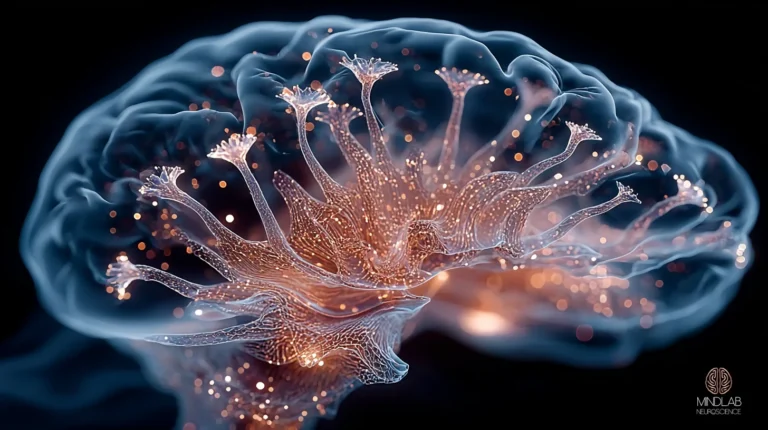
Understanding fear requires understanding the brain’s threat-processing infrastructure. The amygdala, a small, almond-shaped structure deep within the temporal lobes, serves as the brain’s primary threat-detection center. Research has established that the amygdala drives rapid emotional responses to perceived danger, processing sensory information through a fast subcortical route that bypasses conscious evaluation entirely. This is why fear feels involuntary: by the time you become aware of it, the amygdala has already initiated a cascade of physiological changes, elevated heart rate, shallow breathing, muscle tension, cortisol flooding, that prepare the body for immediate action.
What makes this system particularly consequential is its relationship with the prefrontal cortex. The prefrontal cortex provides rational evaluation, contextual assessment, and emotional regulation, the cognitive architecture that allows you to distinguish between a genuine threat and a false alarm. Under normal conditions, the prefrontal cortex modulates amygdala activity, effectively applying the brakes when the threat assessment reveals no real danger. Research in functional neuroimaging has demonstrated that in anxiety-related conditions, the amygdala shows heightened reactivity while the prefrontal regions responsible for top-down regulation show diminished engagement.
Why Fear Becomes Self-Reinforcing
The neurological challenge with persistent fear extends beyond a single moment of activation. When fear circuits fire repeatedly, whether from genuine threat exposure or from learned anticipatory patterns, the architecture of the brain physically changes. Stress signaling pathways flood the prefrontal cortex with catecholamines, impairing the very networks responsible for executive function and rational evaluation. The prefrontal cortex, which should be your most sophisticated regulatory tool, becomes compromised precisely when you need it most.
This creates a self-reinforcing cycle. Each fear response weakens prefrontal regulation. Weakened regulation allows subsequent fear responses to fire with less inhibition. Over time, the threshold for activation drops, situations that once felt manageable begin triggering disproportionate alarm. The brain’s threat-assessment system becomes increasingly sensitive, increasingly inaccurate, and increasingly difficult to override through conscious effort alone. This is the neurobiological explanation for why fear tends to expand rather than contract when left unaddressed: the circuitry literally remodels itself to prioritize threat detection over rational evaluation. That sensitized circuitry also amplifies the impact of chronic negative self-talk, deepening the spiral.
The Two-System Framework: Fear Versus Anxiety
One of the most important distinctions in modern neuroscience is the difference between fear and anxiety, two experiences that feel similar but operate through distinct neural circuits. Fear is a response to a present, identifiable threat. Anxiety is a response to an uncertain, anticipated future threat. Fear and anxiety involve separable neural systems, with acute fear responses centered on the central nucleus of the amygdala and sustained anxiety maintained by the bed nucleus of the stria terminalis. This distinction matters because the strategies that address one do not necessarily address the other.
Many people who describe themselves as “fearful” are actually experiencing chronic anxiety, a sustained state of threat anticipation that keeps the nervous system in perpetual readiness without a specific trigger to confront. The uncertainty itself becomes the threat. Research has demonstrated that intolerance of uncertainty is a core cognitive vulnerability underlying generalized anxiety, activating threat circuits even in the absence of identifiable danger. This is why someone can feel paralyzed by fear without being able to name what, specifically, they are afraid of, the neural system responsible for that state operates on anticipation, not identification.
How Fear Hijacks Decision-Making and Performance
Fear does not simply make you feel uncomfortable. It fundamentally alters cognitive processing. When the amygdala’s threat response dominates, neural resources are redirected away from the prefrontal cortex, the seat of executive function, strategic thinking, and deliberate decision-making, toward subcortical survival circuits. The brain shifts from thoughtful, context-sensitive evaluation to fast, reflexive, binary processing: safe or dangerous, approach or avoid, fight or flee.
This neural hijacking explains a pattern I consistently observe in high-performing individuals: people who are exceptionally capable in low-threat conditions become unrecognizable when fear activates. The CEO who leads with clarity in the boardroom but cannot have a direct conversation with a spouse. The entrepreneur who takes calculated financial risks but freezes when facing personal vulnerability. The shift is not a character flaw: it is a circuit switch. When moderate stress exposure impairs prefrontal cortex function by flooding the region with catecholamines, neural processing shifts toward subcortical, reflexive circuits. The sophisticated cognitive machinery that produces their professional success literally goes offline.
The Three Responses and Their Neural Signatures
The brain’s acute fear response produces three well-documented behavioral outputs: fight, flight, or freeze. Each represents a distinct survival strategy encoded in defensive circuits that evolved over millions of years. More recent research has expanded this taxonomy to include additional defensive behaviors, from active avoidance to reactive immobility, each mapped to specific neural circuit configurations.
What most people do not realize is that their default response pattern is not random. It is shaped by developmental history, prior experiences, and the specific way their neural architecture was wired during critical periods. Someone who consistently freezes under pressure is not choosing passivity, their brain has encoded freezing as the optimal survival response based on previous experience. Someone who defaults to flight, avoiding difficult conversations, leaving situations prematurely, walking away from opportunities, has a nervous system that has learned avoidance as its primary protective mechanism.
The critical insight is that these patterns, while deeply encoded, are not permanent. The same neuroplasticity that wired these default responses can be leveraged to rewire them. But this requires intervention at the level of the neural circuit, not at the level of conscious intention. Telling yourself to “stop being afraid” is neurologically equivalent to telling your amygdala to ignore its primary function, the instruction does not reach the system that needs to change.
Six Neuroscience-Informed Strategies for Moving Through Fear
1. Recognize that catastrophic prediction is a neural default, not reality
The tendency to imagine worst-case scenarios, what I call “apocalypsing”, is not a personal failing. It is the brain’s threat system operating exactly as designed: generating vivid, emotionally charged predictions of danger to motivate avoidance behavior. The problem is that this system evolved for physical threats and applies the same urgency to social, professional, and emotional situations where catastrophic outcomes are extraordinarily unlikely.
Research demonstrates that uncertainty itself activates the brain’s threat-processing infrastructure, generating anticipatory anxiety that can equal or exceed the distress of facing the feared outcome directly. The neural prediction machinery fills uncertainty with danger, not because danger is probable, but because the cost of being wrong about a missed threat was historically lethal. Understanding this mechanism does not eliminate catastrophic thinking, but it provides the crucial reframe: this is your neural architecture doing its job, not an accurate forecast of what will happen. Yes, planes can crash, but the brain’s threat system treats a flight departure with the same alarm it would apply to stepping off a cliff. The circuitry cannot distinguish between the two.
2. Understand that regret rewires differently than fear
Regret and fear occupy very different positions in the brain’s motivational architecture. Fear is an anticipatory signal: it attempts to prevent action. Regret is a retrospective signal: it marks the cost of inaction after the opportunity has passed. What makes regret particularly powerful is that the brain processes the pain of missed opportunity through some of the same neural circuitry it uses for physical pain. The ache of “what if” is not metaphorical, it has a genuine neural signature.
The people who build the life they actually want are not fearless. They have developed the neural capacity to weigh anticipated regret against anticipated fear, and to let the longer-term signal win. This is a prefrontal function: the ability to hold a future consequence in working memory strongly enough that it competes with the amygdala’s immediate demand to avoid. It is trainable. But it requires building the specific neural architecture that allows future-oriented evaluation to override present-moment threat detection.
3. Reframe failure as the brain’s calibration process
The fear of failure is among the most common patterns I encounter in high-performing individuals, and among the most neurologically misunderstood. Failure is not a signal that you have reached your limit. It is the process by which the brain calibrates its predictive models against reality. Every attempt that does not produce the expected outcome generates a prediction error, a signal that updates the neural model and improves the accuracy of future attempts.
Research on prefrontal cortex function demonstrates that this region maintains and updates predictive models through iterative feedback loops, strengthening connections that produce accurate predictions and pruning those that do not. Failure, neurologically, is the mechanism through which the brain learns. The fear of failure is the amygdala responding to prediction error as though it were a threat, because in evolutionary terms, being wrong about a prediction could mean being wrong about a predator. In modern contexts, this same circuitry makes the prospect of a failed business pitch feel existentially dangerous. It is not. It is data.
4. Recognize that you are wired for growth, not stasis
Fear often carries an implicit message: stay where you are. Do not risk the known for the unknown. This is the brain’s homeostatic drive, a deeply wired preference for the familiar that exists because, in evolutionary terms, the familiar was equivalent to the survivable. But the brain is simultaneously wired for something that directly contradicts this conservative impulse: neuroplasticity.
The brain’s capacity to structurally reorganize in response to new experience is not a minor feature. It is the central organizing principle of neural development across the lifespan. Every new challenge, every novel situation, every moment of discomfort that is navigated successfully produces measurable changes in neural architecture, new synaptic connections, strengthened circuits, enhanced regulatory capacity. Research has demonstrated that mindfulness and cognitive training produce measurable reductions in amygdala reactivity to emotional stimuli, even outside of formal practice conditions. The brain does not merely tolerate growth. It is designed for it. Fear’s instruction to remain static is a relic of a survival calculus that no longer applies.
5. Build the neural architecture through deliberate practice
Overcoming fear is not an insight problem: it is a training problem. Understanding why you are afraid is necessary but not sufficient. The neural circuits that produce fear responses must be recalibrated through repeated experience, not through intellectual understanding alone. Research on fear extinction demonstrates that new learning does not erase the original fear memory but creates a competing memory trace that, when strengthened sufficiently, inhibits the fear response. This is why exposure-based approaches work: each successful navigation of a feared situation deposits evidence in the brain that the predicted catastrophe did not occur.
The critical variable is timing. The brain is not equally receptive to new learning at all moments. Research has shown that fear memories can be disrupted during specific reconsolidation windows, brief periods when the memory is reactivated and becomes temporarily labile. This is why working through fear in real time, during the actual moment of activation, produces fundamentally different results than discussing fear retrospectively. The window for neural rewiring is open when the circuit is active, not when you are calmly recounting the experience afterward.
6. Leverage social connection as a neural regulation tool
The brain’s threat-response system does not operate in isolation. It is profoundly influenced by the social environment, specifically, by the presence of trusted others. Research has demonstrated that holding a partner’s hand during a threatening situation produces measurable reductions in neural threat response, with the quality of the relationship directly modulating the degree of neural calming. The brain literally processes threat differently when a trusted person is present.
This finding has profound implications for how fear is addressed. The individualistic model, “face your fears alone”, ignores a fundamental feature of human neural architecture: the threat-response system was designed to operate within a social context. Isolation amplifies fear. Connection regulates it. The people who successfully move through significant fears rarely do it by raw willpower. They do it within relationships that provide the neural safety required for the brain to tolerate discomfort and remain open to new learning. For related insights, see Anxious Depression: When Anxiety and Depression Collide.
From Fear Response to Calibrated Action
The neuroscience of fear reveals something that contradicts most popular advice on the subject: courage is not a personality trait. It is a neural capacity, specifically, the capacity to maintain goal-directed behavior while the amygdala is actively signaling threat. Research has identified activity in the subgenual anterior cingulate cortex as a key neural substrate enabling individuals to act in the presence of fear, effectively overriding avoidance impulses generated by the amygdala. This means courage is not something you either have or lack. It is something the brain builds through repeated practice of acting despite discomfort.
The distinction between healthy fear and limiting fear is functional, not theoretical. Healthy fear is proportionate to actual risk and motivates appropriate protective action. Limiting fear is disproportionate, either in intensity relative to the genuine threat or in scope relative to the situations it governs. When fear prevents behaviors that your values, goals, and quality of life require, it has crossed from protective to restrictive. The neural circuitry has not malfunctioned: it has miscalibrated. And miscalibration, unlike malfunction, can be corrected through anxiety and threat calibration.
In my practice, I work with the brain’s threat-assessment system directly, not by talking about fear after the fact, but by intervening in the live moment when the circuit is active and the brain is biologically primed for change. This is the principle underlying Real-Time Neuroplasticity™: the window for lasting neural rewiring opens when the relevant circuit is engaged, not during retrospective discussion. The fear response that has governed your decisions, restricted your relationships, and constrained your professional trajectory is not a permanent fixture. It is a pattern, and patterns, once understood at the neural level, can be durably restructured.
Every person who has worked through significant fear carries something more valuable than the absence of discomfort. They carry accumulated neural evidence that fear can be tolerated, acted through, and survived, a track record of successful navigation that progressively recalibrates the amygdala’s threat assessment and strengthens the prefrontal cortex’s inhibitory capacity. Each successfully navigated fear experience provides not just the behavioral outcome but a neurological record that the predicted catastrophe did not materialize. Over time, this evidence base transforms the threat landscape from overwhelming to manageable, not because the world changed, but because the brain’s assessment of it did.
Fear that restricts your life is not a character flaw: it is a neural calibration problem. Understanding the mechanism is the first step. Recalibrating the circuitry is the work. If fear has been governing decisions that your rational mind knows it should not control, the neural architecture responsible can be identified and durably restructured.
Take the Next Step
Dr. Sydney Ceruto works directly with the neural circuits that produce disproportionate fear responses, intervening in real time, when the brain is most receptive to lasting change. If fear has been constraining your decisions, your relationships, or your trajectory, a strategy call is the starting point for understanding exactly what is happening in your brain and what can be done about it.
This article explains the neuroscience underlying fear and threat processing. For personalized neurological assessment and intervention, contact MindLAB Neuroscience directly.
What is the neuroscience behind why fear can feel so overwhelming?
Fear activates the amygdala, the brain’s threat-detection center, which triggers a rapid, whole-body stress response that temporarily suppresses the prefrontal cortex’s capacity for rational evaluation. This is why fear can feel overwhelming and disproportionate even when conscious analysis suggests the threat is minimal: the amygdala’s response is faster than conscious evaluation and operates with a biological authority that rational reassurance cannot easily override. The brain’s threat system evolved for survival, not accuracy: it operates by erring on the side of false positives rather than risk missing a genuine danger. When excessive catecholamine signaling floods the prefrontal cortex, amplified by cortisol, the neural circuitry responsible for nuanced assessment goes functionally offline, leaving subcortical survival circuits in control.
What are the most effective neuroscience-based strategies for addressing fear?
Neuroscience research identifies several approaches that work at the circuit level: gradual exposure that desensitizes the amygdala by building a competing safety memory through repeated non-threatening contact with the feared stimulus; cognitive reappraisal that changes the brain’s threat assessment of a situation by engaging prefrontal evaluation networks; affect labeling, the practice of naming the emotional state, which research shows reduces amygdala reactivity; and social co-regulation, where the presence of a trusted individual measurably dampens neural threat response. All of these are more effective than avoidance, which reinforces fear circuitry by preventing the brain from gathering disconfirming evidence.
What is the difference between healthy fear and fear that restricts your life?
Healthy fear is proportionate to the actual risk present and motivates appropriate protective behavior. Restricting fear is disproportionate, either in intensity relative to the genuine threat or in scope relative to the situations it triggers. The clearest distinction is functional impact: if fear is preventing behaviors that your values, goals, or quality of life require, it has crossed from protective to limiting. At the neural level, this reflects a miscalibration of the amygdala’s threat-assessment threshold: the system has become overly sensitive, firing alarm responses to situations that do not warrant them. This miscalibration is modifiable through neuroscience-informed intervention that works directly with the threat-processing circuitry.
Does courage mean having no fear?
Courage is neurologically the capacity to maintain goal-directed behavior despite active amygdala threat signaling, not the absence of fear activation. Neuroscience research on courage identifies activity in the subgenual anterior cingulate cortex and ventromedial prefrontal cortex as the brain regions enabling individuals to override amygdala-generated avoidance impulses. This means courage is a trainable neural capacity, not a fixed personality trait: repeated practice of acting in the presence of fear gradually builds and strengthens the specific neural architecture required for reliable courageous action. The brain learns courage the same way it learns any skill, through iterative experience that reinforces the relevant circuits.
How does resilience develop in people who have worked through significant fears?
Resilience emerges from accumulated neurological evidence that fear can be tolerated, acted through, and survived, a track record of successful navigation that recalibrates the amygdala’s threat assessment and strengthens the prefrontal cortex’s inhibitory capacity. Each successfully navigated fear experience provides a neurological record that the feared situation did not produce the catastrophic result anticipated. Over time, this evidence base transforms the brain’s threat landscape from overwhelming to manageable. Research demonstrates that this process involves measurable structural changes, including enhanced connectivity between prefrontal regulatory regions and the amygdala, that make future fear regulation progressively more efficient.
References
- Arnsten, A. F. T. (2009). Stress signalling pathways that impair prefrontal cortex structure and function. Nature Reviews Neuroscience, 10(6), 410-422. https://doi.org/10.1038/nrn2648
- Arnsten, A. F. T. (2015). Stress weakens prefrontal networks: molecular insults to higher cognition. Nature Neuroscience, 18(10), 1376-1385. https://doi.org/10.1038/nn.4087
- Etkin, A. and Wager, T. D. (2007). Functional neuroimaging of anxiety: a meta-analysis of emotional processing in PTSD, social anxiety disorder, and specific phobia. American Journal of Psychiatry, 164(10), 1476-1488. https://doi.org/10.1176/appi.ajp.2007.07030504
- Hartley, C. A. and Phelps, E. A. (2010). Changing fear: the neurocircuitry of emotion regulation. Neuropsychopharmacology, 35(1), 136-146. https://doi.org/10.1038/npp.2009.121
- Phelps, E. A. and LeDoux, J. E. (2005). Contributions of the amygdala to emotion processing: from animal models to human behavior. Neuron, 48(2), 175-187. https://doi.org/10.1016/j.neuron.2005.09.025