The Neuroscience of Transformation: Beyond Willpower
When you operate at an elite level, you don’t have the luxury of spending years on a couch analyzing your childhood just to change a morning routine or sharpen your executive presence. You require precision, speed, and a return on investment for your mental energy. We are not here to “fix” you, because you aren’t broken. We are here to upgrade your operating system.
Most people rely on willpower to change behavior. From a neuroscientific perspective, this is an inefficient strategy. Willpower is a finite resource, essentially a battery that drains throughout the day. To achieve lasting transformation—the kind that builds empires and legacies—we must bypass the battery and rewire the machine itself.
Your Brain as a Ski Slope
To understand why change feels hard, we have to look at neuroplasticity. Think of your brain like a snowy mountain. Your current behaviors—the habits you want to change—are the well-groomed runs. You’ve been skiing down them for years. It is effortless, fast, and automatic. You don’t have to think; gravity takes you down the path of least resistance.
Trying to build a new behavior is like trying to ski through fresh, deep powder between the trees. It is slow, exhausting, and your brain (which craves energy efficiency) is screaming at you to get back on the groomed run.
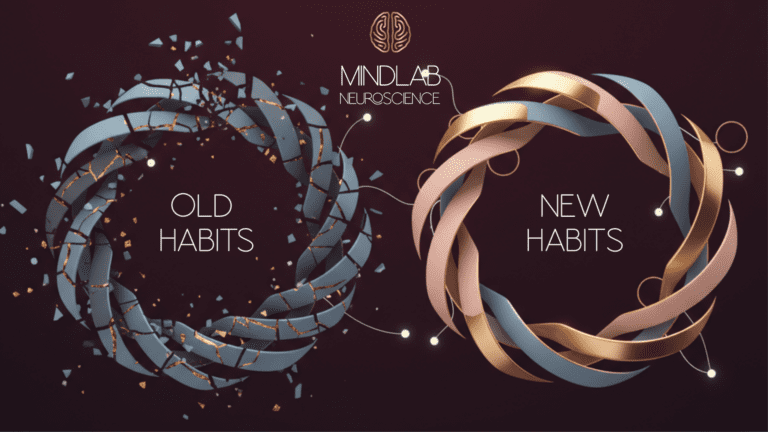
Behavior modification is simply the process of grooming a new run. If you ski that new path enough times, the snow packs down, the trees clear out, and eventually, the new behavior becomes the path of least resistance. We aren’t fighting your brain; we are just redirecting the traffic.
Here’s Exactly How Your Brain Builds Habits
Your brain is a prediction machine designed to automate your life. It does this through a four-step feedback loop. If you want to hack your behavior, you cannot just “try harder.” You must intervene at specific points in this biological algorithm.
The framework we use in neuro-optimization is the Habit Loop:
- Cue: The trigger that tells your brain to go into automatic mode.
- Craving: The motivational force; the desire for a change in state.
- Response: The actual habit or behavior you perform.
- Reward: The satisfaction you get, which teaches your brain to remember this loop for next time.
To change your life, we don’t rely on motivation. We engineer these four steps to make success inevitable and failure impossible.
The Neurobiology of Behavior Modification
To master your behavior, you must first understand the machinery driving it. We are not dealing with abstract concepts of “character” or “grit.” We are dealing with electricity, chemistry, and biological architecture. When you understand the hardware, the software becomes infinitely malleable.
Your brain is partitioned into competing factions. The friction you feel when trying to change a habit is not a lack of discipline; it is a biological conflict between your brain’s executive center and its primitive automation center.
The CEO vs. The Autopilot: PFC and Basal Ganglia
Consider your Prefrontal Cortex (PFC) the CEO of your brain. It handles long-term vision, strategy, and impulse control. It is the part of you that decides to scale a business or run a marathon. However, the PFC is evolutionarily new, energy-expensive, and easily fatigued.
Opposing the CEO is the Basal Ganglia, specifically the Striatum. This is your Autopilot. It stores your habits and routine behaviors. It is ancient, incredibly efficient, and never gets tired. When you are stressed or exhausted, the “CEO” (PFC) goes offline to save energy, and the “Autopilot” (Basal Ganglia) takes over. This is why you revert to old habits precisely when you are under the most pressure.
The Metabolic Cost of Change
Your brain represents roughly 2% of your body weight but consumes 20% of your caloric energy. It is a biological miser designed to conserve fuel. This is the Metabolic Cost of cognition.
Executing a habit costs almost zero energy because the neural pathway is myelinated (insulated) and fast. Building a new behavior requires the PFC to stay online, constantly monitoring and adjusting. This causes a massive spike in glucose consumption. Your brain perceives this high energy expenditure as a threat to your survival. The “resistance” you feel is simply your brain trying to throttle down your energy usage to keep you safe. We must trick the brain into believing the investment is worth the cost.
Dopamine: The Currency of Action
Dopamine is not just a pleasure molecule; it is a learning molecule. It functions based on Reward Prediction Error. If you take an action and the outcome is better than expected, you get a surge of dopamine. This surge acts as a highlighter pen, marking the neural pathway and telling the brain: “That was valuable. Do it again.”
Conversely, if an action feels like a punishment (like a grueling new workout regimen with no immediate payoff), dopamine drops, and the brain marks the behavior as something to avoid. To successfully modify behavior, we must engineer “wins” that trigger dopamine release early in the process, essentially paying the brain to keep the new circuitry active.
Evolutionary Anomalies: The Amygdala Hijack
We are operating with Paleolithic hardware in a digital age. Your Amygdala is the brain’s threat detection center. In the wild, a threat was a predator. Today, a threat is a market downturn, a difficult board meeting, or an aggressive email.
When the Amygdala detects high stress, it initiates a “hijack.” It floods your system with cortisol and adrenaline, effectively cutting off blood flow to the PFC (the rational CEO). You biologically lose access to your higher-order thinking and logic. In this state, behavior modification is impossible because you are in survival mode. Neuro-optimization requires that we first regulate the Amygdala, lowering the threat response so the CEO can get back to work.
Why Standard Interventions Fail the Elite Mind
If you are reading this, likely you have already sat in a therapist’s chair or held a prescription bottle. You are intelligent, self-aware, and driven. Yet, the behavior persists. This is not a failure of your character; it is a failure of the methodology. Standard interventions are designed to bring dysfunctional individuals back to a baseline of “average.” But you are not looking for average. You are looking for optimization.
The Fallacy of “Top-Down” Processing (Talk Therapy)
Traditional talk therapy utilizes a Top-Down approach. It engages the Prefrontal Cortex (PFC) to analyze emotions, dissect childhood trauma, and rationalize behavior. For the high-performer, this presents a unique problem: You are too smart for your own good.
High-IQ individuals are masters of “Cognitive Bypassing.” You can intellectualize your trauma, explain your triggers with perfect clarity, and articulate exactly why you self-sabotage. However, understanding the mechanism does not stop the machine. When high-stakes stress hits, your PFC goes offline (as discussed in the neurobiology section). All that insight vanishes, and the primitive brain takes over. You cannot negotiate with your nervous system using logic; you must speak its language, which is sensory and physiological, not linguistic.
The Blunt Instrument (Medication)
Pharmaceutical interventions often act as a blunt instrument in a system requiring precision calibration. While necessary for acute pathology, for the purpose of behavior modification and performance enhancement, they often come with an unacceptable tax: The blunting of the edge.
Many medications achieve stability by narrowing the emotional dynamic range. They raise the floor of depression or anxiety, but they often lower the ceiling of creativity, drive, and acute mental sharpness. For the executive or creator, that manic burst of insight or that aggressive drive to conquer is a vital asset. We do not want to sedate the tiger; we want to train it. Neuro-optimization seeks to regulate the system without sacrificing the potency of your unique neurochemistry.
The Outlier Problem
Standard psychological protocols are built on the statistical mean—the middle of the bell curve. They are designed to help people function in society. You, however, operate in the statistical tails. The pressures you face—managing millions in assets, leading vast teams, navigating public scrutiny—are not “normal” stressors.
Applying a standard anxiety protocol to a CEO facing a hostile takeover is like bringing a bicycle mechanic to fix a Formula 1 engine. The principles are similar, but the tolerances, speeds, and consequences are vastly different. You require a protocol that respects the velocity at which you live.
Protocols for Executive Optimization
We do not need electrodes or million-dollar imaging machines to change your brain. You possess the most sophisticated biotechnology on the planet: your own nervous system. The following protocols utilize Bottom-Up Cognitive Restructuring. Instead of trying to “think” your way out of stress (which we know fails), we use the body and sensory input to guide the brain into a new state.
These are not relaxation techniques. They are neuro-hacks designed to manually override the Basal Ganglia and regulate the Amygdala in real-time.
Protocol 1: The Kinetic Interrupt (Breaking the Loop)
The Mechanism: When a craving or an unwanted emotional reaction (anger, anxiety) hits, your brain is running a closed loop in the Basal Ganglia. To stop it, you must physically jar the system. A sudden physical sensation forces the brain to shift attention from the internal loop to the external environment, effectively “tripping the circuit breaker.”
The Drill:
- Identify your “Cue” (e.g., the urge to micromanage, the desire to procrastinate, a surge of imposter syndrome).
- Immediately execute a sharp, physical movement. This could be standing up abruptly, snapping a rubber band on your wrist, or splashing ice-cold water on your face.
- The Pivot: In that split second of shock, your Prefrontal Cortex comes back online to assess the physical sensation. Use that window of lucidity to verbally state your intention: “I am resetting the system.” then immediately engage in a pre-planned productive action.
Protocol 2: Optical De-escalation (The Amygdala Switch)
The Mechanism: Your eyes are literally extruded parts of your brain. There is a direct hardline between your visual system and your stress response. When you are stressed or hyper-focused on a problem, your pupils dilate and your vision tunnels (focal vision). This signals the sympathetic nervous system to release adrenaline. You cannot “think” yourself calm, but you can “look” yourself calm.
The Drill:
- When you feel pressure mounting or “tunnel vision” setting in during high-stakes decision making, stop.
- Keep your head still and look straight ahead.
- Slowly expand your awareness to your peripheral vision. Try to see the walls to your far left and right without moving your eyes.
- Maintain this “Panoramic Vision” for 90 seconds. This visual state mechanically triggers the parasympathetic nervous system (rest and digest), forcibly lowering your heart rate and re-engaging your executive logic centers.
Protocol 3: Neuro-Linguistic Distancing (The CEO Perspective)
The Mechanism: When you say “I am angry” or “I am overwhelmed,” you are identifying as the emotion. Your brain lights up the Amygdala. However, studies show that when you label an emotion from a third-person perspective, blood flow shifts from the Amygdala to the Right Ventrolateral Prefrontal Cortex—the brain’s braking system.
The Drill:
- Catch yourself in a negative thought loop.
- Do not say “I am stressed.”
- Instead, speak to yourself by name, as if you are coaching a separate high-value asset. Say: “Sydney is experiencing a cortisol spike right now. Sydney’s brain is predicting a threat that isn’t there.”
- This linguistic shift creates “Psychological Distance.” It separates the Observer (You) from the Machine (The Brain), allowing you to evaluate the data without drowning in the emotion.
Frequently Asked Questions
1. Will I lose my “edge” if I regulate my stress response?
This is the most common fear among the elite. You worry that your anxiety, perfectionism, and hyper-vigilance are the fuel sources of your success. Let me be clear: Anxiety is a fuel source, but it is “dirty fuel.” It burns hot, creates massive exhaust (inflammation, burnout), and eventually destroys the engine. Neuro-optimization switches you to “clean fuel”—dopamine and flow states. You do not lose your drive; you lose the drag. You will move faster because you are no longer fighting your own internal friction.
2. How long does it take to rewire a neural pathway?
Forget the “21 days” myth. Neuroplasticity is not a function of time; it is a function of repetition and intensity. If you ski the new run once a week, it will take years. If you ski it ten times a day with high focus, the path forms rapidly. Most of my clients feel a shift in control within the first 14 days of rigorously applying the kinetic and optical protocols. Complete automatization—where the new behavior becomes the default—usually requires 66 to 90 days of consistent reinforcement.
3. I am not “unwell,” I just want to be better. Is this for me?
Absolutely. In fact, you are the ideal candidate. Traditional therapy is often restorative—bringing a client from -5 back to 0. Neuro-optimization is generative—taking you from +5 to +10. We are not fixing a deficit; we are capitalizing on an asset. Think of this as executive coaching with a neuroscience backbone. We are optimizing your hardware to handle higher computing loads.
4. Am I too old to change my brain?
No. Until recently, science believed neurogenesis (the birth of new neurons) stopped in adulthood. We now know the adult brain remains plastic until death. While it is true that a child’s brain is more malleable (like wet clay), the adult brain is more capable of “directed neuroplasticity” (like sculpting marble). You have the advantage of metacognition—the ability to think about your thinking—which allows for deliberate, strategic rewiring that a child cannot perform.
The Executive Conclusion
You audit your finances. You optimize your tax strategy. You fine-tune your physical health. Yet, most high-performers leave their most critical asset—their neurology—to chance, running on outdated scripts and reactive loops formed decades ago.
Behavior modification through neuro-optimization is the ultimate competitive advantage. It moves you from being a passenger in your own mind to being the architect. By understanding the mechanism of the Habit Loop, respecting the metabolic cost of change, and utilizing bottom-up protocols to regulate your physiology, you stop fighting against your nature and start engineering it.
The goal is not just to achieve more; it is to achieve it with less neurological wear and tear. Welcome to the new standard of operation.
About Dr. Sydney Ceruto
Dr. Sydney Ceruto is a Neuroscientist and Brain Performance Strategist specializing in neurological re-engineering for elite individuals navigating high-stakes environments. As the founder of MindLAB Neuroscience and the pioneer of Real-Time Neuroplasticity™, she translates clinical neurobiology into decisive competitive advantages for tech innovators, professional athletes, entertainers, and private families worldwide. Dr. Ceruto holds dual PhDs in Behavioral & Cognitive Neuroscience from New York University and dual Master’s degrees in Clinical Psychology and Business Psychology from Yale University. She is the author of The Dopamine Code, published by Simon & Schuster.