Your gut controls your mood. This hub delves into the profound, bidirectional highway connecting your gut and brain – the Gut-Brain Axis – governed by the sophisticated Enteric Nervous System, often called our ‘second brain.’ We explore the intricate dance between your microbiome, the vagus nerve, and your cognitive and emotional well-being, guided by the neuroscientific insights of Dr. Sydney Ceruto. Uncover the biological, evolutionary, and executive mechanisms that define how gut health is inextricably linked to mental clarity and emotional resilience.
The Evolutionary Design
Nature built your gut to act as a second brain. It manages digestion so your main brain can focus on survival. This system evolved to detect toxins instantly. It decides if fuel is safe before it enters your blood. It produces most of your serotonin. This chemical controls your mood and sleep. Your body prioritized this link to keep you energized and ready to react to danger.
The Modern Analogy
Your gut–brain axis is like the roots and soil system under a forest, silently feeding and signaling every tree, affecting whether the whole forest thrives or struggles. Modern life dumps poison into this soil. Processed food and chronic stress strip the earth of nutrients. The roots rot and the connection breaks. The trees above turn brown and weak. You experience brain fog and anxiety because the underground network is dying.
The Upgrade Protocol
You must rehabilitate the soil to save the forest. Remove the toxins that poison the ground. Add high-quality fertilizer in the form of probiotics and whole foods. This restores the bacterial balance in the dirt. The roots will heal and strengthen. Clear signals will travel up to the canopy again. Your mental clarity and physical energy will return once the root system is healthy.
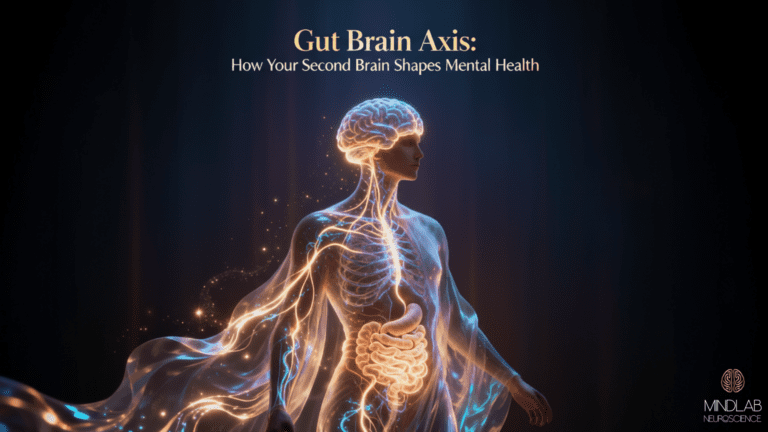
In the rarefied air of high achievement, we are often taught that the mind is a monarchy—a singular ruler residing in the cranial vault, dictating logic, strategy, and emotion from the top down. This is a physiological fallacy. The reality, confirmed by rigorous neuroscience, is that your body operates as a dual-processor system. You do not possess one brain; you possess two.
While you have spent years sharpening the cognitive precision of your cranial brain, you may have inadvertently neglected the “shadow government” operating within your abdomen: the Enteric Nervous System (ENS). This is not merely about digestion; this is about the biological seat of your intuition, your resilience, and your mood.
To understand the Gut-Brain Axis without getting lost in medical jargon, visualize your body as a Fortune 500 company.
Your cranial brain (the Central Nervous System) is the CEO sitting in the penthouse office. It handles high-level strategy, public relations, and long-term vision. However, the CEO does not manage the day-to-day logistics, supply chains, or waste management. That is the job of the Operations Center—your Gut (the Enteric Nervous System).
Here is the critical insight: In most corporate structures, the CEO barks orders down to Operations. But in the human body, the communication lines—specifically the Vagus Nerve—are 90% afferent. This means 90% of the phone calls are going up from the Operations Center to the CEO, not the other way around.
If the Operations Center is in chaos—plagued by inflammation or microbial dysbiosis—it floods the CEO’s phone lines with panic signals. No matter how brilliant the CEO is, they cannot execute strategy effectively when the phone is ringing off the hook with emergency alerts. This is why you cannot “think” your way out of anxiety if your gut is signaling danger.
For the elite biohacker or the wellness-conscious visionary, understanding the ENS is the ultimate leverage point. This mesh-like network of 500 million neurons lining your gastrointestinal tract is capable of operating independently of the brain and spinal cord. It is so complex that it produces 95% of your body’s serotonin—the neurotransmitter responsible for stabilizing mood, feelings of well-being, and happiness.
When we discuss the “gut feeling,” we are not speaking metaphorically. We are referencing a biological data stream. The microbiome—the trillions of bacteria residing in your gut—act as the software engineers of this system. They modulate the signals sent via the Vagus nerve, directly influencing your stress response and neuroplasticity.
True Neuro-Optimization requires us to stop addressing the head and the body as separate entities. We must calibrate the axis. We do not simply suppress symptoms; we upgrade the hardware to ensure the CEO and the Operations Center are speaking the same language of excellence.
To engage in Neuro-Optimization, we must move beyond the vague notion of “wellness” and dissect the precise electrochemical mechanics at play. The connection between your enteric nervous system (ENS) and your central nervous system (CNS) is not merely a pathway; it is a bidirectional superhighway of information known as the Gut-Brain Axis (GBA). This axis regulates the body’s homeostasis through a complex interplay of neural, hormonal, and immunological signaling.
The primary conduit for this exchange is the Vagus Nerve (Cranial Nerve X). While we often think of nerves as delivering commands from the brain to the body, the Vagus is distinctively informative. It constantly samples the “milieu” of the gut—detecting microbial byproducts, inflammatory cytokines, and nutrient availability—and transmits this data directly to the brainstem, specifically the nucleus of the solitary tract. From there, the signal propagates to the limbic system, the brain’s emotional command center.
From an evolutionary perspective, the ENS is often referred to as the “reptilian” sensor. Its primary directive is survival, not self-actualization. When the ENS detects dysbiosis (an imbalance in the microbiome) or inflammation, it interprets these signals as a visceral threat.
This triggers a rapid neural cascade that activates the Amygdala—the almond-shaped structure deep in the temporal lobe responsible for fear and threat detection. Simultaneously, this activation dampens activity in the Prefrontal Cortex (PFC), the area responsible for executive function, impulse control, and long-term planning.
This is a protective mechanism: if you ingest a toxin, your body prioritizes immediate survival (the Amygdala) over complex philosophical thought (the PFC). However, in the modern high-performer, chronic gut inflammation mimics this acute toxic threat. The result is a state of low-grade, persistent “fight or flight” sympathetic arousal. You may perceive this as unexplainable anxiety or brain fog, but biologically, it is your ENS overriding your executive faculties to signal a perceived internal danger.
The brain is an expensive organ, consuming roughly 20% of the body’s metabolic energy. To function optimally, it requires a precise balance of neurotransmitters. Here, the ENS acts as the primary manufacturing plant. As previously established, the gut produces the vast majority of the body’s serotonin (5-HT). However, it also plays a critical role in the synthesis of GABA (gamma-aminobutyric acid) and Dopamine.
GABA is the brain’s primary inhibitory neurotransmitter; it is the “brakes” that prevent neural excitotoxicity and anxiety. Certain strains of gut bacteria, such as Lactobacillus and Bifidobacterium, synthesize GABA from glutamate. When the microbiome is compromised, GABA production falters.
The metabolic cost of this deficiency is high. Without sufficient GABA signaling originating from the gut, the CNS loses its ability to self-regulate stress. The brain must then expend excessive energy trying to maintain equilibrium without the necessary chemical substrates. This manifests as “allostatic load”—the wear and tear on the body which accumulates as an individual is exposed to repeated or chronic stress. You are not just “stressed”; you are chemically under-resourced.
Furthermore, we must address the immune system’s role. The gut houses approximately 70% of the body’s immune cells in the Gut-Associated Lymphoid Tissue (GALT). When the intestinal barrier becomes permeable (often colloquially termed “leaky gut”), lipopolysaccharides (LPS) from bacteria breach the systemic circulation.
The immune system responds by releasing pro-inflammatory cytokines. These cytokines can cross the blood-brain barrier, altering synaptic plasticity and reducing levels of Brain-Derived Neurotrophic Factor (BDNF)—a protein essential for learning and memory. In this state, the brain is biologically resistant to change, growth, and optimization. To optimize the mind, we must first secure the barrier.
If you have previously sought relief through conventional avenues, you have likely encountered a frustrating plateau. This is not a failure of your resolve; it is a failure of the therapeutic architecture. Standard mental health interventions—specifically Cognitive Behavioral Therapy (CBT) and pharmacotherapy—operate on outdated assumptions about where “mind” resides. They address the symptoms of the cranial brain while ignoring the screaming signals from the enteric brain.
Traditional talk therapy relies exclusively on “Top-Down” processing. It assumes that by engaging the Prefrontal Cortex (PFC) through logic, reasoning, and linguistic reframing, one can override emotional dysregulation. Under normal conditions, this is a valid strategy.
However, for the high-performing individual operating under immense pressure, the Gut-Brain Axis is often flooded with “Bottom-Up” error signals. As we established, when the enteric nervous system detects dysbiosis or stress, it sends a high-priority alert up the Vagus nerve that effectively takes the PFC offline. Trying to use talk therapy in this state is like trying to update a computer’s software while the hardware is actively overheating. No amount of “cognitive reframing” can silence a biological alarm bell ringing in the viscera. You cannot rationalize a chemical cascade.
When therapy fails to produce results, the standard medical pivot is toward pharmacology—SSRIs, benzodiazepines, and anxiolytics. While these tools have their place in acute crisis management, for the bio-hacker or executive, they represent a blunt instrument in a delicate ecosystem.
Most psychiatric medications operate by artificially increasing the availability of neurotransmitters in the synaptic gap. They do not, however, address why the production of these neurochemicals was dysregulated in the first place (often a gut-based supply chain issue). Furthermore, these medications often induce “emotional blunting.” They may lower the floor of your anxiety, but they tragically lower the ceiling of your brilliance. They dampen the very drive, creativity, and acute sensory awareness that allowed you to achieve your status. You do not need sedation; you need regulation.
Finally, we must acknowledge the discrepancy in objectives. The standard healthcare model is designed for “normalization”—bringing a dysfunctioning client back to a baseline of average survival. But you are not striving for “average.” You are striving for the 1% of cognitive capability.
A Formula 1 car requires different maintenance protocols than a commuter sedan. Standard interventions fail you because they are calibrated for a lower metabolic and cognitive load. To achieve Neuro-Optimization, we must bypass the limitations of talk therapy and the bluntness of medication. We must intervene at the root of the signal transmission: the gut itself.
We do not need external electrodes to rewrite the neural code of the Enteric Nervous System. You possess the biological machinery required to modulate the Gut-Brain Axis; you simply lack the user manual. The following protocols are designed for Bottom-Up Cognitive Restructuring. By altering the somatic input from the gut, we guide the brain to recalibrate its emotional baseline.
The Mechanism: The Vagus nerve passes through the diaphragm. By manipulating the mechanics of respiration, we can physically stimulate the nerve, increasing “vagal tone.” This is not relaxation; this is a mechanical override of the sympathetic nervous system, forcing the “Operations Center” to signal safety to the CEO.
The Drill:
The Mechanism: High-performers often suffer from “Interoceptive Bias.” Your Insular Cortex (the brain region responsible for sensing internal states) misinterprets neutral gut sensations—such as digestion or slight inflammation—as “anxiety” or “danger.” This protocol retrains the Insula to separate sensation from emotion.
The Drill:
The Mechanism: This utilizes the principle of “directed neuroplasticity.” By focusing conscious attention on specific body regions, we can increase localized blood flow and alter neural firing rates. This protocol aims to reduce visceral hypersensitivity (a common trait in Type-A personalities).
The Drill:
Is my anxiety causing my gut dysfunction, or is my gut causing my anxiety?
This is the classic “chicken or the egg” causality dilemma, but in neuroscience, we view it as a circular feedback loop. Stress in the cranial brain dampens the Vagus nerve, which slows digestion and increases intestinal permeability. Conversely, a permeable gut releases inflammatory markers that travel to the brain to create anxiety. Clinically, it does not matter which started the fire; the most effective way to extinguish it is to cut the fuel supply from the body up. We intervene at the gut level because it is the variable you can most directly control.
Can I simply take high-quality probiotics to optimize this axis?
Probiotics are the “software,” but if your “hardware” (the Vagus nerve and intestinal lining) is damaged, the software cannot run. Dumping billions of bacteria into an inflamed, high-stress environment is often a waste of capital. Without proper vagal tone and a lowered sympathetic response, those bacteria cannot colonize effectively. We must terraform the environment through bottom-up regulation before we worry about the population.
Is “trusting my gut” scientifically valid for decision making?
Absolutely. What you call intuition is actually rapid-fire pattern recognition. The ENS and the basal ganglia process sensory data milliseconds faster than your conscious, logical brain. When you feel a visceral “pull” or “repulsion,” it is your ENS cross-referencing a lifetime of data points against your current situation. Ignoring this signal in favor of pure logic is not “being smart”; it is ignoring a massive dataset that your conscious mind has not yet processed.
What is the latency period before I feel a shift in cognitive performance?
Neuroplasticity is not instantaneous, but the physiological shift from sympathetic (fight/flight) to parasympathetic (rest/digest) can happen in minutes using the protocols above. For lasting structural change—where the default state of your nervous system shifts from reactive to responsive—we typically look at a window of 4 to 6 weeks of consistent practice. You are literally growing new neural pathways; biology respects consistency, not intensity.
For too long, the pursuit of elite mental health has been neck-up, focusing entirely on the “CEO” while the “Operations Center” burns. This is an inefficient allocation of your biological resources.
The competitive advantage of the future belongs to those who view the body and mind not as separate silos, but as a unified, integrated circuit. By mastering the Enteric Nervous System and calibrating the Gut-Brain Axis, you do more than just eliminate anxiety or digestive discomfort. You unlock a level of resilience, intuitive precision, and cognitive endurance that your competitors—who are still just “thinking” about their problems—cannot access.
You have optimized your career, your portfolio, and your lifestyle. It is time to optimize the biological machinery that makes it all possible.
Dr. Sydney Ceruto is a Neuroscientist and Brain Performance Strategist specializing in neurological re-engineering for elite individuals navigating high-stakes environments. As the founder of MindLAB Neuroscience and the pioneer of Real-Time Neuroplasticity™, she translates clinical neurobiology into decisive competitive advantages for tech innovators, professional athletes, entertainers, and private families worldwide. Dr. Ceruto holds dual PhDs in Behavioral & Cognitive Neuroscience from New York University and dual Master’s degrees in Clinical Psychology and Business Psychology from Yale University. She is the author of The Dopamine Code, published by Simon & Schuster.
Join my inner circle for exclusive insights and breakthroughs to elevate your life.
Limited Availability
Your Journey to Unparalleled Personal and Professional Growth Starts Here
Limited Availability
A Truly Bespoke, One-on-One Journey with Dr. Sydney Ceruto
Download The Influence Within and discover how small shifts lead to big transformations.