







Rewire Your Brain: The Neuroscience of Emotional Reactivity

Neuroscience-based change, grounded in how the brain actually rewires.

with Dr. Sydney Ceruto, PhD · Neuroscientist & Author

Neuroscience Advisor · Founder & CEO, MindLAB Neuroscience

PhD in Behavioral & Cognitive Neuroscience (NYU). Master’s degrees in Clinical Psychology and Business Psychology (Yale). Lecturer, Wharton Executive Development Program, University of Pennsylvania. Author of The Dopamine Code (Simon & Schuster).

Book a Strategy Call

Book a time and enter your number. Dr. Ceruto calls you directly at your scheduled time.

Dr. Sydney Ceruto, Neuroscientist and Author, MindLAB Neuroscience
ForbesUSA TodayHuffPostNewsweekAssociated PressCosmopolitanBusiness InsiderForbesUSA TodayHuffPostNewsweekAssociated PressCosmopolitanBusiness Insider

How often have you reacted to situations in a way that feels beyond your control? It’s as if you’re on autopilot, responding without thinking. This automatic reactivity often stems from ingrained patterns in your brain shaped by past experiences. Understanding how that reactivity is produced matters, because it shapes your emotional life and how you function in relationships.

How automatic reactivity gets wired in

Dr. Ceruto’s work identifies how automatic reactivity is produced and addresses it at that level. Our brains, through complex neural networks, form response patterns based on past experiences. These patterns can become so ingrained that they trigger automatic emotional reactions, even when those reactions may not be appropriate or helpful in the current situation.

People with low levels of neuroplasticity, or the brain’s ability to rewire itself, often find themselves trapped in these automatic reactions. They may feel at the mercy of their emotions, reacting impulsively to survive. Our family and upbringing play a crucial role in shaping these patterns. The neural networks we form in our early years often mirror those of our family of origin, leading to similar patterns of emotional reactivity.

Reactivity is our deep emotional system or an inherited emotional field from our family of origin. It’s when we say, “Our family is inside of us,” and often which we don’t feel very readily, that’s why it can be harder to get to. It can take different ways to become less emotionally reactive, heal, and mature that part of us.

Neuroplasticity offers a way to rewrite these neural patterns and break free from automatic emotional reactions. The goal is to raise neuroplasticity and enable the rewiring of the brain. We can reshape our neural networks and develop more adaptive responses by consciously identifying and understanding our automatic reactions.
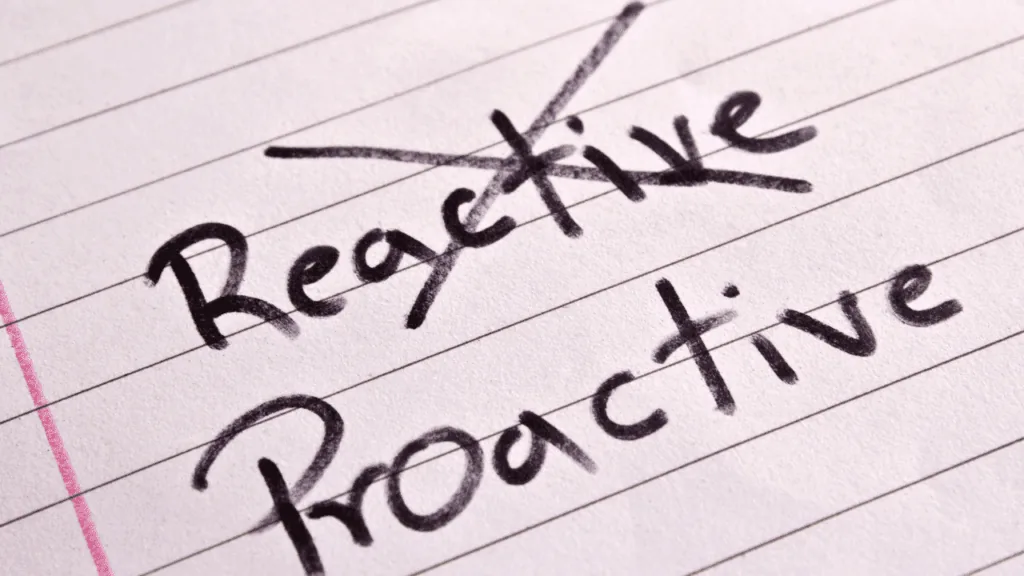
Piece of paper with the word 'reactive' crossed out and 'proactive' written below, symbolizing the transition from emotional reactivity to proactive control through neuroscience-based life coaching and brain-based coaching techniques.
From ‘Reactive’ to ‘Proactive’: the shift that becomes possible once the neural pathway driving an automatic reaction is identified and rewired.

Changing Neural Patterns

It’s important to understand that changing one’s neural patterns isn’t about suppressing emotions. It’s about developing a new relationship with our emotions, allowing us to feel them fully while understanding their origins and impacts. By doing so, we can better navigate our emotional lives and improve our overall well-being.

Many people believe that changing neural patterns is a quick and easy process. However, it requires consistent effort and practice. The good news is that even small changes in our neural networks can significantly impact our emotional reactivity.

To embark on the patterns, you need to commit to the process. It’s about more than just understanding the theory; it’s about applying it consistently. As you do so, you’ll find that you’re changing your reactions and forming a new relationship with life.

The Key to Becoming Less Emotionally Reactive

Approaches that work at the level of feelings address the output of the emotional system. The system itself sits deeper, in the limbic structures that generate a reaction before deliberate thought completes. This is a part of the emotional field. When you change the lizard brain, you change that dynamic field, ultimately changing your feelings and sense of self.

Dr. Ceruto’s work on emotional reactivity draws on natural systems theory, meaning it comes from nature. It’s how nature, cells, and animals interact. This is what’s called the limbic part, the intense emotional region of our brains. Then there’s the lizard brain part of us. This is the higher frontal part. When we change the lower brain, the top brain is less affected. Once achieved, we feel more sense of self and maturity and become less emotionally reactive.

As you already know, feelings are essential because they are how we navigate life. However, working to change this emotional system is most important for more profound permanent change for functioning as adults emotionally, behaviorally, and in relationships.

Observing Rather Than Absorbing

Some behaviors and feelings help us affect our deeper self, the lower brain. You can start by working on observing rather than absorbing. We often absorb other people and relationship systems, so our functioning remains immature and unable to change. We need to become less reactive and much more proactive in controlling our emotional responses.

If we can think more than we feel when interacting with people, we can become stronger and focus on what we need to do. Learn to listen more to others and resist absorbing the other person and their feelings. Try to think more and feel less. Identify and break the family of origin’s beliefs, values, rules, and roles. We challenge those with our sense of self, our authentic self. If it doesn’t match our family values, practices, and roles, we can begin to resist slowly, calmly, and maturely. Over time this will change our lower brain and our functioning. We will become less emotionally reactive and focus on achieving significant change or a personal transformation.

What changes when the pattern changes

Reaching a significant change in your instinctive brain will raise your level of self-differentiation and change how you function in other relationships, increase your awareness when you are pained, feel more confident, and become more emotionally independent and less emotionally reactive. This work addresses that vulnerability to overreact directly, at the brain system responsible for it.

Remember, your success in life and career is only limited by your vision and hard work! Faith and fear both demand you believe in something you cannot see. You choose. Becoming less emotionally reactive is a journey of self-discovery and growth. It’s a journey that requires patience, commitment, and the courage to confront the deep-seated patterns that have shaped your emotional life. But with time and consistent effort, you can rewrite your neural patterns, develop a healthier relationship with your emotions, and ultimately improve your overall well-being.

If you are ready to work on the pattern itself rather than its symptoms, the next step is a Strategy Call with Dr. Ceruto. Together you can build a healthier relationship with your emotions and improve your overall well-being, or if you are ready to make some changes in your life.


Neuroscientist & Author

About Dr. Sydney Ceruto

Neuroscience Advisor · Founder & CEO, MindLAB Neuroscience

Dr. Ceruto is the author of The Dopamine Code (Simon & Schuster) and works with a select number of individuals as their neuroscience advisor.

She holds a PhD in Behavioral and Cognitive Neuroscience from NYU and Master’s degrees in Clinical Psychology and Business Psychology from Yale. She lectures in the Wharton Executive Development Program at the University of Pennsylvania, and brings 26+ years of founding and leading MindLAB Neuroscience to her practice.

Dr. Sydney Ceruto, Neuroscientist and Author

A Message from Dr. Ceruto

Dr. Sydney Ceruto, Neuroscientist and Author, seated at her desk inviting you to the MindLAB Strategy Call

Success Stories

“I could stay composed through almost anything except conflict with people close to me, where I'd either go silent or say something I regretted. Dr. Ceruto identified the nervous system pattern behind the shutdown and helped me rebuild a different response from the ground up. I can stay present in hard conversations now instead of disappearing from them.”

Wesley G., Music Producer, Independent Nashville, TN

“The same relational patterns my mother and grandmother lived through kept repeating in my own life, the hypervigilance, the emotional shutdown, the inability to feel safe even when nothing was wrong. Talking through it changed nothing. Dr. Ceruto identified the epigenetic stress signatures driving the pattern and restructured them at the neurological level. The cycle that ran through three generations stopped with me.”

Gabriela W., Managing Partner, Immigration Law Miami, FL

“I'd relocated internationally before, but this time my nervous system wouldn't settle. Everything unfamiliar registered as danger, new people, new routines, even the sound of a different language outside my window. Pushing through it only deepened the pattern. Dr. Ceruto identified that my nervous system was coding unfamiliarity itself as threat and restructured the response at its source. The world stopped feeling hostile. I stopped bracing.”

Katarina L., Multinational Pharma Zurich, CH

“Four hours a night for over two years. That was my ceiling. Supplements, sleep protocols, medication, nothing touched it because nothing addressed why my brain wouldn't shut down. Dr. Ceruto identified the cortisol loop that was keeping my nervous system locked in a hypervigilant state and dismantled it. I sleep now. Not because I learned tricks, because the pattern driving the insomnia no longer exists.”

Adrian M., Portfolio Manager, Citadel New York, NY

“A car alarm, a raised voice, even certain kinds of silence could put me on edge for hours, and I'd stopped questioning why. Dr. Ceruto identified the hypervigilance pattern rooted in an earlier period of my life and worked through it directly rather than just teaching me to manage the symptoms. The edge is gone. I didn't realize how much of my day it had been quietly running.”

Anouk T. London, UK

“The numbness crept in so gradually I didn't notice until I couldn't feel anything, not stress, not connection, not even relief when things went well. Dr. Ceruto identified it as a dorsal vagal shutdown. My nervous system had flatlined as a survival strategy. Nothing I'd tried before had even named the problem. Within ninety days, the signal came back. I feel things again, clearly and without overwhelm.”

Marcus H., Senior VP, Commercial Real Estate Dallas, TX

“I could perform at the highest level professionally and still feel hijacked emotionally in my closest relationships, and no conventional approach had ever explained why those two realities coexisted. Dr. Ceruto identified the limbic imprint, an amygdala encoding from childhood that was running every intimate interaction I had. She didn't help me understand it better. She dismantled it. The reactivity isn't something I regulate anymore. The pattern that generated it is gone.”

Natasha K., Chief of Staff, Venture Capital Beverly Hills, CA

“Every close relationship I had eventually hit the same wall. I'd flood emotionally and shut down or explode, and nothing I'd tried gave me real control over it. Dr. Ceruto identified that my autonomic nervous system was defaulting to fight-or-flight the moment real intimacy was on the line. She didn't give me coping tools. She restructured the default. The flooding stopped because the trigger architecture changed.”

Simone V., Executive Director, Arts Nonprofit New York, NY

“Unfortunate consequences finally forced me to deal with my anger issues. I’d read several books and even sought out a notable anger specialist, but nothing was clicking. Then I found Sydney’s approach and was intrigued. Her insightfulness and warm manner helped me through a very low point in my life. Together we worked through all my pent-up anger and rage, and she gave me real tools to manage it going forward. I now work to help others learn how to control their own anger.”

Gina P. Naples, FL

“What I appreciate about Dr. Ceruto is her candid, direct approach, truly from a place of warmth and support. Every week delivered concrete value, and I never felt like I was wasting time the way I had with traditional methods. She draws from her clinical and academic expertise to dig deeper into the roots of issues. She helped me make enormous progress after a year of personal loss, including getting my faltering career back on track. She follows up after every session with additional materials.”

Eric F., Vice President, Technology Startup Coral Gables, FL

“The divorce wasn't destroying me emotionally. It was destroying me neurologically. My amygdala was treating every interaction with my ex, every legal update, every quiet evening as a survival-level threat. Years of talk-based approaches hadn't touched it. Dr. Ceruto identified the attachment disruption driving the response and restructured it at the root. The threat response stopped. Not because I learned to tolerate it, because the pattern was no longer running.”

Daniela M., Portfolio Manager, Asset Management North Miami Beach, FL

“After a traumatic experience left me feeling shattered, Dr. Ceruto’s innovative, science-backed approach helped me pick up the pieces. She walked with me every step of the way as I processed my emotions and came to understand how the trauma had shaped my thoughts and behaviors. With her unwavering support and expertise, I found the strength to heal and rebuild my life. Now, I feel empowered and ready to face the world with newfound courage.”

Sarah T., VP of Marketing, Cisco Manhattan, NY

Identifying details withheld to protect client confidentiality.
All outcomes represent genuine engagements with Dr. Ceruto.

Book Your Strategy Call

$250 · One Hour · Private Precision Insight

A focused working session where we map your specific pattern and the neuroscience beneath it. You leave with a concrete plan you can put to use, whether or not we ever work together again.

Book Your Strategy Call

Your hour is entirely one-on-one with Dr. Ceruto, and her read on what is driving the pattern is yours to keep.

Limited availability. Dr. Ceruto works with a select number of individuals at any given time.

MindLAB Neuroscience, private Strategy Call office
Book Your Strategy Call 1 Hour
Secret Link