Biological timing dictates performance. Optimize your sleep-wake cycles and hormonal release windows to maximize energy, alertness, and recovery.
The Evolutionary Design
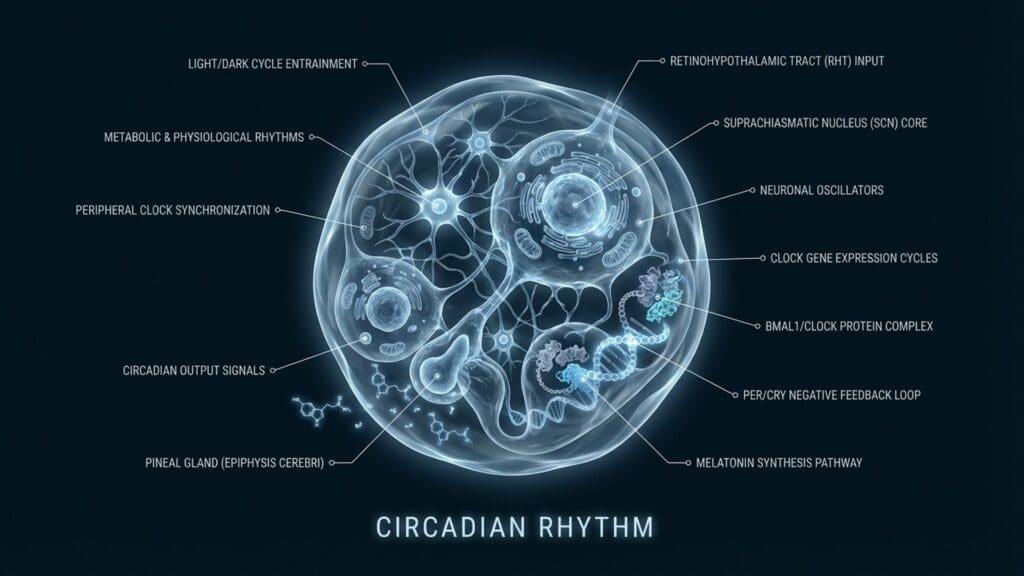
Nature built you to survive on a spinning planet. Light meant safety and hunting. Darkness meant danger and hiding. Your brain needed a way to predict these shifts. It developed a master timer deep in your skull. This timer coordinates your hormones and body temperature. It matches your internal biology to the external world. This synchronization kept your ancestors alive. It ensured they had energy when food was available and rested when predators prowled.
The Modern Analogy
Circadian rhythm is like your body’s internal clock, telling every system when it’s time to wake up, be alert, slow down, and sleep. Imagine a large clock tower in the center of a busy city. When it chimes, the workers start, the shops open, and traffic moves. Modern life ignores this signal. We stare at bright screens at night. We stay indoors all day. This is like smashing the gears of that clock tower. The city falls into chaos. Your liver wakes up when you should be sleeping. Your focus fades when you need to work. The timing is off, and the system fails.
The Upgrade Protocol
You must repair the gears and wind the clock. Light is the tool you need. View bright sunlight within thirty minutes of waking up. This sets the correct time for the entire city. Avoid bright lights after the sun goes down. This prevents the hands of the clock from spinning too fast. Keep your schedule consistent. Eat and sleep at the same times every day. When the clock is accurate, the city runs smoothly. Your energy returns and your performance peaks.

NEUROBIOLOGICAL CONTEXT
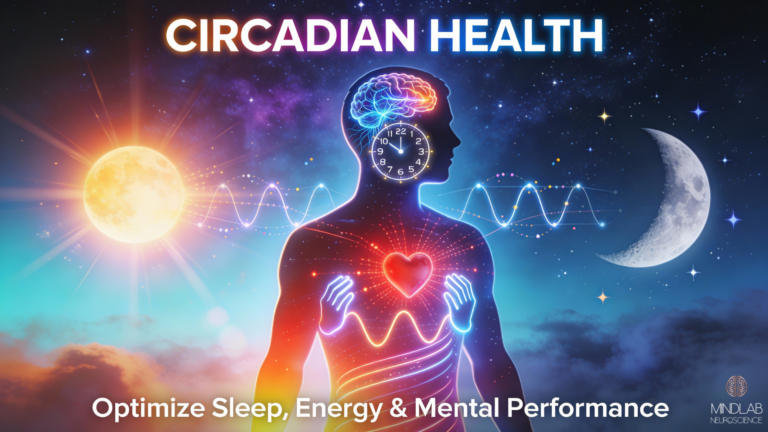
Your Circadian Rhythm is the 24-hour internal clock running in the background of your brain, specifically in the Suprachiasmatic Nucleus (SCN). It regulates not just sleep, but every biological system: hormone release (cortisol/melatonin), body temperature, digestion, and cognitive alertness.
Performance is not linear; it is cyclical.
The Peak: For most people, cognitive acuity peaks in the late morning. This is the window for high-demand analytical work (“The Highlight”).
The Trough: In the early afternoon, there is a natural dip in core body temperature and alertness. Pushing against this biology with caffeine often leads to diminishing returns.
The Rebound: Early evening often brings a second wind for creative or recovery tasks.
Light is the primary “Zeitgeber” (time-giver) that sets your clock.
Morning Anchor: Viewing bright sunlight within 30-60 minutes of waking triggers a cortisol pulse that sets the timer for melatonin release 12-14 hours later.
Darkness Protocol: Artificial blue light after sunset tricks the SCN into thinking it is still noon, suppressing melatonin and delaying sleep onset.
From Dr. Sydney Ceruto’s extensive work with elite performers and high-stakes decision-makers, it is unequivocally clear that the Circadian Rhythm is not merely a sleep-wake cycle; it is the fundamental hardware governing cellular and systemic efficiency. Its disruption represents a direct, quantifiable degradation of peak cognitive function and strategic capacity. This is not a matter of subjective fatigue but a verifiable biological impairment impacting the very essence of leadership. The executive brain, specifically the prefrontal cortex, demands consistent, optimized metabolic support to execute complex functions such as long-term strategic planning, nuanced risk assessment, and innovative problem-solving. When the Circadian Rhythm deviates from its genetically programmed alignment with the solar day, this critical support infrastructure begins to fail. Neurotransmitter synthesis, synaptic plasticity, and neuronal repair mechanisms are compromised, leading to a measurable decline in cognitive agility and decision integrity. Evolutionary biology dictates that optimal physiological function is predicated on predictable environmental cues. Our internal clock, meticulously honed over millennia, orchestrates hormone release, metabolic pathways, and cellular regeneration in anticipation of these cycles. Disrupting this rhythm signals to the ancient brain a state of environmental instability or threat. The body, in response, shifts resources from higher-order cognitive functions—those critical for visionary leadership—towards basic survival energetics. This metabolic recalibration manifests as reduced glucose uptake in key brain regions responsible for executive function, diminished mitochondrial efficiency, and systemic inflammatory responses. The cost to leadership is profound: impaired impulse control, a narrowed perspective, and a tangible reduction in the capacity for nuanced, forward-thinking strategy. The executive, operating under a misaligned Circadian Rhythm, is biologically ill-equipped to perform at their genetic optimum, leading to suboptimal outcomes across all domains of influence.
The circadian rhythm is not merely a biological clock; it is a hardwired, highly conserved survival mechanism. Evolved over billions of years, this intrinsic timing system provided a profound adaptive advantage to organisms operating within a predictably cyclical planet. Its primary mandate was to synchronize internal physiology with external geophysical rhythms, principally the 24-hour light-dark cycle, ensuring optimal function across temporal environmental shifts. This precise temporal organization optimized critical biological functions for survival. It dictated optimal periods for foraging, reproduction, immune vigilance, and evasion of predators. Beyond mere behavior, this internal clock governed the rhythmic expression of thousands of genes, the synthesis and release of vital hormones, and the intricate metabolic pathways essential for cellular maintenance and energy balance. For instance, peak immune activity often aligns with rest phases, facilitating repair and recovery when the organism is least exposed to external threats, while energy-intensive processes like digestion are primed for active periods. The suprachiasmatic nucleus (SCN) in the hypothalamus serves as the master circadian pacemaker, a testament to this evolutionary imperative. Its direct anatomical connection to the retina ensured that the most potent environmental cue—light—could directly entrain and calibrate internal time. This central clock then orchestrates peripheral clocks in virtually every organ, creating a unified, synchronized physiological state perfectly adapted to the daily cycle. This inherent predictive capacity allowed for proactive resource management, ensuring sustained cellular health, robust cognitive function, and successful species propagation across diverse ecological niches. However, this ancient, exquisitely tuned hardware now confronts an unprecedented modern disconnect. The human circadian system, honed under natural light-dark cycles and seasonal shifts, is fundamentally ill-equipped for persistent artificial illumination. Chronic exposure to artificial blue-spectrum light at night, emitted from screens and modern lighting, directly antagonizes the evolutionary signal for darkness. This misinterprets night as an extension of day, overriding millennia of biological programming. This perpetual “day” state profoundly disrupts melatonin synthesis, a critical hormone signaling darkness and preparing the body for sleep and repair. Consequently, the downstream cascade of restorative processes – cellular detoxification, metabolic regulation, and neuroplasticity – becomes severely compromised. The system, designed for distinct phases of activity and recovery, is forced into an ambiguous, chronically alerted state, leading to suboptimal cellular performance. Furthermore, the constant availability of food, often ultra-processed and decoupled from natural light cues, contributes to profound metabolic desynchronization. The body’s natural inclination to process nutrients efficiently during daylight hours, governed by circadian signals, is overridden by late-night eating, leading to metabolic strain and fat accumulation. Irregular sleep patterns, demanding shift work, and chronic psycho-social stressors further erode the rhythm’s coherence, weakening the SCN’s ability to maintain central control and synchronize peripheral clocks. These persistent assaults on our inherited temporal blueprint manifest as widespread metabolic dysfunction, systemic inflammation, impaired cognitive function, and heightened susceptibility to chronic degenerative diseases, directly compromising peak human performance and long-term vitality.
The human circadian system, fundamentally a neural clock, operates as critical biological hardware. Its suboptimal function directly compromises executive performance, resilience, and adaptive capacity. My methodology, Real-Time Neuroplasticity™, moves beyond superficial behavioral adjustments to engage with the core neural architecture governing these rhythms. This is not about managing symptoms; it is about re-engineering the system.
Our evolutionary heritage dictates a precise alignment with natural environmental cues. Modernity, however, has introduced pervasive chronodisruptors, forcing the suprachiasmatic nucleus (SCN) and its downstream effectors into persistent states of misalignment. This internal desynchronization impairs cellular function and cognitive integration. Real-Time Neuroplasticity™ directly addresses this neural dysregulation. The methodology leverages the brain’s inherent capacity for plasticity to recalibrate these foundational timing mechanisms. We target the neural pathways that transmit light, temperature, and activity signals to the SCN, optimizing their interpretation and output. This involves precise, data-driven interventions designed to re-establish robust oscillatory patterns. We are not merely suggesting new habits; we are architecting new neural connections.
Real-Time Neuroplasticity™ entails an active, guided process of neural retraining. This protocol systematically introduces specific, timed environmental stimuli and cognitive interventions that serve as potent re-synchronizers. For example, controlled light exposure and precisely timed cognitive loads are deployed not just as external cues, but as triggers for internal neural adaptation. The goal is to fortify the amplitude and phase of the endogenous circadian oscillators. This proprietary approach enables individuals to actively sculpt their neural responses, transforming a disarrayed internal clock into an optimized, high-fidelity system. By meticulously re-regulating the interplay between genetics, environment, and neural processing, we unlock a heightened state of physiological and cognitive coherence. The result is a demonstrable increase in processing speed, decision-making acuity, and sustained mental endurance, directly linked to a harmonized circadian infrastructure.
Dr. Sydney Ceruto stands as a preeminent figure in neuroscience and elite performance optimization. As the founder of MindLAB Neuroscience, she spearheads an institution dedicated to understanding and elevating human cognitive architecture. Her groundbreaking work includes the pioneering of Real-Time Neuroplasticity™, a methodology that directly influences neurological pathways for accelerated adaptation and superior function. She is the esteemed author of “The Dopamine Code,” published by Simon & Schuster, a definitive text exploring the neurochemical underpinnings of drive and motivation. Dr. Ceruto holds dual PhDs in Behavioral and Cognitive Neuroscience from NYU. Complementing this, she possesses dual Master’s degrees in Clinical Psychology and Business Psychology from Yale University, integrating profound psychological insight with robust organizational strategy. Her approach is clinical, evolutionary, and empirically driven, deconstructing human potential to its fundamental neurological mechanisms.
Neuroscience-backed analysis on how your brain drives what you feel, what you choose, and what you can’t seem to change — direct from Dr. Ceruto.