The state of peak cognitive throughput. We analyze the neurobiology of attention residue, the high metabolic cost of context switching, and the protocols required to induce flow states.
Executive Neuro-Brief
The Evolutionary Design
Your brain is built to hunt. In the past, survival meant focus. You had to track an animal for miles. You had to chip a stone into a spear. Distraction meant hunger or death. Nature designed your brain to lock onto one target. This singular focus conserved energy and ensured success. It is a biological survival tool.
The Modern Analogy
The modern world is full of waves. Notifications and noise crash constantly at the surface. Most people tread water there. They get tired and achieve little. Deep work is like diving to the bottom of a quiet pool, away from the noise at the surface, so you can focus on just one treasure at a time. Down there, the water is still. Your brain waves slow down. You stop reacting to the chaos above. You can finally see clearly.
The Upgrade Protocol
You must train your lungs. Start with short dives. Block out the surface noise for thirty minutes. Swim down to the silence. Grab the treasure and bring it back up. Do not float aimlessly. Pick one specific goal before you dive. With practice, you can stay deep longer. The pressure builds mental strength. The real value is found at the bottom.
Energy management isn't about squeezing more hours into your day, it's about understanding how your neurochemical state determines your capacity to perform, decide, and lead effectively.
Dopamine anchoring pairs effort with a reliable reward signal, so your brain wants the work, you start faster, and your habits finally stick in real life.
Discover how to focus by harnessing neuroplasticity to rewire your brain. Learn practical tools, daily habits, and a 30-day plan to strengthen attention even if you have ADHD..
Understanding the difference between activity and productivity is crucial for maximizing our time and achieving our goals. Neuroscience productivity techniques offer valuable insights into how we can boost...
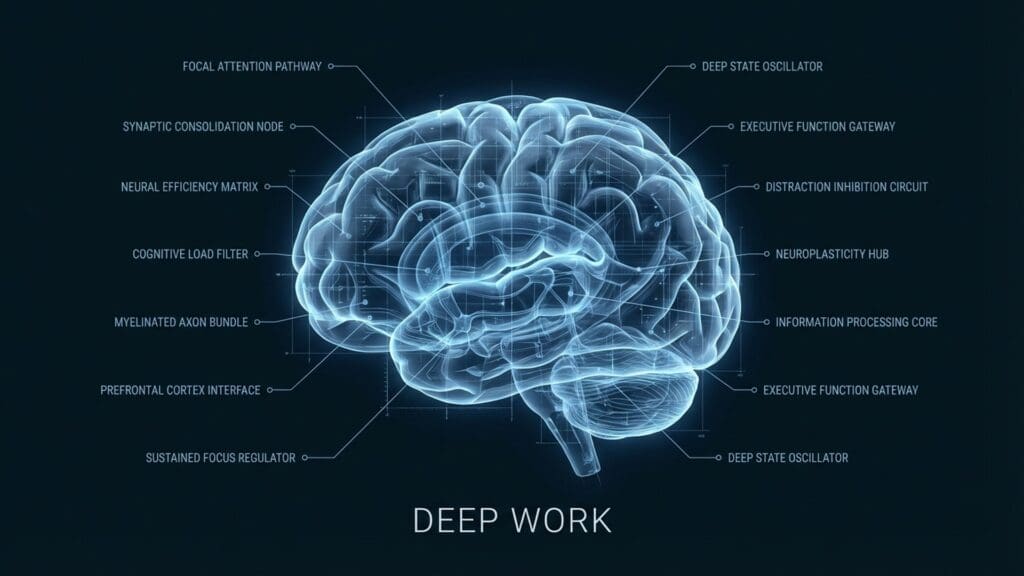
Deep Work is not merely “working hard”; it is a specific neurophysiological state of distraction-free concentration that pushes your cognitive capabilities to their limit. In this state, the Prefrontal Cortex (PFC) synchronizes neural firing to a specific task, maximizing “myelination”—the insulation of nerve fibers that increases the speed and efficiency of neural transmission. It is the only state in which you can master hard things quickly.
The Cost of Switching
The enemy of deep work is “Attention Residue.” Neuroscience reveals that when you switch from Task A to Task B (e.g., checking Slack while coding), your attention does not follow immediately. A significant portion of your cognitive resources remains “stuck” processing the previous task.
Metabolic Drain: Rapid context switching burns through glucose and depletes neurotransmitters (like norepinephrine) faster than sustained focus, leading to premature cognitive fatigue.
The Shallow Trap: Chronic multitasking trains the brain to seek novelty, effectively atrophying the neural circuits responsible for sustained attention.
Protocols for Depth
Deep work is a skill that must be trained, not a habit you simply decide to have.
Bimodal Segmentation: The most effective protocol involves strict compartmentalization. Separate your day into “Deep Blocks” (zero connectivity, high complexity) and “Shallow Blocks” (admin, communication). Do not mix them.
Progressive Overload: Just like a muscle, the PFC fatigues. Start with 60-minute intervals of intense focus and progressively extend them. Most human brains max out at 4 hours of true deep work per day.
The Intelligence Brief
Neuroscience-backed analysis on how your brain drives what you feel, what you choose, and what you can’t seem to change — direct from Dr. Ceruto.